
Peptides
October 16, 2026
GHK-Cu for skin: what the small human studies actually measured
On this page
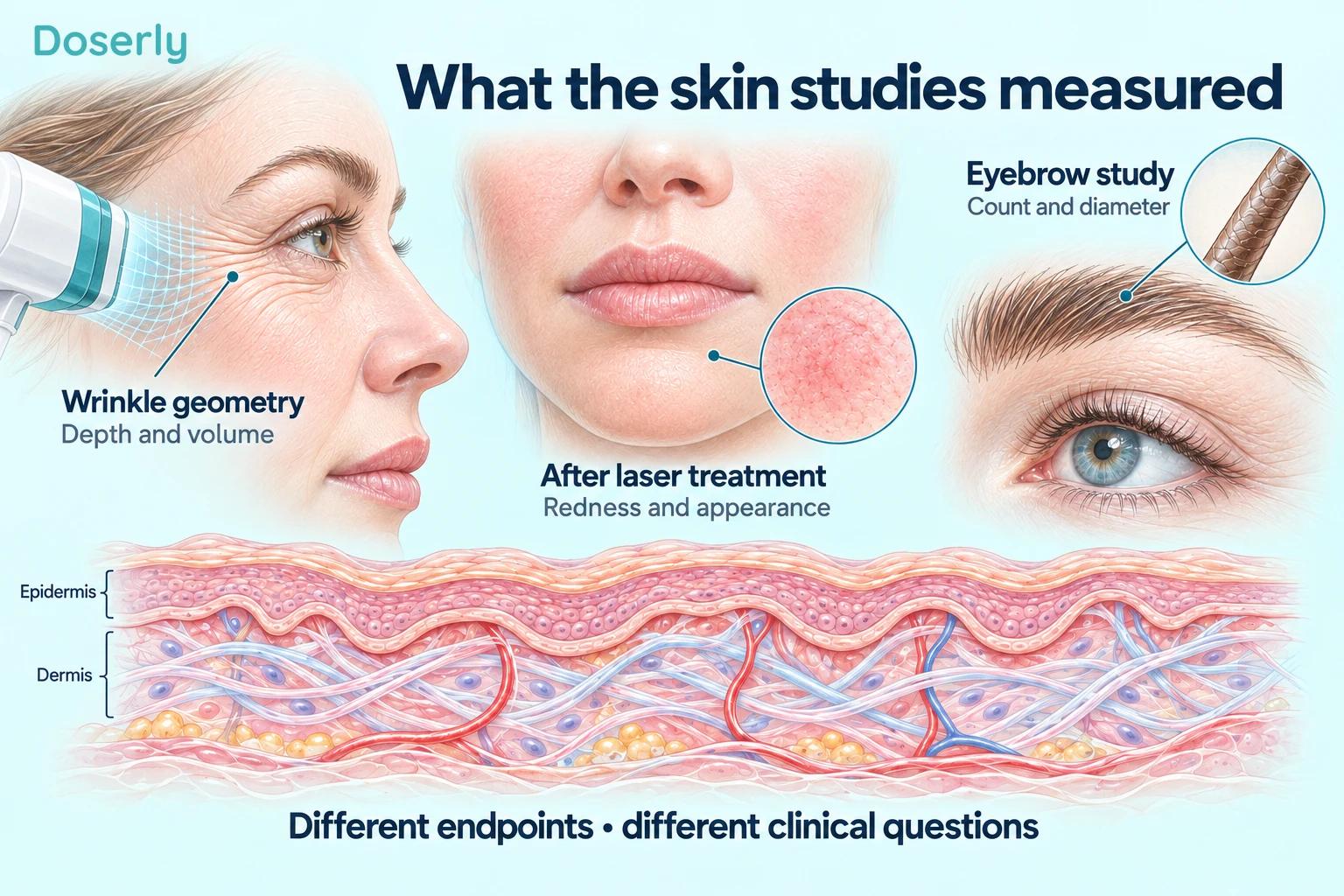
GHK-Cu has more human skin research behind it than many peptides sold for broad “regeneration.” But that research is a collection of specific experiments, not a single demonstration that copper peptides rejuvenate skin. A wrinkle study measured surface geometry. A laser-recovery study measured redness, appearance, and satisfaction. An ulcer study measured wound closure alongside wound care. A newer eyebrow study counted hairs.
Those distinctions matter when deciding what a product claim means. An improvement in one measurement can be interesting without establishing a different benefit, a benefit from every formulation, or an effect from injecting the ingredient. The most useful reading of the evidence starts with what investigators actually put on the skin and what they measured afterward.
What makes a copper peptide biologically interesting?
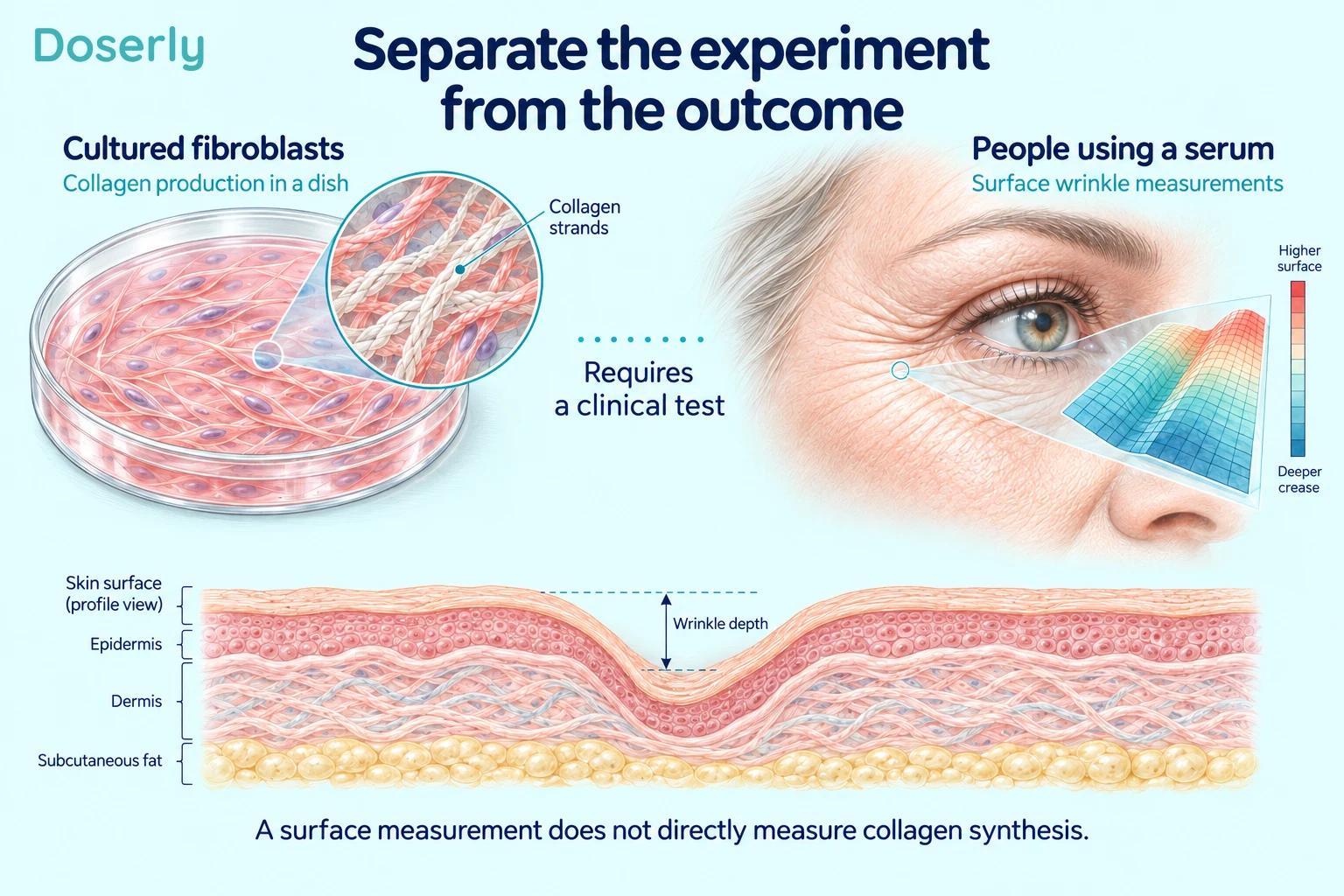
GHK is a three-amino-acid peptide; GHK-Cu is its copper complex. Laboratory work provides a plausible reason to study it in skin. In a 1988 experiment, GHK-Cu increased collagen synthesis in cultured fibroblasts, the cells that help produce connective tissue. That was a measurement in a culture system, not a demonstration of increased collagen in people using a cosmetic. Original fibroblast experiment
The distinction is easy to lose because “stimulates collagen” sounds like a visible clinical result. In a dish, researchers control the concentration around the cells. On a face, the formulation must deliver the relevant substance through or into skin, and the resulting change must be large enough to affect a meaningful outcome. A plausible cellular mechanism helps explain why a trial is worth doing; it does not supply the trial’s result.
Our GHK-Cu guide covers the broader ingredient and delivery evidence. Here, the question is narrower: how much can the small human skin studies actually tell someone reading a serum label?
The facial-wrinkle trial: a result for one tested formulation
A 2016 paper combined laboratory experiments with an eight-week cosmetic study. Forty women aged 40–65 entered the clinical portion. Each used a GHK-Cu serum in a particular nano-carrier system on the right side of the face. The comparison product went on the left: either the vehicle control or a commercial peptide product containing Matrixyl 3000. Participants were randomized between those comparator groups; the active treatment was not randomized between the two sides of the face. Full study
Investigators used three-dimensional optical imaging near the eye to measure the depth and volume of a selected wrinkle. This is more informative than a manufacturer simply showing flattering photographs. It produces a quantitative measurement with a defined method. It also remains a local measurement: a selected wrinkle is not a direct measure of whole-face aging, skin health, or how much younger someone looks.
Thirty-nine women completed the study. The reported comparisons favored the GHK-Cu formulation for wrinkle volume against both comparison products and for depth against vehicle. The depth comparison against the other peptide product did not reach the paper’s conventional statistical threshold: its reported p-value was 0.0577. “Better than another peptide serum” therefore needs the endpoint attached; it was not a uniform finding across both wrinkle measurements.
The often-repeated “55.8%” figure needs particular care. In this paper, it describes a relative comparison of wrinkle-volume improvement against the control, not a finding that 55.8% of someone’s wrinkles disappeared. The table of changes from baseline gives a different view: in the vehicle-comparison group, mean wrinkle-volume reduction was 24.1% on the GHK-Cu side and 15.0% on the control side. Both sides changed. A between-product comparison and an absolute change from starting appearance are different quantities.
Neither should be converted into a promise about a shopper’s face. The sample was small, follow-up was short, and the measurements were collected under a particular regimen. The study also cannot isolate the peptide from its delivery system: the control lacked both GHK-Cu and the nano-carrier. The result supports further interest in that formulation, not an assumption that every copper-peptide serum has equivalent performance.
The manufacturer and a New Zealand innovation agency funded the work; the authors stated that the sponsor did not participate in data collection, analysis, interpretation, or writing. Funding does not cancel a result. It makes independent replication with transparent methods especially useful when a study is also being used to market a product.
A laboratory result in the same paper is still a separate experiment
The 2016 investigators also exposed cultured fibroblasts to GHK-Cu and measured gene expression and production of collagen and elastin. Those experiments are relevant to a proposed mechanism. They were not biopsies showing that the women in the cosmetic trial produced more collagen in their faces.
Putting the two parts of the paper together allows a reasonable hypothesis: a formulation with a biologically active ingredient may affect skin appearance. It does not establish the entire causal chain. Moisturization, the carrier, measurement variability, and other formulation effects can influence the appearance of a surface wrinkle. To attribute the clinical result specifically to increased collagen production would require evidence connecting those steps.
This is a useful reading habit beyond GHK-Cu. When a paper contains both cell work and a small human trial, ask which findings came from which participants—or from which dishes. A sentence that combines the strongest mechanistic finding with the strongest cosmetic result can sound more definitive than either experiment warrants.
After laser resurfacing: satisfaction and objective recovery differed
A 2006 randomized study tested postoperative skin-care regimens with or without a topical copper tripeptide complex after carbon-dioxide laser resurfacing around the mouth. Thirteen participants completed it. This was a study of recovery after a procedure, not a test of an ordinary serum on otherwise untreated facial skin. Original study abstract
The investigators did not find a statistically significant difference between groups in the resolution of redness. Blinded assessments also did not establish an added benefit for the objective appearance outcomes. Both groups improved in wrinkles and overall skin appearance after resurfacing. That shared improvement cannot be attributed to the copper peptide: both groups had received the laser treatment.
Participants using the copper-peptide regimen did report a greater improvement in satisfaction with overall skin quality, with a reported p-value of 0.04. Satisfaction is a legitimate outcome, especially in cosmetic care. It is also different from faster healing or a larger objectively measured wrinkle improvement. A fair summary preserves both parts: a favorable patient-reported result, without a demonstrated advantage on the study’s objective measures.
Thirteen completers provide limited precision. A nonsignificant comparison does not prove that two regimens are identical; a positive questionnaire comparison does not establish a large or durable benefit. The abstract supports a restrained conclusion, not either extreme of “proven ineffective” or “clinically proven skin regeneration.”
Diabetic ulcers: medically important, but not a facial-cosmetic trial
An older multicenter, randomized, evaluator-blinded trial examined a topical GHK-Cu gel for diabetic ulcers. Treatment was part of structured wound care that included sharp debridement, pressure-relieving footwear, education, and daily gel application. The reported benefit therefore belongs to that clinical setting. Original 1994 trial abstract
The abstract reports greater median reduction in plantar-ulcer area with the active gel than with vehicle: 98.5% versus 60.8%. That is an area-closure measurement. It does not mean that 98.5% of participants had a fully healed ulcer. Changing the denominator from wound area to people would create a much stronger—and different—claim than the source supports.
Ulcer healing is more than a cosmetic endpoint, but it is also a different biological and clinical problem. An open diabetic wound under professional care is not intact facial skin. This trial does not establish that a cosmetic serum treats diabetic ulcers, that someone should replace wound care with a peptide, or that an injectable product reproduces the topical result.
The accessible original abstract supports those design and outcome distinctions. It does not provide enough detail to independently assess every aspect of allocation, missing data, or longer-term recurrence. That limitation should remain visible rather than being filled with assumptions from later summaries.
A 2026 eyebrow study adds a different, narrow question
A small randomized, double-blind, vehicle-controlled split-face study published in conference proceedings in May 2026 tested a 2% GHK-Cu serum for sparse eyebrows. Eighteen adults aged 18–40 applied active serum to one eyebrow and vehicle to the other for 12 weeks. The investigators assessed hair count, hair diameter, photographs, and satisfaction. Original proceedings report
The abstract reports favorable differences for the active side. It does not give sufficient numerical effect estimates or confidence intervals to judge the size and precision of those differences from the abstract alone. Its report of no serious adverse events or allergic reactions is reassuring within those 18 participants and 12 weeks, but cannot establish broad long-term safety.
This is an early signal in eyebrow hypotrichosis. It is not a scalp-hair-loss trial, a wrinkle trial, or evidence for systemic rejuvenation. The publication format and sample size also matter: a small proceedings report should not carry the weight of a large, independently replicated clinical program.
What a registered trial can—and cannot—add
The CuHeal registry entry describes a planned phase 2 study of topical GHK-Cu gel in standardized small skin wounds in healthy adults. It compares active gel and vehicle on paired biopsy wounds, with wound closure and scar outcomes. As checked on October 15, 2026, the record had no posted results; its last posted update was February 27, 2026. CuHeal trial record
Registration is useful because it makes the intended population, comparisons, and endpoints visible before results are available. It is not evidence that the gel has succeeded. A product page citing a recruiting or planned trial as “clinical proof” has skipped the most important part: the actual results and their assessment.
How to read a claim about a product you might use
Start with whether the cited study tested that formulation, on a comparable area of skin, for the same purpose. Then identify the measurement. “Wrinkle volume,” “patient satisfaction,” “ulcer area,” and “eyebrow count” are more informative than the umbrella phrase “skin regeneration.” Ask whether the comparison was against vehicle, another active product, or simply the participant’s starting measurement.
Also separate tolerability from proof of safety. In the 2016 trial, one participant withdrew after a minor reaction on both treated sides. Short studies can describe the reactions they observed; they cannot rule out uncommon problems or establish safety for every concentration, combination, or route. A cosmetic trial is especially poor evidence for the safety of an injected preparation.
A result can also be statistically distinguishable without being visibly important to every user. The wrinkle trial's optical measurements and the laser study's satisfaction questionnaire describe different perspectives on benefit. A strong follow-up trial would ideally report both the size of an objective change and whether participants considered it worthwhile, together with uncertainty and durability. That would be more useful than choosing whichever single measurement makes the largest headline.
The human evidence supports taking topical GHK-Cu seriously as a research topic, with some promising but limited clinical signals. It supports much less certainty about the size, durability, and generalizability of cosmetic benefits. A useful product claim names the tested formulation and outcome. The broader the promise becomes, the less these small studies can do to substantiate it.
Sources
- Maquart et al. — Stimulation of collagen synthesis in fibroblast cultures (1988)
- Badenhorst et al. — GHK-Cu, collagen and elastin production, and facial wrinkle parameters (2016)
- Effects of topical copper tripeptide complex on CO2 laser-resurfaced skin (2006)
- Mulder et al. — Enhanced healing of ulcers in patients with diabetes (1994)
- GHK-Cu serum for eyebrow hypotrichosis (2026)
- ClinicalTrials.gov — CuHeal, NCT07437586