
Peptides
October 16, 2026
GHK-Cu and the 4,000-genes claim: what gene expression can tell us
On this page
“Changes more than 4,000 genes” sounds like a remarkably broad health benefit. It is actually a statement about a laboratory measurement and its analysis. To understand what it means for GHK, it helps to ask four smaller questions: which cells were studied, what substance was added, what counted as a change, and whether the change improved anything beyond the measurement itself.
The underlying research is interesting. Gene-expression patterns can identify biological pathways worth investigating, and GHK has been studied in follow-up experiments that measured cell behavior. But the popular gene count is not a count of repaired genes, reversed diseases, or benefits demonstrated in people. It also does not establish that a topical or injected GHK-Cu product recreates the same response throughout the body.
Gene expression describes activity, not a rewritten DNA sequence
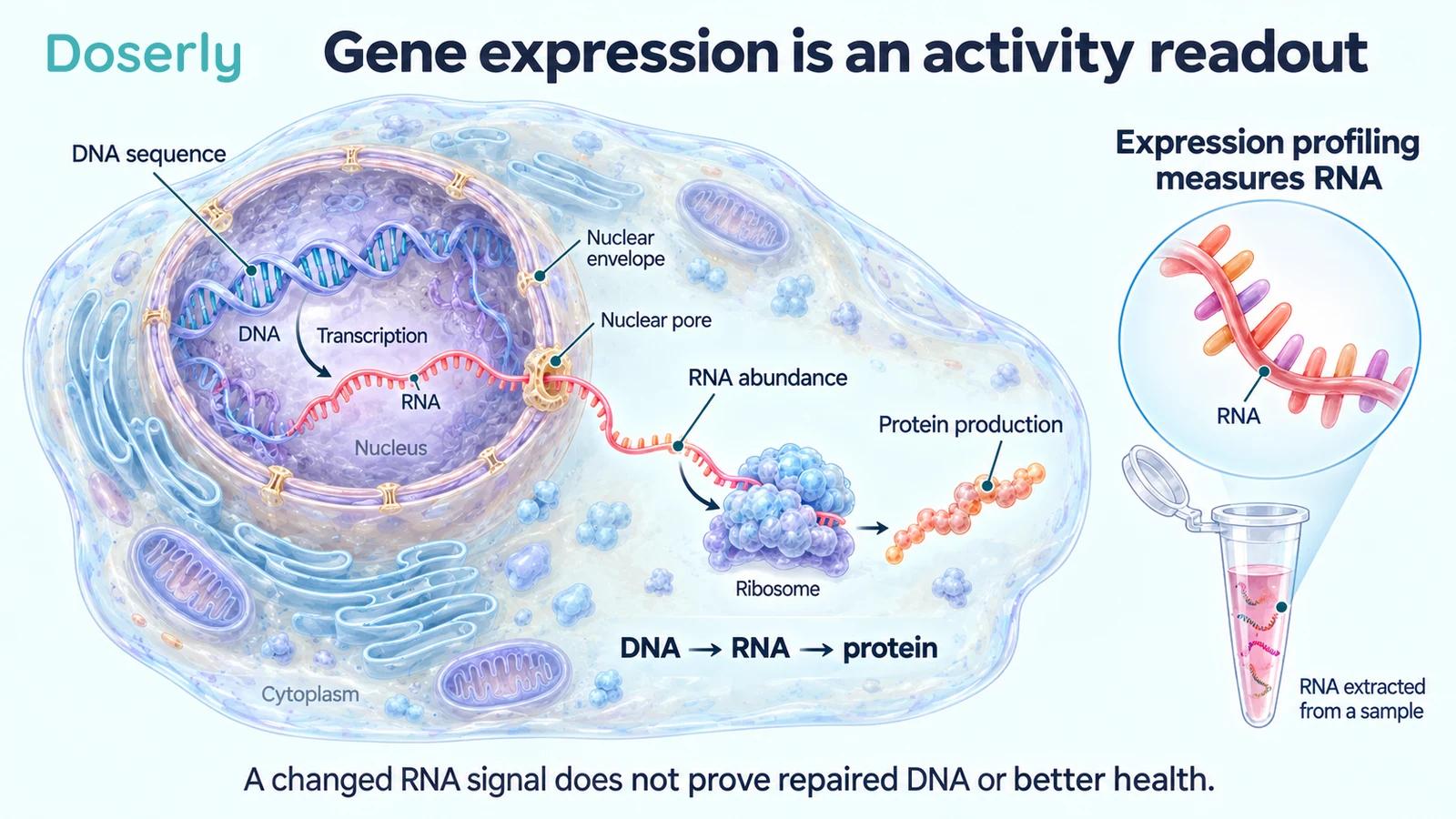
A gene’s DNA sequence and its expression are different things. Expression profiling measures signals related to how actively cells use genetic information, often by measuring messenger RNA. A change in an RNA signal does not mean the underlying DNA sequence has been edited or repaired.
Nor is RNA abundance identical to the amount or activity of the resulting protein. Cells regulate multiple steps between transcription, protein production, and biological function. The original GHK analysis itself acknowledged that gene-expression responses were suggestive and could vary by cell type. Original 2014 analysis
This matters for phrases such as “activates DNA repair genes.” That can describe a change in expression of genes associated with repair pathways. It does not automatically establish that a specific DNA lesion was repaired, that mutations were prevented, or that a person’s risk of disease fell. Each stronger claim requires an additional measurement.
Think of expression data as a detailed activity report from a particular group of cells. It can reveal a response worth understanding. It does not, by itself, tell us whether that response is beneficial, harmful, compensatory, or clinically inconsequential.
Where the “about 4,000” number comes from
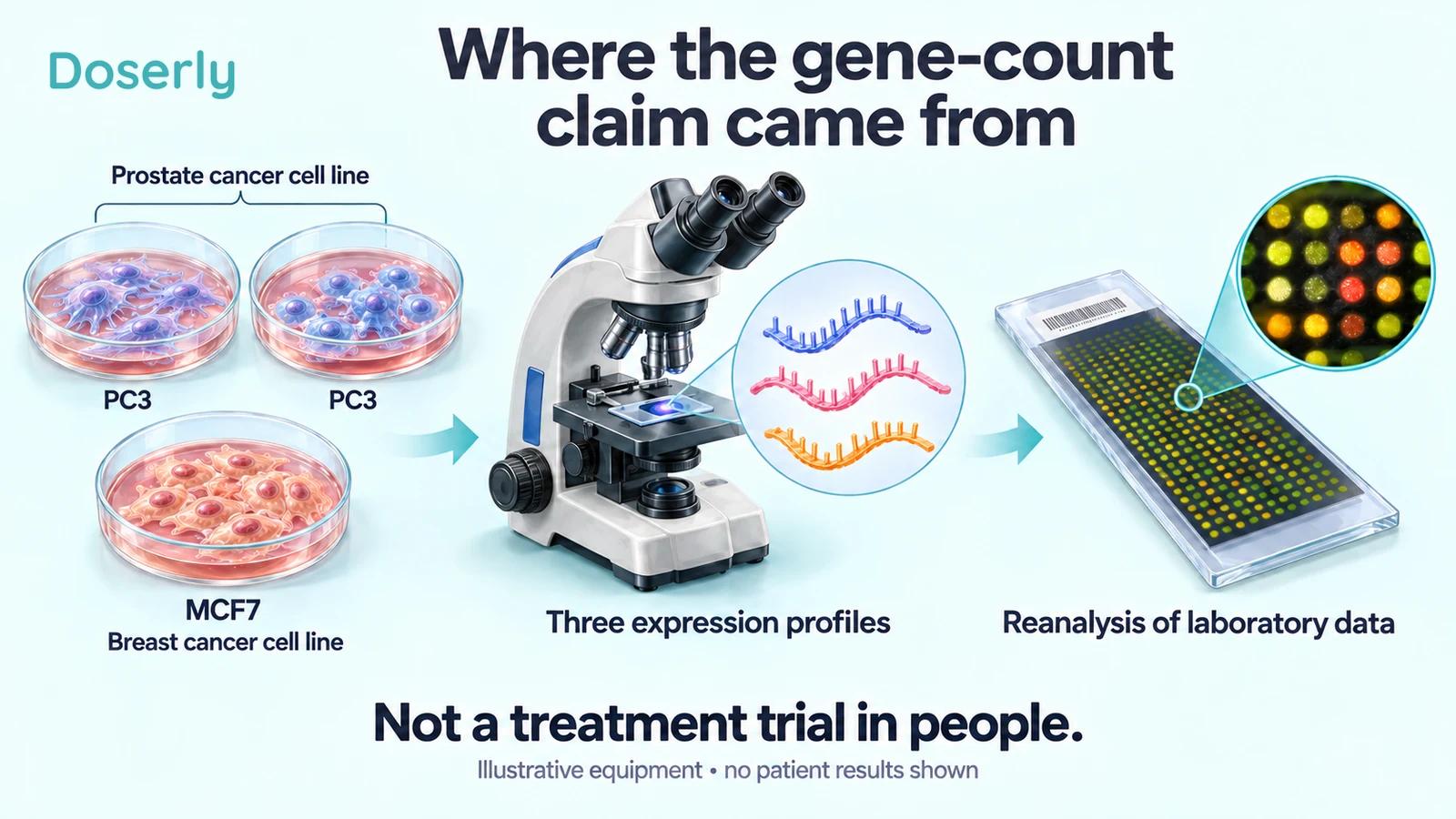
A 2014 analysis by Pickart and colleagues reused data from the Broad Institute’s Connectivity Map. The GHK data comprised three expression profiles: two from PC3 cells and one from MCF7 cells. These are cancer cell lines used as laboratory models, not samples from a trial in which people received GHK-Cu.
The investigators analyzed microarray probe signals and estimated the number of genes represented. Their paper reported an estimated 4,194 of 13,424 represented genes with an expression change meeting its 50%-or-greater threshold, summarized as 31.2%. The count was derived from the assay and processing method, including how multiple probes representing a gene were handled. It was not a census of all genes in every tissue. Methods and results
A related 2014 paper discussed the same three-profile analysis in the context of aging and potential therapeutic uses. It was not an independent trial confirming thousands of benefits. Its title, GHK and DNA: resetting the human genome to health, is broader than what an RNA-expression analysis can demonstrate clinically. Authors’ related analysis and discussion
The most defensible short description is therefore “about 4,000 estimated gene-expression changes in a reanalysis of cell-line data.” Keeping the words estimated, expression, and cell-line may seem fussy. Removing them changes the scientific meaning.
A cutoff is not a health-benefit threshold
A count depends on the rule used to include a signal. A gene just above an analysis threshold contributes one item to the total; a gene just below it does not. Moving the threshold can change the count even though the underlying experiment has not changed.
The count also treats different genes as items, not as equally important clinical effects. A large change in a gene with little relevance to the proposed outcome may matter less than a smaller, reproducible change in a key pathway. Several signals can belong to the same biological process, so thousands of changed signals do not necessarily represent thousands of independent actions.
Direction alone is not a health rating. Increasing expression is not universally beneficial, and decreasing it is not universally harmful. The useful direction depends on the cell, its starting state, the pathway, the duration, and the question being asked. A response that is useful in one experimental setting may be irrelevant or undesirable in another.
These are reasons to examine the pattern and then test a hypothesis, rather than treating the largest gene count as the strongest treatment. A compound that affects many RNA signals still needs evidence about the consequences of those changes.
The threshold's wording also matters. A 50% increase means one-and-a-half times a starting value; a doubling means a 100% increase. Those phrases cannot be swapped simply because both sound like a large molecular response. The original analysis reported a threshold of 50% or greater, not a uniform doubling of every counted gene.
Similarly, “affected” does not mean “activated.” The reported total includes signals moving in both directions. Rewriting it as thousands of genes switched on loses that distinction before any discussion of clinical benefit even begins. Keeping the original measurement language is a small but important safeguard against making an already preliminary finding sound stronger.
What the Connectivity Map is designed to do
The Connectivity Map was developed to compare gene-expression patterns produced by compounds in cultured human cells. A researcher can compare a pattern associated with a disease or biological state against reference patterns generated by different compounds. A compound producing an opposing pattern may become a candidate for further investigation. Original Connectivity Map publication
That is a discovery method. It helps generate a reason to test something; it does not certify a treatment. Reversing a disease-associated expression pattern does not necessarily reverse the disease that produced it. Some signals may be consequences of disease, some may be protective responses, and others may reflect differences in which cells were sampled.
The relevant next question is functional: does the candidate change a biological behavior that matters in a suitable model? After that come questions about delivery, exposure, safety, and outcomes in people. Skipping from a pattern match to a clinical promise bypasses the work that determines whether the hypothesis survives.
This is why the cell-line origin is important without making the experiment worthless. Standardized cell lines can be useful for comparing responses. They cannot stand in for all healthy tissues or reproduce the relationships among organs in a living person.
The colorectal-cancer paper did not treat patients with GHK
A 2010 study examined expression profiles from colorectal-cancer patients and matched controls to develop a signature associated with metastatic risk. Investigators then queried the Connectivity Map using a subset of the signature. GHK and securinine emerged as compounds with potentially relevant opposing expression patterns. Original study abstract
The people contributing clinical samples did not thereby become participants in a GHK treatment trial. The drug-candidate step was computational. The paper proposed therapeutic possibilities; it did not demonstrate that administering GHK prevented metastasis, improved survival, or safely treated cancer.
This distinction often disappears in retellings. “A study used human cancer samples” becomes “GHK was tested in cancer patients,” even though those statements describe different designs. Reading the methods restores the missing boundary between the patient-derived disease signature and the cell-based compound-response database.
The same caution applies to calling an expression pattern “anticancer.” Such a label can describe a biological hypothesis or a pattern selected for further testing. It is not a clinical recommendation, and it does not establish cancer prevention in otherwise healthy users.
The lung study went further—but still remained preclinical
A 2012 study of emphysema illustrates why follow-up experiments are valuable. The researchers compared gene expression across regions of human lung tissue with differing emphysema severity, then used the Connectivity Map to identify compounds with opposing expression patterns. GHK was one candidate. Original study
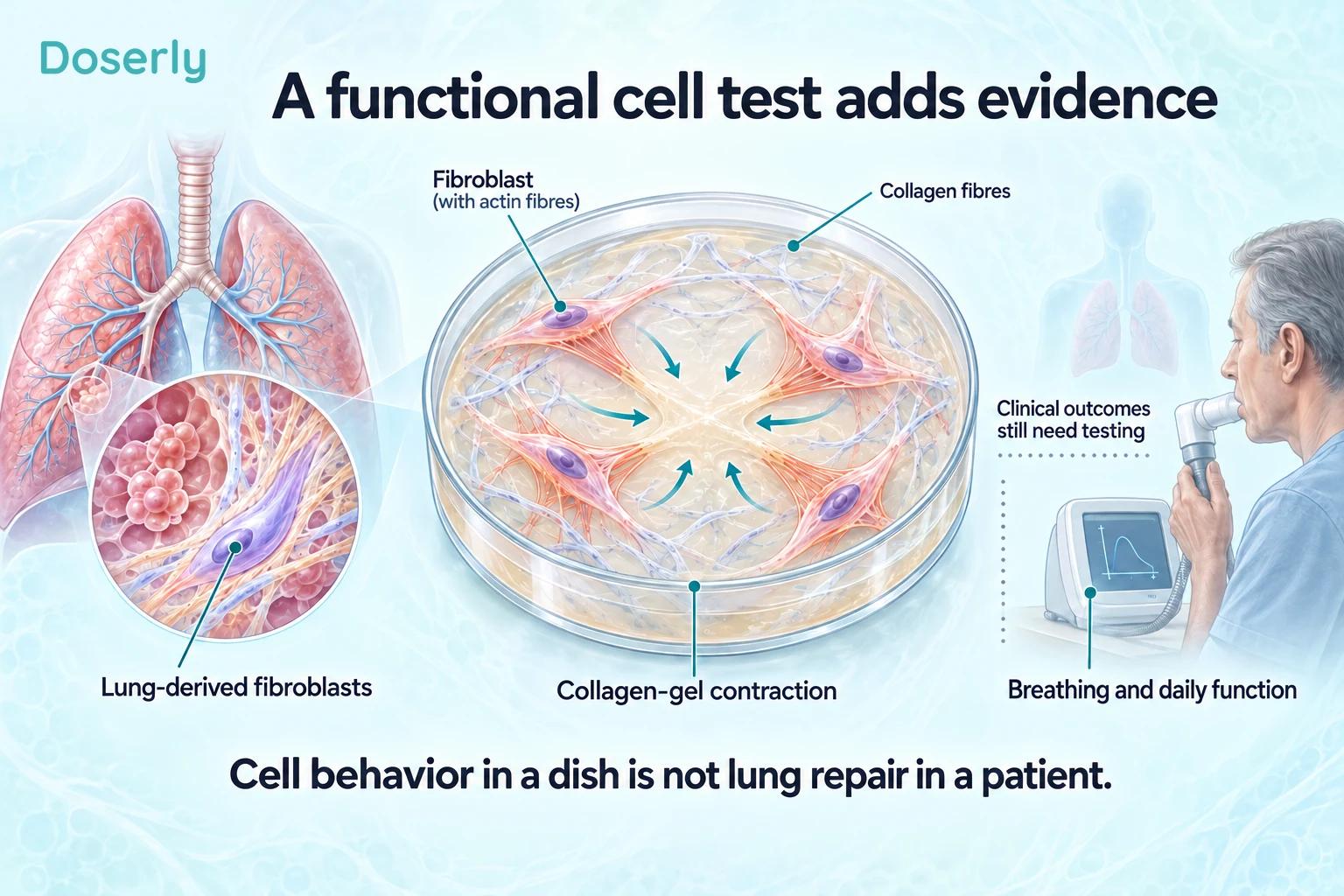
They then tested GHK in cultured human lung fibroblasts, a cell type relevant to connective-tissue remodeling. They examined expression responses and cell behavior. In collagen-gel experiments, fibroblasts derived from people with COPD had impaired contraction compared with cells from former smokers without COPD. GHK treatment improved contraction and remodeling in that laboratory assay.
That is more informative than stopping at a computer-generated match. The study connected the hypothesis to a measured function in a relevant cell model. It still did not show that treating a person with GHK restored damaged air sacs, improved breathing, reduced exacerbations, or prolonged survival. Those patient outcomes were not the treatment endpoints of the experiment.
The distinction preserves the value of the work. Calling it meaningless would ignore a functional observation. Calling it lung regeneration in patients would overstate what was tested. The accurate description is a promising mechanistic and cellular result that requires further translation.
GHK and GHK-Cu need careful naming
The expression analyses describe the tested compound as GHK. Many consumer claims instead name GHK-Cu, the copper complex, or refer to a particular commercial serum or injection. Those names should not be silently substituted in a description of the experiment.
This does not mean copper is irrelevant or that cells exposed to GHK necessarily contain no copper. Copper binding is dynamic. A 2021 laboratory study demonstrated complexes involving GHK, copper, and human serum albumin, illustrating that the surrounding chemical environment matters. Original copper-binding study
The practical point is narrower: the experiment’s stated reagent and conditions should remain visible. A cell-culture exposure is not a pharmacokinetic study of a marketed copper-complex product. It does not establish that topical application or injection produces the same chemical species, concentration, duration, or gene-expression response in human tissues.
Our GHK-Cu guide covers the broader formulation and route distinctions. Those distinctions remain necessary even when a compelling gene-expression mechanism is part of the product’s story.
Human skin results answer a separate question
There are small human studies of topical copper-peptide formulations. For example, a randomized study after carbon-dioxide laser resurfacing included 13 completers. It found a favorable patient-satisfaction result without establishing an added advantage on its objective redness or appearance measures. Original clinical abstract
That result does not confirm or disprove every proposed gene pathway. It measures a clinical question under particular conditions. Equally, the gene count cannot fill in a clinical benefit that the study did not demonstrate. Mechanistic findings and treatment outcomes should inform each other without becoming substitutes for one another.
A useful evidence chain would connect the actual product to exposure, the exposure to a reproducible biological effect, and that effect to a meaningful improvement. It would also assess adverse outcomes. No single large count of RNA changes completes those steps.
Reading the next gene-expression claim
When you encounter a claim about thousands of genes, look for the experimental setting before considering the headline number. Identify the cells, reagent, comparison, timing, and analysis threshold. Then ask what researchers measured beyond RNA and whether any benefit was demonstrated in treated people.
For GHK, the gene-expression literature provides hypotheses and some useful follow-up cell experiments. It does not demonstrate a whole-body genomic reset, thousands of health benefits, or a proven anti-aging treatment. The most informative evidence is not the biggest number in the headline; it is the next experiment showing what a specific change actually does.
Sources
- Pickart et al. — GHK, the Human Skin Remodeling Peptide, Induces Anti-Cancer Expression of Numerous Caspase, Growth Regulatory, and DNA Repair Genes (2014)
- Pickart et al. — GHK and DNA: resetting the human genome to health (2014)
- Lamb et al. — The Connectivity Map (2006)
- Hong et al. — A metastasis-prone signature for early-stage colorectal cancer (2010)
- Campbell et al. — Emphysema-related gene expression and GHK (2012)
- Bossak-Ahmad et al. — Ternary copper complexes of serum albumin and GHK (2021)
- Effects of topical copper tripeptide complex on CO2 laser-resurfaced skin (2006)