
Peptides
October 16, 2026
GHK-Cu and collagen: from fibroblasts to visible skin changes
On this page
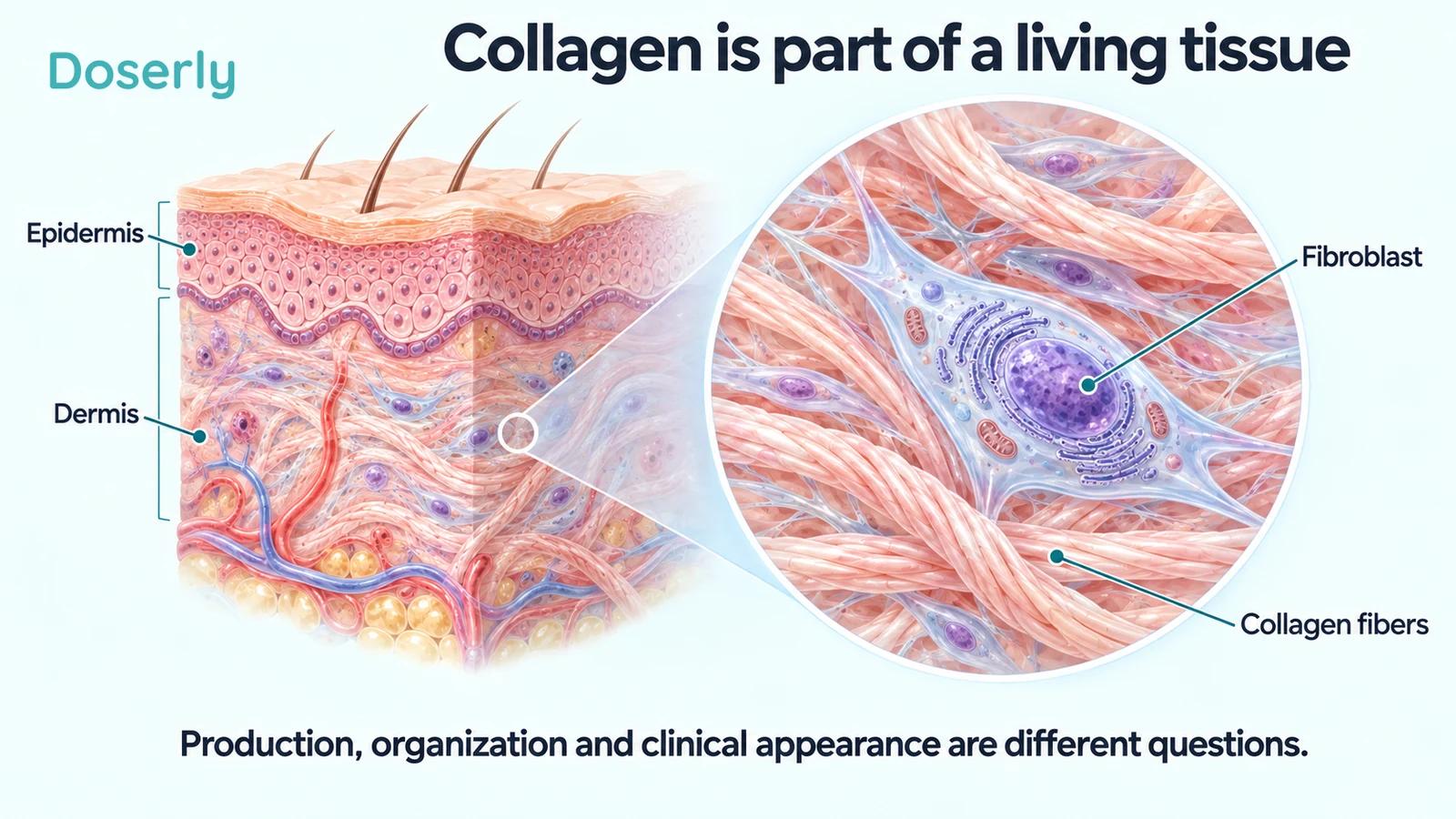
Collagen helps give skin its structure. It is produced and remodeled within living tissue, with cells called fibroblasts contributing to the surrounding extracellular matrix. This makes collagen a reasonable subject for skin research. It does not make every increase in a collagen-related measurement equivalent to fewer wrinkles, a flatter scar or stronger tissue.
GHK-Cu, a copper-binding peptide, has a long history in this research. Cell experiments, rat wound models and small human studies provide different pieces of the story. The useful question is how those findings connect to the result you care about: appearance, comfort, wound closure or function.
There are real observations worth understanding, including an early human biopsy study. They need to stay attached to the formulations, body sites and measurements actually studied. Our GHK-Cu guide gives a broader introduction; this article focuses on what “stimulates collagen” can mean in practice.
Collagen production is only one part of skin quality
Fibroblasts produce components of the extracellular matrix, the material around cells. Collagen contributes to that matrix, but its organization and remodeling matter as well as its amount. The skin surface also depends on structures and processes beyond collagen. A measurement of one protein cannot capture every feature someone sees in the mirror.
This is particularly important for scars. A depressed scar and a raised scar are different problems; increasing a general collagen signal would not automatically be the right solution for both. The American Academy of Dermatology emphasizes identifying the scar type before treatment because the appropriate approach varies with its features, age and effects on the person. AAD scar guidance.
A useful treatment goal is therefore more specific than “more collagen.” Someone with a scar that restricts movement wants improved function. Someone bothered by uneven texture wants a visible change. Someone with an open wound needs reliable closure and prevention of complications. Those outcomes may involve collagen biology, but they must be measured in their own right.
What the early fibroblast experiment found
In 1988, Maquart and colleagues reported that GHK-Cu stimulated collagen synthesis in fibroblast cultures. The response began at very low concentrations and was greatest around 10⁻⁹ molar in the tested system. The increase was not explained by a change in cell number. This was a laboratory experiment measuring cellular production, not a trial of a skin cream on patients. Original fibroblast study.
That result helps establish biological plausibility. It suggests that under the experimental conditions, the compound can affect a process relevant to connective tissue. It does not identify a consumer dose, because the concentration surrounding cultured cells is not the same as the amount printed on a serum label.
Between a product on the skin and an effect in the dermis lie several additional questions. Does the formulation deliver the relevant substance to the relevant cells? Does it remain chemically suitable? Is exposure sustained long enough to matter? Does the resulting tissue change improve a clinical outcome without causing problems? The cell experiment does not answer those questions by itself.
The same restraint applies to the word “natural.” A molecule's relationship to normal biology can explain why researchers study it. It cannot establish that every route, concentration or repeated exposure is beneficial.
What the rat wound model added
A 1993 study examined GHK-Cu in implanted wound chambers in rats. Researchers administered it into the chambers and analyzed the material that accumulated. They reported increases in extracellular-matrix components, including collagen and glycosaminoglycans, along with changes in collagen-related messenger RNA. A control tripeptide did not have the same effect. Maquart and colleagues, JCI.
This extended the question beyond isolated cells into a living animal. But the experimental setting was specific: implanted chambers, local administration and tissue analysis. It was not a study of a facial moisturizer, spontaneous human scars or ordinary subcutaneous use by a person.
The outcome was matrix accumulation in an experimental wound environment. That is not automatically the same as normal skin regeneration, better scar appearance or increased mechanical strength. Those claims would require their own measurements. The value of the model is that it helps identify processes and questions to investigate, rather than providing a complete clinical answer.
It would also be inappropriate to convert the animal administration into a human protocol. Species, route and exposure differ. The scientific observation can be discussed without turning its experimental method into advice for a reader.
The human biopsy study is interesting—and often misquoted
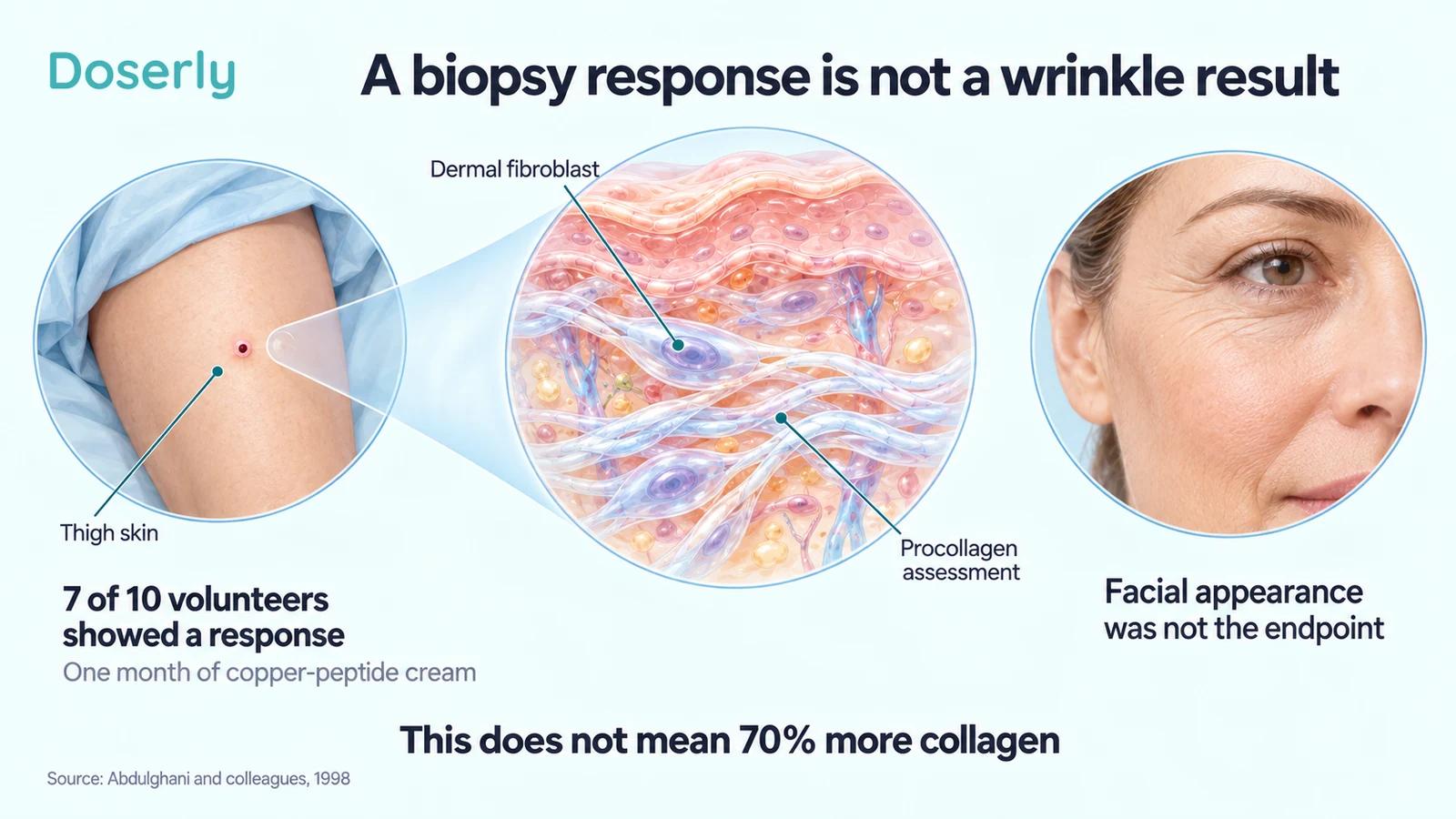
A 1998 pilot included 20 healthy volunteers for one month. Ten used tretinoin on one thigh and vitamin C cream on the other. A separate ten used melatonin cream on one thigh and a copper-binding peptide cream on the other. Researchers compared skin biopsies before and after treatment.
Increased procollagen synthesis was reported in 7 of 10 volunteers using the copper-peptide cream, compared with 4 of 10 using tretinoin and 5 of 10 using each of vitamin C and melatonin. Procollagen is a precursor involved in making collagen. The measurements concerned skin tissue, not a facial wrinkle score. Original institutional publication record and abstract.
Seven of ten responders does not mean 70% more collagen. It describes how many people showed a response, not the magnitude of their collagen increase. It also does not establish that seven of ten users of any present-day copper serum will see a worthwhile cosmetic improvement.
The comparison with tretinoin needs care because different groups of ten received the copper and tretinoin products. This small pilot was not a large, definitive head-to-head facial anti-aging trial. One month's biopsy findings cannot settle relative effectiveness across products, long-term appearance or tolerability.
Do clinical wound studies supply the missing answer?
They add clinically relevant information, but the findings are not uniform across conditions. In a randomized evaluator-blinded venous-ulcer trial, 86 evaluable participants completed follow-up. The study compared a 0.4% copper-tripeptide cream, 1% silver sulfadiazine and vehicle. The publisher's abstract reports greater ulcer-size reduction with silver sulfadiazine than with either comparison. That result does not establish a general clinical advantage for the copper cream. Bishop and colleagues, 1992.
A different randomized evaluator-blinded study in diabetic neuropathic ulcers reported a positive result for a particular GHK-Cu gel alongside standardized wound care. For plantar ulcers, the reported median percentage of wound-area closure was 98.5% with gel versus 60.8% with vehicle. Both groups received measures including debridement and pressure-relieving footwear. Mulder and colleagues, 1994.
Those percentages describe median area closure, not the percentage of patients completely healed. The accessible abstract does not provide all the participant and follow-up detail needed for a full independent appraisal, so the result should not be used to promise a particular recovery rate today. It also cannot justify replacing standard diabetic foot care with a peptide.
The studies concern different wound causes and formulations. A venous ulcer and a neuropathic plantar ulcer are not interchangeable conditions. Their results remind us that a broad biological mechanism does not predict the same effect in every clinical setting.
Neither study answers whether a cosmetic serum improves an old scar or facial wrinkles. Wound care and cosmetic appearance overlap in tissue biology but have different treatment goals and background care. A positive result should not lose its clinical address simply because it involves collagen-related repair.
What about visible cosmetic results?
A small trial after circumoral CO₂ laser resurfacing offers a relevant caution. Thirteen participants completed follow-up after assignment to regimens with or without GHK-Cu. Blinded and computer assessments found no significant added improvement in redness, wrinkles or overall appearance, although patients reported higher satisfaction with skin quality. Miller and colleagues, 2006.
This does not negate the cell or biopsy findings. It shows that a plausible mechanism and a visible clinical result are different stages of the question. A compound might affect a tissue marker without producing a detectable difference on the outcome or timescale chosen. Conversely, a person might prefer a regimen without an objective appearance difference.
The result also prevents an overly simple ranking of evidence. “Human study” can describe a biopsy experiment, a wound trial or a cosmetic appearance trial. Each is useful for a different question. For wrinkles, an appearance measure is more directly relevant than matrix accumulation in a rat chamber. For an open ulcer, closure and complications matter more than a cosmetic satisfaction score.
If your goal is improved skin appearance, ask which actual outcome changed and by how much. A claim that merely repeats “collagen stimulation” leaves that practical question unanswered.
Formulation and route cannot be skipped
The products in these studies were not interchangeable. A cream, a gel applied to an ulcer and a locally administered experimental solution create different exposure conditions. The amount in a container does not show how much reaches a specific tissue compartment. Nor can a topical study, such as the laser-resurfacing trial, establish the effects of injecting the peptide elsewhere in the body.
This matters when people compare percentages on labels. A higher listed concentration is not proof of greater clinical benefit. Different vehicles, co-ingredients and application conditions can affect delivery and tolerability. A useful trial identifies the formulation clearly enough that its findings can be interpreted and, ideally, replicated.
It also matters when GHK-Cu appears in a multi-ingredient routine. If someone adds a moisturizer, changes sun protection and starts several active products at the same time, improvement cannot be attributed confidently to one ingredient. That experience may be encouraging, but it does not isolate a collagen-mediated peptide effect.
For a clinical discussion, bring the actual product and explain the desired result. The question should be whether that formulation is appropriate for that problem, not whether the ingredient has ever affected a cell in a laboratory.
Choosing a useful skin or scar goal
For a scar, describe the feature that bothers you: elevation, depression, redness, pain, itch or restricted movement. AAD guidance describes different approaches for different scar types, including silicone, injections, pressure therapy and procedures in suitable circumstances. Those options require appropriate assessment rather than a universal promise to increase collagen. AAD scar diagnosis and treatment.
For a cosmetic concern, define what would count as worthwhile change before repeatedly adding products. Consistent photographs can help document appearance, but changing lighting, expression or hydration can alter the impression. A clinician can help distinguish surface dryness, pigment, texture and structural concerns that may require different approaches.
For an open or poorly healing wound, seek clinical care. The diabetic-ulcer trial involved organized wound management, not unsupervised use of a cosmetic ingredient. Applying a product because it has a collagen-related reputation may miss pressure, infection, circulation or another factor requiring treatment.
GHK-Cu's collagen research gives a reasonable basis for continued investigation. The clearest current interpretation is that laboratory and small tissue findings demonstrate biological activity, while patient benefits remain dependent on the specific condition, formulation and endpoint. A useful clinical claim must make that final connection rather than treating collagen production itself as the finished result.
Sources
- Maquart and colleagues, 1988: fibroblast collagen synthesis.
- Maquart and colleagues, 1993: rat wound-chamber matrix accumulation.
- Abdulghani and colleagues, 1998: human skin-biopsy pilot.
- Bishop and colleagues, 1992: venous-ulcer trial.
- Mulder and colleagues, 1994: diabetic neuropathic ulcer trial.
- Miller and colleagues, 2006: post-laser clinical outcomes.
- AAD: scar diagnosis and treatment.