
Peptides
October 16, 2026
GHK-Cu after laser resurfacing: satisfaction and visible recovery
On this page
Laser resurfacing deliberately changes the skin so that healing and remodeling can improve its appearance. During recovery, the questions are immediate: how uncomfortable will the skin feel, how long will redness last, and will the final result be worth the downtime? A product that makes recovery easier would be welcome, even if it does not change every visible measurement.
GHK-Cu, a copper-binding peptide used in skin products, has been studied in this setting. The best-known controlled trial produced a mixed result: patients using a GHK-Cu regimen reported greater satisfaction with skin quality, while blinded and computer assessments found no significant added improvement in redness, wrinkles or overall appearance. Both findings deserve to be reported accurately. Miller and colleagues, 2006.
The practical question is what that result can justify when planning aftercare. It supports interest in the patient's experience; it does not establish faster wound closure, less scarring or a shorter recovery period. Understanding the difference can help you discuss a proposed product without either dismissing how you feel or assuming a biological benefit that was not shown.
What is recovering after resurfacing?
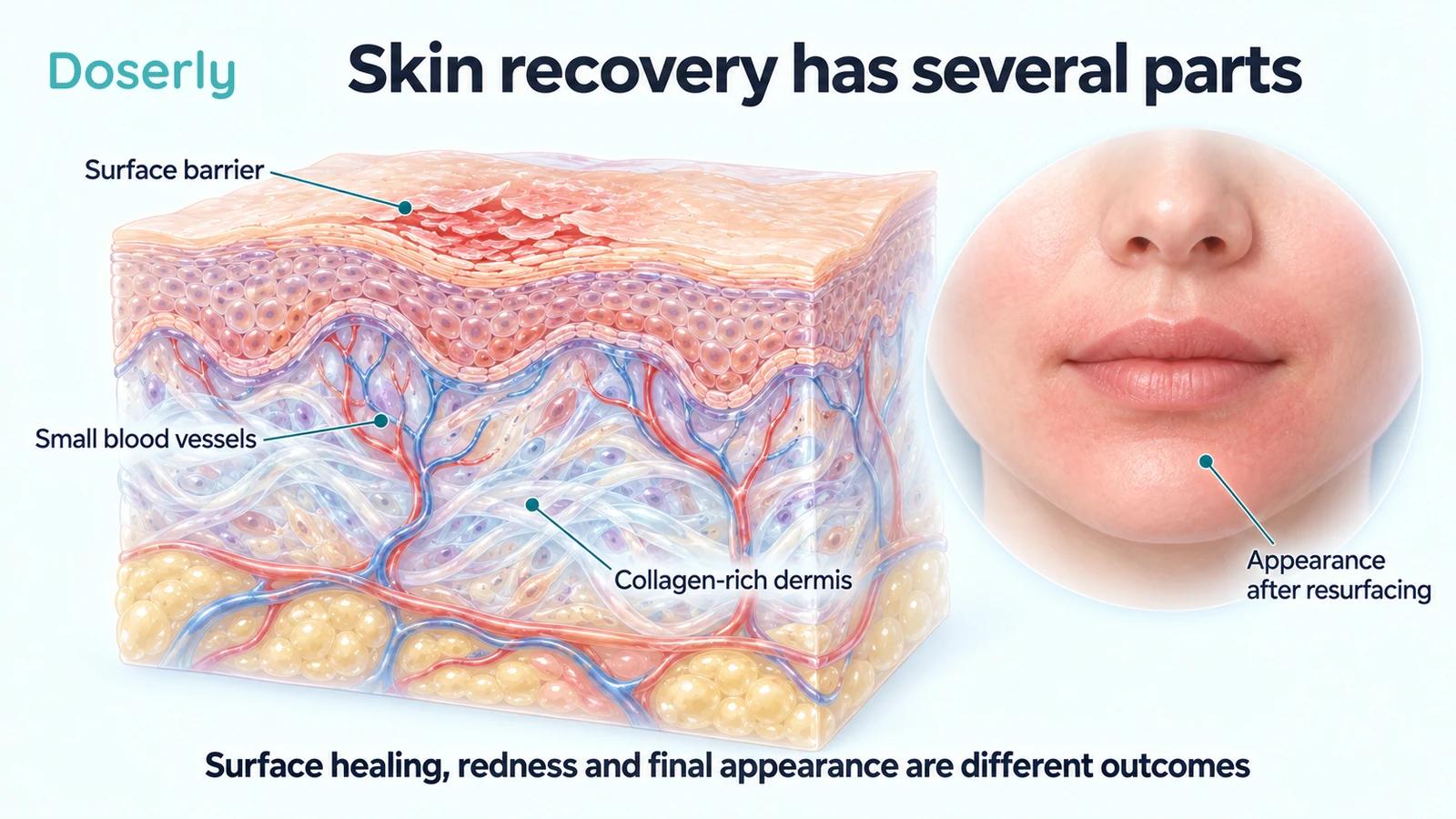
Skin has several layers and functions. Its outer surface acts as a barrier. Below it, blood vessels, connective tissue and other structures contribute to color, support and sensation. A procedure can affect these aspects differently, so recovery cannot be reduced to one photograph or one calendar date.
The American Society for Dermatologic Surgery describes laser resurfacing as removing upper skin layers with controlled treatment depth. The treated area may swell, sting, itch and peel; recovery depends on the procedure's location and extent. Recognized risks include scarring and discoloration as well as the more immediate discomfort. ASDS laser-resurfacing information.
That background explains why aftercare has several goals. Protecting a disrupted surface is different from reducing persistent redness. Improving eventual texture is different from making a product comfortable to wear. A person may value all of them, but a study has to measure each goal directly if it claims to improve it.
What did the GHK-Cu trial compare?
The 2006 study involved carbon dioxide, or CO₂, laser resurfacing around the mouth. Participants were randomized to post-treatment skin regimens with or without GHK-Cu. Thirteen patients completed the study. Redness was assessed using computer analysis and blinded evaluators; wrinkles and overall appearance were also assessed at 12 weeks. Patients completed a validated questionnaire before treatment and at follow-up.
The objective assessments did not find significant between-group differences in redness resolution, wrinkle improvement or overall skin quality. Questionnaire results favored the GHK-Cu regimen for improvement in skin quality, with p=0.04. Original trial abstract.
This was a comparison of aftercare regimens following the same general procedure, not a comparison of GHK-Cu against no resurfacing. Improvements in both groups cannot all be attributed to the peptide. The question was whether adding the studied regimen changed outcomes beyond the comparison care.
The available abstract does not provide enough information to calculate an absolute satisfaction benefit or define the smallest improvement patients considered worthwhile. It would be inappropriate to invent a percentage reduction in downtime or a number of days saved. Our GHK-Cu guide puts this small topical study alongside other research on the compound.
Why satisfaction and photographs can disagree
A person experiences recovery throughout the day. A photograph captures one moment under particular conditions. A questionnaire may capture aspects of perceived skin quality that are not fully represented by a redness measurement or a wrinkle score. Those tools do not necessarily assess the same thing.
For example, a person could prefer the feel of a regimen or feel more confident about their appearance without a detectable difference on a standardized image. Conversely, a visible improvement might not feel worthwhile if treatment is uncomfortable or burdensome. These are possible explanations for disagreement between measures; the GHK-Cu trial does not establish which explanation produced its result.
FDA recognizes patient-reported outcomes as one type of clinical outcome assessment, alongside clinician reports, observer reports and performance measures. A patient report can therefore be legitimate evidence. Its value depends on what the question measures, how reliably it is measured and whether it addresses the treatment goal. FDA clinical outcome assessment explanation.
The fair interpretation avoids two mistakes. It does not call satisfaction meaningless simply because it is subjective. It also does not rename satisfaction “accelerated healing.” If someone says they were happier with their skin, that report should remain about their experience unless separate measurements establish a change in tissue recovery.
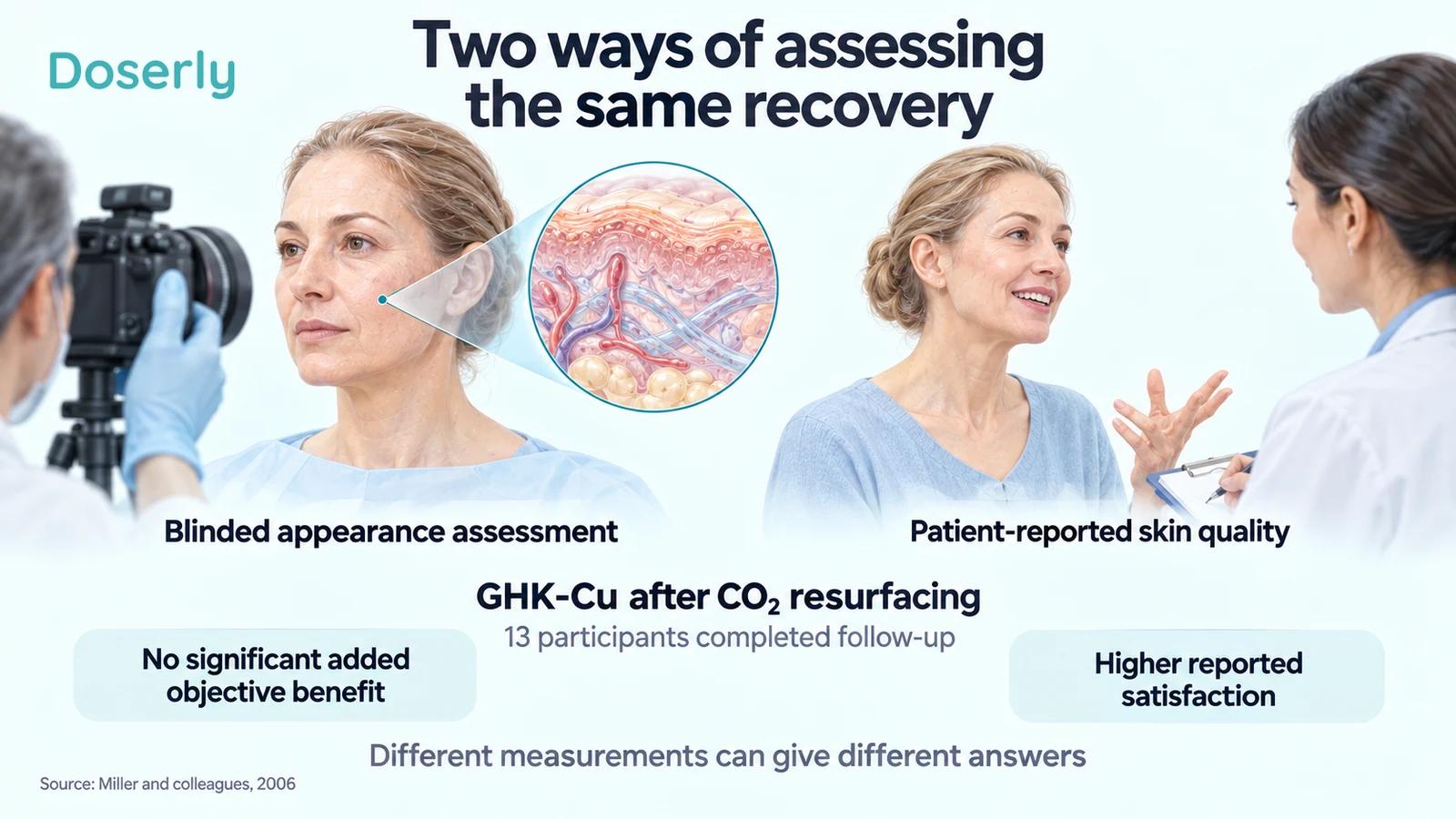
Image sources: Source: Miller and colleagues
Does a nonsignificant result mean the products were identical?
No. Failing to detect a difference is not the same as proving that the difference is exactly zero. A small trial may be unable to distinguish modest effects from normal variation. But that uncertainty cannot be converted into a positive claim either. “A benefit might have been missed” and “a benefit was demonstrated” are different statements.
With only 13 completers in the original study, the estimate of any treatment advantage is fragile. A few participants can have a substantial influence on the result. The study is therefore more useful as an early comparison than as a basis for confidently predicting an individual's recovery.
The positive questionnaire p-value also does not tell us the chance that the treatment works for a particular person. It relates to a statistical comparison under the study's assumptions. Clinical importance requires more context: the size of the change, its consistency, its duration and whether the difference matters to patients.
For someone deciding whether to pay for an added product, the missing information is practical. How many people noticed enough improvement to justify the cost? Was it easier to tolerate? Did it reduce the need for other care? Did a benefit last after the regimen ended? The reported result does not answer all of those questions.
Formulation and procedure still matter
“Contains GHK-Cu” does not mean “is the product studied.” A skin regimen includes a base, other ingredients and instructions for use. The condition of the skin also changes the exposure. A formulation tolerated on intact skin is not automatically appropriate on a freshly treated surface.
The procedure matters too. Fully ablative, fractional ablative and nonablative treatments should not be treated as identical recovery settings. A result from circumoral CO₂ resurfacing cannot simply be copied onto every laser, every body area or every treatment intensity. The relevant comparison is with the aftercare your own clinician recommends for the procedure actually performed.
A separate randomized study illustrates this specificity. Ten people undergoing fractional ablative erbium laser resurfacing used a petrolatum-based product on one side and a silicone gel on the other for seven days. The open-label study reported less redness and hyperpigmentation with silicone, while by day 60 there was no difference in signs and symptoms of healing. It was small, used a different laser and tested different products. Yeh and colleagues, 2019.
This finding does not identify a universal best dressing or rank those products against GHK-Cu. It shows why the entire aftercare regimen and the outcome being assessed deserve attention. A formulation can affect one aspect of recovery without establishing superiority across every endpoint.
What should guide care after a laser procedure?
The treating team should provide an aftercare plan tailored to the procedure and the skin's condition. Memorial Sloan Kettering's fractionated CO₂ guidance emphasizes using only products approved by the care team on the treated area, avoiding makeup until healing, and contacting the team about concerning changes. It also highlights a history of herpes or cold sores because preventive medication may be appropriate. MSK post-laser guidance.
An article cannot safely replace that plan with a universal schedule. Even routine instructions can differ by treatment intensity, location and individual risk. The useful action is to clarify the plan before the procedure, including what to clean with, which products to apply, when to restart usual cosmetics and whom to contact outside office hours.
If a copper-peptide product is suggested, ask what role it is meant to play. Is the goal comfort, cosmetic satisfaction, redness reduction or wound healing? Ask whether the supporting evidence uses the same product and procedure. A clear answer makes it easier to evaluate the expected benefit and avoid paying for a claim broader than the research.
Do not add multiple active products at once because each has a separate reputation for skin improvement. Apart from complicating aftercare, that makes any irritation or benefit harder to attribute. The treating clinician can advise when the surface is ready for ordinary skin-care ingredients again.
What changes should prompt a call?
Some redness and discomfort are expected, but worsening symptoms deserve attention. MSK advises contacting the care team for fever, chills, green or yellow drainage, increasing pain, increasing redness or swelling, and bleeding that does not stop with pressure. Follow your own team's instructions and contact them promptly if the course seems abnormal. MSK warning signs.
A concerning change should not be interpreted as proof that a product is “stimulating repair.” Nor should a favorable satisfaction score from a study justify continuing a product through worsening symptoms. Evaluation of a possible complication takes priority over deciding whether a cosmetic ingredient is generally promising.
For routine follow-up, dated photographs and a brief symptom record can help. Keep lighting and camera distance similar, and note when products change. Describe what affects daily life, such as discomfort or difficulty following the dressing routine. Those observations complement a clinical examination; they do not replace it.
What a stronger study would add
A larger trial could separate the important questions more clearly. It could measure time to surface recovery, duration of redness, patient comfort, satisfaction and longer-term appearance, with a prespecified main outcome. Matching the comparison regimen would help isolate the added ingredient's contribution. Reporting adverse reactions and discontinuations would make the benefit-risk discussion more useful.
Such a study should also make the size of any difference understandable. A statistically detectable score change may be too small to matter, while a modest reduction in discomfort may be valuable to patients even if photographs look similar. Both possibilities can be studied without treating one kind of measurement as the only legitimate outcome.
For now, the GHK-Cu laser study offers a limited patient-experience signal alongside negative objective comparisons. That is a narrower finding than faster healing or better wrinkle correction. If you are planning resurfacing, choose aftercare with the treating team, define the benefit you want, and keep the product's evidence attached to the outcome it actually measured.
Sources
- Miller and colleagues, 2006: GHK-Cu after CO₂ resurfacing.
- ASDS: laser resurfacing and expected recovery.
- FDA: clinical outcome assessments.
- Yeh and colleagues, 2019: randomized post-laser dressing comparison.
- MSK: care before and after fractionated CO₂ treatment.