
Supplements
October 16, 2026
Folate, folic acid and MTHFR: choosing a form for the right reason
On this page
Folate helps cells make DNA and supports normal blood-cell production. You may encounter it as folate in food, folic acid in fortified foods and supplements, or methylfolate on a supplement label. The decision can become confusing after a genetic test reports an MTHFR variant and a product advertisement says you can no longer use ordinary folic acid.
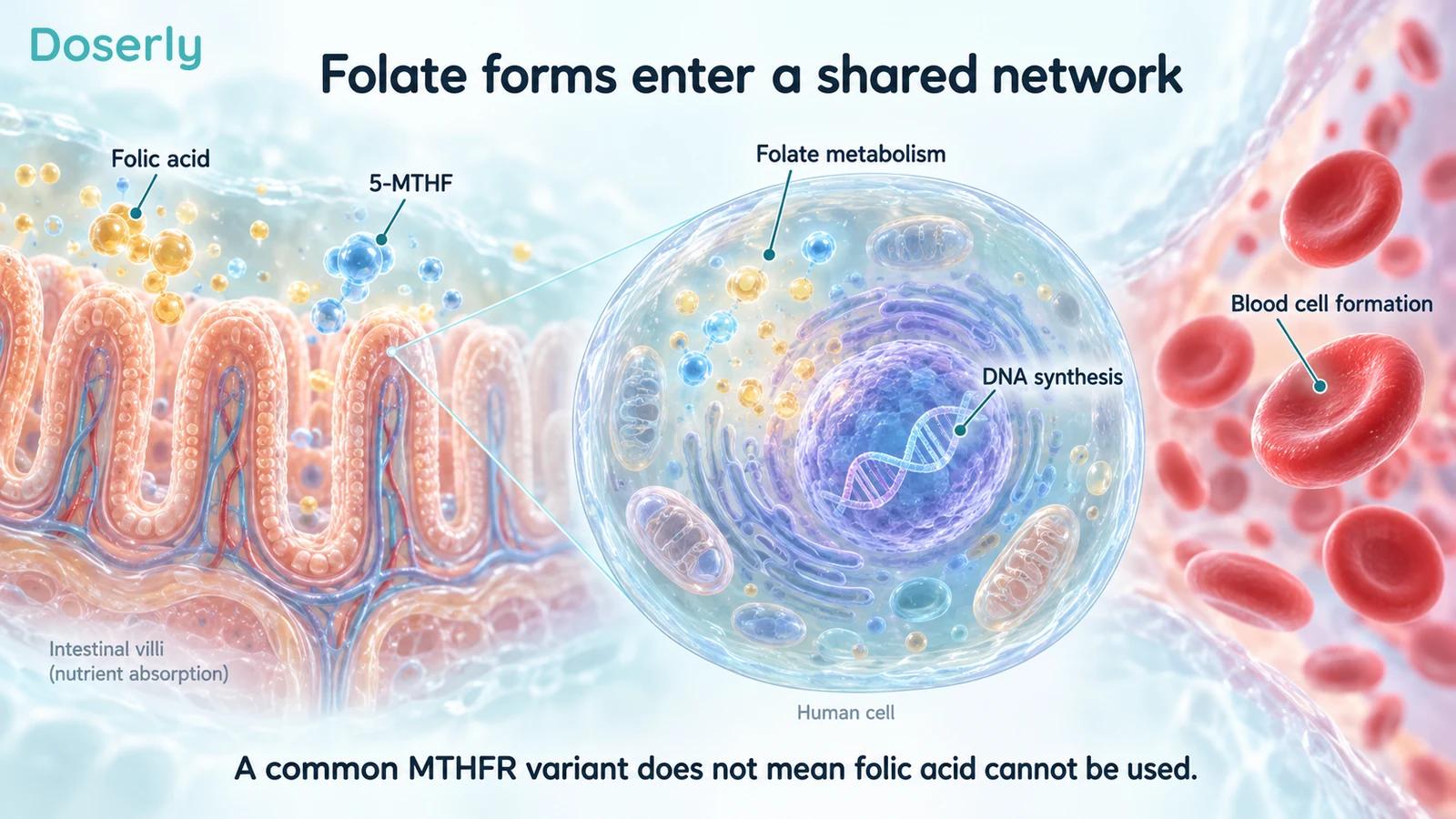
A common MTHFR variant does not mean your body is unable to process folic acid. It also doesn't, by itself, establish a deficiency or identify the best treatment for fatigue, fertility concerns or another symptom. The useful starting point is why you need folate: meeting nutritional needs, preparing for pregnancy, investigating anemia or following a specific medical treatment plan. CDC explanation of MTHFR variants
Our vitamin B9 guide introduces the different forms. This article explains what genetic information adds, what human comparisons have measured, and why a favorable blood test is not the same result as preventing a pregnancy complication.
What the names on the bottle mean
Folate is the family name for vitamin B9 compounds. Folic acid is a form used in supplements and fortification. 5-methyltetrahydrofolate, often abbreviated 5-MTHF or called methylfolate, is a reduced folate form involved in the body's one-carbon metabolism: reactions that transfer small chemical groups needed for making and maintaining cellular materials.
MTHFR is an enzyme within this network. It helps produce 5-MTHF from another folate compound. Describing methylfolate as “active” identifies a biochemical form; it does not demonstrate that a particular product improves every clinical outcome more than folic acid. The pathway involves more than one step, and other nutrients, including vitamin B12, also matter. NIH folate fact sheet
A useful comparison is therefore more specific than natural versus synthetic. Which form was studied, at what amount, in whom, and for which goal? The answer can differ between a study of short-term blood concentrations and a trial measuring pregnancy outcomes. Neither answer needs to be forced into a single ranking of all folate products.
What a common MTHFR result does and does not tell you
The commonly discussed C677T variant changes the activity of the MTHFR enzyme. Having one or two copies can influence folate-related measurements, but common variation is not the same as a complete inability to use a vitamin. CDC states that people with these variants can process folic acid and that intake is an important determinant of blood folate. CDC MTHFR facts
A consumer report describes a genetic finding, not everything happening in your metabolism today. It doesn't measure what you've eaten, whether you absorb nutrients adequately or whether a symptom has another cause. It also doesn't tell you whether a larger supplement dose will improve how you feel. Those are separate questions requiring different information.
Rare inherited disorders involving folate metabolism belong in specialist care. They should not be conflated with a common variant reported by a consumer test. If a report is presented as evidence of a serious metabolic disorder, ask what diagnosis is being proposed and how it was confirmed. The words “gene mutation” can sound decisive even when the finding is a common population variant.
Does genetic testing improve the decision?
The American College of Medical Genetics and Genomics concluded that common MTHFR polymorphism testing has little clinical utility in routine thrombophilia evaluation. Thrombophilia refers to a tendency to form blood clots. Its guideline addresses the temptation to turn associations between genes, homocysteine and disease into a useful clinical test without showing that testing improves care. ACMG practice guideline
That is a specific recommendation about a clinical use of testing, not a claim that genetics never matters. It also does not mean someone with symptoms should be dismissed. A clinician can investigate anemia, neurological symptoms, pregnancy history or nutritional risk using information relevant to that problem.
If you've already received a result, you don't need to purchase a special product before discussing it. Bring the actual report, rather than a summary from a supplement seller. Ask whether the finding changes a recommended action. A test is most useful when its result leads to a decision that has evidence behind it, not simply to a longer list of products.
What methylfolate-versus-folic-acid trials actually show
A randomized, double-blind trial in 144 women compared daily folic acid, two amounts of 5-MTHF and placebo for 24 weeks. The groups received 400 micrograms of folic acid, 416 micrograms of 5-MTHF, 208 micrograms of 5-MTHF or placebo. Researchers measured plasma folate and total homocysteine, a substance involved in amino-acid metabolism.
All three supplemented groups lowered homocysteine, without a statistically significant difference in the reductions between them. The lower 5-MTHF amount produced a smaller increase in plasma folate than the two higher-amount interventions. This supports the ability of both forms to influence biochemical measures under the conditions tested. It was not a trial of birth-defect prevention or treatment of unexplained fatigue. Lamers and colleagues, 2004
Another 24-week randomized study in women of childbearing age compared 5-MTHF, folic acid and placebo using plasma and red-cell folate measurements. Its conclusion was that the two supplemented forms produced similar increases in blood folate indices. Again, the measured outcome was folate status. Venn and colleagues, 2002
These studies are useful: methylfolate is not merely a marketing word without human research. But their results need to stay attached to their endpoints. A nutrient form can work well for increasing a blood concentration without having direct evidence that it prevents a specific clinical event better than another form.
Why pregnancy changes the comparison
Neural tube defects affect development of the structures that become the brain and spinal cord. Prevention needs attention early, because neural tube development occurs before many people recognize a pregnancy. The US Preventive Services Task Force recommends 400–800 micrograms of folic acid daily for people planning or capable of pregnancy, beginning at least one month before conception and continuing through the first two to three months of pregnancy. This is a general US prevention recommendation; it does not cover every high-risk situation. USPSTF recommendation, 2023
The reason folic acid remains central is the outcome evidence. In the 1991 Medical Research Council Vitamin Study, 1,817 women with a previous affected pregnancy were randomized to folic acid, other vitamins, both or neither. Among 1,195 completed pregnancies with known neural tube defect status, there were six affected pregnancies in the folic-acid groups and 21 in the other groups. The reported relative risk was 0.28, with a 95% confidence interval of 0.12–0.71. MRC Vitamin Study
The often quoted 72% reduction is a relative effect in a high-risk recurrence-prevention study. It is not a 72-percentage-point reduction, a guarantee for an individual pregnancy, or a comparison of folic acid with methylfolate. The population and comparator are central to understanding the result.

Should an MTHFR variant change a prenatal supplement?
CDC's clinician guidance continues to support folic acid for neural tube defect prevention, including in people with common MTHFR variants. It distinguishes the evidence for folic acid from claims that other folate forms have demonstrated the same prevention outcome. A genetic result alone is not a reason to avoid folic acid. CDC clinical overview
That doesn't mean every prenatal product or amount suits every person. A prior neural tube defect-affected pregnancy, certain medications and other risk factors can require a different plan. Someone already pregnant or preparing for pregnancy should take the complete label to their prenatal clinician rather than replace a product based on a genetic-test interpretation alone.
Consider a practical example: two products advertise the same large “folate” number, but one contains folic acid and the other only 5-MTHF. The label comparison should identify both the amount and the form. If the intended purpose is neural tube defect prevention, ask how the chosen product delivers the ingredient supported by the recommendation. A broader folate total can obscure that question.
Reading the units without accidentally doubling up
Folate labels may use dietary folate equivalents, abbreviated DFE, to account for differences in availability between food folate and folic acid. The amount expressed in DFE is not necessarily the same number as the folic-acid amount listed in parentheses. NIH also notes that high supplemental folate can correct the anemia of vitamin B12 deficiency without correcting its neurological consequences. NIH folate fact sheet
For a review, record the label exactly: total folate in DFE, the named form and its listed amount, and servings per day. Include prenatal vitamins, B-complex products and separate folate tablets. Don't add unlike units and assume the resulting number is meaningful.
A clinician evaluating possible deficiency needs to know what was taken before testing. Starting several high-dose products at once can make the history harder to interpret. If the question is anemia or tingling, ask whether B12 assessment is part of the evaluation rather than treating the blood count or symptom with folate alone.
Matching the choice to your actual goal
For nutritional adequacy, discuss diet, absorption and any documented deficiency. For neural tube defect prevention, use the relevant folic-acid recommendation and have higher-risk circumstances reviewed individually. For an abnormal homocysteine result, ask what it means in your clinical situation rather than assuming a lower value proves a reduction in every associated disease risk.
For symptoms such as fatigue, write down their onset and what changed around the same time. A common MTHFR result doesn't explain a symptom merely because the result and symptom coexist. If methylfolate is being prescribed for a separate medical indication, that decision should be evaluated using the evidence for that indication, not borrowed from prenatal or blood-folate studies.
The useful question is: what benefit are we trying to achieve, and which form has evidence for that benefit in someone like me? Bring the genetic report, current labels and reason for supplementation to that conversation. The vitamin B9 guide can help with terminology, while the clinical goal determines which details matter most.
Sources
- CDC: MTHFR Gene Variant and Folic Acid Facts.
- NIH: Folate, health professional fact sheet.
- ACMG practice guideline, 2013: clinical utility of common-variant testing.
- Lamers et al., 2004: randomized biochemical comparison over 24 weeks.
- Venn et al., 2002: blood-folate comparison.
- MRC Vitamin Study, 1991: recurrence prevention in a high-risk population.
- USPSTF recommendation, 2023.
- CDC: Folic Acid Facts for Clinicians.