
Supplements
October 16, 2026
Fisetin and senescent cells: what human studies have found
On this page
Fisetin is a plant flavonoid being studied for effects on inflammation and cellular senescence. A senescent cell has stopped dividing but remains biologically active. Some senescent cells release substances that influence nearby tissue, which has led researchers to investigate whether selectively removing them could help treat particular diseases.
That proposed activity is called senolysis. It's a much more specific claim than saying a substance has antioxidant properties. For a person considering fisetin, the useful questions are whether it changes senescent cells in the body, whether that helps a particular health problem and whether the benefits justify the risks.
Human studies exist, including newer findings that go beyond the early trial announcements. They still don't establish fisetin as a general treatment for aging. Our fisetin guide explains the compound's wider background; here we'll focus on what the senolytic reputation does and doesn't tell you about clinical benefits.
A senescent cell is not simply an old or dead cell
Senescence can occur when a cell encounters damage or other stresses. Stopping division can prevent damaged cells from multiplying. The cell may remain metabolically active and produce a mixture of signaling molecules, sometimes called the senescence-associated secretory phenotype, or SASP. Those signals can affect inflammation and the surrounding tissue. Fisetin trial rationale
This makes the familiar “zombie cell” nickname incomplete. It can suggest that every senescent cell is useless and should be eliminated. The clinical research question is more selective: which cells, in which disease, should be targeted, and what happens afterward?
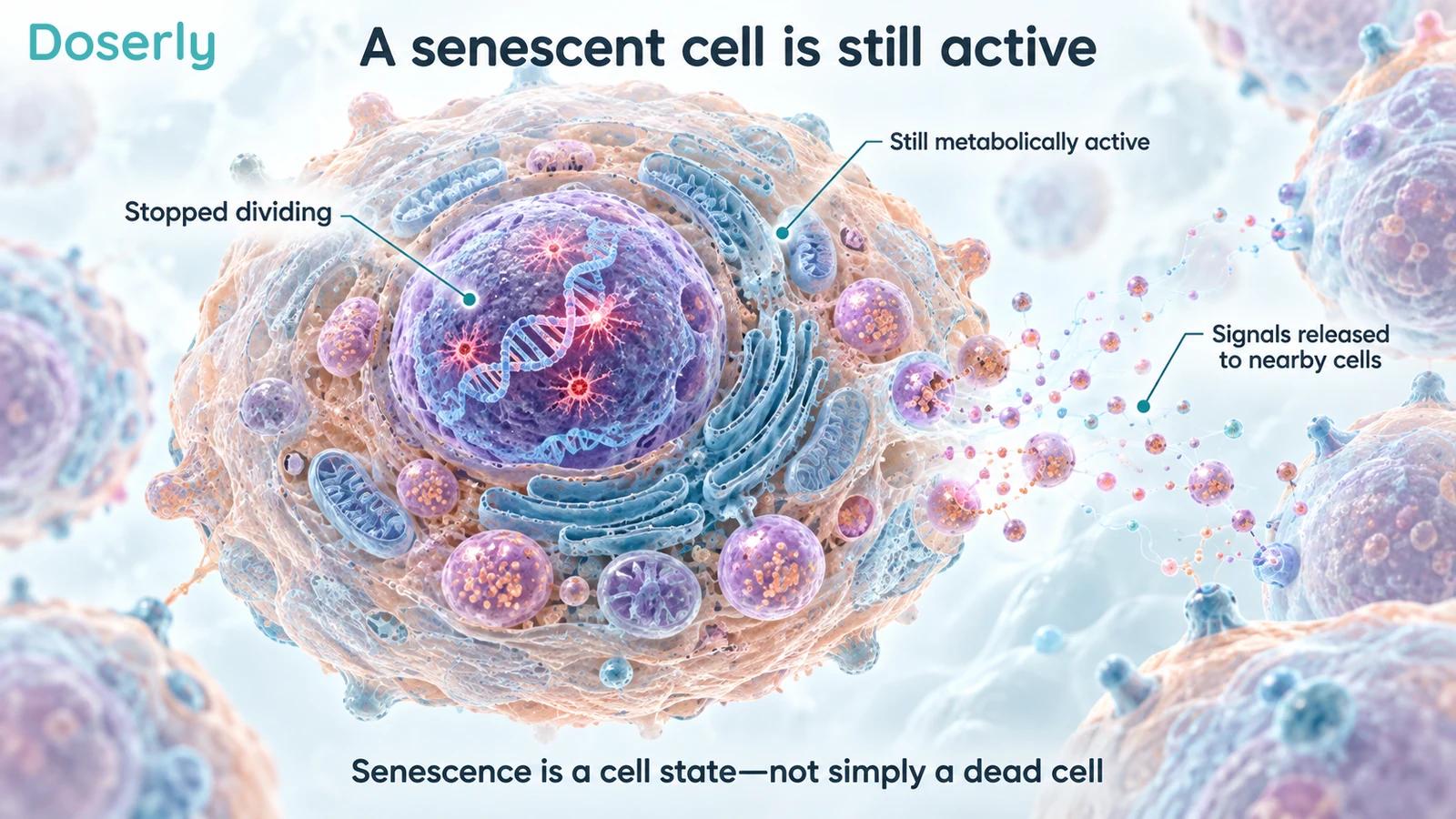
A treatment that lowers an inflammatory protein may act through several pathways. It doesn't automatically follow that it killed senescent cells. To make that claim convincingly, researchers need appropriately selected tissue or cell measurements, preferably alongside a patient benefit. Feeling less tired after a capsule cannot identify that cellular mechanism.
Where did fisetin's reputation come from?
An influential 2018 experimental study screened flavonoids in senescent cells and investigated fisetin in mouse models. Researchers reported changes in senescence-related measures and longer survival in treated aged mice. They also exposed human fat-tissue samples to fisetin outside the body. Yousefzadeh and colleagues
The human tissue experiment is relevant because it involves human cells, but the people who supplied the tissue were not treated to establish a clinical effect. A compound placed directly into a laboratory preparation bypasses digestion, metabolism and distribution through the body. The study also found differences across cell types, which makes a blanket “clears old cells” description misleading.
The mouse findings justified human trials. They didn't identify an effective human longevity dose or establish that intermittent supplement use would reproduce the animals' outcomes. Converting an animal experiment into a consumer schedule requires assumptions about exposure and safety that the experiment itself cannot resolve.
The COVID-19 paper was a plan, not a successful treatment result
The 2021 nursing-facility paper described the rationale and practical design of a placebo-controlled fisetin trial in older residents with SARS-CoV-2 infection. It discussed the overlap between inflammatory processes in severe infection and signals associated with senescent cells, as well as difficulties conducting research in care facilities. It did not report that fisetin reduced hospitalization or death. Original design paper
This matters because an impressive institution, public funding and a carefully designed trial can make an intervention sound more established than it is. Those features support taking the research question seriously. They don't supply the missing treatment result.
A trial protocol is also not an instruction sheet for someone with an infection. Researchers define eligibility, monitor adverse events and arrange clinical care within a study. None of the design paper's rationale establishes that a retail supplement is an effective substitute for treatment of COVID-19 or another respiratory illness.
Have studies found improvements in inflammatory markers?
A small 2018 randomized trial enrolled 37 people with colorectal cancer receiving chemotherapy. Eighteen received 100 mg fisetin daily and 19 placebo for seven weeks. Researchers measured inflammatory proteins and matrix metalloproteinases, enzymes involved in tissue remodeling. Colorectal cancer trial
Several measures fell within the fisetin group, but only the change in IL-8 was significantly different from placebo among the reported measures. That distinction is easy to lose when a study is summarized as broadly “reducing inflammation.” The appropriate comparison asks whether the treated group changed more than the control group, not just whether its final value was lower than its starting value.
The trial did not establish longer survival, cancer prevention or selective removal of senescent cells. It also involved people receiving chemotherapy, so its result cannot simply be transferred to otherwise healthy supplement users. Anyone undergoing cancer treatment should bring supplement questions to their oncology team; a small adjunct study is not a basis for self-directed changes to treatment.
What did the knee osteoarthritis trial find?
Knee osteoarthritis offers a concrete test of the theory: if targeting senescence helps an affected joint, do pain, function or cartilage measurements improve?
A 2025 Orthopaedic Research Society conference report described 74 randomized participants, 34 receiving fisetin and 40 placebo, with assessments over 12 months. Researchers examined adverse events, cartilage MRI measurements, pain, patient-reported outcomes, walking tests, strength and gait. They reported no significant benefit for pain, function or cartilage health with the treatment studied. Adverse-event measures did not differ significantly between groups. Original conference report
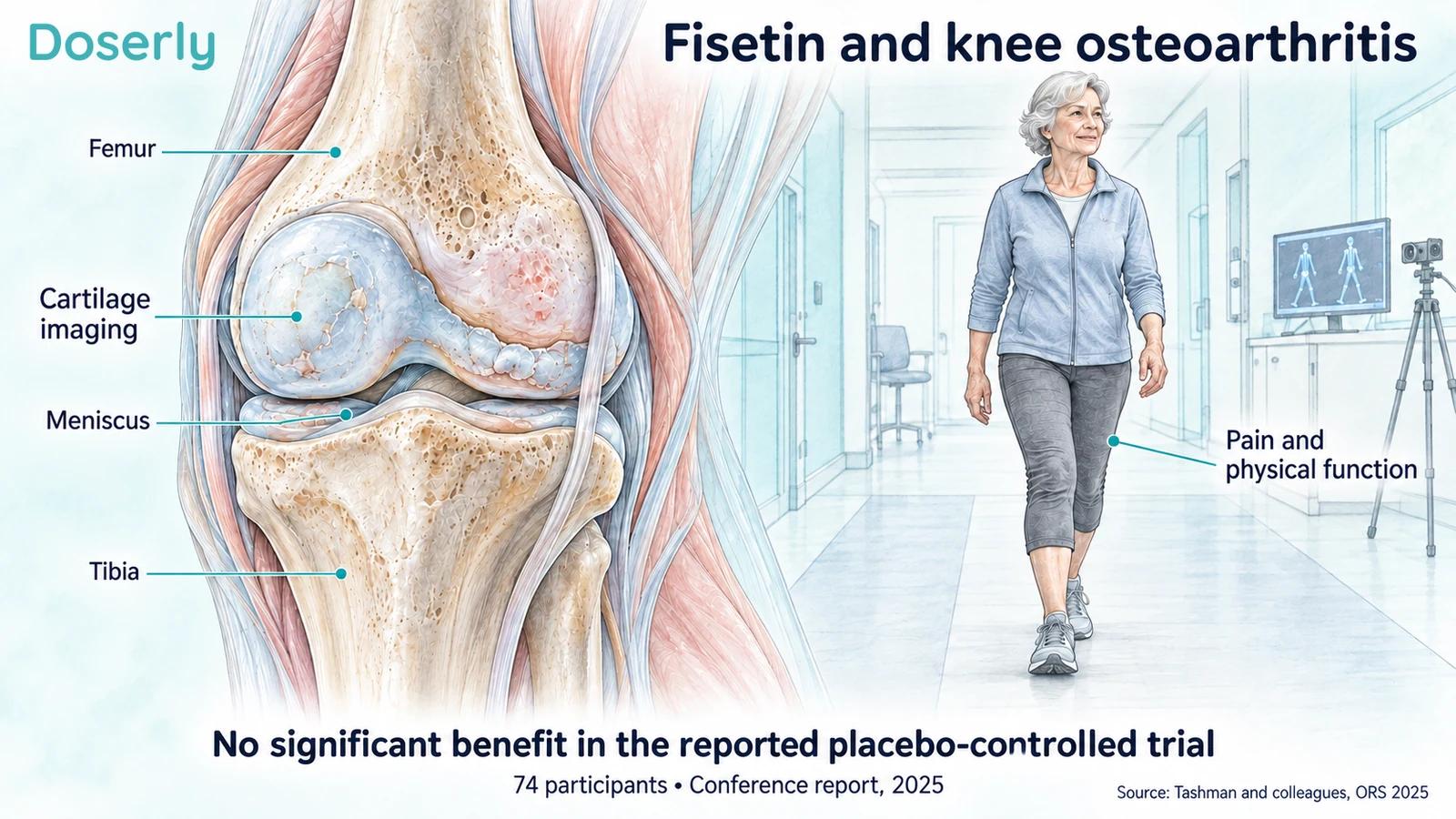
A conference abstract provides less methodological detail than a full paper, so the result should be described at that level. It still matters: the findings do not support promising joint improvement from the formulation and strategy tested. Suggesting that a different formulation might work is a hypothesis requiring a new comparison, not an explanation that turns a negative result into a positive one.
What do the skeletal-health registry results show?
The registered study NCT04313634 included separate dasatinib-plus-quercetin, fisetin and untreated groups. Its posted primary-outcome record reports 11 fisetin participants in the analysis of a bone-resorption marker, compared with 28 in each of the other two groups. Bone resorption is the breakdown side of normal bone remodeling. Primary trial registry and posted results
This is a useful example of why the actual treatment arm matters. A statistical comparison for dasatinib plus quercetin cannot be cited as proof for fisetin. Nor does a change in a bone-turnover marker establish fewer fractures. The small fisetin group and limited outcome reporting leave substantial uncertainty about its skeletal effects.
The registry is a primary record submitted by the investigators. Posted results are more informative than a registration alone, but they still need careful reading: which groups were compared, how many participants contributed and whether the endpoint was a laboratory marker or something patients experienced.
Does the newer exercise study demonstrate senolysis?
A 2026 trial reported on 60 sedentary men with obesity assigned to placebo, fisetin, exercise plus placebo or exercise plus fisetin over 12 weeks. The fisetin intervention was 200 mg daily. Its principal measurements included asprosin, MCP-1 and adiponectin, signals involved in metabolic and inflammatory regulation. Exercise and fisetin trial
The investigators reported favorable changes in several measurements, with the combined exercise-and-fisetin group showing particularly large changes in some markers. However, the study did not perform direct mechanistic assays establishing senescent-cell clearance. The authors themselves note that the proposed mechanisms remain hypothetical.
For someone interested in metabolic health, this is early human evidence worth following. It doesn't show that fisetin reproduces exercise, and a combination result cannot be attributed entirely to the supplement. It also doesn't demonstrate reduced diabetes complications, cardiovascular events or longer life. Those are different outcomes requiring different studies.
Are the major aging trials finished?
For the AFFIRM trial, NCT03430037, the registry checked on October 15, 2026 listed enrollment by invitation and no posted results. Its most recent posted update was May 2026, with estimated completion dates. It studies frailty-related questions in older women. AFFIRM registry
An estimated completion date is not a finding. Trial records can lag behind events, and results may later appear in a paper or registry update. The accurate statement is that this checked record did not provide results on the research date—not that no human fisetin research exists anywhere.
This distinction prevents two opposite mistakes: treating every ongoing study as proof of benefit, or dismissing a field because an older article said the evidence was preclinical. The field is developing, but the findings still need to answer a practical question for a defined group of people.
What should someone considering fisetin discuss with a clinician?
Name the problem you're hoping to improve. Knee pain, declining mobility and fatigue need different assessments; none is a reliable personal indicator of senescent-cell burden. Ask whether the supporting study measured that problem in people like you, and whether it tested the same formulation.
Bring the entire product label and medication list. A blend may contain other flavonoids or ingredients that were not part of the cited trial. More ingredients do not establish broader cell targeting, and changing several products together makes both benefits and adverse effects harder to interpret. Our senolytics guide explains the broader category and why evidence for one experimental intervention cannot be assigned to another.
Be particularly cautious about interpreting unpleasant effects as proof of “cell clearance.” Headache, nausea or feeling unwell is not a validated senolysis test. Report symptoms in ordinary clinical terms, including when they began, what you took and whether other treatments changed. That gives a clinician information they can use without assuming the desired mechanism occurred.
Fisetin has a credible experimental rationale and an expanding human literature. At present, that literature contains small biomarker studies, limited registry data and a negative knee-osteoarthritis conference report, alongside trials still awaiting results. It supports further investigation rather than a confident promise of whole-body rejuvenation or a proven self-directed senolytic routine.
Sources
- Fisetin for COVID-19 in skilled nursing facilities: trial rationale and design (2021)
- Fisetin is a senotherapeutic that extends health and lifespan: experimental study (2018)
- Fisetin and inflammatory factors in colorectal cancer (2018)
- Knee osteoarthritis randomized trial: ORS conference report (2025)
- Skeletal-health trial: posted registry results
- Exercise and fisetin metabolic-marker trial (2026)
- AFFIRM: current trial registry