
Longevity
October 17, 2026
Fasting, autophagy and aging: what has actually been measured in people?
On this page
Fasting is often presented as a way to give the body time to clean itself. The explanation usually centers on autophagy, a cellular recycling process, followed by a confident claim about how many hours without food will switch it on. Sometimes a ketone reading or a feeling of mental clarity is offered as proof that the process is working.
There is real biology behind the interest. There is also a considerable gap between that biology and a personalized fasting timetable. Human studies now include direct measurements of autophagic flux, alongside trials of weight, glucose regulation and other health markers. These findings deserve more careful attention than either a promise of rejuvenation or a blanket dismissal of fasting.
The most useful starting point is to separate three questions. Does an eating pattern help someone manage a recognized health problem? Does it change a cellular process in the tissue researchers sampled? And does that change improve long-term health or survival? The evidence for one answer cannot automatically supply the other two.
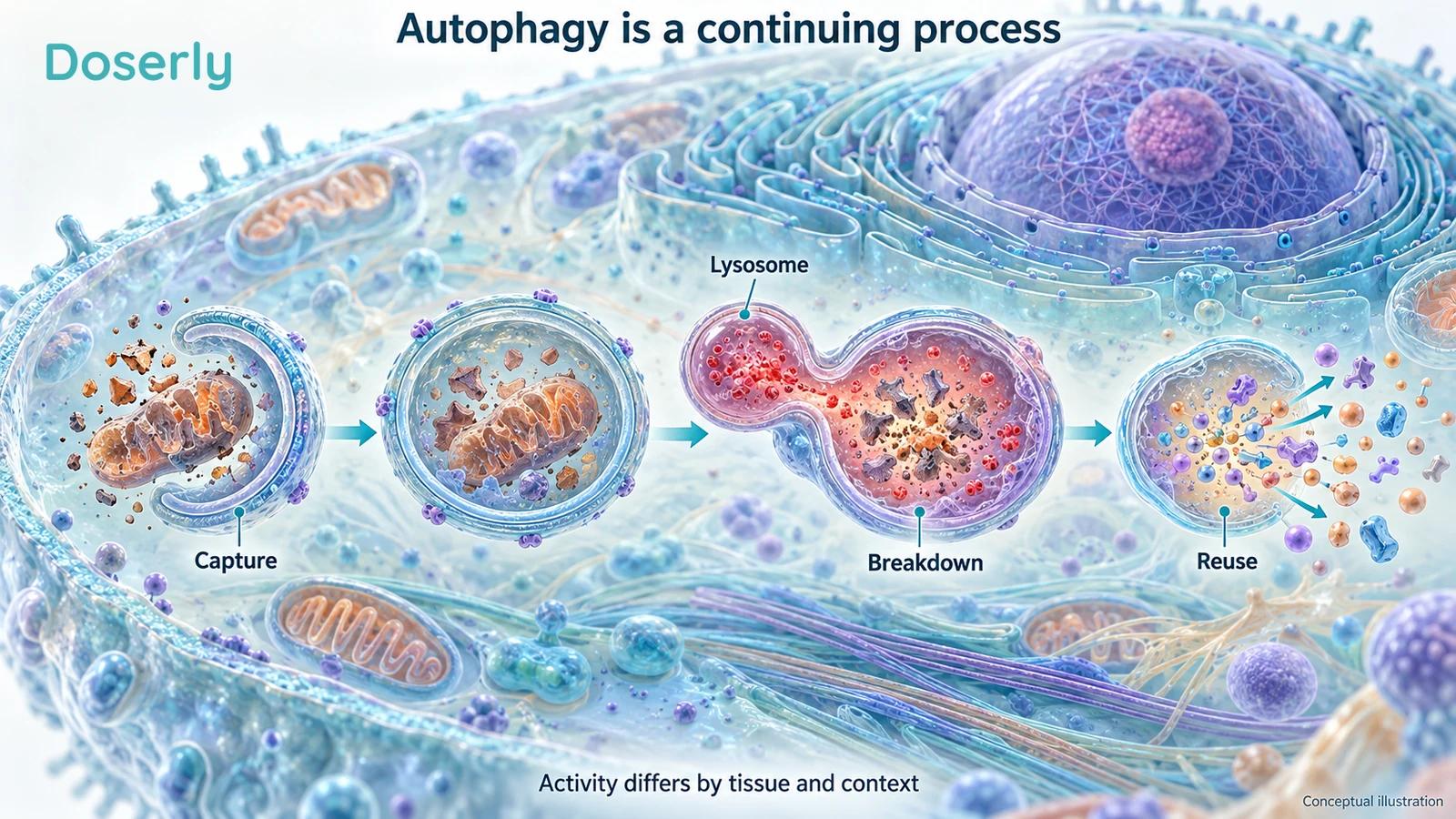
Autophagy is an ongoing process, not a countdown
Cells continually maintain their components. In one major form of autophagy, material is enclosed within a membrane-bound compartment called an autophagosome. This interacts with a lysosome, where enzymes break the contents into components that can be reused. The process helps cells respond to changing conditions and manage material that needs removal.
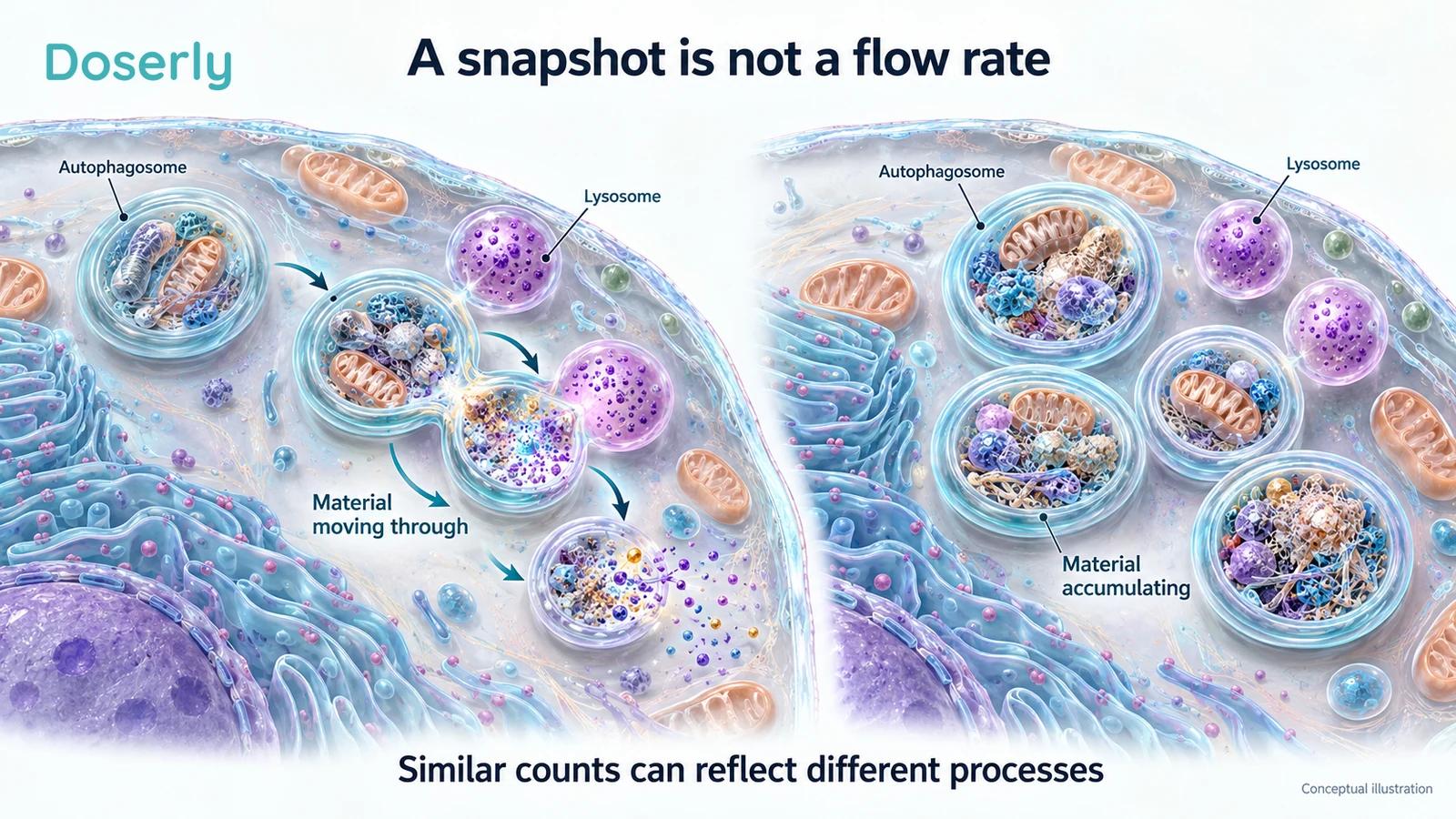
The amount of machinery visible at one moment is not necessarily the amount of material being successfully processed. More autophagosomes could reflect faster formation, slower clearance, or both. That is why researchers distinguish a static marker from autophagic flux: movement through the pathway over time. International assay guidelines emphasize that no single measurement is suitable for every question and that complementary methods are often needed. Klionsky and colleagues, Autophagy
Think of parcels in a sorting depot. A large pile might mean many deliveries are arriving, or it might mean the conveyor has stopped. Counting parcels alone cannot tell you which explanation is correct. The analogy is useful because it shows why a photograph of cellular compartments, or a concentration of one protein, may not establish efficient recycling.
This also changes the meaning of “activating autophagy.” The body is not waiting for a single fasting threshold before any recycling occurs. Different tissues face different demands, and the effect of an intervention depends on what is measured and when. The appealing simplicity of an on-off switch does not describe the research question very well.
What the first direct human studies found
A 2025 exploratory analysis studied 121 adults with obesity assigned to intermittent fasting combined with time-restricted eating, daily calorie restriction, or standard care. Researchers measured flux in peripheral blood mononuclear cells, a group of circulating immune cells, using a method that kept them in the context of whole blood. Bensalem and colleagues, Journal of Physiology
At six months, the change differed between the intermittent group and standard care in a post hoc comparison. There was no significant within-group increase from baseline in the intermittent group, and the difference may partly reflect a tendency for flux to decline in controls. Differences were not significant at two months. Daily calorie restriction did not significantly differ from standard care on this measure. That is a suggestive, qualified finding rather than a demonstration that fasting universally increases autophagy.
Another pilot trial, published online in December 2025 and in a 2026 journal issue, randomized thirty healthy participants to two fasting-mimicking formulations or a control. Blood-cell flux and several metabolic measures differed between groups in changes through the end of the six-day dietary intervention, but the differences were not significant at every time point. The trial was sponsored by L-Nutra, which makes one of the formulations. Espinoza and colleagues, GeroScience
The small sample, short duration, multiple measurements and commercial sponsorship all belong beside the result. Sponsorship does not erase the observation. It makes independent replication particularly valuable. Neither study established that the measured changes prevent dementia, cancer or disability, or that they increase lifespan.
These experiments are progress because they examine the proposed mechanism more directly. Their value does not require pretending that they already answer the larger clinical question. They provide methods and hypotheses that larger, longer studies can test.
Blood is an accessible window, not the whole body
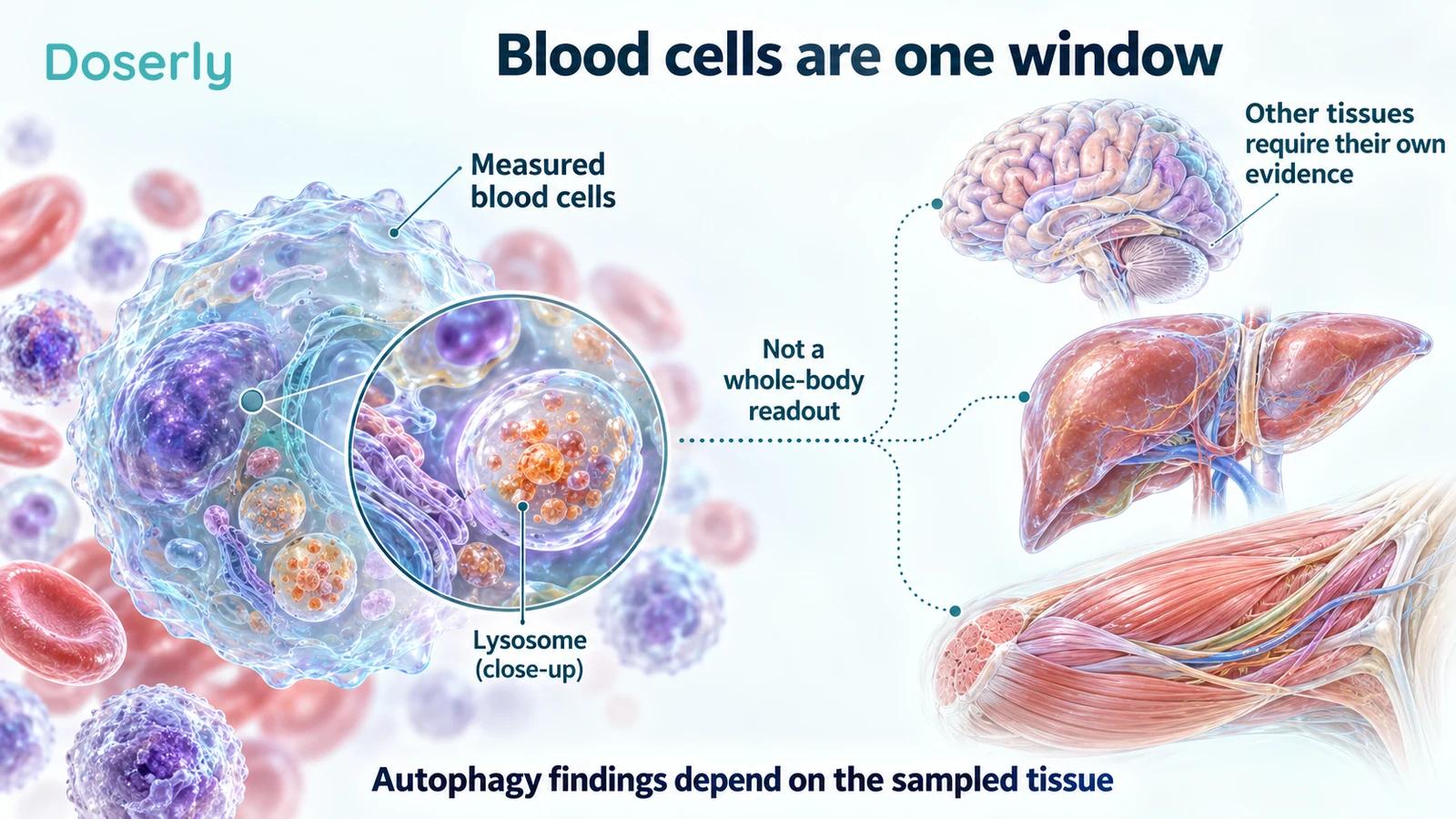
A blood sample is much easier to obtain repeatedly than a biopsy of the brain, liver or muscle. That practical advantage makes circulating cells valuable for human research. It also creates a boundary around what the result can establish.
If an intervention changes flux in sampled immune cells, it demonstrates something about those cells under the assay conditions. It does not demonstrate an identical change throughout every organ. The liver's role in nutrient handling and a neuron's long-term maintenance needs are different. A claim about one should not silently become a claim about the other.
The laboratory method also matters. Researchers may compare samples with and without a substance that blocks lysosomal processing outside the body. The accumulation during that controlled interval helps estimate turnover. That experimental step is part of an assay; it is not a treatment that participants should reproduce.
A 2026 randomized crossover study offers a useful counterpoint to simple nutrient-sensing stories. Seventy-four healthy adults were assigned to lower- and average-protein diets, with sixty-three completing both periods. Four weeks of moderate protein reduction, intended to maintain energy balance, did not significantly increase blood-cell autophagic flux. The confidence interval included both lower and higher flux. Singh and colleagues, Clinical Nutrition
The result does not settle every question about protein or every tissue. It does show why a plausible mechanism from preclinical work needs a direct human test. A dietary change can sound as though it should activate a pathway while failing to produce the expected measurement in the population studied.
Ketones and hunger cannot certify cellular cleanup
A ketone measurement describes a fuel-related state. A glucose reading describes glucose in the measured compartment. Hunger and alertness describe experiences that can be meaningful to the person feeling them. None is a direct measurement of autophagic flux.
This is an important distinction when an app marks a particular fasting hour as “autophagy mode.” The display may be an estimate based on a generalized model rather than a measurement taken from your cells. Its precision can make the claim seem more established than it is.
A meal's composition, prior activity, energy reserves and health status can all affect metabolic responses. Even if a device accurately measures one response, that does not validate an unmeasured downstream claim. A lower glucose value cannot tell you how much damaged material a brain cell has recycled, just as a higher ketone value cannot tell you how many healthy years you have gained.
The practical question is what the measurement is being used for. Monitoring glucose can be clinically useful in an appropriate diabetes-care plan. Using the same reading to award an anti-aging score asks it to do a different job. A meaningful monitoring tool does not become a universal window into every biological pathway because its graph is available in real time.
“Fasting” describes several different interventions
Time-restricted eating limits the hours during which food is consumed. Intermittent energy restriction reduces intake on selected days. Continuous calorie restriction reduces average intake across days. A fasting-mimicking diet provides food formulated to induce selected fasting-related responses. These approaches can overlap, but they are not equivalent exposures.
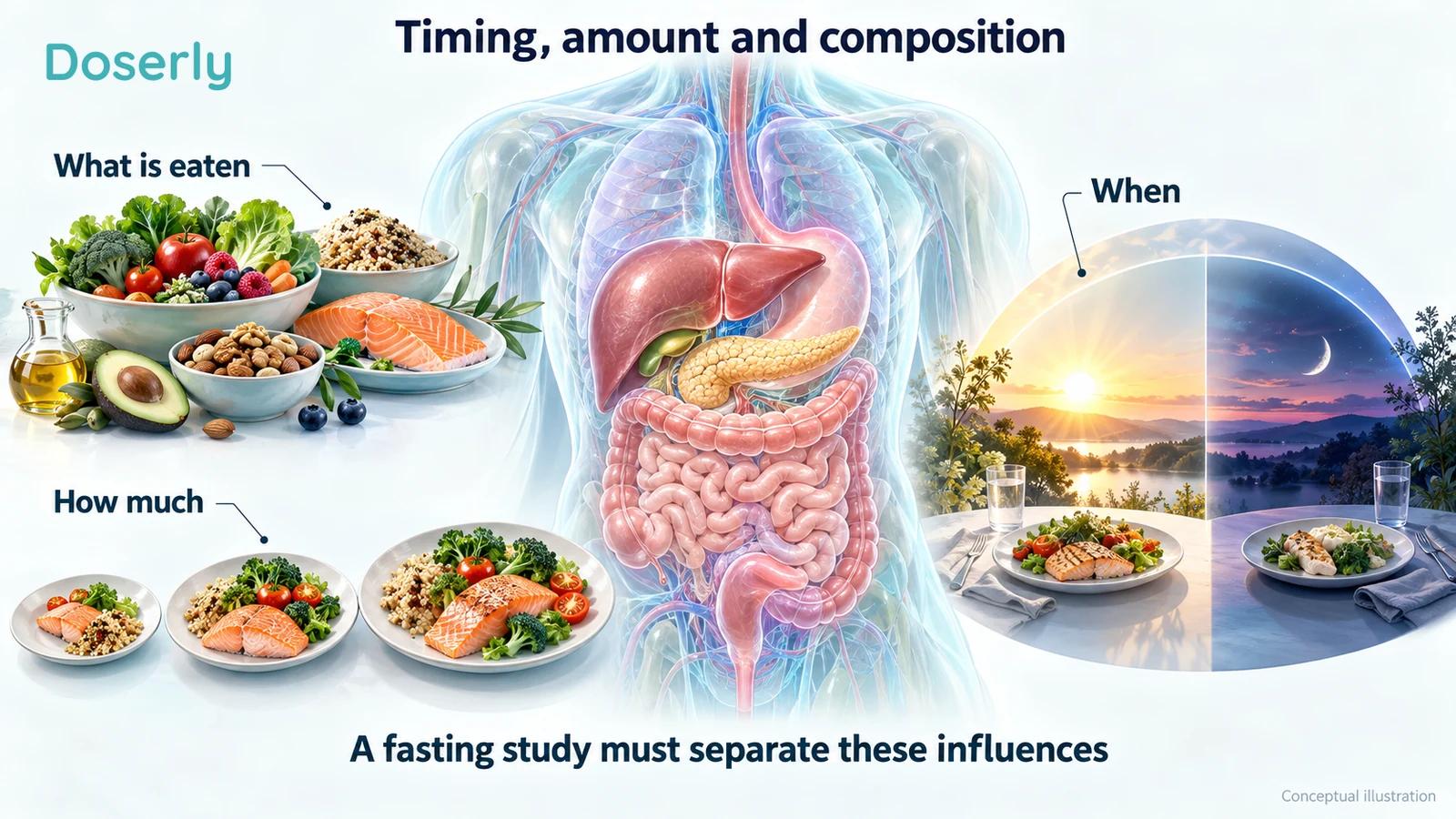
The distinction matters because changing an eating window may also change total energy intake. Someone who stops evening snacking may eat less without counting calories. Another person may eat the same amount within a shorter window. A third may replace meals with a different food pattern. The same label can therefore describe very different nutritional changes.
A trial comparing an eating-window intervention with usual habits tests the whole package. A trial matching energy intake more closely asks whether timing adds something beyond the calorie change. Both questions can be useful, but they should not be mixed when interpreting results.
The National Institute on Aging distinguishes calorie restriction without malnutrition from fasting patterns that may or may not reduce total intake. Adequate nutrients remain part of the research concept, rather than an optional detail. NIA explanation of calorie restriction and fasting
For an individual, the distinction is equally practical. “I stopped eating after dinner” describes a behavior. It does not establish the total nutritional effect of the change. Understanding that effect means considering what the person eats during the remaining hours, how they feel and function, and whether the pattern is sustainable.
What longer weight-loss trials tell us
A 2022 randomized trial assigned 139 adults with obesity to calorie restriction with or without an early daily eating window. At twelve months, average weight loss was about eight kilograms with time restriction and 6.3 kilograms with calorie restriction alone. The between-group difference was not statistically significant, and body-composition and metabolic outcomes did not establish a clear additional benefit from the eating window. Liu and colleagues, New England Journal of Medicine
That finding does not mean nobody can find a time window useful. It means the trial did not show that adding this schedule to calorie restriction produced superior weight loss under those conditions. A behavior can be helpful because someone finds it easier to follow, even if it has no special advantage when intake is otherwise comparable.
In a 2025 trial, 165 adults entered a behavioral weight-loss program comparing a 4:3 intermittent restriction pattern with daily restriction. The intermittent group lost an average of about 2.9 kilograms more at twelve months. Only 125 participants completed the trial, and both groups received substantial behavioral support. This was evidence about weight-management strategies, not about autophagy-mediated longevity. Catenacci and colleagues, Annals of Internal Medicine
The two results are not necessarily contradictory. Different schedules, support, adherence and energy intake can produce different outcomes. A label such as “intermittent fasting” does not make all trials tests of the same treatment.
It is also possible for a strategy to help weight management without being the best choice for a particular person. Work shifts, family meals, exercise, appetite and medical treatment affect whether a plan can be maintained. In everyday care, a modestly effective approach that fits those realities may be more useful than a theoretically appealing schedule that repeatedly fails.
Does time of day have effects beyond calories?
Small controlled experiments suggest that timing can matter metabolically. A 2018 crossover feeding study in eight men with prediabetes found improvements in insulin sensitivity and other measures with early time-restricted feeding while aiming to maintain weight. It was an intensive, short study in a very selected population, not a long-term prevention trial. Sutton and colleagues, Cell Metabolism
A larger 2025 trial compared early, late and participant-selected eating windows with usual care based on Mediterranean-diet education in 197 adults with overweight or obesity. The time-restricted groups lost more weight, but did not show a significant advantage over usual care for the primary outcome, visceral adipose tissue. No one window emerged as a universal solution from that primary comparison. Dote-Montero and colleagues, Nature Medicine
Together, these studies leave room for timing-specific effects while resisting an overly precise rule for everyone. A metabolic response seen under controlled feeding conditions may be difficult to separate from behavior in daily life. An early schedule can also be socially or occupationally difficult, which matters when the goal is a lasting habit.
The scientific question is more interesting than whether breakfast or dinner is morally superior. It is how meal timing interacts with physiology, sleep, activity and total intake in different people. A useful recommendation should account for those interactions rather than treating one clock time as a universal biological deadline.
What animal longevity research can and cannot supply
Animal experiments can follow an entire lifespan and examine tissues in ways that human studies cannot easily reproduce. They are essential for testing mechanisms. They are also a source of particularly large translation errors when their feeding schedules are copied directly into human routines.
A 2024 experiment followed 960 genetically diverse female mice under different dietary-restriction patterns. Diet affected lifespan, but genetic background had a larger influence, and metabolic responses did not neatly explain survival differences. The study also showed that health measures and lifespan do not always move together in a simple way. Di Francesco and colleagues, Nature
The subjects were mice, with different lifespans, feeding biology and experimental living conditions. An interval without food occupies a different physiological context in a mouse than in an adult person. Multiplying or copying the hours does not solve that difference.
The appropriate translation is a research hypothesis: nutrient availability and its timing may influence processes relevant to aging. The inappropriate translation is a human fasting prescription claimed to reproduce the animal lifespan effect. Human clinical trials must establish benefits and harms in the people who would actually use the intervention.
Biological age changes are another intermediate result
Some dietary trials measure methylation clocks or other age-related biomarkers. These tools can help detect physiological responses over a feasible study period. They do not remove the need to study clinical outcomes.
In the CALERIE randomized trial, a post hoc analysis found slower DunedinPACE change with calorie restriction, while PhenoAge and GrimAge did not significantly change. The analysis involved adults without obesity over two years. It did not show that a given amount of restriction added a calculable number of years to life. Waziry and colleagues, Nature Aging
This matters because a fasting claim can pass through several inferential steps without the reader noticing. A diet changes a marker; the marker is associated with aging; the diet is then described as reversing aging. Each step needs its own evidence. A trial can supply a valuable answer at the first step while leaving the final claim unresolved.
For a person considering a dietary change, it is reasonable to give greater weight to established, relevant outcomes than to a new score whose treatment meaning is still being worked out. Better function and appropriately managed risk factors remain meaningful even when an experimental aging marker is unchanged.
Nutritional reserve changes the calculation
An adult trying to reduce excess weight and an older adult struggling to maintain weight do not face the same problem. An eating window that feels convenient for the first may remove important opportunities to eat for the second. Poor appetite, difficulty chewing, illness and limited access to meals can make nutritional adequacy harder before any fasting rule is introduced.
The practical concern is not simply the number on a scale. A person needs enough energy and protein to support activity and recovery. If a dietary pattern is accompanied by declining strength, persistent fatigue, unintended weight loss or difficulty meeting nutritional needs, those are reasons to reassess the plan. They should not be celebrated as evidence that a deeper cleanup process has begun.
Medication use changes the calculation as well. Insulin and some glucose-lowering medicines can cause hypoglycemia when food intake changes. A randomized study in people with type 2 diabetes found more hypoglycemia during fasting despite medication reduction within the trial. Corley and colleagues, Diabetic Medicine
That is why medication and monitoring decisions belong with the treating clinician. The NIDDK specifically discusses the need to plan fasting around diabetes treatment and hydration. This article does not provide medication-adjustment instructions. NIDDK fasting and diabetes guidance
Pregnancy, breastfeeding, an eating-disorder history and frailty are also contexts where a restrictive routine should not be adopted as a general longevity experiment. A favorable result in selected research volunteers cannot be assumed to apply to people whose nutritional needs and risks were different or who were excluded from the study. NIH discussion of fasting precautions
A useful way to judge the next fasting claim
Ask what was actually measured. Weight loss, insulin sensitivity, blood-cell flux and survival are different outcomes. Then ask who participated and what the comparison group did. A supported dietary program compared with usual care does not isolate a single cellular mechanism.
Look at the duration and the practical experience as well. Did participants maintain the pattern? Were nutrition, symptoms and adverse events assessed? Did the main outcome improve, or only a selected secondary measurement? Those details often explain more than the headline.
For personal decisions, start with the problem you are trying to solve. An eating pattern may be a reasonable tool for a defined metabolic goal when it fits medical care and nutritional needs. It does not need an unproven rejuvenation story to have value.
Human autophagy research is becoming more direct and more informative. Its current message is that dietary interventions can be tested for tissue-specific effects, with mixed and preliminary findings. It does not establish a universal hour at which aging reverses, or a reason to push through a routine that leaves you less nourished and less able to live well.