
Supplements
October 16, 2026
Peppermint oil for IBS: why enteric coating matters
On this page
Peppermint oil contains concentrated compounds from the peppermint plant, including menthol. Researchers have studied oral preparations for the abdominal pain and other symptoms of irritable bowel syndrome, or IBS. For someone dealing with recurrent cramps, a familiar plant ingredient can sound like a straightforward option. The details of the capsule make the story less straightforward—and more useful.
Enteric coating changes where the oil is released. It is part of the treatment being studied, not just a convenience. It can help limit release in the stomach, where peppermint oil may cause heartburn. But a sophisticated delivery system does not guarantee symptom relief, and the best human trials have produced mixed findings.
Here is how to understand the coating, the clinical results and the practical questions before choosing a product. Our peppermint oil guide covers the ingredient in more detail.
What IBS treatment is trying to improve
IBS involves recurring abdominal pain associated with changes in bowel habits. Some people mainly have constipation, some diarrhea, and others a mixture. Bloating and a sense of incomplete emptying can also be part of the experience. IBS is understood as a disorder of gut-brain interaction: bowel movement patterns and sensitivity to normal amounts of gas or stool can contribute to symptoms. NIDDK explanation
This makes the goal broader than simply relaxing a muscle. Less pain, more predictable bowel movements and being able to leave home comfortably are related but distinct outcomes. A preparation may affect one symptom without improving all of them.
For example, someone whose main concern is cramping after meals may judge treatment differently from someone whose main problem is infrequent, difficult stools. A study that reports an overall IBS score can combine several experiences into one number. It helps to look at which individual symptoms were measured and which type of IBS participants had.
Peppermint oil is generally considered for symptom relief. The research discussed here does not establish that it removes the cause of IBS, repairs damaged bowel tissue or permanently changes the condition. IBS itself is not synonymous with inflammatory bowel disease, and these trials should not be used as treatment evidence for Crohn's disease or ulcerative colitis.
What enteric coating actually does
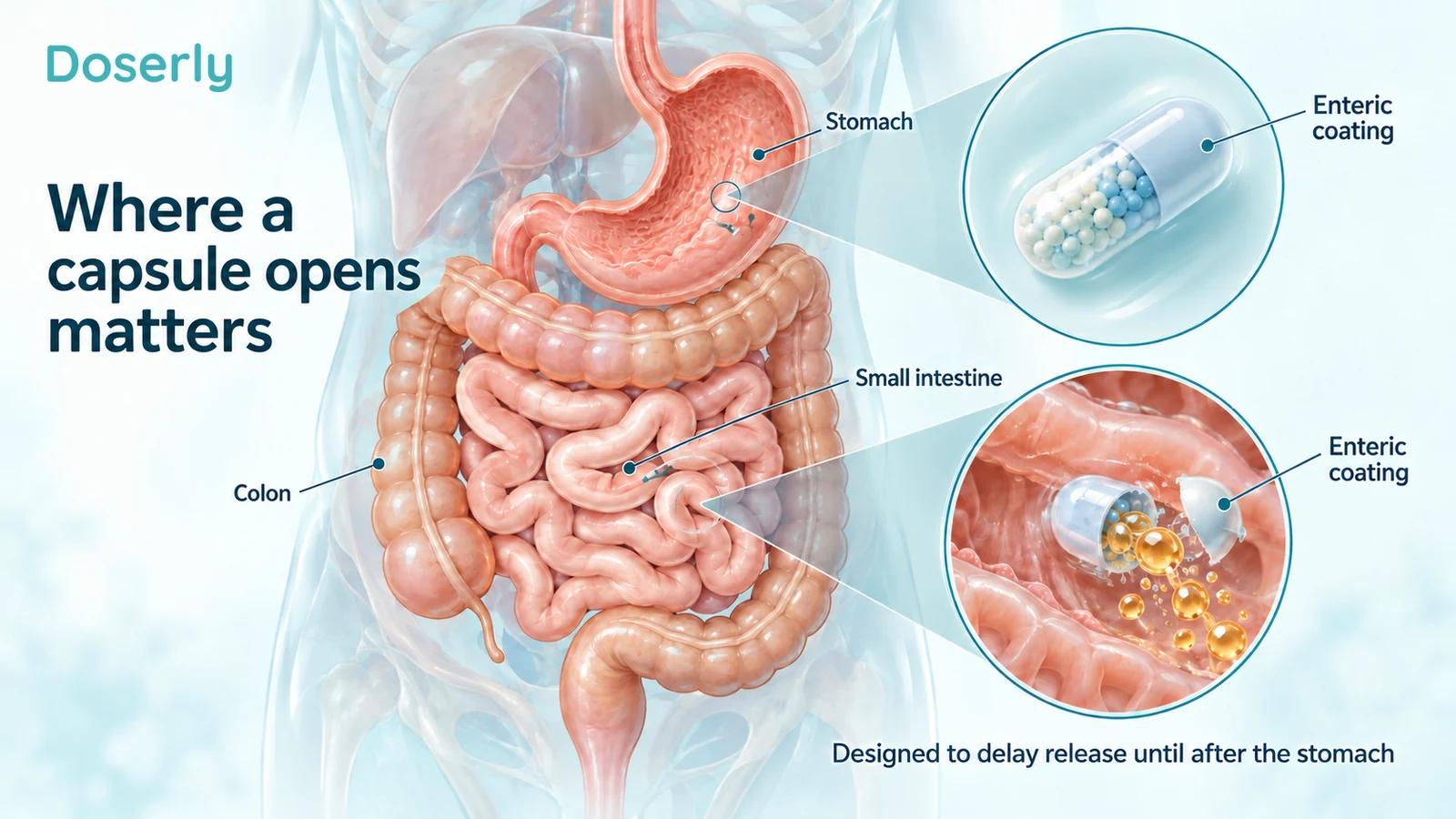
An enteric preparation is designed to resist opening in the stomach and release its contents farther along the digestive tract. The word describes a delivery strategy; it does not identify one universal capsule or a precise release location shared by all products.
That distinction is especially relevant to an essential oil. Peppermint tea is made from leaves, whereas peppermint oil is a concentrated preparation. Oral oil capsules, tea, flavorings and oils intended for other uses are not interchangeable versions of the same tested treatment. NCCIH notes that the IBS evidence largely concerns enteric-coated capsules and that evidence for peppermint leaf is limited. NCCIH peppermint overview
Some research preparations target the small intestine. Others have been designed for release near the end of the small intestine and the beginning of the colon, called ileocolonic release. A later release location may sound more targeted, but whether it helps must be tested in patients. The anatomical destination alone cannot establish a better outcome.
A smaller trial found encouraging symptom improvement
The IBSREST trial compared a formulation designed for sustained small-intestinal release with placebo over four weeks. Seventy-two adults with diarrhea-predominant or mixed IBS were randomized: 35 to peppermint oil and 37 to placebo. The main outcome was change in a total IBS symptom score.
The score fell by 40% from baseline in the peppermint group and 24.3% in the placebo group, with a statistically significant between-group difference. Some symptoms also improved early in treatment. Cash and colleagues
These percentages are changes in symptom scores, not the percentage of people cured. They also show that participants receiving placebo improved substantially. The result supports the particular formulation over four weeks in the types of IBS studied. It does not tell us whether the benefit continues for years or applies equally to constipation-predominant IBS.
For a reader with mixed bowel habits, this is a relevant positive study to discuss. For someone looking for guaranteed control of every symptom, it is much less definitive. A modest-sized trial is useful evidence, but its confidence depends on whether other well-conducted studies find a compatible result.
A larger trial compared two release locations
A Netherlands trial randomized 190 people with IBS, with 189 included in the intention-to-treat analysis. Participants received small-intestinal-release peppermint oil, ileocolonic-release peppermint oil or placebo for eight weeks.
The main abdominal-pain response required at least a 30% reduction in weekly average worst daily pain during at least four weeks. Response occurred in 29 of 62 people with small-intestinal release, 26 of 63 with ileocolonic release and 22 of 64 with placebo—46.8%, 41.3% and 34.4%, respectively. Neither active comparison reached statistical significance. The other main outcome, overall relief, also did not significantly differ. Weerts and colleagues
Small-intestinal release did improve some secondary measurements of pain, discomfort and overall severity. Mild adverse effects were more common in both peppermint groups. That combination of results needs to remain intact: the study missed its main response outcomes while finding some encouraging secondary changes.
The trial does not support the assumption that pushing release farther down the bowel necessarily produces better relief. It also does not show that nobody benefits. Its overall result leaves uncertainty about the size and reliability of the treatment effect under those conditions.
Why the outcome definition changes the answer
Consider two ways of assessing the same symptom diary. One asks how much the average score changed over treatment. Another asks how many people achieved a defined improvement repeatedly across several weeks. A treatment could move the average somewhat without reliably moving many more people across the response threshold.
For a person with fluctuating IBS, that difference is practical. One slightly better week is welcome, but it may not be enough to make travel or work predictable. A response definition requiring improvement across multiple weeks asks a more demanding question than a single end-of-treatment average.
This does not make one outcome meaningless. It means the article or product claim should name the result it is discussing. Describing a positive secondary pain score as if the trial's main response outcome succeeded would give the reader the wrong impression of how consistent the benefit was.
Another placebo-controlled trial found similar improvement in both groups
A 2021 US trial tested enteric-coated peppermint oil against placebo for six weeks in people with moderate to severe IBS. The main outcome was the IBS Severity Scoring System, a questionnaire-based measure.
Both groups improved substantially. The average reductions were about 90.8 points with peppermint oil and 100.3 points with placebo, and the between-group difference was not significant. Secondary outcomes likewise did not show a significant advantage. Nee and colleagues
Improvement in a placebo group is not evidence that participants imagined their symptoms. Symptoms can fluctuate, people often enter trials during a difficult period, and attention and expectations can influence reported experiences. A blinded comparison helps estimate what the active preparation adds beyond those shared influences.
For someone who feels better after starting capsules, the improvement can still be worth discussing. The trial evidence simply prevents us from assigning every improvement to the oil or promising the same experience to everyone else.
Where the overall evidence leaves peppermint oil
NCCIH describes a small body of research suggesting that enteric-coated peppermint oil may improve adult IBS symptoms. It also reports the American College of Gastroenterology's conditional recommendation for overall symptom relief. The evidence includes different formulations, trial durations and symptom definitions, which helps explain why the broad picture can be favorable while particular modern trials are negative. NCCIH overview
The sensible interpretation is that peppermint oil may be an option for some people with IBS, with realistic expectations and attention to tolerability. It is not established as a universally effective treatment or as a permanent solution. The fact that the ingredient is available without prescription does not remove the need to confirm what problem is being treated.
A useful discussion names the actual product and the symptom goal. If your main goal is fewer painful episodes, decide how that would be recognized. If heartburn already limits meals or sleep, that may weigh differently in the decision than it would for someone without upper-digestive symptoms.
Why heartburn remains important even with coating
Oral peppermint oil can cause heartburn, nausea, abdominal discomfort and other adverse effects. Enteric coating is used to reduce the likelihood of heartburn, but it cannot guarantee that it will not occur. NCCIH also notes rare allergic reactions and limited information about medicinal oral use during pregnancy or breastfeeding. Safety information
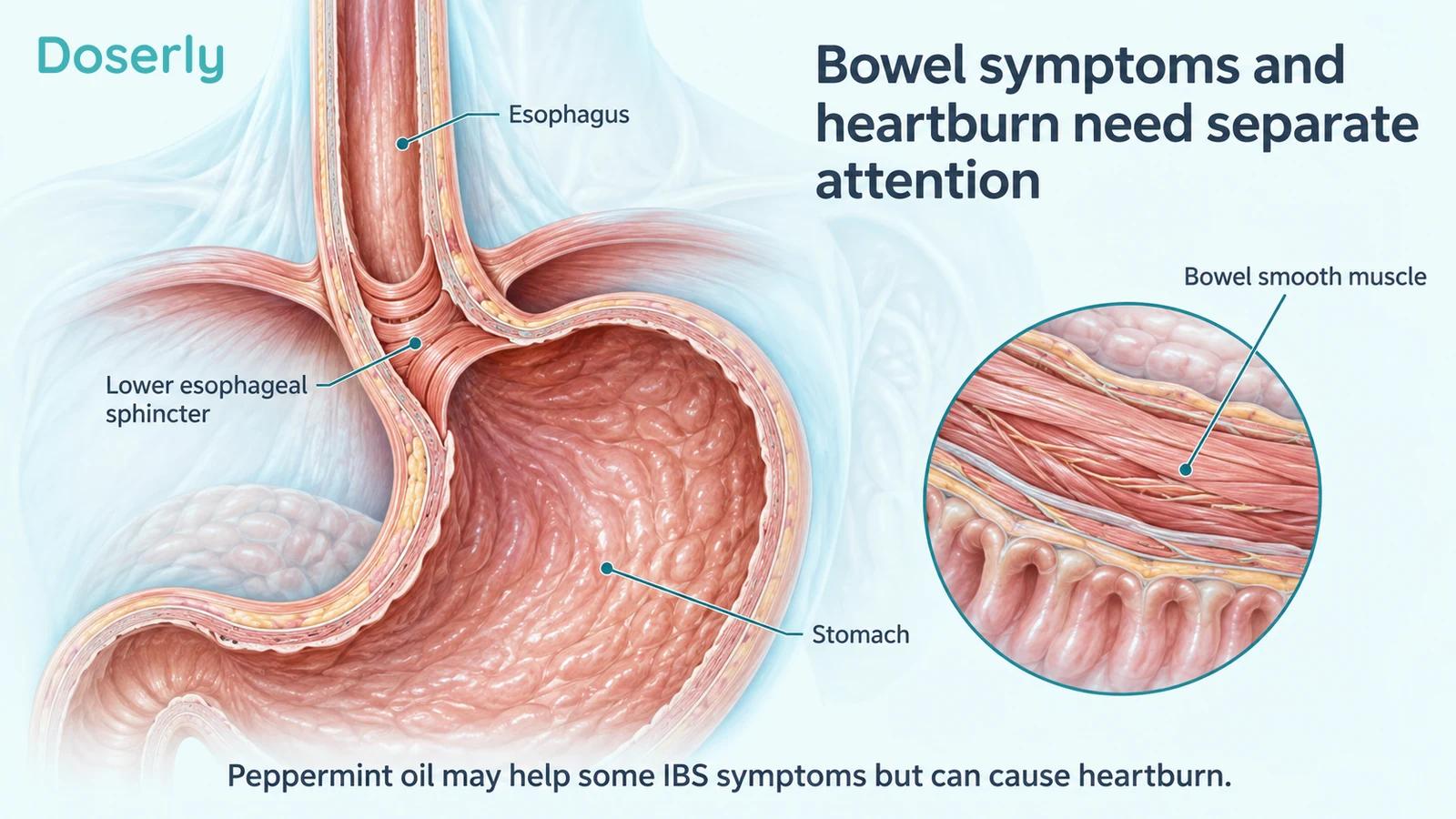
A person may have fewer cramps but worse heartburn. That is not a contradiction: a treatment's value depends on the combined experience. Describe both changes rather than recording only the symptom you originally hoped to improve.
If a new symptom begins after a product change, include the exact preparation and timing when speaking with a clinician or pharmacist. A different coating or additional ingredient may matter even when the name on the front still says peppermint oil.
The capsule instructions are part of using the formulation
The NHS advises swallowing peppermint oil capsules whole rather than breaking or chewing them. This preserves the intended delivery system. It also advises following the product instructions or the prescriber's directions and seeking medical advice if symptoms persist after a short period of self-treatment. NHS administration guidance
Medicines used for indigestion can affect how the preparation works. NHS guidance identifies antacids, proton pump inhibitors and H2 blockers and advises a two-hour separation around peppermint capsules. Product-specific instructions and a pharmacist's assessment remain important, especially when acid-suppressing treatment is prescribed. Do not stop a prescribed medicine to make room for a supplement. NHS interaction guidance
The same logic explains why opening a capsule into a drink or substituting an unformulated oil is not a minor change. It changes the exposure the formulation was designed to create. If swallowing the capsule is difficult, discuss alternatives rather than modifying it on your own.
What to bring to a follow-up conversation
Record the main symptom you are trying to change, bowel patterns, relevant meal timing and any heartburn. Note when the product was started and whether other treatments changed at the same time. Keep the label or a photograph of it so the formulation can be identified.
A useful follow-up asks whether improvement was large enough to matter in daily life and whether adverse effects offset it. It also checks whether the symptoms still fit the original diagnosis. Repeatedly switching products without reviewing the pattern makes it harder to understand what is helping.
Enteric coating deserves attention because release location and tolerability are clinically relevant. The next step is to connect that formulation with an actual patient result, rather than assuming the coating itself proves effectiveness. The Doserly peppermint oil guide can help organize that conversation.
Sources
- NIDDK: IBS symptoms and causes.
- NCCIH: peppermint oil evidence and safety.
- Cash et al., 2016: IBSREST trial.
- Weerts et al., 2020: release-location trial.
- Nee et al., 2021: six-week placebo-controlled trial.
- NHS: how to take peppermint oil.
- NHS: peppermint oil and other medicines.