
Supplements
October 16, 2026
Electrolyte powders: does an ordinary workday need one?
On this page
Electrolytes help your nerves, muscles and fluid balance work normally. They also leave the body in sweat, which explains why drinks containing them can be useful during prolonged exertion or heat. But the need to replace a substantial loss is different from the need to add minerals to every glass of water.
For a healthy adult spending a comfortable day indoors, an electrolyte powder is usually an optional drink, not a demonstrated requirement. The case changes when the day includes hours of sweating, illness with fluid loss or a medical condition with an individualized fluid plan. The product's ingredients and your circumstances matter more than the word “hydration” on the packet.
Our electrolyte powders guide explains common formulations. Here we'll compare everyday drinking with the settings that actually motivate electrolyte replacement, and look at what hydration experiments can tell us.
What electrolytes do
An electrolyte is a mineral that carries an electrical charge when dissolved in body fluid. Sodium, potassium and chloride are examples. These substances help regulate water distribution, nerve and muscle activity, and acid–base balance. They are present in food as well as drinks. MedlinePlus: fluid and electrolyte balance
The body needs an appropriate balance, rather than the largest possible intake. A supplement containing necessary minerals can still be unnecessary for a particular person on a particular day. The same reasoning applies to the amount: a product with more sodium isn't automatically more effective for someone who hasn't lost much sodium.
Sweat is relevant because cooling involves moving water to the skin surface, where evaporation releases heat. Water and salts leave together. The amount depends on the work, environment and individual, which is why a cool office and a long outdoor shift should not share a universal replacement rule. NIOSH: keeping workers hydrated and cool
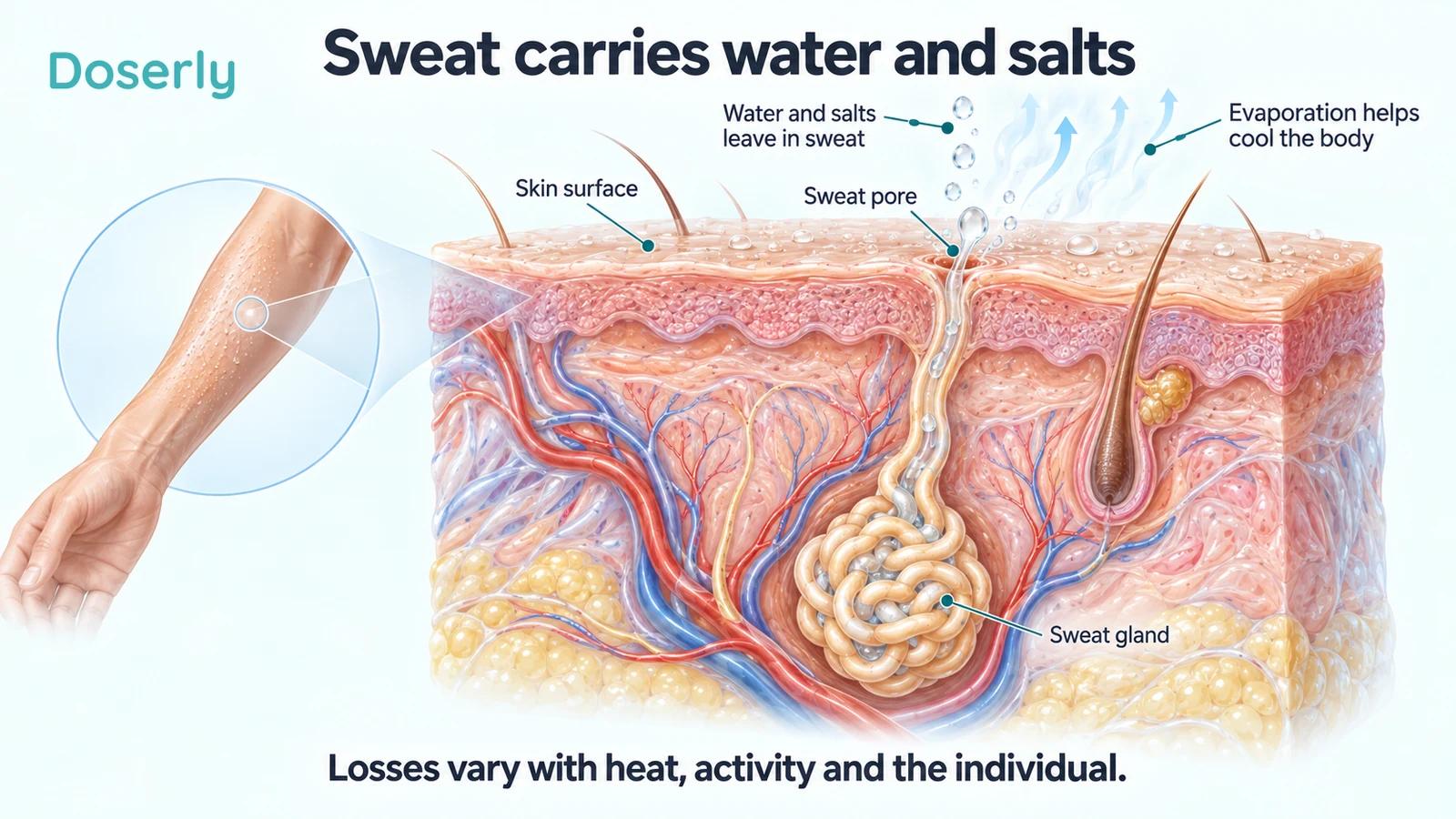
What makes an ordinary day different?
Imagine a day with a short commute, desk work, normal meals and a brief walk. There may be no prolonged sweating or other unusual fluid loss to replace. An electrolyte packet can add flavor, but the exercise literature doesn't establish that adding it improves concentration, energy or health in this situation.
That doesn't mean everyone must drink only plain water. Preference matters if it helps someone drink comfortably. It does mean that enjoying a beverage and needing its mineral load are separate explanations. A person who likes the taste need not invent a deficiency to justify it, and someone who prefers water need not assume they're missing a special absorption technology.
Food also belongs in this assessment. FDA notes that sodium is already common in packaged and prepared foods, and that most Americans consume more than recommended. Repeated high-sodium drinks can therefore add to an existing intake rather than replace a deficit. FDA: sodium in your diet
The useful question is: what loss or practical problem is the powder addressing today? If the answer is simply “I want a flavored drink,” compare it on taste, ingredients and cost. If the answer is “I sweat for several hours at work,” a replacement plan deserves more attention.
What exercise guidance actually says
The American College of Sports Medicine's 2007 position stand concerns people performing physical activity. It emphasizes starting appropriately hydrated and tailoring replacement because sweat rates and sweat electrolyte concentrations vary. It describes circumstances in which carbohydrate and electrolyte drinks can offer advantages over water alone. ACSM position stand
This is professional guidance, not a trial demonstrating that everyone needs a daily packet. Its recommendations are tied to exercise duration, losses and opportunities to drink. Applying an endurance strategy to a sedentary day removes the very circumstances that made the strategy relevant.
If you're preparing for a long event, questions become practical: how hot will it be, how long will you be active, can you carry drinks, and will you eat? Sports nutrition advice may also consider carbohydrate for fuel. The presence of carbohydrate in that context has a purpose beyond simply making water taste sweet.
For ordinary recreation, don't assume a wet shirt alone establishes a large mineral deficit. For demanding training, don't assume that a product's standard serving is a personalized replacement calculation. The exercise guidance supports considering the person and activity rather than treating the packet as a universal unit of need.
A hot workday needs a plan beyond a drink
Occupational heat exposure can be prolonged and may involve protective clothing, restricted breaks and limited access to water. Current NIOSH recommendations call for access to cool drinking water, work–rest adjustments and acclimatization. They distinguish shorter moderate activity in heat from prolonged sweating lasting several hours, when drinks with balanced electrolytes may be appropriate. NIOSH workplace recommendations
This doesn't mean a powder makes an unsafe shift safe. The work environment still needs attention. A worker who can't stop to drink or cool down has a problem that changing brands cannot solve.
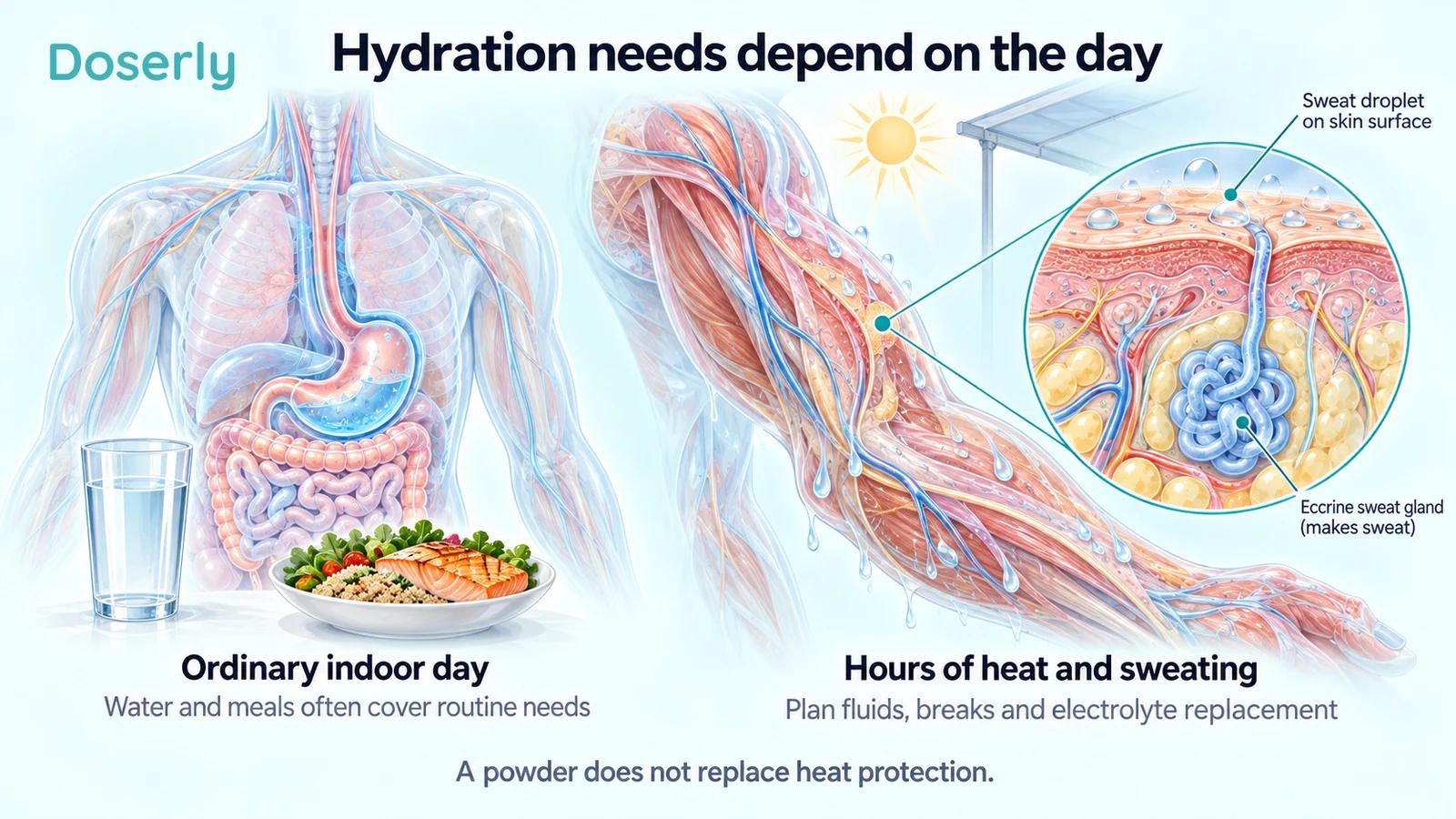
It also explains why apparently conflicting advice may address different settings. Sports guidance may emphasize thirst and avoiding overdrinking, while workplace programs schedule access to drinks because workers can become absorbed in tasks or have limited opportunities. An individualized plan can account for both inadequate intake and excessive intake. A headline about “the right amount” should identify whose activity and environment it is describing.
Does a drink that stays in the body longer improve health?
A frequently cited experiment developed a beverage hydration index by comparing urine output after different drinks. In the 2016 study, 72 healthy, adequately hydrated men participated in testing across 13 beverages. On study visits, participants drank one litre over 30 minutes, and researchers collected urine for four hours.
An oral rehydration solution and milk produced less urine over four hours than water. The tested sports drink did not differ significantly from water in cumulative four-hour urine output. Maughan and colleagues, 2016
That is a useful physiological experiment, but its endpoint was short-term fluid retention. It didn't test office productivity, prevention of headaches, long-term health or every electrolyte powder now available. The volunteers also began hydrated, rather than recovering from diarrheal dehydration.
Retaining more of a fixed drink over a few hours can be useful when access to fluid is restricted. It doesn't follow that a healthy person with easy access to water should always seek the highest possible retention. The kidneys normally adjust water excretion; producing urine after a drink isn't evidence that the water “didn't work.”
The study also can't establish that one ingredient explains the whole result. Drinks differ in energy, protein, carbohydrate and minerals. A marketing claim that a powder is better “because of electrolytes” needs evidence for that formulation and outcome, not just a ranking from a different beverage.
More fluid can also cause harm
Exercise-associated hyponatremia means an abnormally low blood sodium concentration during or after exercise. Excess drinking relative to losses is a major cause. Importantly, drinking a sports beverage does not make unlimited fluid intake safe: these drinks can still deliver more water than the body can excrete. The international consensus statement addresses avoiding overdrinking and the role of thirst in prevention. 2015 hyponatremia consensus
This is why “drink as much as possible” is poor advice, even when a drink contains sodium. Blood sodium concentration reflects the relationship between water and sodium, not simply whether some salt entered the stomach.
Symptoms during heat or exercise also deserve care. Confusion, collapse or altered mental status can signal an emergency. Don't assume a person merely needs another packet or more water. CDC identifies heat stroke as a medical emergency requiring immediate help and cooling. CDC: heat-related illnesses
These are reasons to plan sensible access and replacement, not reasons to fear normal drinking. The important distinction is between responding to ordinary needs and forcing large volumes to meet an arbitrary target.
Read the label as an amount, not a promise
Start with the serving size and the preparation instructions. One scoop, one sachet and one prepared bottle may represent different quantities. Check the sodium and potassium amounts per serving, then consider how many servings you actually use.
As a hypothetical label example, a packet containing 500 mg sodium would supply 1,000 mg if you use two packets. That arithmetic is not a suggested target. It illustrates why a modest-looking single serving can become a substantial daily addition.
Look separately at carbohydrate, caffeine and other added ingredients. If a product includes several active ingredients, feeling more alert afterward does not identify minerals as the cause. If you use it during exercise, distinguish fluid replacement from fueling. If you use it during a quiet workday, decide whether those additional ingredients serve your purpose.
Compare like with like. “More minerals” doesn't explain whether the proportions fit the intended use, and a large list of trace ingredients doesn't necessarily improve the drink's relevance. Keep the product's actual job in view: flavor, sport fueling, prolonged sweat replacement or a clinician-directed purpose.
When kidney function and medicines change the answer
Potassium helps normal function, but extra potassium can be hazardous when the kidneys cannot excrete it adequately. NIH identifies chronic kidney disease and medicines such as ACE inhibitors or potassium-sparing diuretics as circumstances in which blood potassium can become too high. NIH potassium fact sheet
If you have a prescribed fluid, sodium or potassium restriction, a general hydration article cannot replace that plan. Bring the exact label to your clinician or pharmacist. A low-sodium product may still contain potassium that matters to your care, and a product promoted for “balance” may conflict with individualized instructions.
The same principle applies to anyone receiving extra salt or fluid as part of treatment for a diagnosed condition. That medical purpose should remain visible. Advice intended for a particular patient group should not become a general recommendation for everyone with afternoon fatigue.
Illness-related dehydration is a different use case
Oral rehydration solution, or ORS, is designed to replace fluid and electrolytes lost through diarrhea using a defined balance of glucose and salts. WHO distinguishes rehydration treatment from ordinary drinking and notes that severe dehydration or shock may require intravenous fluids. WHO: diarrhoeal disease
A sports or wellness powder should not be assumed to be equivalent because both labels mention electrolytes. The relevant formula, concentration and intended use differ. Our oral rehydration salts guide explains this specific tool.
For a routine workday, the decision can stay simple. Notice whether there is prolonged sweating or another clear loss, consider your meals and medical instructions, and read the actual serving amounts. Use a powder if it meets a practical need you understand. Its presence in the glass is not, by itself, evidence of better hydration.
Sources
- MedlinePlus: fluid and electrolyte balance.
- NIOSH: keeping workers hydrated and cool, 2011.
- ACSM: exercise and fluid replacement, 2007.
- NIOSH workplace heat recommendations.
- Maughan et al.: beverage hydration index trial, 2016.
- International exercise-associated hyponatremia consensus, 2015.
- FDA: sodium in your diet.
- NIH: potassium.
- CDC: heat-related illnesses.
- WHO: diarrhoeal disease.