
Longevity
October 17, 2026
What dog longevity trials could teach us about healthier aging
On this page
A dog growing older beside its family offers a different view of aging from a mouse living in a laboratory. The dog shares a home, a neighborhood and many environmental exposures with people. Its daily life includes meals, movement, relationships, illnesses and veterinary care. Those similarities make companion dogs valuable research participants, while also making their lives more complicated to study.
Dog longevity research is now testing a question that matters to owners and geroscientists alike: can an intervention preserve good function and extend life, rather than merely change an aging-related blood test? The Dog Aging Project's TRIAD trial is investigating rapamycin. Separate commercial programs, including Loyal's LOY candidates, are pursuing other approaches. Their methods, regulatory milestones and results should not be mixed together.
As of the October 16, 2026 evidence check for this article, the large TRIAD survival result has not been established in the primary sources reviewed. Loyal's current materials also describe ongoing development rather than an already demonstrated lifespan extension from its large efficacy trial. The interesting story is the quality of the questions being tested, not a completed discovery that a pill reliably gives every dog more healthy years.
Why dogs can fill a gap between laboratory studies and human trials
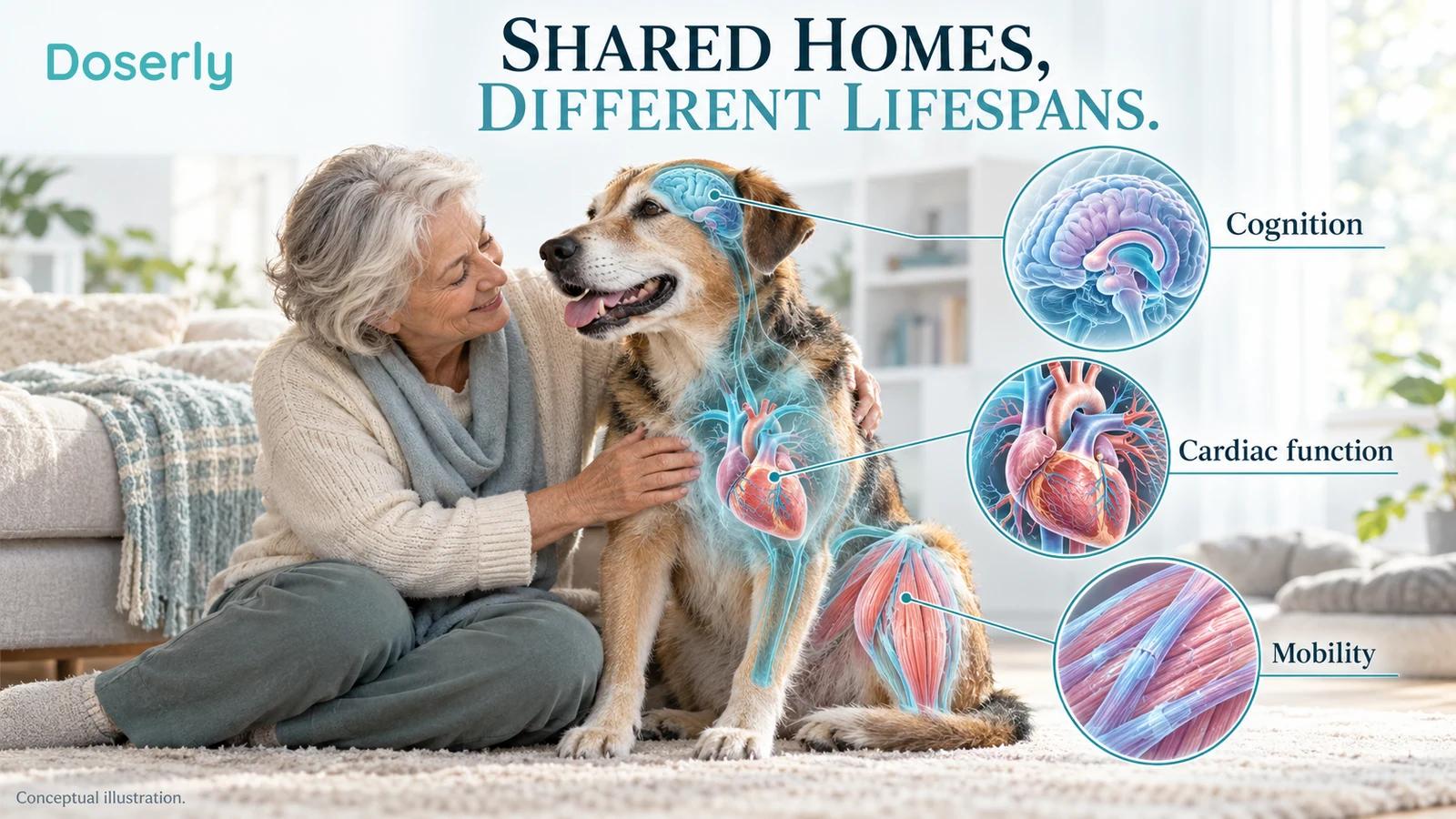
Laboratory animals allow tight control of genetics, diet and exposure. That control helps identify biological effects. Human studies must then contend with people who differ widely in health, habits, medications and living circumstances. Companion dogs occupy an informative middle ground: they are mammals living in varied real-world environments, but their shorter lives allow some outcomes to be studied on a more compressed timeline.
The Dog Aging Project's environmental research framework incorporates the physical and built environment, chemical exposures, diet and exercise, and social surroundings. These are not simply background details. They may influence health directly, interact with biological susceptibility or affect how consistently an intervention can be delivered.
A dog that develops joint pain may become less active. Reduced activity can change body composition and the owner's perception of energy. A new medication, a move to a different home or a change in caregiving may alter daily routines. Tracking those events helps researchers distinguish a potential drug effect from other changes occurring at the same time.
Dogs also develop naturally occurring diseases of later life. Studying those conditions can complement models in which a disease is produced experimentally. Natural disease is more variable, however, and the causes of death or disability are not identical to those in people. A successful dog trial would strengthen a treatment hypothesis; it would not replace a human trial.
The benefit to dogs is important in its own right. Companion-animal research does not need to be justified only as a shortcut to human longevity. Better mobility, less disease and more comfortable time with a family would be meaningful veterinary outcomes even if the treatment never became useful in people.
There is no single conversion from dog years to human years
The familiar idea that one dog year equals seven human years is too crude for research. Dogs differ dramatically in adult size, breed-associated disease risks and typical lifespan. They also mature quickly early in life, so aging cannot be represented by a constant multiplication across the whole lifespan.
A 2024 study of 584,734 UK dogs examined variation in longevity across breed, body size, sex and head shape. Its findings illustrate why a study needs to specify which dogs it enrolled. They do not provide an exact forecast for an individual pet, and the underlying records reflect a particular population and data-collection system.
Size is especially relevant when interpreting longevity-drug programs. Large dogs often have shorter average lives than small dogs, but an association between size and lifespan does not prove that changing one growth-related hormone in adulthood will extend life. That proposed intervention needs its own controlled test.
The same issue appears when comparing a trial restricted to middle-aged, generally healthy larger dogs with one enrolling a broader group of seniors. Their participants start with different risks and may have different opportunities to benefit. A drug that affects one common cause of illness could appear more helpful in one group simply because that condition is more prevalent there.
For owners, the practical lesson is to think in terms of the dog's condition and trajectory rather than an exact human-equivalent age. Changes in walking, sleep, appetite, interaction and recovery from illness are more informative than a conversion calculator alone.
What the Dog Aging Project collects, and what TRIAD adds
The wider Dog Aging Project is a longitudinal research effort. Owners contribute information about health and daily life, and parts of the project collect biological samples and more detailed assessments. Its current data documentation describes annual curated releases and a Health and Life Experience Survey with more than 200 questions. This creates opportunities to study patterns across many dogs.
Observational patterns can reveal useful associations. They do not automatically show that changing a behavior will cause the associated benefit. Owners may change feeding or activity because their dog is already ill, and some important differences may never be fully captured in a questionnaire.
TRIAD, the Test of Rapamycin in Aging Dogs, adds random assignment to an intervention or placebo. Its 2025 design paper describes a planned 580-dog, double-masked, multicenter trial with a one-year treatment period and three years of observation per dog. The primary outcome is survival time from randomization; healthspan and functional outcomes are also assessed. These are planned tests, not reported benefits.
The project’s September 2026 eligibility information describes dogs at least seven years old, within a specified larger-dog weight range, without major conditions or medications that make participation unsuitable. Owners must be able to attend repeated visits, maintain usual veterinary care and keep observations. These requirements help protect participants and define the population to which eventual results may apply.
A design paper is valuable because it makes the intended comparison visible before the answer is known. Readers can later ask whether the published result addresses the original primary outcome, includes all randomized dogs appropriately and reports harms as fully as benefits.
Why rapamycin is being investigated
Rapamycin influences mTOR signaling, a system involved in coordinating cellular responses to nutrients and growth signals. Interest in aging research grew from experiments in laboratory organisms. But a pathway that affects lifespan in one setting also has roles in ordinary tissue maintenance and immune function. The goal is to find a useful balance, not to suppress a pathway as much as possible.
In dogs, the early clinical work focused on tolerability and organ function before attempting a large survival study. A 2017 randomized trial in 24 middle-aged companion dogs examined a short treatment period and reported encouraging changes in some cardiac measurements. It was not designed to show longer life, and a finding on an ultrasound measure is not the same as fewer episodes of heart failure.
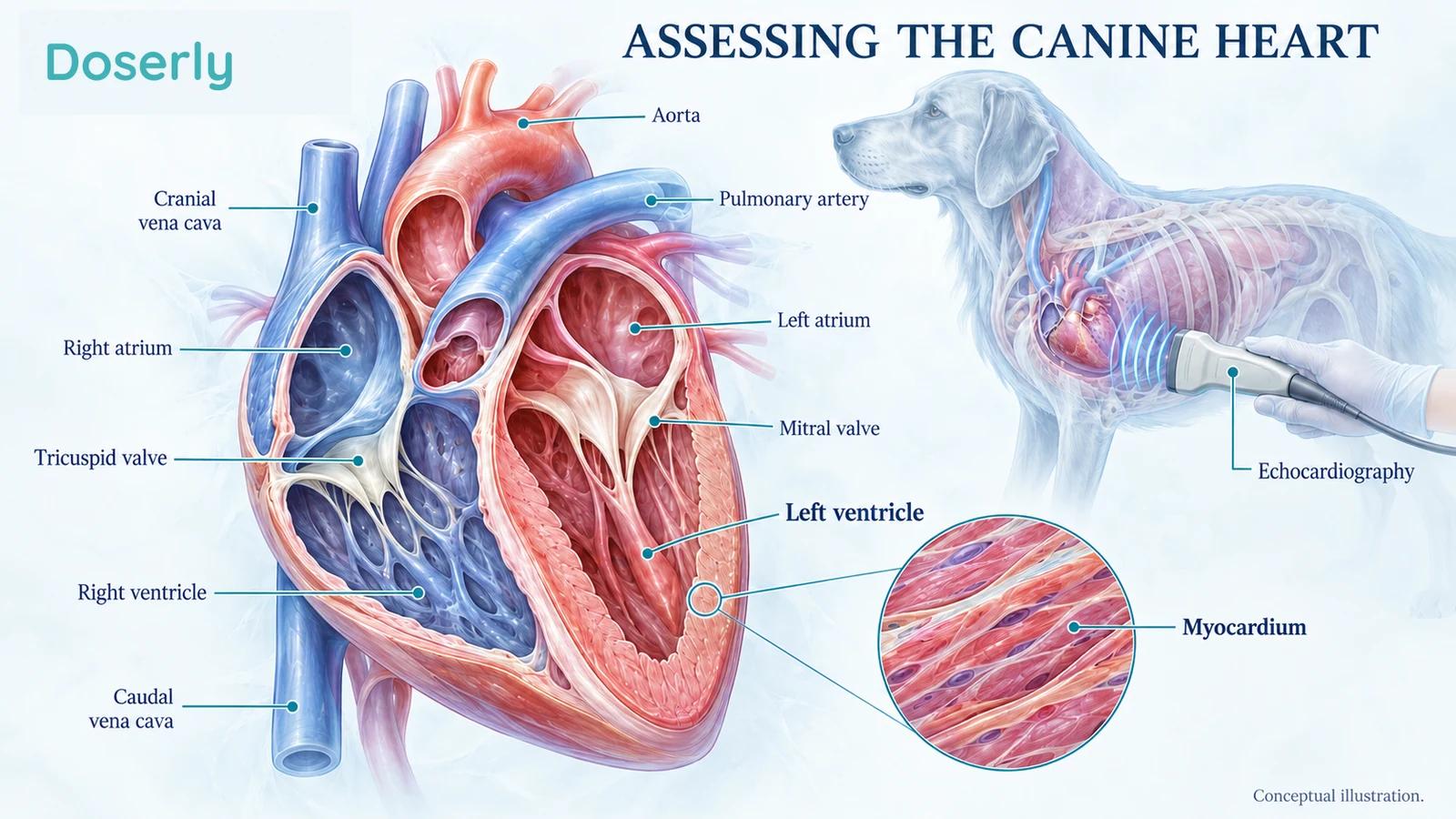
A 2023 masked randomized trial followed 17 healthy client-owned dogs after six months of rapamycin or placebo. It found no statistically significant between-group differences in the assessed echocardiographic measurements at six or twelve months. No clinically significant adverse events were reported. Owners in the rapamycin group more often reported perceived positive changes, but that exploratory observation did not establish a survival benefit.
These studies are not necessarily contradictory. They were small, differed in exposure and follow-up, and measured several aspects of cardiac function. A genuinely useful effect could be missed in a small study; an encouraging early result could also be larger than the effect seen later. The larger trial is intended to move beyond that uncertainty.
The absence of major problems in a small, selected group is reassuring only within its limits. It cannot tell us how an intervention will interact with every illness or medicine an older dog may encounter. Nor does the word “low-dose” establish safety without specifying the product, population and monitoring involved.
Healthspan has to be more than a reassuring label
Lifespan is the duration of life. Healthspan concerns the quality and function within that time. They overlap, but an intervention could affect one more than the other. Owners understandably want additional time that a dog can enjoy, not simply a later date on a record.
Useful outcomes include the ability to walk comfortably, maintain ordinary activity, interact with family and cope with daily routines. A trial may also examine diagnoses, sensory changes, cognition and the need for treatment. No single measure captures all of these dimensions, so researchers must explain how they define improvement.
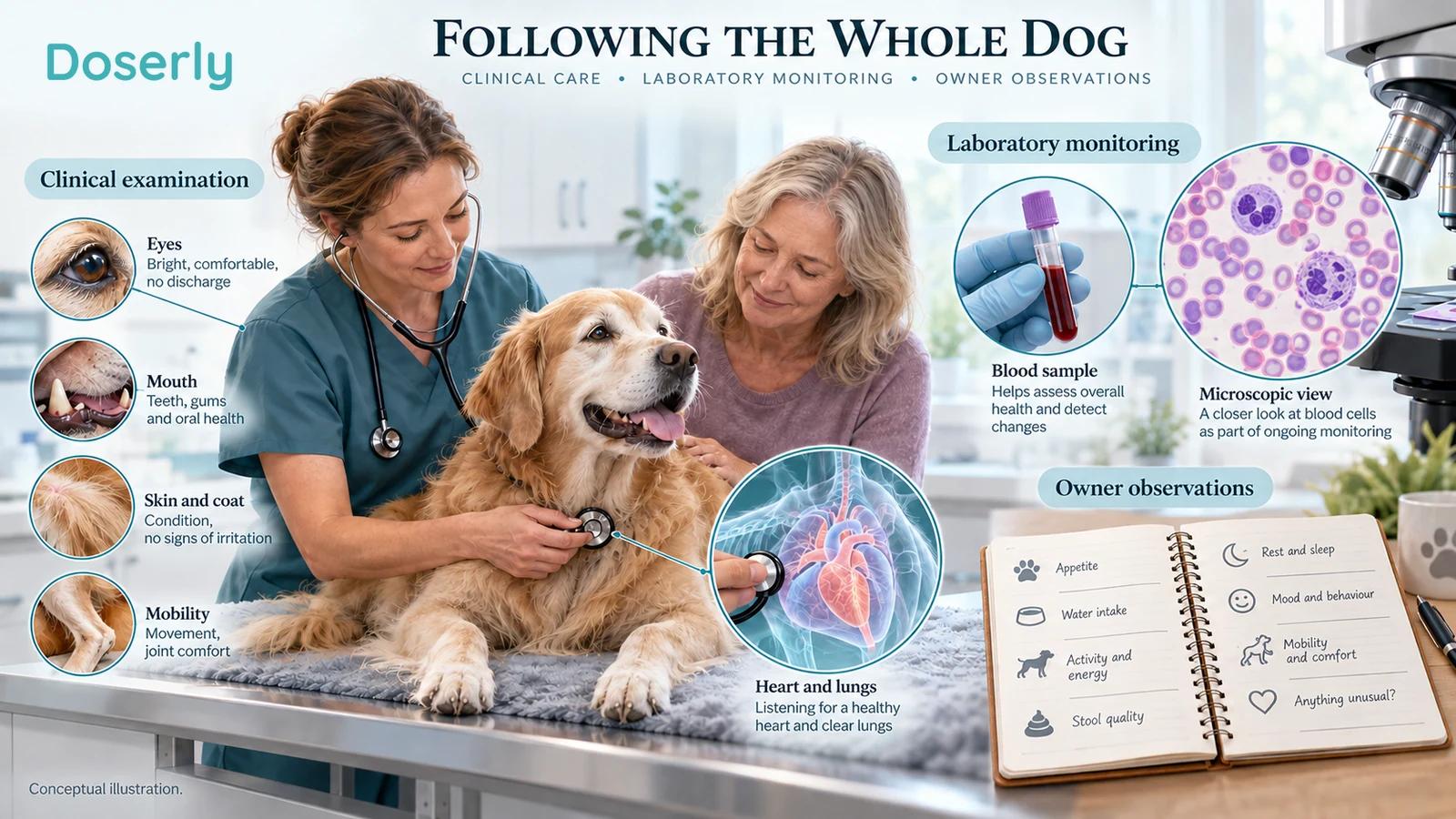
A dog may walk less because of pain, weakness, heart disease, impaired vision or a change in weather. A simple activity count cannot distinguish those causes. Clinical examinations and owner observations complement one another: the owner sees the daily pattern, while the veterinary team can investigate what might explain it.
The Dog Aging Project's work on cognitive testing developed short tasks addressing abilities such as spatial memory, executive function and social cognition. Such tools can help researchers examine function rather than relying only on a general impression that a dog seems younger. They still require attention to motivation, sensory ability and consistent administration.
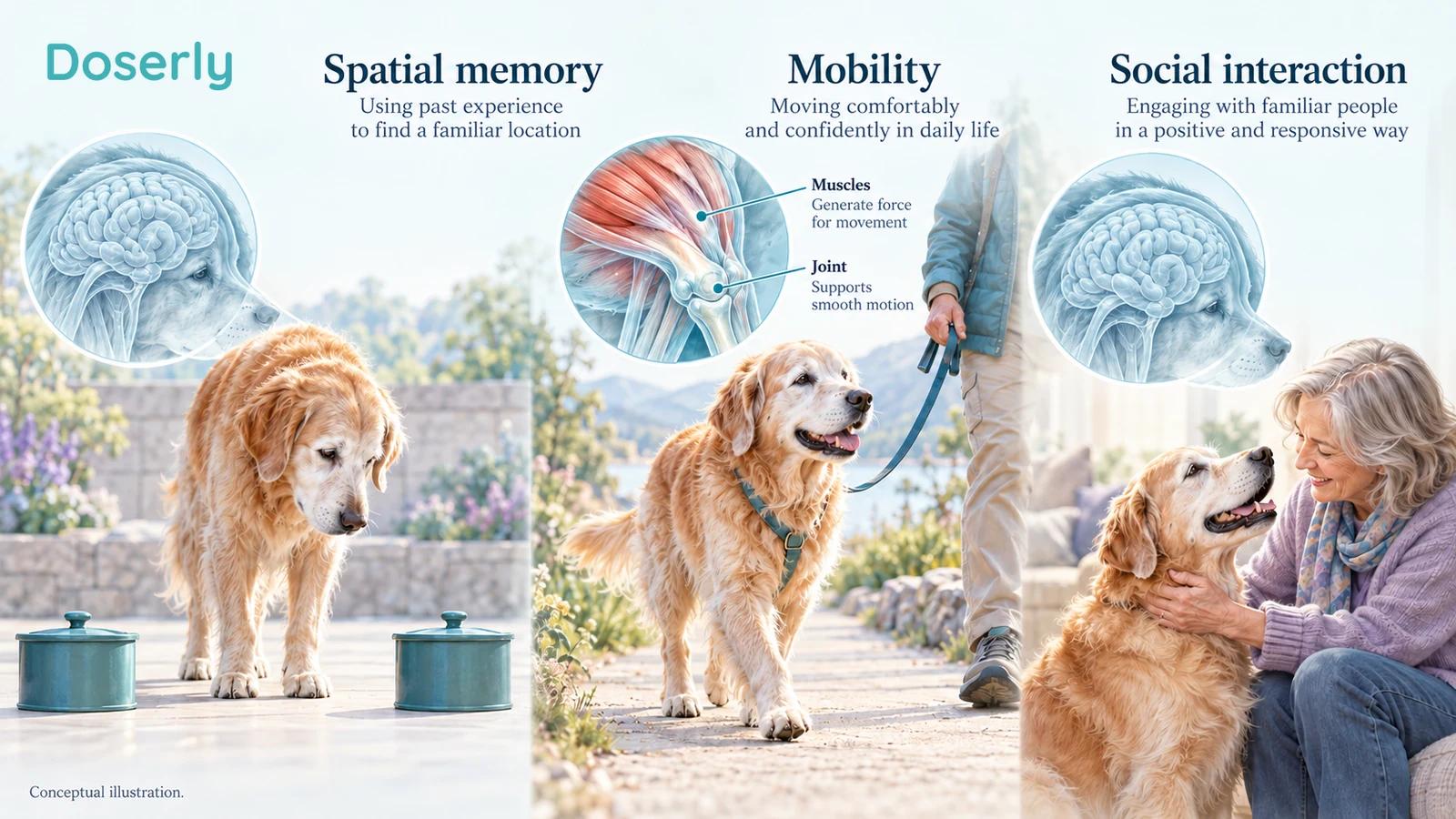
An older dog that fails to approach a remembered reward may have forgotten its location, but it may also have difficulty seeing, hearing or moving comfortably. Separating those possibilities is part of good measurement. It is also why an owner should not interpret an isolated home task as a diagnosis of dementia.
What owners notice matters, even when it is hard to quantify
Owners often detect subtle changes before a clinic visit. A dog may hesitate at a step, stop greeting people at the door or begin waking at unusual times. Those observations are useful because they occur in the animal's familiar setting. They become more informative when recorded consistently rather than reconstructed from memory after a striking event.
Blinding helps protect that information from expectation. If an owner knows the dog received a promising drug, normal variation can look like improvement. If the owner knows the dog received placebo, the same variation may be interpreted less favorably. Keeping treatment assignment concealed cannot remove every bias, but it reduces one important influence.
A useful diary describes the behavior itself: how often a dog stopped on a familiar route, whether it needed assistance, or when a new symptom began. “More youthful” is much harder to compare across owners. The point is not to make family life into a laboratory. It is to give the veterinary team a clearer picture of what changed.
Treatment burden belongs in that picture too. Repeated visits, testing, travel and administering medication can be stressful or difficult. An intervention's practical value depends on whether its benefits justify those demands for the dog and its caregiver, not only on whether a laboratory measurement moves in the desired direction.
Survival research must respect end-of-life care
In companion dogs, the time of death can involve a decision to euthanize when suffering or loss of function becomes unacceptable. That decision is part of responsible care, and it cannot be treated as a technical inconvenience to be postponed for a trial endpoint.
Research therefore needs to document the circumstances around death, including disease and function beforehand. Blinding can help reduce the risk that treatment expectations influence interpretation, but owners and veterinarians still need to make decisions in the animal's interests. A research program should explain those arrangements clearly during consent.
The TRIAD protocol includes end-of-life information and records deaths whether they occur naturally or by euthanasia. That matters when interpreting a survival difference: the result should be considered alongside health and quality-of-life information, not detached from it. A later death would be less persuasive as a healthspan benefit if the added time involved more distress or disability.
There is also a statistical issue that applies beyond dogs. If follow-up ends while many participants are alive, researchers must analyze time-to-event data appropriately rather than compare only those who have died. Losing contact with families can also distort the picture if their dogs differ systematically from those who remain in the study.
Loyal's programs are separate from TRIAD
Loyal is a veterinary biotechnology company developing several investigational products. They are not simply different names for rapamycin. According to its veterinary program description, LOY-002 targets age-associated metabolic dysfunction in senior dogs, while LOY-001 and LOY-003 focus on growth-related biology in large and giant dogs. Those descriptions state the company's therapeutic hypotheses.
The company's STAY study page describes a double-blinded, placebo-controlled study with more than 1,300 dogs across about 70 veterinary practices, now fully enrolled. It is intended to evaluate lifespan, health and quality of life for LOY-002. An enrollment milestone demonstrates that a study is underway; it does not reveal its eventual treatment effect.
In January 2026, Loyal announced acceptance of the Target Animal Safety section of its application for expanded conditional approval of LOY-002. The company had previously reported acceptance of a reasonable-expectation-of-effectiveness package. Its current veterinarian page still marks manufacturing review, conditional approval and market availability as in progress. These are sponsor-reported development milestones, not evidence that full approval has already been granted.
A September 2026 announcement for LOY-003 described another reasonable-expectation-of-effectiveness milestone. It concerned a different product. Moving a result or regulatory step from one LOY candidate to another would give readers the wrong impression of what has been established.
Conditional approval is a specific regulatory category
The FDA explains that conditional approval permits eligible animal drugs to be marketed for their labeled use while the sponsor gathers the remaining evidence needed for full effectiveness approval. Safety and manufacturing requirements still apply. The distinction concerns the effectiveness standard: reasonable expectation for conditional approval versus substantial evidence for full approval.
Acceptance of one technical section is not itself conditional approval. Conditional approval is also not full approval. This vocabulary matters because a headline about an FDA milestone can otherwise sound like a completed demonstration that a drug extends life.
For an owner considering a product in the future, the relevant information will be its actual approval status, labeled population, known benefits and harms, and the quality of the supporting trial. A general claim that a regulator has recognized longevity as a worthwhile research target does not answer those product-specific questions.
The same distinction applies when translating veterinary news to people. An animal-drug regulatory pathway does not authorize human use. Even a fully successful veterinary program would leave human dosing, safety, efficacy and appropriate patient selection to be investigated separately.
A future result will also need to be read in absolute terms. A relative reduction in the risk of death during a study is not the same as adding that percentage to every dog's total lifespan. The number of events, duration of follow-up and uncertainty around the estimate will determine what the result means in practice. If the benefit occurs mainly in a particular subgroup, that finding needs confirmation rather than an assumption that it applies to all breeds and sizes.
Families will also need to know how often treatment had to be stopped and whether ordinary veterinary care became more complicated. A trial can answer those questions only when discontinuations and new illnesses remain part of the report. Following the entire randomized group is more informative than describing only dogs that tolerated treatment and completed every visit.
What dog studies can teach us before a longevity drug succeeds
Not all useful findings will involve a medicine. The Dog Aging Project has reported associations between physical activity and cognitive health, but the investigators explicitly note that less activity could be a consequence of cognitive impairment or related illness. That is a valuable question to pursue, not proof that a particular exercise prescription prevents canine dementia.
There is older experimental evidence that everyday care can influence canine lifespan. A paired feeding study in 48 Labrador retrievers found longer median survival and delayed signs of chronic disease in the more restricted feeding group. It began in puppyhood in a controlled setting and involved one breed. It is not an instruction to cut an older pet's current food by a fixed percentage, particularly when illness or muscle loss is present.
Together, these studies encourage attention to body condition, mobility and disease management while more ambitious therapies are tested. Those observations are best discussed with the dog's veterinarian, who can distinguish ordinary variation from pain, nutritional problems or a condition needing treatment.
Dog trials may also improve how human aging studies are designed. They can test whether functional assessments remain practical over years, how home observations complement clinic measurements, and whether a biological signal predicts a benefit people can recognize. A negative result can be useful if it prevents a weak hypothesis from consuming larger human trials.
The strongest eventual finding would be a reproducible improvement in survival accompanied by preserved function and acceptable harms. Until then, the most valuable contribution of companion dogs is helping researchers ask a more complete question: not merely whether a marker looks younger, but whether a life is longer and better lived.