
Peptides
October 16, 2026
Does stimulating LH with kisspeptin establish a testosterone benefit?
On this page
Kisspeptin can stimulate the hormonal signals that lead to testosterone production. That makes it an interesting research target for some forms of reproductive dysfunction. It also makes a laboratory result easy to overinterpret: if luteinizing hormone rises, does that mean a person will feel better, have more energy or recover from testosterone deficiency?
An LH rise establishes a response in the signaling pathway. It does not, by itself, establish a lasting testosterone increase or a meaningful improvement in symptoms. Human kisspeptin studies have observed testosterone increases as well, but their populations, duration and outcomes determine what those increases tell us. Early kisspeptin-10 experiment
The important distinction is between activating a physiological system and treating a clinical problem. Understanding the steps between the two helps explain both the promise of this research and the questions it has not yet answered.
LH is a signal to the testes
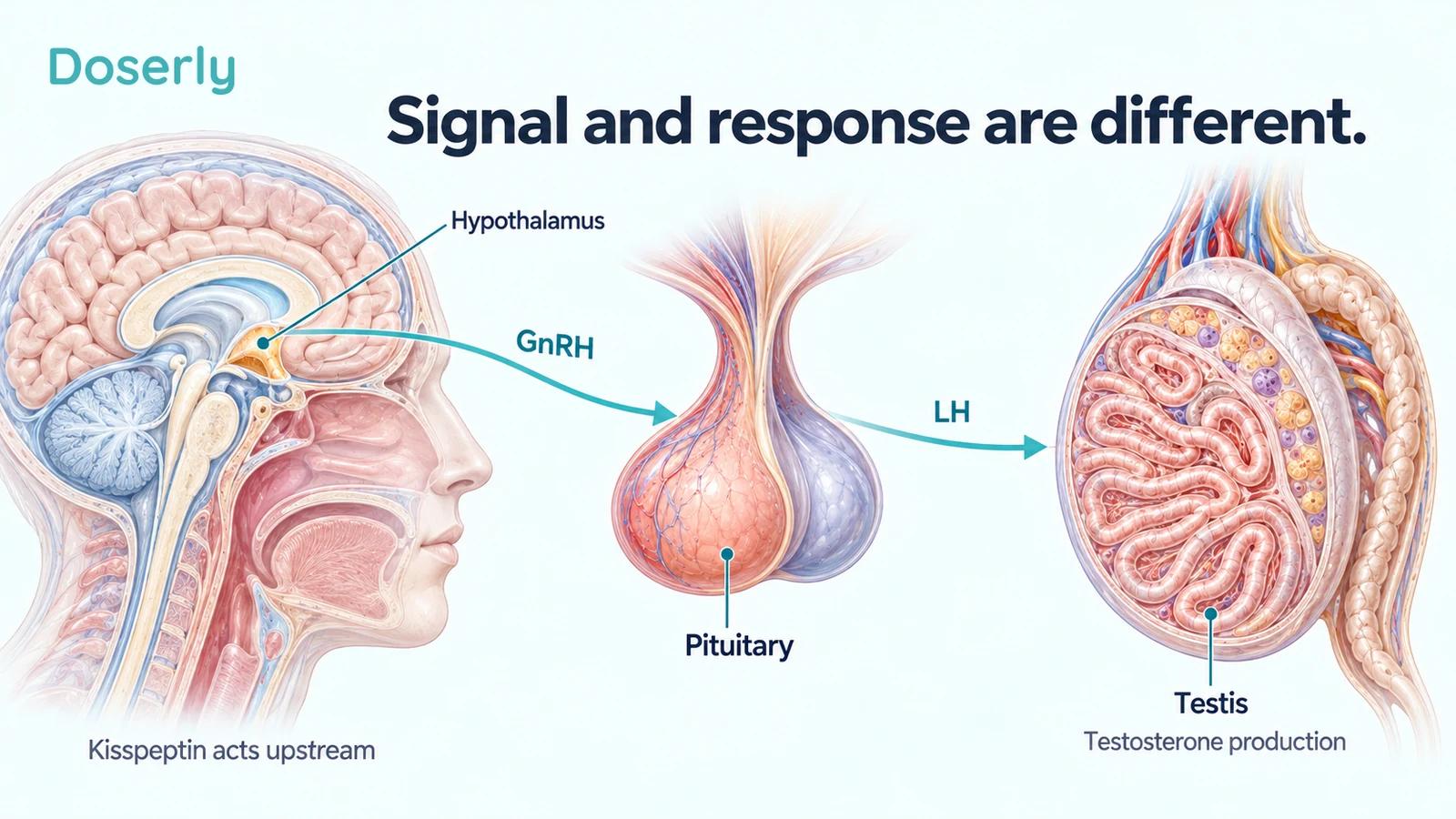
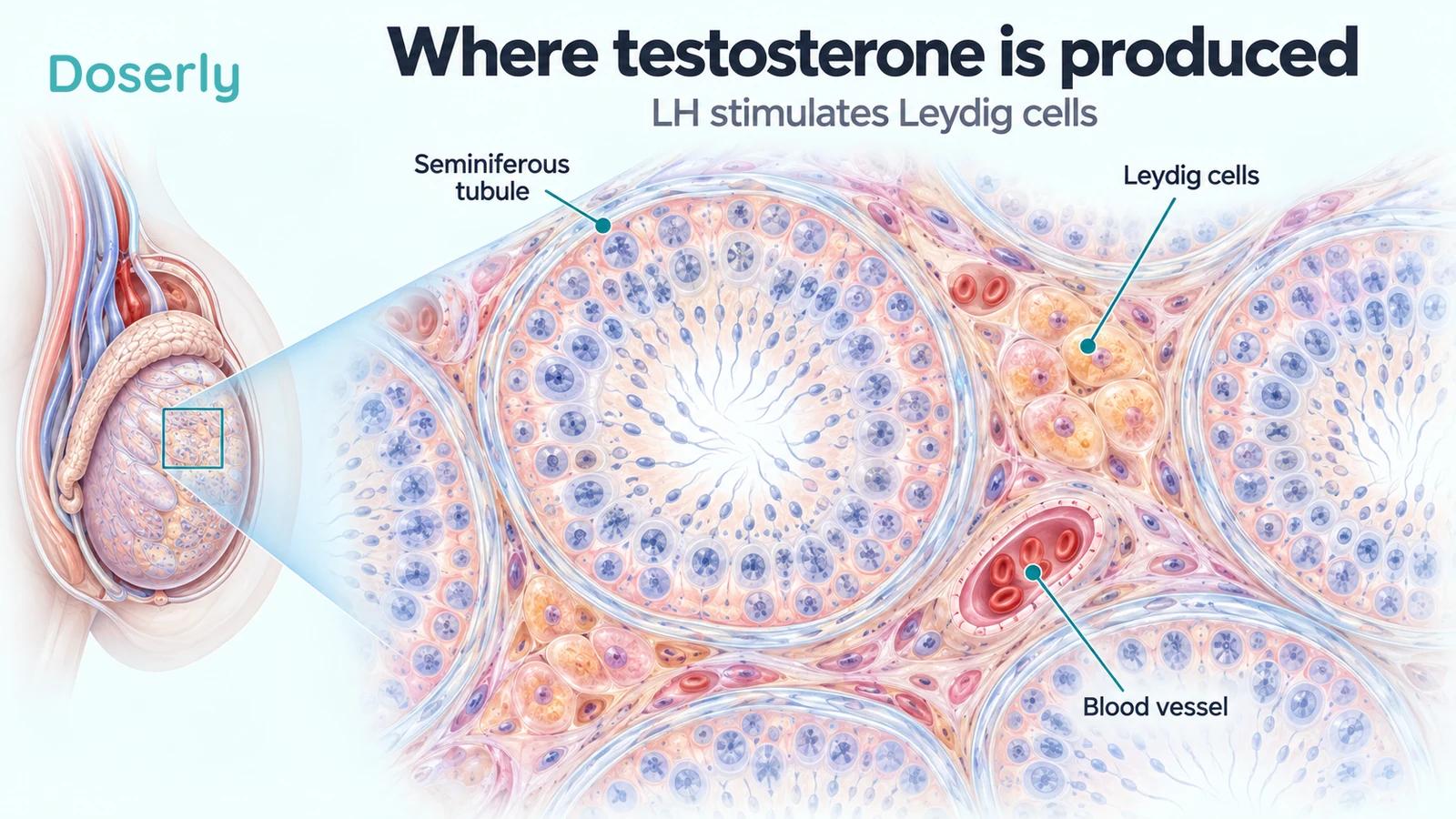
The reproductive hormone system links the hypothalamus, pituitary gland and testes. Kisspeptin acts upstream of gonadotropin-releasing hormone, or GnRH. GnRH stimulates the pituitary to release luteinizing hormone, or LH, and follicle-stimulating hormone, or FSH. LH then stimulates testosterone production by Leydig cells in the testes.
The steps are related, but they are not identical measurements. A blood test showing more LH tells us about the signal reaching the testes. A testosterone measurement tells us about the resulting hormone concentration. Symptoms and daily function describe another level of outcome entirely.
This is why researchers often measure several hormones repeatedly. They are trying to locate where and when a response occurs, rather than assume that one measurement represents the whole system. Our kisspeptin guide explains the upstream mechanism and the different peptide forms studied.
Low testosterone has more than one explanation
A clinical diagnosis of hypogonadism is not based on an isolated low number or on fatigue alone. Endocrine Society guidance calls for compatible symptoms and signs together with unequivocally and consistently low testosterone concentrations, with confirmation using a repeat morning fasting measurement. Clinical guideline
The next question is where the problem originates. Primary hypogonadism involves the testes. Secondary hypogonadism involves the hypothalamic or pituitary level of the system. LH and FSH measurements help distinguish these patterns, and further evaluation addresses the underlying cause.
That distinction matters for an upstream intervention. If the testes are not responding adequately despite an existing hormonal signal, producing more signal cannot simply be assumed to restore normal output. If the problem lies upstream, responsiveness may still depend on which part of the pathway is affected.
These categories are useful clinical concepts, not instructions for self-diagnosis from one laboratory panel. A kisspeptin response in a research participant does not replace assessment of symptoms, repeated measurements and the broader medical context.
What the early human experiments showed
In a 2005 study, six healthy men received kisspeptin-54 or saline during research visits. Kisspeptin stimulated reproductive hormone release, including a later testosterone increase. This established that administering kisspeptin could recruit the human reproductive axis. It was not a treatment trial in men with symptomatic testosterone deficiency. Dhillo and colleagues
A 2011 kisspeptin-10 study examined bolus and infusion responses in small groups of healthy men. During one infusion experiment involving four participants, mean testosterone increased from 16.6 to 24.0 nmol/L alongside increased LH. Other experiments examined the frequency and size of LH pulses. George and colleagues
These are real endocrine effects. The limitation is the clinical inference attached to them. The participants were healthy, the experiments were brief and the main questions concerned hormone physiology. A higher concentration in that setting does not establish that someone with persistent symptoms will benefit from repeated treatment.
It also does not show that raising an already adequate testosterone level improves health. A laboratory increase and correction of a clinically diagnosed deficiency are different propositions. A study must actually investigate the second before its results can support a treatment claim.
A small study moved closer to a clinical population
A 2013 proof-of-concept study included five men with type 2 diabetes and low testosterone, with seven healthy men in an acute comparison. A separate infusion experiment involved four of the men with diabetes. During that experiment, mean testosterone rose from 8.5 to 11.4 nmol/L and LH rose from 3.9 to 20.7 IU/L. Primary study
This was more directly relevant to low testosterone than a healthy-volunteer experiment. It suggested that the reproductive axis retained responsiveness in this selected group and justified further investigation of an upstream approach.
However, the infusion lasted 11 hours. The study did not establish sustained symptom relief, better sexual function, improved fertility or long-term safety. Four participants also provide little information about how variable the response might be across the much wider population of men with diabetes and low testosterone.
The size of the LH increase should not be mistaken for the size of a clinical benefit. LH and testosterone have different units and physiological meanings. A several-fold increase in a signaling hormone cannot be translated into a corresponding improvement in energy, mood or sexual interest.
The older-men study shows why the steps must stay separate
A 2018 experiment compared healthy older men's responses with those of younger men. Five older men underwent short kisspeptin-54 and GnRH infusion visits, with young comparison groups of five. The older participants did not have late-onset hypogonadism.
Their gonadotropin responses were preserved, and the LH response to the highest kisspeptin exposure was greater than in the younger group. Yet their testosterone responses were smaller. Older-men physiology study
That is an important counterexample to the assumption that more LH necessarily produces a proportionate testosterone increase. The system can respond at the hypothalamic and pituitary levels while downstream testicular responsiveness differs.
This finding does not prove that kisspeptin cannot help any older man. It shows why age-related physiology and the location of dysfunction matter, and why the hormone that is easiest to stimulate may not be the outcome that needs treatment. A study of healthy older volunteers also cannot stand in for a trial of symptomatic patients.
What longer exposure studies now tell us
Research has moved beyond a single brief infusion. A 2026 study of three healthy men examined continuous intravenous kisspeptin-10 over 24 hours. LH rose markedly, reached a peak and then declined from that peak before the infusion ended. FSH and testosterone increased more modestly. Continuous-infusion study
A separate 2026 randomized study investigated subcutaneous kisspeptin-10 in a program involving 15 healthy men. It included continuous exposure over five days and intermittent daily infusions over 12 days. The intermittent regimen sustained gonadotropin responses through day 12. After five days of continuous exposure, gonadotropins were similar to vehicle even though testosterone remained elevated. Subcutaneous study
These results make the research more informative than a story based only on older acute studies. They also show that the pattern of exposure matters. The response during ongoing stimulation need not remain identical to the response seen at the beginning.
Still, 12 days in small groups of healthy men is not evidence of a durable treatment benefit in hypogonadism. These studies measured physiology. They do not establish months of symptom improvement, reproductive outcomes or the safety profile needed for routine treatment.
Why one impressive blood test is not enough
Hormone studies often collect many samples because secretion changes over time. A result at a peak, an average across an infusion and a result after treatment stops answer different questions. The timing of a blood draw can therefore change the apparent size of an effect.
For a potential therapy, the relevant issue is not simply whether a peak can be produced. Researchers need to understand the pattern of exposure over the intended treatment period, how consistently people respond and whether the response persists under practical conditions.
Group averages also conceal individual variation. An average testosterone increase could include strong responders, modest responders and people with little change. Larger studies with clear reporting are needed to identify whether a proposed treatment has a predictable role for a particular clinical population.
There is a similar problem with before-and-after comparisons outside trials. Symptoms can change with sleep, illness, stress, other treatments and expectations. Without an appropriate comparison group, a change occurring after an intervention cannot automatically be attributed to it. This is why a controlled symptom trial adds information that serial blood tests alone cannot supply.
What would count as a meaningful testosterone benefit?
The answer begins with the problem being treated. In someone with a properly established diagnosis, a useful trial would assess whether treatment improves the relevant symptoms or functions, alongside appropriate hormone measurements. It would also track adverse effects and reasons for stopping treatment.
Those outcomes should be specified in advance. Sexual symptoms, physical function and other concerns are not interchangeable, and no single questionnaire or laboratory threshold captures every person's priorities. A change should be large enough to matter to participants, not merely detectable in a statistical calculation.
A longer trial would also need a suitable comparator. Depending on the clinical question, that could involve placebo or established care, with appropriate medical oversight. A claim that kisspeptin is a better alternative to an existing treatment requires direct comparative evidence, not a comparison between separate studies conducted in different populations.
Fertility deserves its own outcomes. Stimulating LH and testosterone does not establish improved sperm production or pregnancy chances. FSH, testicular function and the wider reproductive context also matter. A treatment claim about fertility therefore requires fertility evidence rather than a favorable testosterone result alone.
“Stimulating your own production” does not answer every question
An upstream approach is sometimes described as more natural because it recruits endogenous hormone production. That description identifies a mechanism; it does not establish superior safety, effectiveness or suitability.
A substance that alters the body's own signaling still requires a characterized formulation, a tested exposure pattern and clinical monitoring appropriate to its effects. The fact that kisspeptin participates in normal physiology does not tell us what repeated administration will do in every disease state.
Nor do early studies justify combining kisspeptin with other hormonal treatments in an attempt to reproduce a laboratory response. Combining interventions changes the clinical question and makes it harder to know which component caused a benefit or an adverse effect. The trials discussed here should be read as evidence about the interventions they actually tested.
How to discuss the research with a clinician
If low testosterone is a concern, the useful starting point is whether the diagnosis has been established and what is causing it. A discussion can then distinguish the person's goals from the laboratory findings: which symptoms need attention, what other explanations remain and what evidence supports the available options?
When kisspeptin is proposed, ask which form, population and treatment duration support the claimed benefit. An answer based on healthy volunteers' LH responses is different from one based on sustained outcomes in people with the same diagnosis. The kisspeptin evidence guide can help frame that conversation.
Human research shows that kisspeptin can stimulate LH and, in some settings, increase testosterone. Newer work is exploring how to sustain those signals. The remaining clinical question is whether a defined approach produces worthwhile, lasting benefits for a defined group of patients at an acceptable risk. An LH increase is part of that investigation, not its conclusion.
Explore the research
- Kisspeptin-54 in healthy men, 2005
- Kisspeptin-10 hormone and pulse responses, 2011
- Type 2 diabetes and low-testosterone proof of concept, 2013
- Healthy older-men physiology study, 2018
- Continuous kisspeptin-10 infusion study, 2026
- Repeated subcutaneous kisspeptin-10 study, 2026
- Endocrine Society diagnostic guidance