
Peptides
October 16, 2026
Does Semax act like a stimulant? What the comparison can tell us
On this page
Semax is a synthetic peptide studied for effects on the nervous system. It is often described as a nootropic, a term used for substances intended to influence cognition. If you are considering it because you feel tired, distracted or mentally slow, the practical question is understandable: will it help you concentrate, and will it feel like a stimulant?
The available research doesn't establish Semax as a substitute for prescription stimulants or show that it delivers their benefits with fewer risks. It does contain interesting animal findings involving dopamine and serotonin, as well as small human studies of brain activity and neurological illness. Those findings answer different questions. Understanding that distinction makes the research more useful than simply labeling Semax “stimulating” or “non-stimulating.”
Our Semax guide covers its broader history and clinical research. Here, we'll focus on alertness, attention, the amphetamine experiments and what would be needed for a meaningful comparison.
What does a stimulant actually help with?
In everyday speech, a stimulant is something that makes you feel more awake. In medicine, the term can refer to particular drugs used for defined conditions. Prescription stimulants include amphetamine-based medicines and methylphenidate. Depending on the product and indication, they can help with attention-deficit/hyperactivity disorder, narcolepsy or binge-eating disorder. Their benefits and risks have to be considered together. FDA explanation of prescription stimulants.
These uses involve different goals. Staying awake during the day is different from resisting an impulsive response. Completing an attention task is different from feeling motivated to begin it. Someone can describe all three experiences as having more energy, but that description doesn't identify which ability changed.
ADHD also involves more than occasional distraction. Its symptoms are persistent, occur across settings and interfere with daily life. That is why an intervention that seems helpful during one demanding afternoon cannot establish that it treats ADHD. An evaluation considers the pattern of difficulty and its impact, rather than the response to a substance alone. NIMH overview of ADHD.
For a Semax comparison, start by identifying the intended benefit. Is it fewer attention lapses, less daytime sleepiness, better working memory, or improved function after brain injury? A trial designed around one of those questions cannot automatically answer the others.
Why dopamine findings attract attention
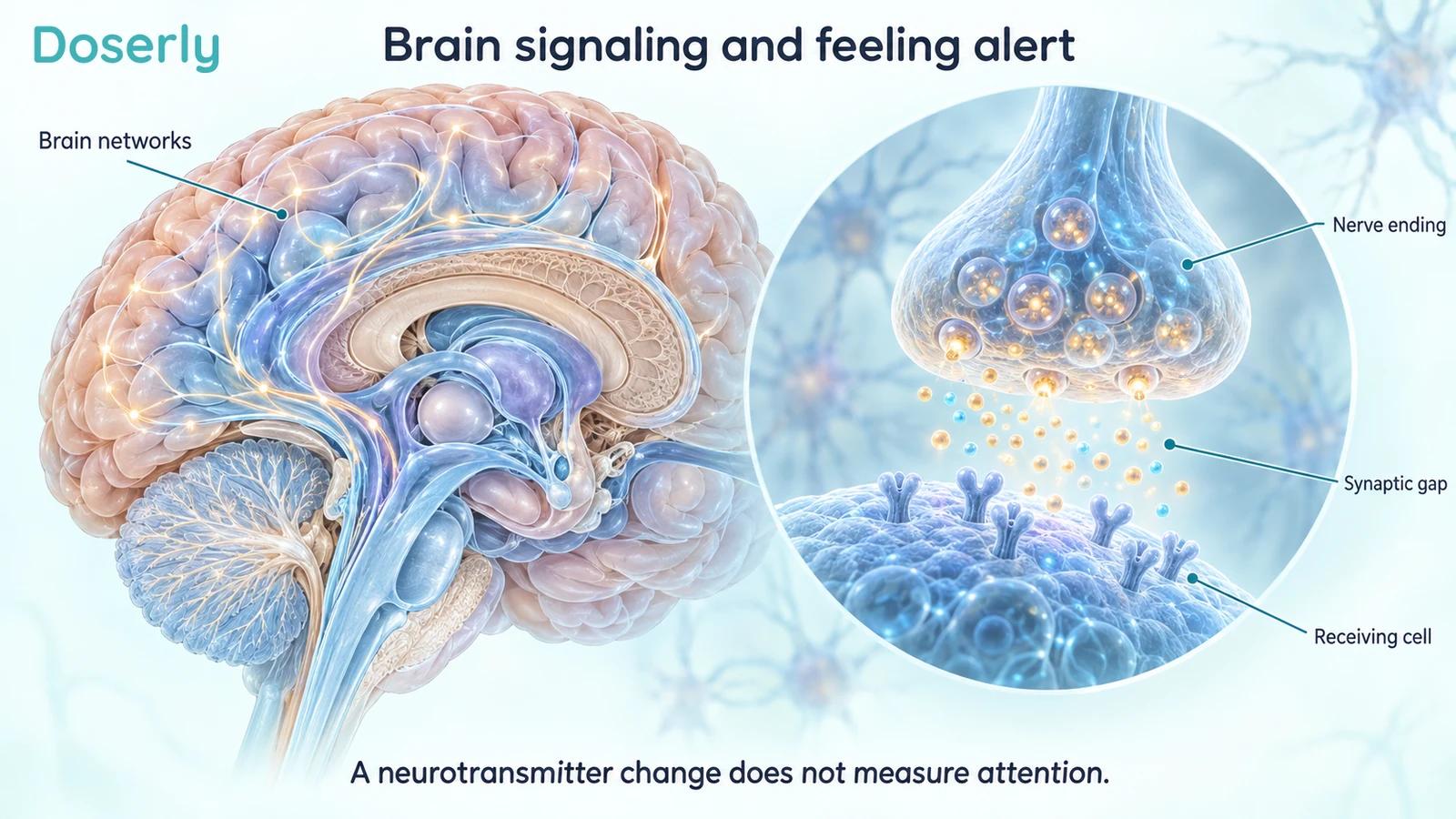
Nerve cells communicate through electrical activity and chemical messengers called neurotransmitters. Dopamine and serotonin are two of those messengers. Researchers can measure their concentrations, their breakdown products, or aspects of the behavior associated with changes in signaling.
A concentration outside cells is one measurement in one part of a biological system. It isn't a direct reading of motivation or concentration. Likewise, measuring a breakdown product provides information about chemical turnover, but does not tell us exactly how a person feels.
This distinction matters for the often-cited 2005 Semax paper. In rodents, Semax changed measurements related to serotonin metabolism. Given alone under the tested conditions, it did not change tissue or extracellular dopamine concentrations or the measured dopamine metabolites. When administered before D-amphetamine, however, it enhanced the amphetamine-associated dopamine and movement responses. Eremin and colleagues, 2005.
That is a more specific finding than “Semax boosts dopamine.” It concerns a drug combination, a particular experimental setting and animal measurements. It suggests a reason to investigate interactions. It does not identify the effect of Semax alone in a person taking a nasal product.
The paper also doesn't justify the opposite simplification: “Semax never affects dopamine.” A failure to change a measurement in one setting is not a complete map of a compound's activity. The useful conclusion stays close to what was actually tested.
What happened in the amphetamine experiments?
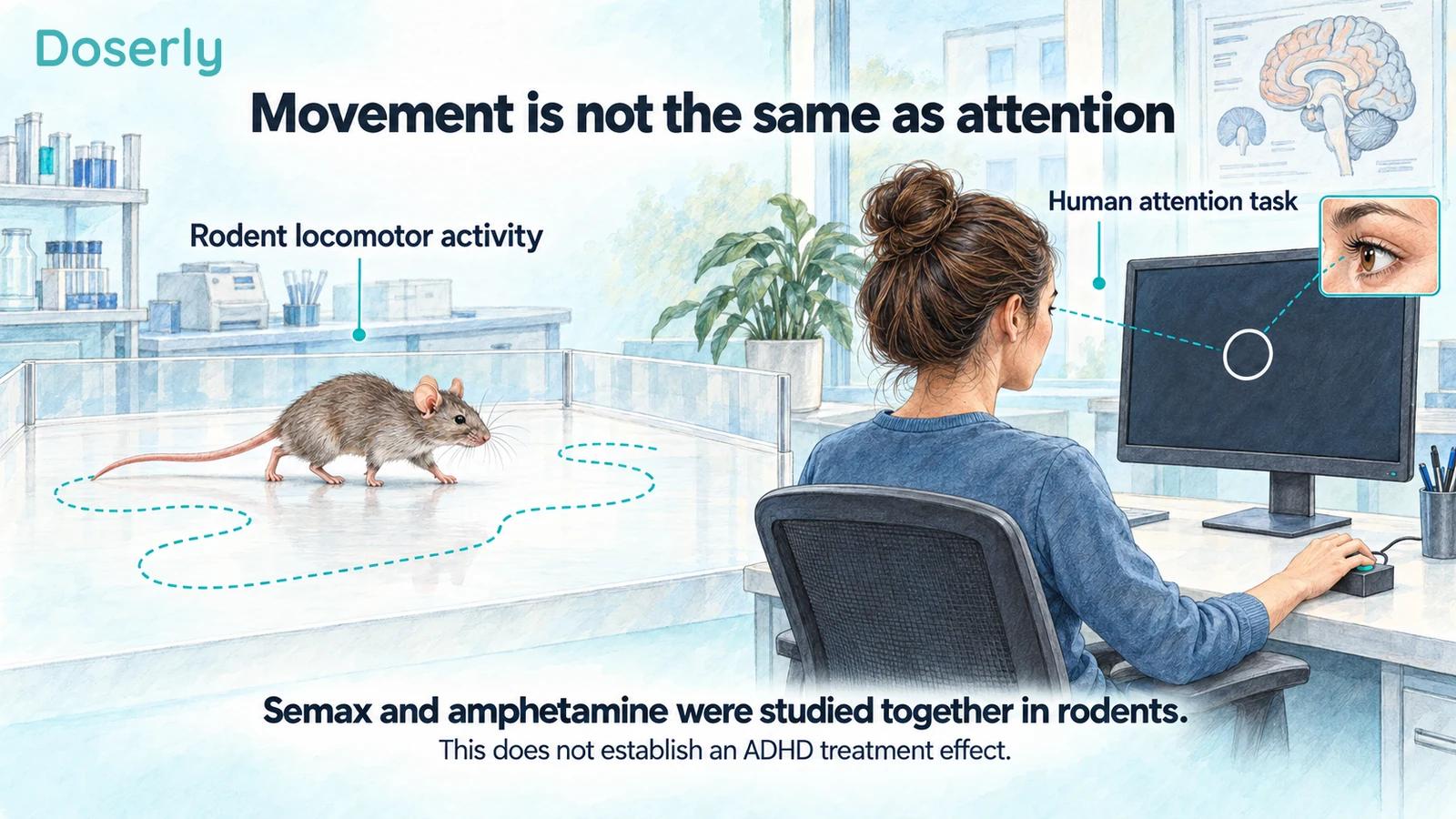
A related 2004 report examined extracellular dopamine in the striatum of rats and locomotor activity in mice. The striatum is a brain region involved in movement and other functions. Locomotor activity means how much an animal moves in the experimental setting.
In the mouse experiment, amphetamine increased movement to 182% of the baseline level, while the combination with Semax produced a value of 261%. These were animal activity measurements, not percentages of people benefiting and not changes in attention scores. Original 2004 report.
The distinction between “to” and “by” matters here. A value of 182% of baseline represents an 82% increase above baseline; 261% represents a 161% increase. Neither number can be converted into a human dose or an expected improvement in productivity. The two reports came from related experimental work and should not be counted as independent large clinical confirmations.
More movement is not necessarily a desirable treatment outcome. If the goal is sustained attention, researchers would need an attention measure. If the goal is reduced hyperactivity, interpreting increased rodent movement as success would be especially misleading. The experiment was valuable for pharmacology, but it was not an ADHD treatment trial.
Does this mean Semax interacts with prescription stimulants?
The animal results give a reason to study that possibility. They do not quantify a clinical interaction or tell us whether a particular combination is safe. A human interaction study would need to examine the actual formulation, exposure, symptoms and relevant physiological measurements.
In its 2026 briefing, FDA highlighted the amphetamine-potentiation finding and the absence of studies needed to characterize reinforcement and abuse potential. The same review found no supporting literature for the nominated ADHD use. These were identified gaps, not a finding that Semax causes addiction or an authorization to use it for ADHD. FDA Semax briefing, pages 7 and 33–34.
If someone already takes a stimulant, the useful question is therefore about the combination, not whether Semax belongs to the same category. Two substances can have different primary descriptions and still influence one another's effects.
A personal record can help a clinician understand what happened: exact product, timing, other medicines, sleep and new symptoms. It cannot establish that the combination is safe or isolate which substance caused a change. Increasing or combining products to reproduce an animal result would be a different experiment with unknown human implications.
What have human brain scans shown?
One 2018 study used resting-state functional magnetic resonance imaging, or fMRI, in 24 healthy volunteers. Fourteen received intranasal Semax and ten received placebo. Scans were obtained before administration and at five and twenty minutes afterward. The researchers reported a difference in a component of the default mode network, a network studied when the brain is not performing a specific external task. Original imaging study.
This supports investigating an acute effect on a brain-network measurement. It does not establish better concentration. The abstract does not report an ADHD symptom outcome or a demonstrated improvement on an attention task.
The word “volume” in the report describes the imaging-defined network component. It should not be retold as the brain growing within minutes. Functional imaging identifies patterns in signals associated with activity; it is not a before-and-after measurement of newly formed brain tissue.
For someone seeking a practical benefit, the next step would be to connect any imaging difference with meaningful performance or daily function. A scan might help explain a clinical effect after that effect has been demonstrated. It cannot substitute for measuring the benefit itself.
What about the studies after stroke?
A 2018 report examined 110 people after ischemic stroke, a stroke caused by interrupted blood supply. It considered Semax alongside rehabilitation, with measurements including blood levels of brain-derived neurotrophic factor, motor performance and the Barthel index, which assesses daily activities. The investigators reported favorable associations with recovery. Gusev and colleagues, 2018.
Those patients were recovering from neurological injury. Rehabilitation timing and other care were part of the setting. Their results cannot be used to predict how a healthy person will perform at work, or how someone with ADHD will respond compared with an established medicine.
BDNF is also not an attention score. A change in its concentration in blood does not by itself demonstrate improved brain function. The clinical outcomes are more directly relevant to recovery, while the biological measurement can contribute to a hypothesis about how treatment might work.
The accessible abstract does not provide the detail required to establish a blinded, placebo-controlled comparison with a stimulant. It should be read as a condition-specific clinical report, not as evidence that Semax offers stimulant-like benefits without stimulant-like adverse effects.
Can we say how long the alerting effect lasts?
These studies do not establish a reliable duration of increased alertness in people. A brain scan taken twenty minutes after administration is an observation at that time, not a measurement of how long a person remains more attentive.
Similarly, following recovery after stroke does not measure the duration of a stimulant-like feeling. The endpoint, population and treatment context differ. Estimates borrowed from those studies can sound precise while answering another question entirely.
A useful duration study would measure the desired effect repeatedly, compare it with placebo and distinguish immediate sensations from sustained performance. It would also record sleep that night and function the next day. An apparent improvement during a short task could have a different practical value if it were accompanied by impaired sleep or new symptoms.
There is consequently no evidence-based interval we can extract from these reports for repeating Semax to maintain focus. The absence of such an interval is a research gap, rather than an invitation to infer one from how long a subjective sensation lasts.
Is “not a conventional stimulant” reassuring?
A different description does not establish a better safety profile. Prescription stimulant warnings reflect known and studied risks, including misuse and addiction. Those warnings should be taken seriously, but they don't make an incompletely studied alternative safer by comparison. FDA safety communication.
A fair comparison would measure adverse effects in both groups with the same methods and follow-up. It would also distinguish prescribed use from nonmedical use, and evaluate the actual Semax product rather than assuming all similarly named preparations are interchangeable.
The question isn't settled by whether someone feels jittery. A person can experience an unwanted effect without describing it as stimulation, and can feel alert without showing improved task accuracy. Patient experience matters, but the description needs to be connected to an outcome and a time course.
What would make the comparison useful for you?
Bring the specific problem to a clinician: losing track during conversations, falling asleep during the day, difficulty completing tasks, or a change following illness. Those concerns can lead to different evaluations and treatment choices.
If Semax is proposed, ask which human study matches that problem and whether it measured the benefit you want. Ask what the comparator was, how long participants were followed and whether the formulation matches the proposed product. A confident comparison with prescription stimulants should be supported by an actual comparative trial.
The research reviewed here gives a reason to investigate Semax's effects on brain signaling and possible interactions. It does not establish an ADHD treatment, a predictable alerting duration or a safer stimulant replacement. The complete Semax guide provides further context for discussing the compound's formulations and evidence with a clinician.
Sources
- Eremin and colleagues, rodent neurotransmitter experiments, 2005.
- Eremin and colleagues, Semax with D-amphetamine in rats and mice, 2004.
- Semax and resting-state brain networks, 2018.
- Gusev and colleagues, stroke rehabilitation report, 2018.
- FDA Semax compounding briefing, July 2026.
- FDA prescription stimulant safety communication, 2023.
- NIMH ADHD overview, reviewed August 2026.