
Peptides
October 16, 2026
Does oral KPV have to reach the bloodstream to be studied for gut effects?
On this page
An oral substance does not have to produce a high blood concentration for researchers to investigate effects at the intestinal surface or within intestinal tissue. The relevant exposure depends on where the intended target is. That makes local delivery a reasonable research question for KPV, a tripeptide studied in experimental intestinal inflammation.
But “it can act locally” is a hypothesis about location, not proof that a particular capsule works. A peptide still has to reach the relevant site in a suitable form, interact with the intended cells and produce a useful effect. Whether it also enters circulation remains important for understanding exposure and safety.
KPV research includes free peptide in mouse drinking water, carrier-loaded nanoparticles and a newer chemically linked prodrug called proKPV. These are different experimental interventions. The KPV guide introduces the compound; this article explains why the delivery system and the measurement matter as much as the word “oral.”
First define what “reaches the gut” means
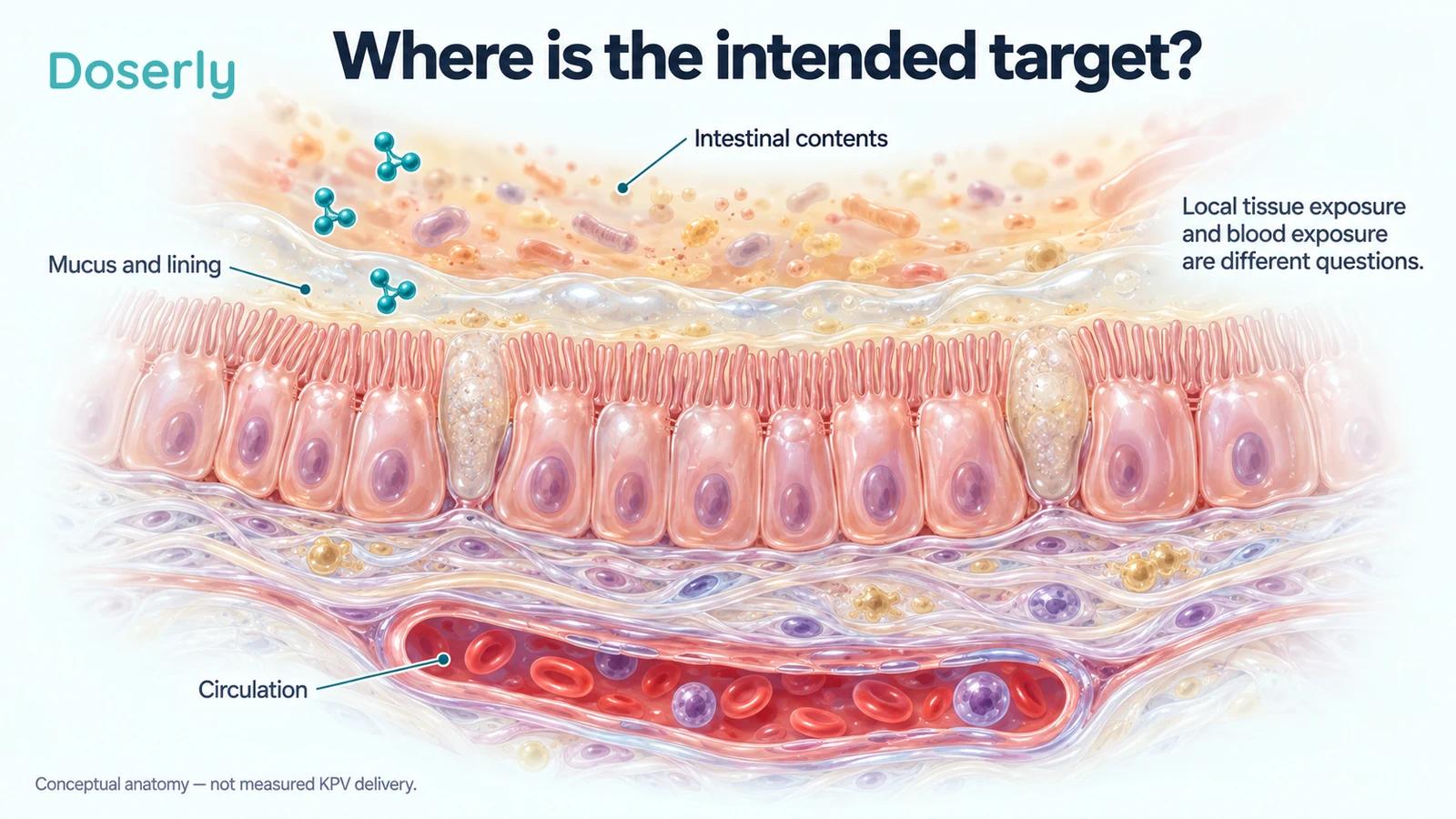
Swallowing a product places it in the digestive tract, but that does not establish exposure at every part of the tract. The intestinal contents, mucus layer, epithelial cells and deeper tissue are separate locations. A substance can be present in one compartment without reaching another in an active form.
For a local effect, researchers need to identify the target. Is the intended interaction within the intestinal contents, at the surface of a cell, inside epithelial cells or within immune cells beneath the lining? Each possibility creates different delivery questions.
The distinction also changes what counts as a useful measurement. Detecting material in a colon sample is not the same as showing uptake into a particular cell population. Showing a cell response is not the same as showing symptom relief. A delivery experiment becomes more informative when it connects location, active material and biological response instead of treating them as one event.
What the original oral KPV experiments showed
Dalmasso and colleagues studied KPV uptake and inflammatory signaling in cultured intestinal epithelial and immune cells. Their findings implicated PepT1, a transporter for small peptides. They also administered KPV in drinking water in two chemically induced mouse-colitis models and reported reduced inflammatory findings. Original 2008 study.
Those experiments explain why the oral route was investigated. A potential cellular uptake mechanism and effects in orally exposed mice provide a research rationale. The paper does not establish the exposure profile or efficacy of a human capsule, and it does not offer a human dose conversion.
It would be equally inaccurate to dismiss the experiment solely because an oral peptide might face digestion. The appropriate question is what was observed under the tested conditions and whether the relevant delivery can be reproduced in a different setting. The mouse observations are evidence about those mice and that protocol, with clinical translation still unresolved.
A local hypothesis should therefore stay precise. “Researchers observed reduced inflammation after oral exposure in mice” is a supported description. “Oral KPV works because it never needs absorption” combines an observation with an unproven explanation and an overly broad claim.
Cellular uptake and bloodstream exposure are separate steps
PepT1-related uptake concerns entry into a cell. Systemic pharmacokinetics concerns the pattern of exposure in the circulation over time, including the material being measured and its persistence. A transporter result does not supply that entire profile.
For comparison, a study of valacyclovir in wild-type and PepT1-knockout mice measured circulating acyclovir, its active metabolite, after oral administration. Serial blood measurements allowed the investigators to examine exposure directly. That is a different experiment from measuring inflammatory signaling after exposing cultured cells to KPV. It does not provide any KPV exposure value. Original valacyclovir pharmacokinetic study.
The comparison illustrates a method, not a recommendation for another drug. To establish a blood-exposure claim, researchers need an assay and sampling design that measure the relevant substance. To establish a local-tissue claim, they need measurements appropriate to that tissue. Sometimes both are necessary.
Low blood exposure, if demonstrated, would not automatically establish adequate local exposure. High blood exposure would not automatically establish a useful intestinal effect. The meaning depends on where the target is and whether the measured material remains active.
Why the 2017 nanoparticle study is not a plain-capsule study
Xiao and colleagues loaded KPV into polymeric nanoparticles functionalized with hyaluronic acid, then used a chitosan/alginate hydrogel for oral administration. The work investigated delivery to colonic epithelial cells and macrophages and tested the system in mouse colitis. The hyaluronic-acid-functionalized system performed better on reported inflammatory and tissue outcomes than the comparison KPV nanoparticle/hydrogel system. Original 2017 study.
This was a formulation experiment. The carrier, its surface characteristics and the hydrogel were part of the intervention. Removing those details from a summary changes the question the study answered. It cannot be reduced to “KPV capsules treated ulcerative colitis.”
The comparator matters too. Comparing two nanoparticle systems can help identify a contribution of the delivery design. It does not necessarily tell us how every unformulated product would perform, and it certainly does not compare marketed human capsules with standard care in patients.
A product using the same peptide name would need evidence that its relevant characteristics match the tested intervention before those results could even begin to support an equivalence argument. Ingredient overlap alone is insufficient. The delivery system may be responsible for much of what makes the experiment work.
The 2026 proKPV study adds a new delivery design
Cheng and colleagues developed an inflammation-responsive conjugate called proKPV. It chemically linked a peptide payload to an engineered scaffold with features intended to protect delivery and permit release in response to reactive oxygen species. The constructs assembled into nanoparticle-like systems and were studied in laboratory experiments and mouse disease models. Original 2026 study.
The researchers reported improved colonic accumulation and anti-inflammatory effects in colitis mice compared with free KPV. They also investigated distribution and effects in a mouse model of acute lung injury after oral administration. Some distribution experiments used fluorescently labeled material. These findings concern the engineered conjugate and its measurement methods, not a demonstrated human exposure profile for an ordinary KPV capsule.
The lung experiments are especially useful for avoiding a false either-or story. Oral delivery research can investigate both local intestinal targets and targets reached beyond the intestine. An article should not claim that all orally administered KPV-related material necessarily stays in the gut simply because local effects are plausible.
At the same time, a fluorescence signal should be described as such. Its interpretation depends on the label, assay and study design. It should not be casually rewritten as a precise human concentration of intact active KPV or as a validated human oral-bioavailability percentage.
“Oral” describes a route, not a complete product
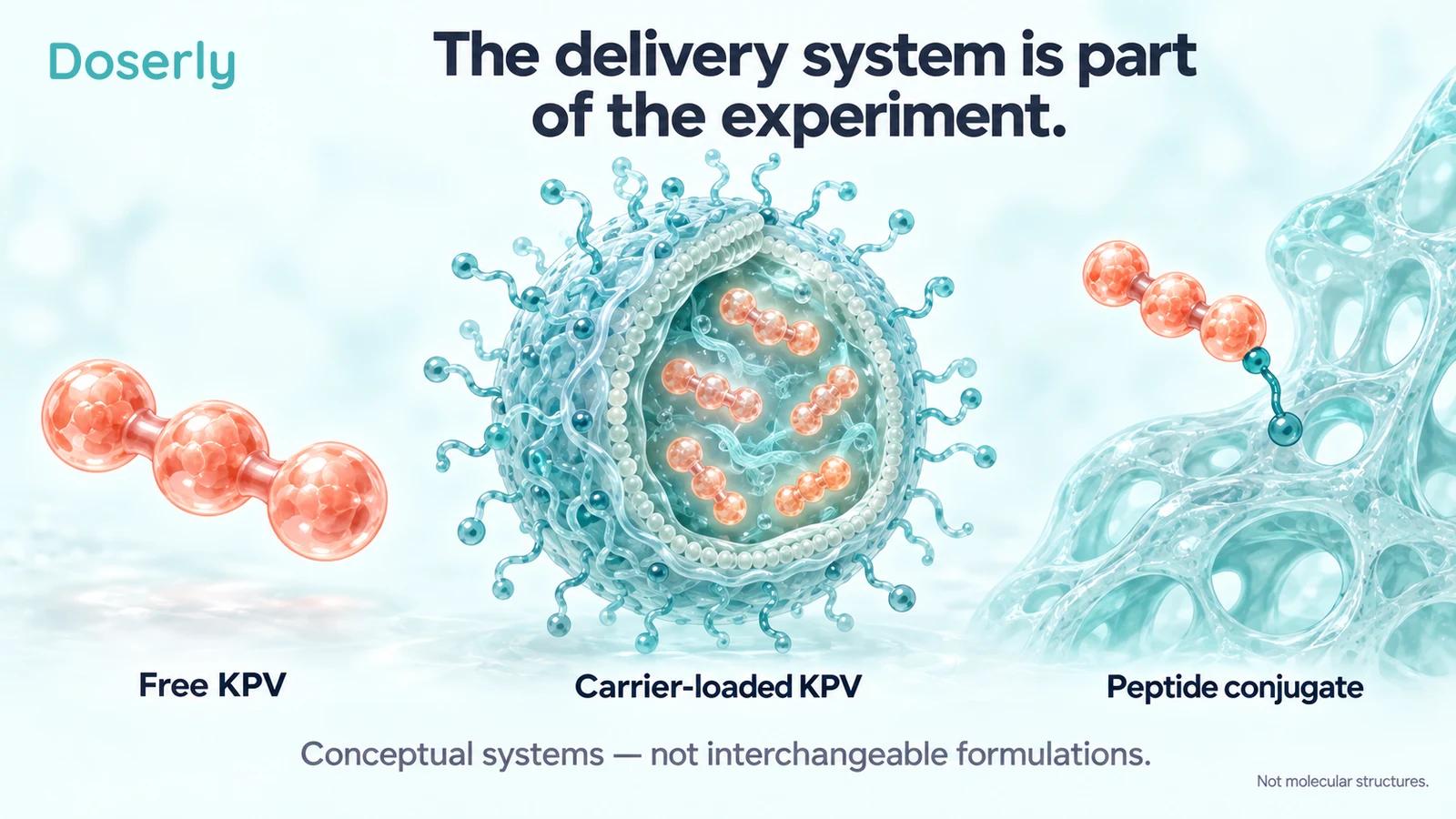
The three examples show why route alone is an incomplete description. Free peptide in drinking water, peptide enclosed in a carrier and peptide chemically attached to a scaffold can expose tissue differently. A claim about one should not silently become a claim about the others.
The same applies to terms such as delayed release, enteric coated, liposomal or targeted. Those words describe intended formulation features. They do not, by themselves, demonstrate where active material goes, how much reaches the target or whether people benefit.
A useful product-specific study would characterize the actual preparation and its behavior. What is released, under what conditions and over what period? Is the material identified after release? How does the formulation perform in the biological setting being claimed? A label listing the peptide cannot answer these questions.
This is why a newer, more elaborate delivery paper can increase scientific interest without validating existing commercial products. The new design may be the central advance. Borrowing its results while omitting its engineering reverses the meaning of the research.
Local delivery does not eliminate the need for safety studies
A locally intended product still requires safety assessment at the tissue it contacts. Researchers also need to determine whether any of it, or any relevant breakdown product, reaches other tissues. Intended localization is not proof of exclusive localization.
The FDA’s July 2026 briefing reported that it had not identified human clinical pharmacokinetic or pharmacodynamic studies for KPV free base or acetate by any route. It also found no human clinical exposure data sufficient to establish a safety profile. FDA assessment.
The newer conjugate experiments do not resolve that human gap. A mouse formulation study and a human clinical exposure study remain different evidence categories. A favorable short-term laboratory safety observation also cannot answer every question about repeated use, other medications or a different patient population.
There is no supported human dosing schedule in these sources. A drinking-water concentration, a nanoparticle amount and a conjugate dose may refer to different quantities. Even before considering species differences, it is necessary to know whether an amount refers to the entire delivery construct or the peptide payload. Those research quantities should not become personal dosing instructions.
Four measurements that should not be merged
A study may measure whether material remains intact in simulated digestive conditions. That addresses stability under the chosen test conditions. It does not establish arrival at a patient’s target tissue.
A study may measure distribution in an animal or tissue sample. That addresses where a measured signal or identified substance is found. It does not establish a clinical benefit, and the analytical method determines what exactly has been detected.
A study may measure biological activity, such as a change in inflammatory signaling or tissue findings. That connects exposure with a response in the experimental system. It still leaves questions about whether the same response occurs in people and whether it improves outcomes they value.
Finally, a clinical study can measure symptoms, disease activity and adverse effects in a defined patient population. This is the step needed to support a treatment claim about that population and product. Combining several earlier measurements can strengthen the rationale for such a study; it does not make the clinical study unnecessary.
How to evaluate an oral KPV claim
Ask which formulation the cited paper used. If the answer is a hydrogel containing functionalized nanoparticles or a chemically linked prodrug, the claim should retain those details. If the product being offered differs, the explanation should identify what evidence connects it to the studied system.
Ask where exposure was measured. “Absorbed” might refer to uptake into cultured cells, fluorescence in an animal tissue or an identified substance in blood. These are not equivalent. A useful answer names the compartment and the measurement instead of relying on a general absorption claim.
Ask what outcome was demonstrated. Delivery alone is not treatment benefit, and an inflammatory marker is not automatically a clinical result. For a human use, look for evidence in people receiving the actual intervention for the relevant condition.
The answer to the title question is therefore no: substantial bloodstream exposure is not a prerequisite for investigating a local gut effect. But local action still has to be demonstrated, and systemic exposure still has to be assessed appropriately. KPV’s oral-delivery research is a reason to study those questions carefully, not a shortcut around them.
Sources
- Dalmasso et al., KPV uptake and mouse oral exposure.
- PepT1 and measured valacyclovir pharmacokinetics in mice.
- Xiao et al., KPV nanoparticle/hydrogel delivery.
- Cheng et al., inflammation-responsive oral peptide conjugates.
- FDA, human KPV exposure and safety gaps.