
Peptides
October 16, 2026
Does KPV prevent cancer in people? The evidence gap behind the laboratory claims
On this page
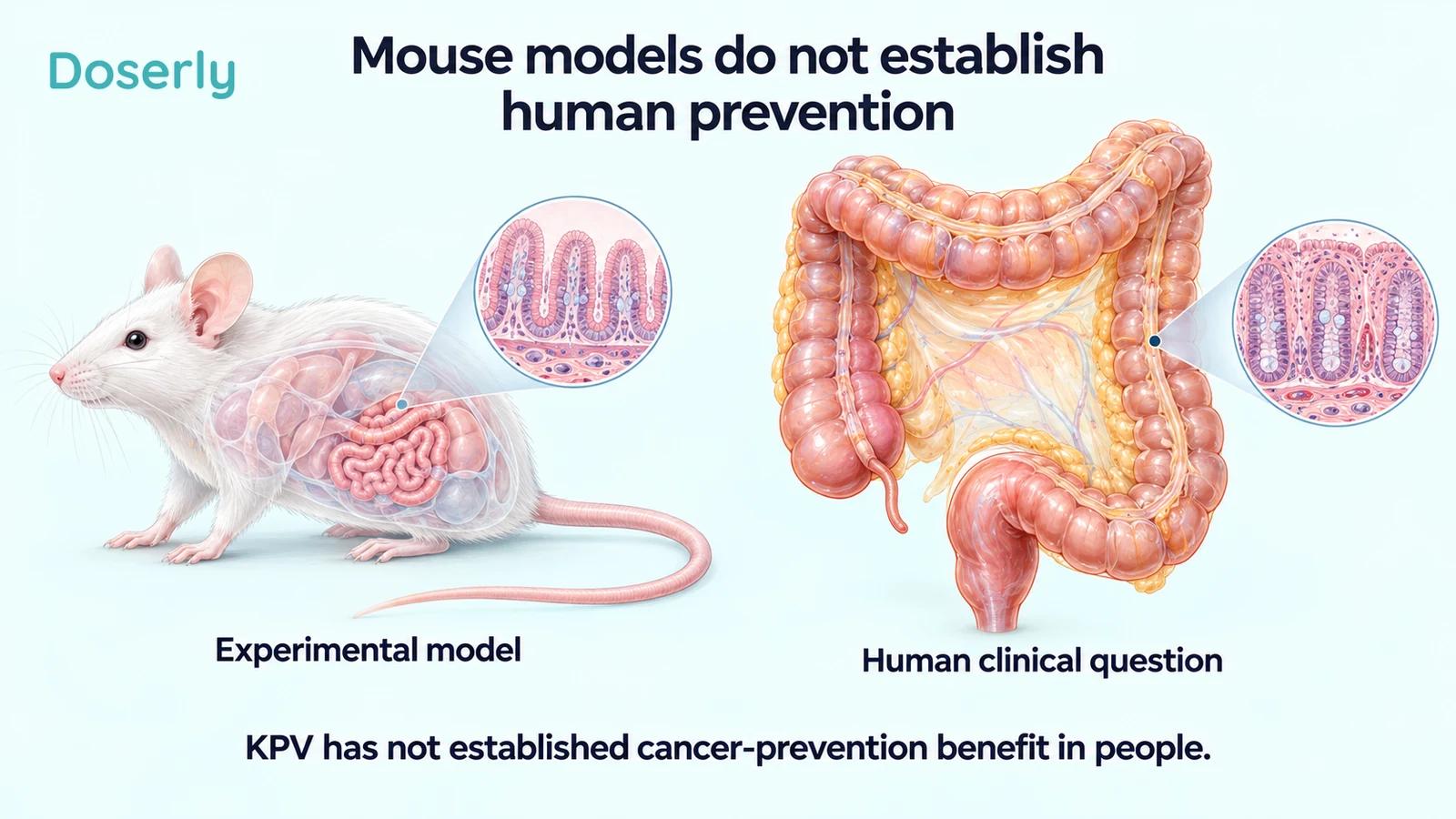
KPV has not been shown to prevent cancer in people by the primary sources checked for this article. The frequently cited cancer experiment was conducted in mice, and its results were more selective than a broad cancer-prevention claim suggests. In one inflammatory model, KPV reduced tumor development. In a separate genetic model, it did not reduce tumor burden despite lowering an inflammation marker.
That difference is central to the story. “Anti-inflammatory” does not automatically mean “prevents cancer,” and a favorable result in one experimental setting cannot establish a benefit across all cancers or all people. The original study is worth understanding because it tested a specific mechanism and also showed a limit to the effect.
Our KPV guide provides the broader peptide background. Here, the focus is what the cancer research actually measured, what its human tissue component means, and why it should not change an established screening, surveillance or treatment plan.
What the main cancer paper studied
Viennois and colleagues investigated PepT1, a transporter for small peptides, in a mouse model of colitis-associated cancer. The model used azoxymethane, abbreviated AOM, followed by dextran sulfate sodium, or DSS. Researchers compared mice with different PepT1 expression and tested KPV during the inflammatory treatment cycles. Original 2016 study.
In the wild-type KPV experiment, there were six mice per group. KPV-treated mice had fewer and smaller tumors and lower overall tumor burden. The benefit was not statistically demonstrated in PepT1-knockout mice under the modified protocol used for that group. The investigators also examined human tissue for transporter expression; they did not administer KPV to people. Full study.
This was an investigation of tumor development within defined animal models, not a clinical trial of preventing cancer in humans. The timing also matters: administering an intervention during a tumor-induction protocol is different from showing that it treats an established human cancer.
The negative result should remain beside the positive one
The same paper tested KPV in APC Min/+ mice, a genetic model that develops intestinal adenomas. After 13 weeks of treatment, KPV did not reduce tumor burden in the small intestine or colon. An intestinal inflammation measure, fecal lipocalin-2, nevertheless decreased. Original study’s genetic-model results.
This finding prevents a simple chain of reasoning: KPV reduces inflammation, inflammation can contribute to cancer, therefore KPV must prevent cancer. In this experiment, the first observation did not guarantee the last. Tumor outcomes had to be measured separately, and the result differed by model.
Leaving out that result would make the research appear more uniform than it was. It would also remove one of the paper’s most useful lessons for readers: a biological effect can be real without producing every hoped-for downstream benefit.
The negative experiment does not prove that KPV could never have a useful role in any future setting. It narrows what the existing study supports. A responsible summary includes the conditions in which an effect was observed and the conditions in which it was not.
Human tumor samples are not a human prevention trial
The human component of the 2016 study examined PepT1 expression in tissue samples. Finding a transporter in a tumor can help researchers propose a target or delivery route. It does not show that giving a substrate for that transporter prevents cancer, shrinks a tumor or improves survival.
This distinction can be lost when a summary says that a paper “included human cancer data.” The phrase is technically broad enough to cover tissue analysis, but many readers reasonably interpret it as evidence from treated patients. A clear description should say what happened: tissue was examined, while the KPV intervention was tested in mice.
There is also a difference between a marker associated with disease and a treatment that changes the disease. A tumor may express a protein without that protein being a safe or effective clinical target. A successful intervention requires more than detecting the target; it requires evidence about delivery, response and effects on the whole person.
The PepT1 finding therefore contributes to a research rationale. It cannot carry the clinical conclusion by itself, even when it appears in the same paper as favorable animal results.
A cancer-related laboratory measurement is not always a clinical endpoint
Researchers use many measurements to understand tumor biology: cell proliferation, inflammatory signals, tumor number, tumor size and tissue appearance. These measures can be informative without answering the same question. A person considering prevention wants to know whether an intervention lowers their chance of developing clinically important disease while avoiding unacceptable harm.
The National Cancer Institute distinguishes surrogate endpoints from stronger direct measures such as survival or quality of life. A surrogate can allow earlier assessment, but it does not always accurately indicate clinical benefit. NCI explanation.
For KPV, the gap comes even earlier than validating a human surrogate. The primary intervention findings discussed here are preclinical. A reduction in a mouse inflammation marker is not an established substitute for fewer human cancers. Nor can a count of tumors at an animal experiment’s endpoint be translated into a percentage reduction in a person’s lifetime risk.
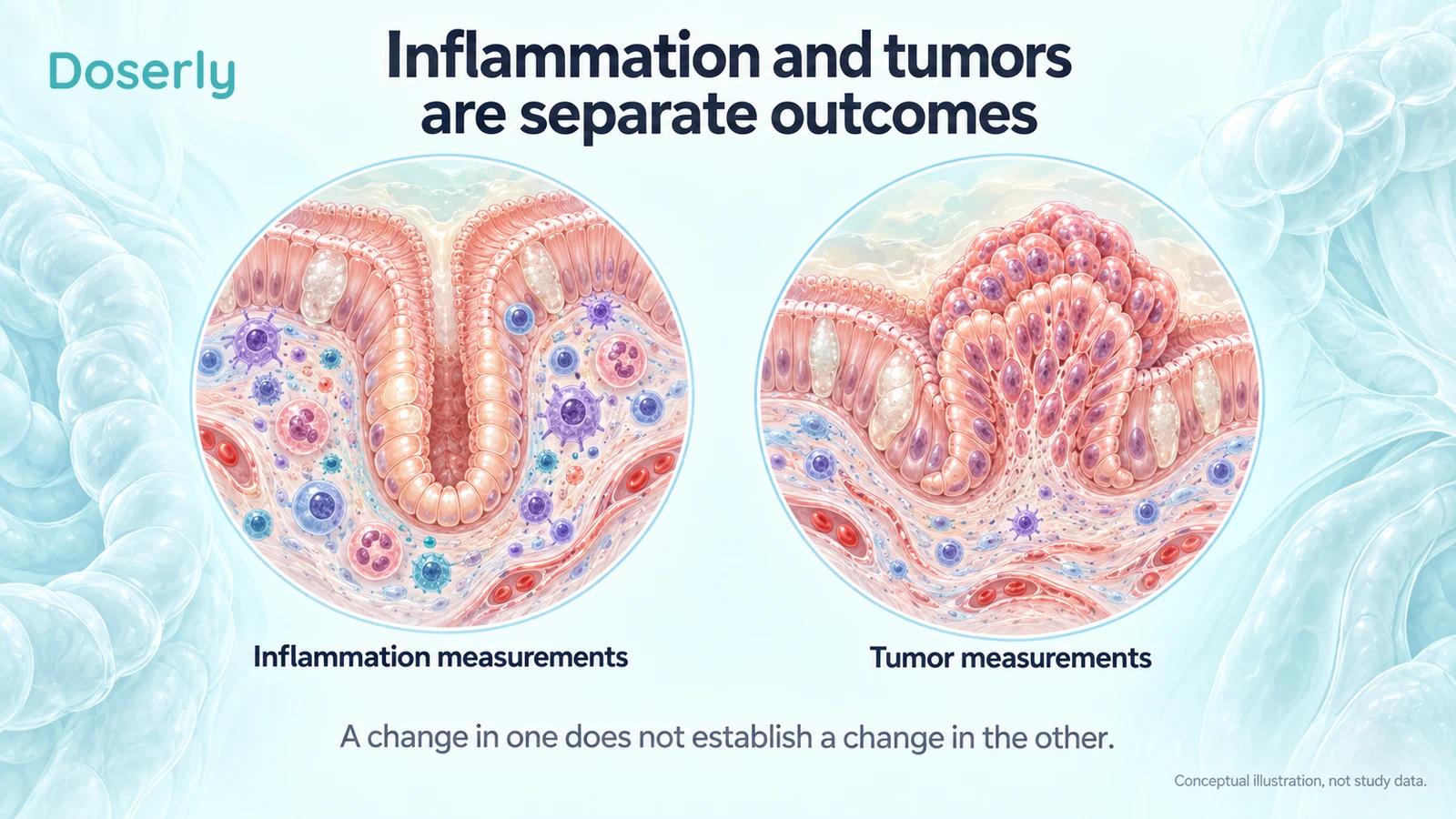
The practical reading habit is to finish the sentence precisely. “Reduced what?” is a useful question whenever a claim says an intervention “reduced cancer risk.” If the actual answer is a cell-signaling protein, a mouse tumor count or an inflammatory marker, that should be the wording used.
Cancer prevention and cancer treatment are different claims
Prevention asks whether an intervention reduces the occurrence of disease in a defined population. Treatment asks whether it helps people who already have disease. Preventing recurrence after treatment is another specific question. A study designed around one of these questions does not automatically answer the others.
For example, an intervention given while tumors are being experimentally induced, as in the colitis-associated mouse experiments, does not demonstrate that established tumors will regress. Likewise, an effect on tumor formation in one part of the intestine does not establish protection against breast, lung or another cancer. The claim must follow the tested setting.
Even the word “cancer” can conceal important differences in an experiment. Tumor burden, adenoma formation and invasive disease are not identical outcomes. The original methods and pathology determine what was counted. Summaries should avoid replacing a measured experimental endpoint with a more dramatic clinical one.
These distinctions are especially important when information is being used to sell a product. A broad promise of protection can sound reassuring while providing no applicable estimate of benefit, no suitable dose and no adequate safety information for the person considering it.
A search for “KPV cancer” can find the wrong KPV
A separate lung-cancer paper uses KPV as shorthand in the name of a genetically engineered mouse model involving Kras, p53 and vimentin. Its experiments concern vimentin and tumor progression, not administration of the lysine–proline–valine peptide. Original vimentin study.
This is a concrete reason to read past a search result. The same three letters can identify different things in biomedical literature. A title, gene-model notation or image caption containing KPV is not sufficient evidence that the peptide was tested.
When checking a citation, find the intervention in the methods or abstract. Was lysine–proline–valine actually administered? Was KPV instead part of an animal genotype label? Was the study testing a related peptide or a new delivery conjugate? Answering those questions prevents unrelated research from being added to the peptide’s evidence base.
What the human evidence currently establishes
The FDA’s July 2026 assessment of KPV free base and acetate reported no identified human clinical studies or exposure data through any administration route, including no human pharmacokinetic or pharmacodynamic studies. The briefing also described gaps in nonclinical safety characterization. FDA assessment.
That does not prove that a future well-designed KPV intervention must fail. It means a human cancer-prevention claim is not established by the available sources examined here. The absence of demonstrated harm is also not enough: without suitable exposure and follow-up data, important risks can remain unknown.
A preventive intervention may be taken by people who do not currently have the disease, sometimes over a long period. Its evidence therefore needs to address both the likelihood of meaningful benefit and the harms introduced by use. A mechanism diagram and a short animal experiment cannot supply that balance.
No dose recommendation follows from this literature. Mouse drinking-water concentrations are part of an experimental protocol, not a human dosing guide. Converting them into a personal regimen would add assumptions that the study did not test.
Keep colorectal screening and IBD surveillance on their own evidence base
The National Cancer Institute describes established colorectal screening approaches and their benefits and limitations. Some tests examine stool, while endoscopic approaches can inspect the bowel and obtain or remove tissue. Screening choices should be discussed in relation to personal risk and the follow-up required after an abnormal finding. NCI colorectal screening overview.
People with colonic inflammatory bowel disease may need a surveillance plan tailored to their disease. AGA guidance considers disease history, prior inflammation, dysplasia, family history and primary sclerosing cholangitis when planning surveillance. It also emphasizes effective control of the underlying disease. AGA IBD dysplasia guidance.
A KPV claim is not a reason to delay a planned examination or replace prescribed disease management. Feeling less bloated or having fewer symptoms would not establish that dysplasia is absent or that future cancer risk has fallen. Those questions require their own assessment.
At a clinical visit, ask which screening or surveillance pathway applies to you, what the previous examination found and when the next step is due. If family history or a prior diagnosis changes, report it. These are concrete ways to keep prevention decisions tied to the relevant risk information.
If you already have cancer, discuss any peptide use with the treatment team
Someone receiving cancer treatment may encounter KPV as an alleged protective or supportive therapy. The studies discussed here do not establish that adding it improves cancer outcomes or is compatible with a particular treatment regimen. Unknown interactions are not the same as proven interactions, but they also are not evidence of compatibility.
NCI advises people with cancer to discuss complementary approaches with their doctor or nurse because some can interfere with treatment. It recommends sharing a complete list of products and medicines. NCI patient guidance.
If a product has already been used, bring its name, ingredients, formulation, route and dates. This is useful information for care, not something that needs to be hidden because the evidence is uncertain. Decisions about continuing or changing treatment should be made with the team responsible for the cancer plan.
The KPV cancer paper offers a specific preclinical finding and a meaningful counterexample. Reading both together supports further scientific questions. It does not establish cancer prevention in people, and it does not replace the evidence behind screening, surveillance or cancer treatment.
Sources
- Full study, including negative APC Min/+ model.
- NCI, surrogate endpoints.
- Vimentin mouse study using the unrelated KPV genotype abbreviation.
- FDA, KPV human-data and safety assessment.
- NCI, colorectal screening.
- AGA, colorectal dysplasia surveillance in IBD.
- NCI, discussing complementary approaches during cancer care.