
Peptides
October 16, 2026
Does BPC-157 need to be near an injury?
On this page
The claim that BPC-157 works better when injected near an injury sounds plausible: put the substance close to the tissue you want to affect. But plausibility does not establish that the tissue receives a useful exposure, that the injury heals faster or that the approach is acceptably safe.
The human reports and animal experiments reviewed for this article do not establish a near-injury injection advantage in people. They also do not prove that every injection location is equivalent. The missing evidence is a direct, well-designed comparison that separates the effect of location from the product, route, dose and underlying injury.
This is an explanation of the evidence, not a recommendation for an injection site or technique. BPC-157 remains an experimental treatment with limited human evidence. The BPC-157 guide provides the wider context on the compound and its safety uncertainties.
“Near the injury” does not specify where a substance goes
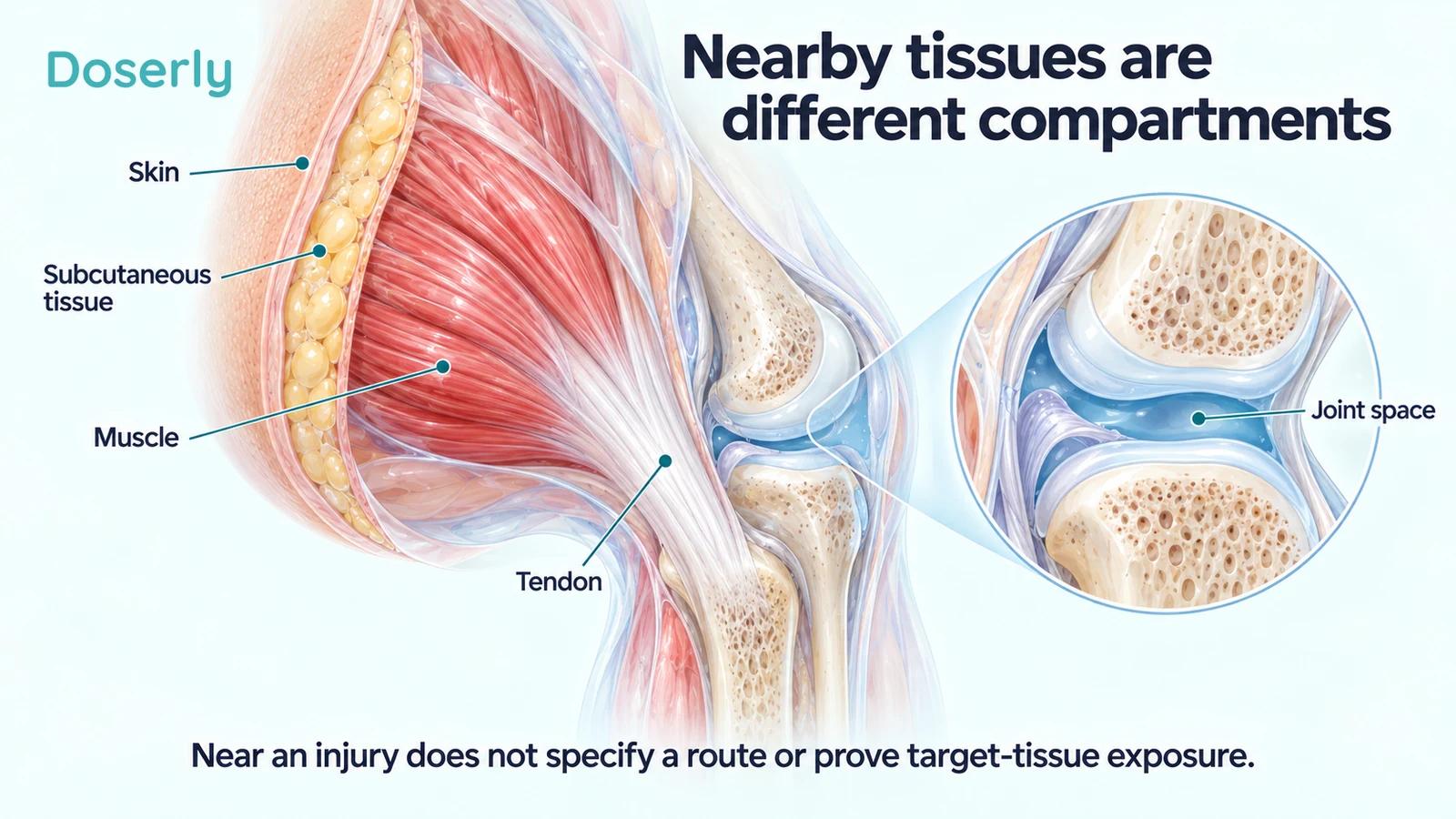
Skin, subcutaneous tissue, muscle, tendon and a joint space are different compartments. A site described in everyday language as “near the knee” does not tell us which compartment receives the product or how much intact peptide reaches the tissue of interest.
Distance on the skin's surface is therefore an incomplete description of delivery. A tendon can lie close to a visible landmark while still being separated from it by other tissues. Placement near a painful region also does not prove that the pain originates in the tissue being targeted.
The distinction between route and location helps. A route describes how a preparation enters the body or a particular compartment, such as oral, intravenous or intra-articular administration. Location describes where that route is used. Changing both at once makes it difficult to attribute an outcome to either.
A fair comparison of nearby and distant delivery would need to specify what remains the same. If one group receives a different formulation, a different amount or a different procedure, any difference in outcome cannot simply be credited to proximity.
What the early tendon experiments actually tested
A 2003 study investigated BPC-157 after surgical transection of rat Achilles tendons. Treatment was administered intraperitoneally, meaning into the abdominal cavity, rather than injected next to the injured tendon. Researchers assessed function, mechanical properties and microscopic tissue findings and reported favorable healing measures. Original rat Achilles experiment
A later rat study examined tendon-to-bone healing after detaching the Achilles tendon from the heel bone. It also used intraperitoneal treatment and reported improvements in functional, mechanical and tissue measures. Some groups additionally received a corticosteroid. Original tendon-to-bone study
These experiments are relevant because they do not support the claim that all favorable BPC-157 findings required placement directly beside an injury. They are not evidence that a particular remote injection site works for a human tendon problem.
The laboratory route, species, controlled injury and outcome measurements all remain attached to the result. Intraperitoneal dosing in rats is not interchangeable with a person's subcutaneous injection. Nor is an acutely transected tendon equivalent to every chronic overuse injury described as tendinitis.
The proper inference is limited: these experiments studied effects under specified animal conditions. They do not identify an optimal human route or location, and they do not establish a treatment plan for an individual injury.
The ligament study used several routes—but it still cannot choose a human site
A 2010 study examined healing after surgical transection of the medial collateral ligament in rats. It reported improvements with intraperitoneal administration, oral delivery in drinking water and topical treatment applied at the injury site. Original rat ligament study
This is more informative than a claim that only one route has ever been investigated. It also illustrates why “local versus systemic” can be an oversimplification. A topical cream, an oral preparation and an abdominal-cavity injection differ in several ways beyond their distance from the injured ligament.
A favorable outcome in multiple treatment groups does not establish equal exposure, equal effectiveness or equivalent safety. Demonstrating equivalence requires a study designed for that question, with enough precision to exclude a clinically important difference.
The study also did not compare two subcutaneous injection locations in people with the same diagnosed injury. Its findings can support further research into delivery, but they cannot settle the practical question that a person asking about a nearby injection site is trying to answer.
Does circulation mean the location cannot matter?
Not necessarily. A substance reaching the circulation may distribute beyond its entry point, while local exposure can still differ. The relevant quantities are how much active material reaches a tissue, how long it remains there and whether that exposure produces a useful biological effect.
Those questions are not answered by declaring a compound “systemic.” They require pharmacokinetic evidence—measurements of absorption, distribution, metabolism and elimination—and, ultimately, clinical outcomes.
The reverse claim is also incomplete. A higher concentration near an entry point would not automatically establish better healing. The concentration might be short-lived, occur in the wrong compartment or fail to improve the outcome that matters. Greater exposure can also create different safety questions.
For BPC-157, the evidence reviewed here does not provide the human tissue-exposure and outcome comparison needed to select a near-injury approach. A mechanistic explanation can make a research question reasonable without answering it.
What the rat-and-dog pharmacokinetic study can tell us
A 2022 study measured BPC-157 after intravenous and intramuscular administration in rats and beagle dogs. The reported elimination half-life of the intact parent compound was less than 30 minutes under the studied conditions. Intramuscular bioavailability also differed between species. Original pharmacokinetic study
These findings show why route and species cannot be ignored. They do not establish a human half-life, a preferred injection interval or a useful concentration inside an injured human tendon. The paper was a preclinical pharmacokinetic investigation, not a human comparison of injection locations.
A short plasma half-life also does not tell us, by itself, how long any downstream biological effect lasts. Exposure and effect are related questions, but they are not the same measurement. Neither a brief measured half-life nor a proposed lasting effect can supply the missing clinical evidence.
This matters when a pharmacokinetic number is used to justify an administration routine. Translating an animal concentration curve into a human regimen would require additional evidence about the product, exposure, intended benefit and risks. The study does not provide that regimen.
A tracer signal is not automatically intact BPC-157
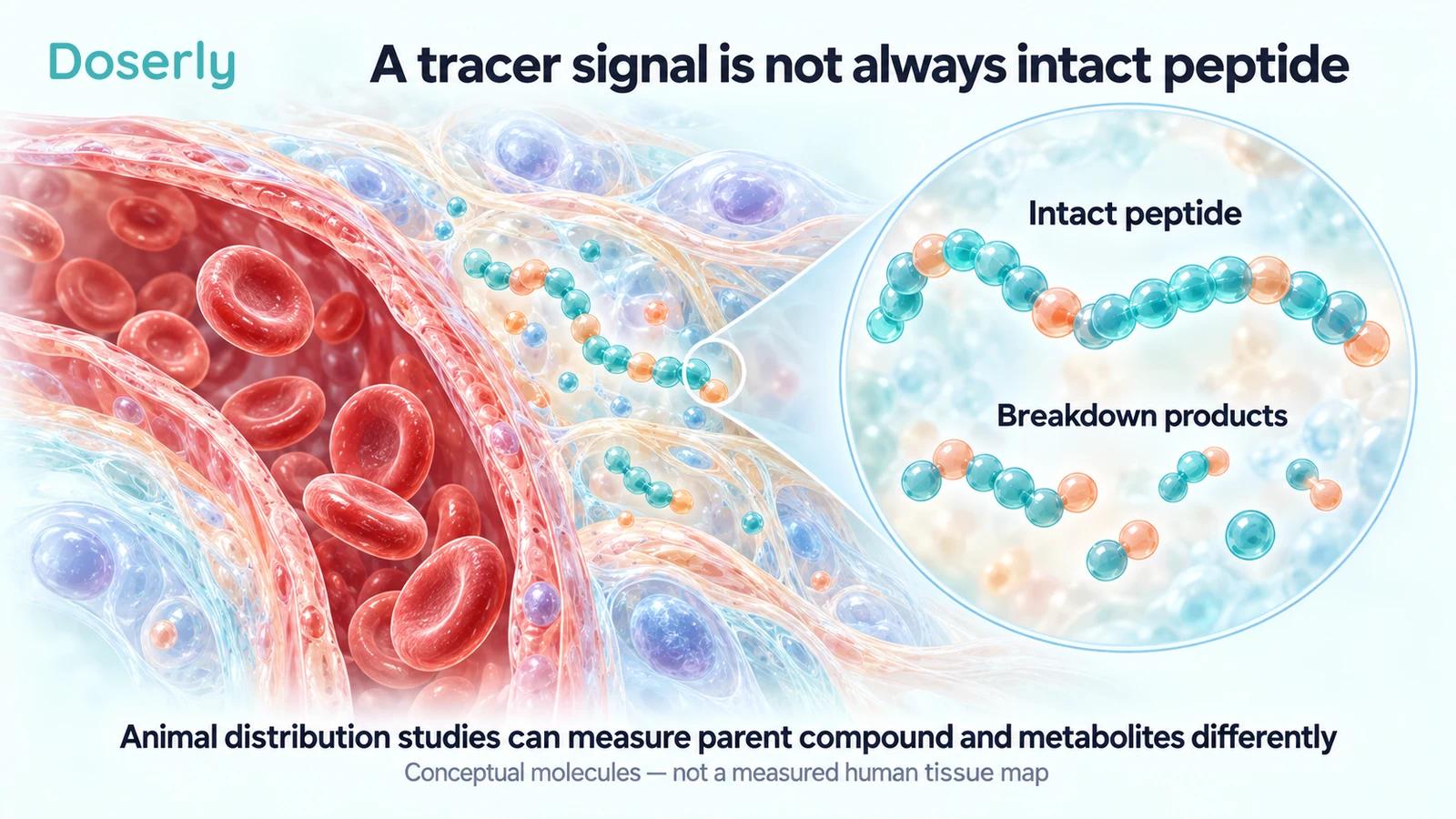
The same investigation used radiolabeled BPC-157 to examine distribution and metabolism in rats. Total radioactivity can include material derived from the peptide after it has been broken down. The researchers identified smaller fragments and amino-acid-related material as part of that process.
This distinction matters when a tissue-distribution image or table is presented as proof that active BPC-157 reaches a particular organ. Detecting a label in tissue is not necessarily the same as measuring intact parent compound there. It is also not a measurement of tissue repair.
A careful reading asks what the assay detects. Is the result for the parent compound, a metabolite or all tracer-derived material together? Without that distinction, a long-lasting tracer signal can be mistaken for a long-lasting concentration of intact peptide.
The study provides useful preclinical information about metabolism and distribution. It does not map an effective human injury dose or show that a nearby injection produces better outcomes than a distant one.
The human knee report does not compare locations
The small 2021 knee report involved injections into the joint and later reports of pain improvement. It did not randomize people to local versus distant administration. It also included both a BPC-157-only group and a smaller group receiving BPC-157 with thymosin beta-4. Original knee report
An intra-articular procedure is not equivalent to placing an injection somewhere near the knee. The study therefore cannot establish the benefit of a different nearby route. Its lack of a concurrent control group also limits conclusions about whether the treatment itself caused the reported improvement.
The outcome was another important boundary: reported pain relief did not demonstrate cartilage or tendon regeneration. A claim about location improving healing would need both a location comparison and an appropriate healing outcome. The knee report supplies neither combination.
This does not dismiss the participants' experiences. It describes the question that the study was capable of answering and the separate questions that remain unresolved.
A registered hamstring trial asks a different question
The ClinicalTrials.gov record for NCT07437547, checked on October 15, 2026, described a planned randomized comparison of investigational BPC-157 and placebo in people with MRI-confirmed grade II hamstring strains, with standardized rehabilitation in both groups. It listed subcutaneous administration and outcomes including return to sport and MRI-assessed injury volume. No results were posted. Primary hamstring-trial registry
A registry describes a study plan and sponsor-submitted status; it is not evidence that the proposed treatment works. The listed comparison also concerns BPC-157 versus placebo, not two different injection locations.
If results eventually become available, they should be interpreted according to the actual population, product, procedures and outcomes studied. Even a favorable result would not automatically establish that proximity caused the benefit or that another route is equivalent.
The useful development is the attempt to measure a defined human injury and relevant outcomes. The question about injection location remains distinct.
What a meaningful location comparison would require
A well-designed study would enroll people with the same clearly defined condition and compare specified locations while keeping the product, route and other important treatment conditions consistent. Rehabilitation and other care would need to be accounted for, because they can affect recovery independently.
Measurements should include outcomes that matter to patients, such as function and return to activity, with structural measures when a repair claim is being tested. Researchers would also need to assess adverse events associated with the product and the procedure.
Blinded outcome assessment would help reduce the influence of expectations. Follow-up should be long enough to distinguish an early symptom change from durable recovery. If investigators wanted to explain a location effect through tissue exposure, appropriate pharmacokinetic measurements would strengthen that explanation.
Such a design would make the claim testable. Repeated anecdotes about a customary site do not provide the same comparison, even when the people reporting them are sincere.
Location is not the only unresolved safety question
FDA's BPC-157 scientific briefing describes limited human safety evidence and potential concerns involving peptide impurities, aggregation and immunogenicity. These uncertainties concern the preparation and route, not simply how close it is to an injury. FDA scientific briefing
Changing location cannot establish a product's identity or sterility, and an apparently uneventful administration does not demonstrate long-term safety. The absence of a proven near-injury advantage should therefore not be turned into reassurance that another unsupervised route is safe.
The current evidence supports a precise answer: the reviewed studies do not establish where a person should inject BPC-157 to improve injury outcomes. They support further research into defined conditions and delivery methods. For an actual injury, diagnosis and a care plan with a qualified clinician remain more useful than choosing between unvalidated location claims.
Sources
- BPC157 accelerates healing of transected rat Achilles tendon.
- Achilles detachment in rat and BPC157.
- BPC157 improves ligament healing in the rat.
- Pharmacokinetics distribution metabolism excretion of BPC157 in rats and dogs.
- Intra-Articular Injection of BPC157 for Multiple Types of Knee Pain.
- BPC157 for Acute Hamstring Muscle Strain Repair.
- FDA BPC157-related bulk drug substances briefing.