
Peptides
October 16, 2026
Desmopressin in dogs: why treating thirst is not the same as diagnosing its cause
On this page
A dog that suddenly empties the water bowl and needs to go outside repeatedly deserves more than a treatment aimed at making the drinking stop. Excessive thirst can be a response to water being lost in urine, and several diseases or medicines can disturb that balance.
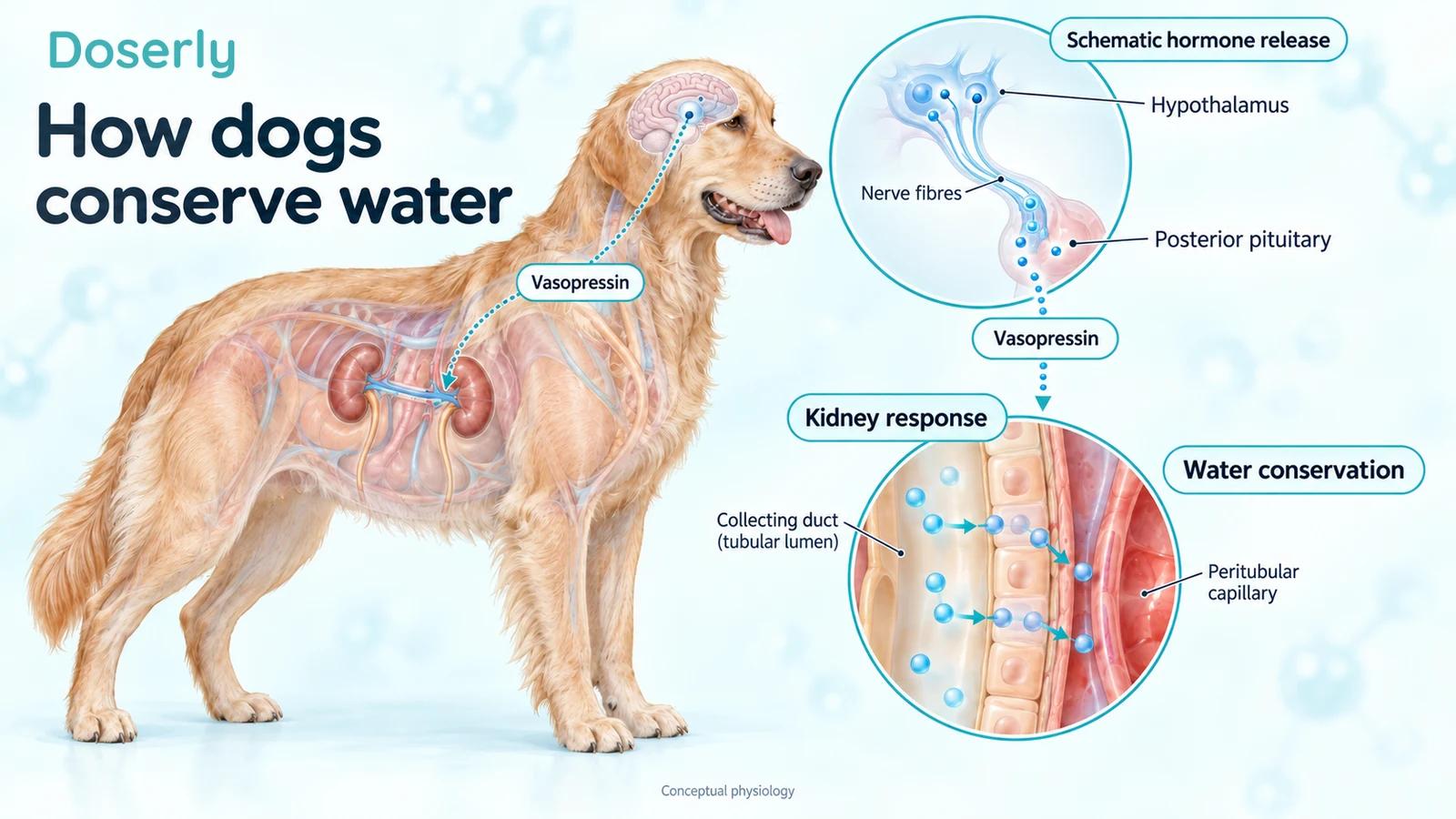
Desmopressin is a synthetic analogue of vasopressin, also called antidiuretic hormone. It can help the kidneys conserve water in dogs with central diabetes insipidus, a disorder of the hormone signal. It is a useful veterinary medicine in the right setting. A response to desmopressin still needs to be interpreted alongside the dog's history, tests, and other signs.
Two kinds of dog research make the distinction especially clear: a clinical series of dogs with central diabetes insipidus, and an experiment in healthy dogs given prednisolone. Both found a response to desmopressin, but they were studying different causes of excessive drinking. Neither supports owners trying a peptide to diagnose or treat thirst themselves.
What the brain and kidneys normally coordinate
Vasopressin is made in the hypothalamus, a region of the brain, and released through the posterior pituitary. It helps regulate how much water the kidneys retain. When that signal is missing or the kidneys cannot respond adequately, a dog can pass large amounts of dilute urine and drink more to replace the loss.
Central diabetes insipidus concerns inadequate hormone secretion. Nephrogenic diabetes insipidus concerns an inadequate kidney response. The latter can arise in association with other diseases or medicines as well as rare inherited problems. The names describe different failures in the same water-regulation system. MSD Veterinary Manual
This is different from diabetes mellitus, in which glucose regulation is disturbed. The shared word “diabetes” can cause understandable confusion. A dog with diabetes mellitus may also drink and urinate excessively, but that does not make desmopressin a substitute for diabetes treatment.
For an owner, the distinction matters because similar behaviour at the water bowl can lead to very different diagnostic and treatment plans. The veterinarian is trying to identify why the water balance changed, not merely confirm that it changed.
Start with the pattern, not the medicine
The terms polyuria and polydipsia mean increased urine production and increased drinking. Owners may notice larger puddles, more frequent requests to go outside, overnight accidents, or a water bowl that needs refilling unusually often. Those observations are useful, but they do not identify the cause.
Frequent attempts to urinate are also different from producing a large total volume. A dog repeatedly passing small amounts, straining, or showing discomfort may need a different investigation from a dog comfortably producing large volumes. Describing what actually happens is more useful than labelling every change “excessive urination.”
A dated account can include when the change started, whether it followed a new medicine, appetite, body-weight changes, and any vomiting or altered behaviour. If your veterinarian asks for water measurements, note that shared bowls, spills, wet food, and drinking outdoors can complicate the estimate. An imperfect measurement is still useful when its limits are clear.
Do not restrict access to water to see whether the problem resolves. In a dog losing water excessively, drinking may be compensating for that loss. Formal water-balance testing requires veterinary selection and monitoring; it is not an experiment to reproduce at home. MSD Veterinary Manual
Why routine blood and urine tests come first
Blood and urine findings help distinguish conditions that can look similar from the outside. For diabetes mellitus, AAHA's current dog guidelines emphasize compatible clinical signs together with concurrent high blood glucose and glucose in urine. That is a different diagnostic pattern from a water-regulation disorder alone. AAHA canine diabetes diagnosis guidance
Other endocrine disorders also enter the assessment. Canine hypercortisolism, often called Cushing's syndrome, can include increased thirst and urination along with other clinical and laboratory changes. AAHA recommends interpreting those findings through the overall presentation rather than diagnosing the disease from a single nonspecific sign. AAHA hypercortisolism diagnostic approach
This helps explain why a veterinarian may ask about skin changes, appetite, medicines, and previous laboratory results when the apparent complaint is thirst. Those details can change which explanations deserve attention.
It also explains why replacing the initial work-up with a treatment trial can be misleading. If the dog has another condition requiring treatment, a reduction in drinking could improve one symptom while leaving that condition unresolved. The purpose of the investigation is to avoid losing that larger picture.
What urine concentration can tell the veterinarian
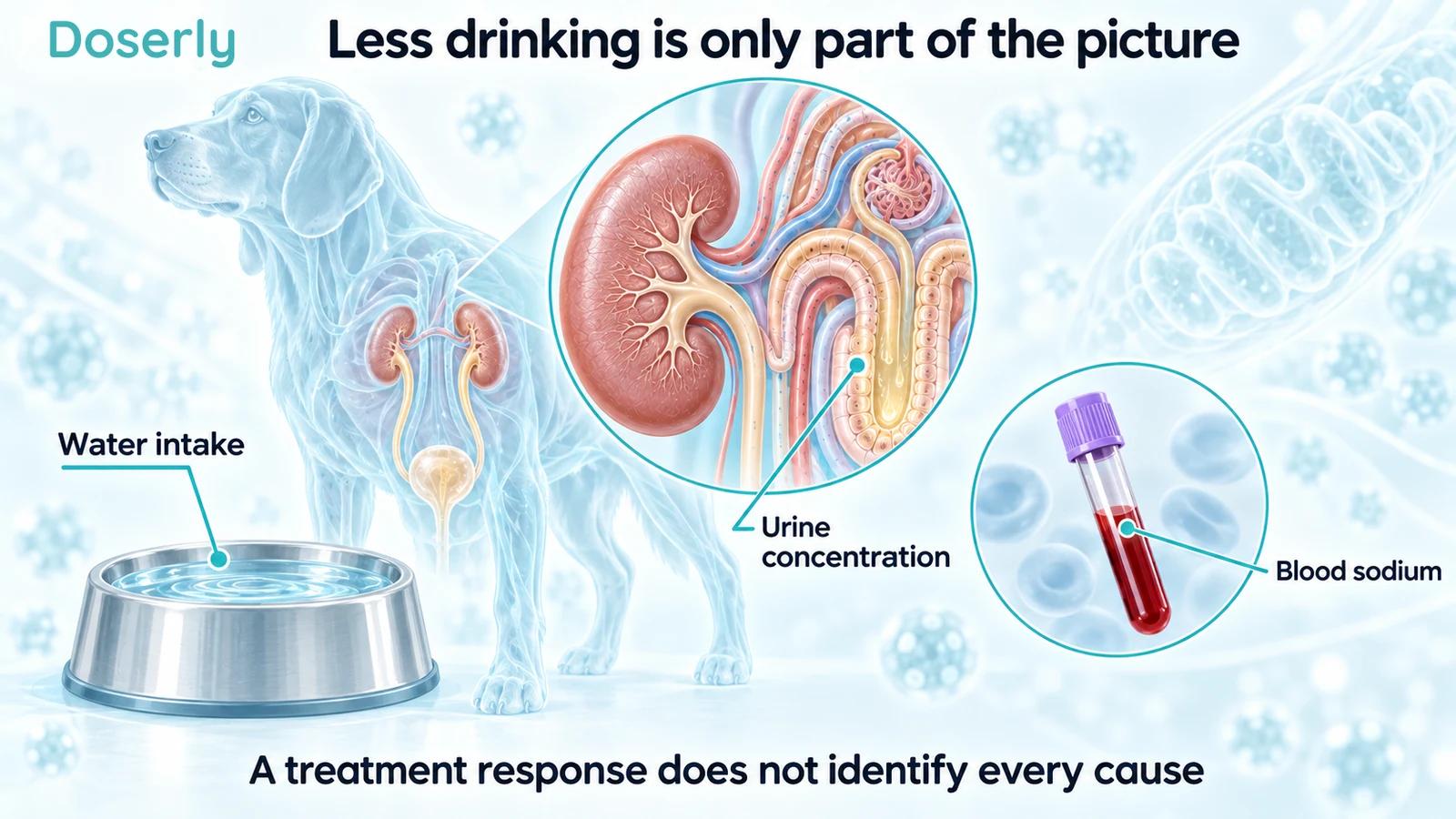
Urine specific gravity, often abbreviated USG, is a measure used to assess urine concentration. It helps describe the kidney's handling of water, but it is interpreted alongside hydration, blood findings, medicines, and the timing of the sample.
A single dilute sample does not establish central diabetes insipidus. Nor should an owner assume that a sample that is not maximally dilute excludes it. In the historical clinical series discussed below, partial disease was common, illustrating why the pattern can be more complicated than an all-or-nothing failure.
Repeated measurements can be informative because concentration varies over time. A 1999 report investigated four dogs classified as having primary polydipsia. Their hormone responses and urine measurements showed complex regulation rather than a simple separation into “medical” and “behavioural” drinking. Some produced concentrated urine spontaneously. Van Vonderen and colleagues
That small report does not create a home diagnostic rule. It shows why a veterinarian may need to interpret a series of observations and reconsider an initial label. Drinking behaviour and hormone physiology can interact.
What the 20-dog clinical series actually found
A 1996 retrospective report reviewed 20 dogs with central diabetes insipidus seen between 1986 and 1995. The investigators examined medical records and supplemented them with owner follow-up. Seven dogs were classified as having complete disease and 13 as having partial disease. Dogs treated with desmopressin responded well. Harb and colleagues
The same report documented important underlying disease in some dogs. Seven of the ten dogs that died developed neurological signs after diagnosis; imaging or postmortem examination identified pituitary-region tumours in evaluated subsets. These observations support continued attention to the cause and to new neurological signs.
The study was not a randomized trial, and a referral case series cannot establish the probability that an individual dog has a tumour. Its clinical lesson is that controlling excessive urine production does not guarantee that the disorder causing it is benign or resolved.
For an owner whose dog improves, this distinction can initially feel counterintuitive. The medicine may be doing its intended job while a separate investigation or follow-up plan remains important. Improvement and ongoing diagnostic uncertainty can both be real.
A treatment response can occur in a different setting
A 2021 study investigated desmopressin during prednisolone treatment in seven healthy adult Walker Hounds. Prednisolone is a glucocorticoid medicine used in veterinary care; increased drinking and urination can be troublesome effects.
Six dogs developed increased drinking and received desmopressin during a short treatment period. The study used sequential phases: baseline, prednisolone, the combination, and prednisolone after desmopressin was stopped. Water intake decreased and urine became more concentrated when desmopressin was added. Prednisolone–desmopressin study
These were research dogs with a medication-associated change, not a series of pets with spontaneous central diabetes insipidus. The study therefore supplies a concrete reason not to interpret every desmopressin response as proof of one diagnosis.
It was also small and short, with treatment phases in a fixed sequence rather than a large parallel randomized comparison. Its results help identify a physiological effect and a safety concern. They do not establish routine unsupervised use for a thirsty dog.
Why sodium belongs in the conversation
The same prednisolone experiment found a decrease in blood sodium when desmopressin was added. In one dog, sodium fell from 142 to 131 mEq/L over three days. That is a measured safety signal in this specific experiment, not an estimate of how often the problem occurs in pets. Study safety findings
Sodium concentration reflects the relationship between sodium and water, not simply how much salt an animal eats. A treatment that changes water retention can therefore change the blood result even while drinking appears more normal.
That is why a reassuring change in the water bowl cannot replace follow-up. The desired symptom response and an unwanted physiological effect can occur together. Owners cannot assess the relevant blood chemistry by appearance alone.
If desmopressin is prescribed, the monitoring plan should come from the veterinarian who knows the dog's diagnosis, other medicines, and laboratory findings. The experiment's treatment schedule is not a plan to copy. Nor should an owner independently change prednisolone because of thirst: the original reason for that medicine still matters.
What a supervised trial is trying to establish
A veterinary desmopressin trial is more informative when it begins with a defined question and baseline observations. The veterinarian can specify what response to look for, how it will be measured, and which changes would require reassessment.
The response may contribute to a diagnosis, but it does not replace the rest of the case. The medication history is especially relevant when a drug could be contributing to thirst. Laboratory findings help establish whether a symptom improvement is accompanied by a safe physiological response.
A trial also needs a plan for ambiguous results. Little apparent change might reflect several possibilities, including a different underlying mechanism or difficulties with the prescribed formulation and administration. It should prompt discussion with the veterinarian rather than an owner escalating treatment or trying another product.
Similarly, a striking improvement should be reported accurately. “The overnight accidents stopped” and “the measured water intake fell” are useful observations. “The underlying disease is cured” is a different claim that those observations cannot establish.
Follow-up should include the dog, not only the water bowl
Ask your veterinarian which new signs should trigger an urgent call and how the next assessment will be organized. A dog that becomes markedly unwell, weak, disoriented, or develops seizures needs prompt veterinary attention rather than continued home observation. These signs can have multiple causes and should not be used to diagnose a sodium problem without testing.
Over time, the useful record includes activity, appetite, weight, urinary changes, medication changes, and any missed or difficult administrations. Keep the actual prescribed formulation clear in that record. Products with different concentrations or routes should not be treated as interchangeable because they share a drug name.
If the initial cause remains uncertain, ask what the next decision depends on. It may be repeat laboratory findings, the clinical examination, a medication review, or imaging in a selected case. Knowing that plan can make follow-up feel less like repeating tests and more like answering the remaining question.
Questions to take to the appointment
The most helpful questions connect diagnosis, symptom control, and safety:
- What causes of increased thirst and urination fit this dog's examination and test results?
- What would a desmopressin response tell us, and what would it leave unanswered?
- How will urine concentration and blood sodium be followed if treatment is prescribed?
- Does the age, history, or neurological examination make further investigation important?
- Which changes should lead to a call before the planned follow-up?
Desmopressin can be valuable when a veterinarian identifies the appropriate use. Its value does not depend on treating it as a universal remedy for thirst. Understanding why the dog is drinking more helps make symptom relief part of a sound care plan.
Sources
- MSD Veterinary Manual: Diabetes Insipidus in Animals — clinical physiology and diagnostic context.
- AAHA: recognizing and diagnosing diabetes mellitus in dogs, 2026 — glucose-related differential diagnosis.
- AAHA: canine hypercortisolism diagnostic approach — interpretation of clinical presentation.
- Harb et al., 1996: Central diabetes insipidus in dogs: 20 cases — retrospective clinical series.
- Van Vonderen et al., 1999: disturbed vasopressin release in four dogs — primary-polydipsia investigation.
- Effects of desmopressin acetate administration in healthy dogs receiving prednisolone, 2021 — short experimental study and sodium safety finding.