
Peptides
October 16, 2026
Delta sleep-inducing peptide: does DSIP actually improve sleep?
On this page
Delta sleep-inducing peptide, usually shortened to DSIP, is a small chain of nine amino acids that researchers have investigated for effects on sleep. Its name makes a powerful first impression. If you're lying awake at night or waking exhausted, a substance called “sleep-inducing peptide” sounds as though the most important question has already been answered.
It hasn't. Small human studies produced different results, and the better-controlled insomnia experiments did not establish a substantial, reliable benefit. DSIP is an interesting research subject, but its name is not evidence that it restores deep sleep or treats chronic insomnia. Understanding that distinction doesn't require dismissing the positive studies. It means looking at what happened in them, who participated and which improvements were actually measured.
Our DSIP guide covers the broader background. Here, we'll focus on the sleep question: where the name came from, what the human experiments found and what those findings can tell someone hoping to sleep better.
What does “delta sleep” mean?
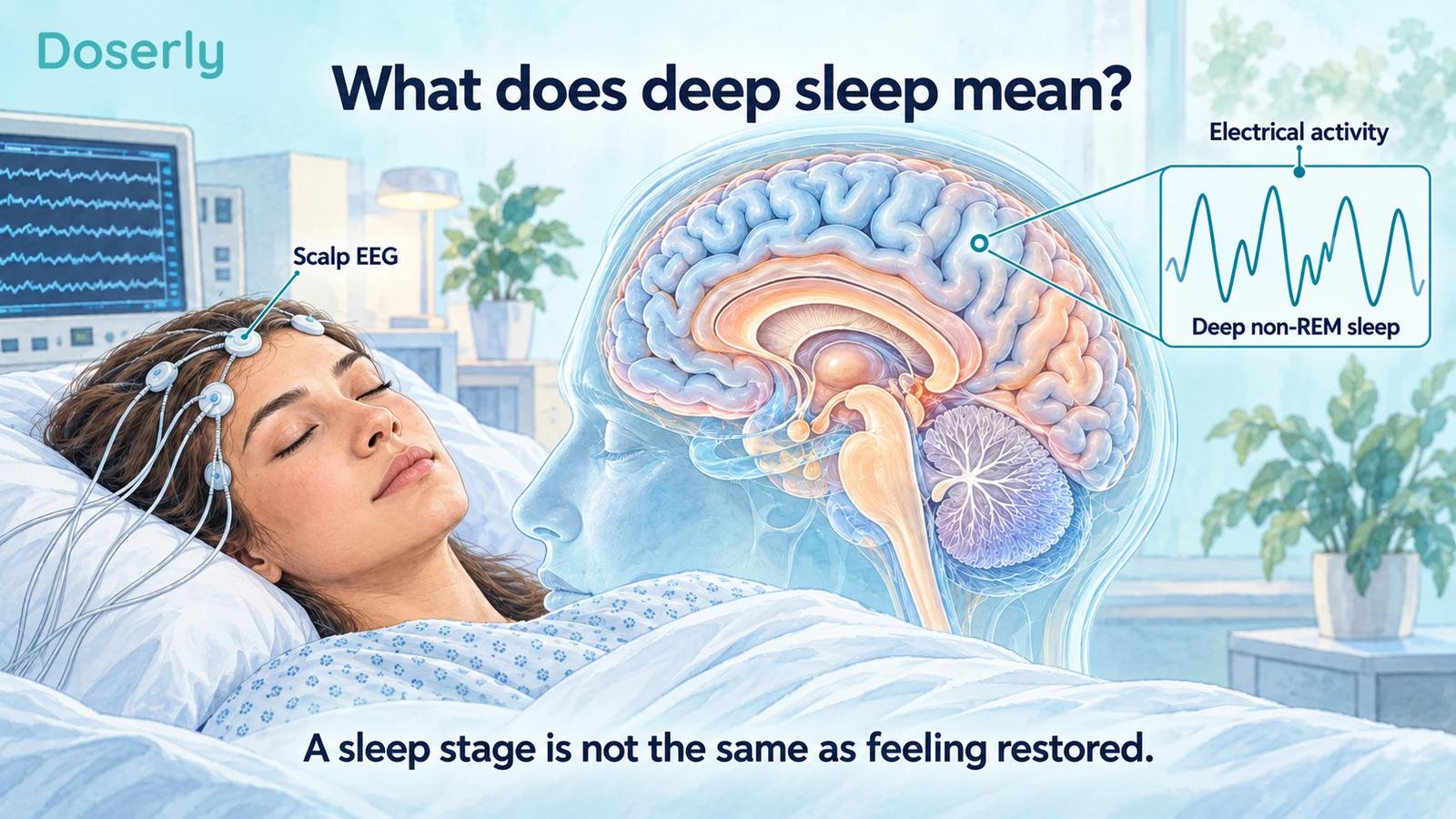
Sleep changes across the night. During non-rapid-eye-movement sleep, or non-REM sleep, brain activity progresses through different stages. Stage N3 is often called deep sleep or slow-wave sleep because of the slower electrical patterns recorded from the scalp. REM sleep is a different state, associated with rapid eye movements and a different pattern of brain activity. Both belong to normal sleep; a healthy night isn't simply a continuous stretch of the deepest stage. NIH explanation of sleep stages
An electroencephalogram, or EEG, records tiny electrical signals through electrodes placed on the scalp. Researchers can use those signals, along with eye movements and muscle activity, to classify sleep stages. They aren't measuring whether the person feels refreshed directly. Someone's experience the next morning has to be assessed separately.
The historical DSIP name grew out of experiments concerning slow-wave sleep in rabbits. The original research program investigated whether material obtained from sleeping animals could influence sleep in other animals, then isolated and synthesized the peptide. Those were animal experiments, not demonstrations that a marketed DSIP preparation treats insomnia in people. The original investigators also described species differences in sleep responses, a reminder that even animal results were not one uniform effect. Historical experimental account
Why the first human experiment attracted attention
An early study enrolled six healthy volunteers, four men and two women. In a blinded crossover experiment, they received DSIP and placebo on separate occasions, allowing each person to contribute to both comparisons. Researchers administered DSIP slowly into a vein in the morning and observed sleep and behavior.
The report described a 59% increase in median total sleep time during a 130-minute observation period compared with placebo. It also reported changes in the following night's sleep, including shorter time to fall asleep and better sleep efficiency. Sleep efficiency means the proportion of the measured time in bed spent asleep. Early human DSIP experiment
That 59% figure deserves its full context. It concerns a short daytime observation window in six healthy people. It does not mean that people with insomnia slept 59% longer every night, or that their deep sleep increased by 59%. Those would be different outcomes in a different population. The report was a reason for further investigation, not a practical estimate of the benefit a patient should expect.
The distinction matters especially when numbers travel without their denominators. A relative increase can sound substantial even when the underlying period is short. Without the starting number of minutes and a relevant patient population, it cannot answer how much additional sleep someone with chronic insomnia might obtain.
What happened when researchers studied insomnia?
One early study examined six middle-aged people with chronic insomnia after intravenous DSIP. The authors reported longer sleep, fewer interruptions and somewhat more REM sleep. They also described an initial period of slight arousal before the sleep-promoting effects appeared. 1981 insomnia study
These findings help explain why DSIP remained of interest. They also show why calling it a straightforward sedative oversimplifies the research. The reported pattern was not simply immediate unconsciousness after administration. Timing, study conditions and the type of sleep measurement all mattered.
Later findings were less persuasive. In Monti and colleagues' 1987 blinded crossover study, researchers recorded sleep during DSIP and placebo nights in people with chronic insomnia. Some measures moved in a favorable direction, but awakenings, time awake and time to enter non-REM sleep did not differ significantly from baseline or placebo. Slow-wave sleep and REM sleep were not changed. Differences involving stage 2 sleep were complicated by differences that already existed at baseline. The authors judged the improvement to have little clinical significance. Monti study
That is particularly relevant to the deep-sleep claim. More total non-REM sleep is not automatically more deep sleep: non-REM includes lighter stages too. The specific study did not demonstrate an increase in slow-wave sleep, despite the compound's name.
A 1992 study enrolled 16 people with chronic insomnia. Eight received DSIP and eight placebo during a five-night laboratory stay, with treatment before the final three nights. Some objective measures favored DSIP, including sleep efficiency and sleep latency, the time needed to fall asleep. However, the effects were weak, some appeared related to changes in the placebo group, and subjective sleep quality did not improve. The researchers did not consider short-term treatment likely to provide a major therapeutic benefit. Bes and colleagues
Does mixed evidence mean DSIP never changes sleep?
No. “Not established as a useful treatment” is different from “incapable of changing any sleep measurement.” A small experiment may identify a biological effect without showing that the effect is large, consistent or useful enough for treatment.
Imagine a person who spends less time falling asleep but still wakes repeatedly and feels just as exhausted in the morning. An improvement in sleep latency would be real if measured reliably. Whether the overall treatment is worthwhile would depend on the size of that improvement, the remaining symptoms and any harms. Conversely, someone may report feeling better without a dramatic change in laboratory staging. The patient's experience deserves measurement too.
The main problem with the DSIP literature is not merely that it is old. A well-conducted older study can remain informative. The difficulties are the very small samples, short observation periods, inconsistent findings and limited information about sustained benefits. Those features make it hard to estimate how often a meaningful response occurs or which patients, if any, are likely to benefit.
Nor can positive and negative papers be counted like votes. An uncontrolled improvement in seven people and a blinded placebo comparison in 16 people don't provide equivalent information. Study design determines how confidently an observed improvement can be attributed to treatment.
What would count as sleeping better?
The answer begins with the person's problem. Someone who cannot fall asleep needs a different primary improvement from someone who wakes for long periods during the night. A person who sleeps for an apparently adequate time but remains sleepy during the day may need assessment for a different sleep problem altogether.
Useful outcomes include time to fall asleep, time awake after first falling asleep, total sleep time, perceived sleep quality and daytime functioning. They overlap but are not interchangeable. A stage percentage is especially easy to overinterpret because its denominator changes. If total sleep time falls, the percentage spent in one stage can rise even without an increase in the minutes spent there.
Researchers therefore need to explain both the amount of sleep and its composition. They should also ask whether people notice a worthwhile difference. A statistically detectable shift is not automatically large enough to matter to someone trying to work, care for family or feel rested.

Do older intravenous studies support today's products?
The route of administration is part of the treatment. Giving a peptide into a vein bypasses the absorption step required after an injection beneath the skin. A nasal preparation introduces another set of questions about delivery and absorption. Similar names on product labels do not establish equivalent exposure.
FDA's 2026 emideltide briefing—emideltide is another name used for DSIP—reviewed the proposed subcutaneous route. Staff found no effectiveness studies supporting that route for chronic insomnia and considered the intravenous evidence insufficient for a firm effectiveness conclusion. This is a statement about the reviewed evidence, not a claim that all possible formulations have been tested and failed. FDA emideltide briefing
Consequently, the early intravenous findings cannot supply a validated schedule for a different product. They also don't establish that an online vial has the same identity, purity or stability as the preparation used in a published experiment. A clinician considering any investigational treatment would need product-specific information as well as an explanation of the intended benefit.
What can we say about safety?
Some early reports described good short-term tolerance. That is useful information, but six or 16 participants observed briefly cannot establish long-term safety or reliably detect uncommon adverse effects. A report of no observed serious problem is bounded by the number of people studied and the length of follow-up.
Safety also includes effects that matter specifically to sleep treatment. Does the person feel impaired the next morning? Does a benefit persist with repeated use? What happens after stopping? Does the treatment interact with medicines or substances already being taken? The short DSIP studies cannot provide a complete answer to these practical questions.
This is why uncertainty about benefit and uncertainty about harm need to be considered together. A treatment does not become a good option simply because the literature has not documented a large number of injuries. Small exposure datasets leave both sides of the comparison uncertain.
A more useful starting point for persistent insomnia
If poor sleep keeps recurring, describe the pattern rather than beginning with a preferred compound. Bring information about bedtimes, estimated time to fall asleep, prolonged awakenings, wake times and daytime effects. A brief diary can help a clinician understand what is happening without turning every night into a performance score.
AASM's guideline strongly recommends multicomponent cognitive behavioral therapy for insomnia, commonly called CBT-I, for adults with chronic insomnia. It also distinguishes that treatment from sleep-hygiene advice alone. CBT-I is a structured treatment approach, not simply an instruction to avoid screens or try harder to relax. AASM behavioral treatment guideline
If DSIP comes up in that conversation, useful questions are specific: Which study supports the proposed use? Did it involve people with this sleep problem? Was the formulation and route the same? What improvement would justify continuing, and how would adverse effects be assessed?
DSIP's history offers a reason to investigate a sleep-related peptide, and its small human studies provide observations worth understanding. They do not establish a dependable deep-sleep treatment. The most useful goal is better sleep and better daytime function for the person seeking help, measured directly rather than inferred from a name.
Sources
- Schoenenberger, historical experimental account of DSIP, 1984.
- Acute and delayed DSIP effects in six healthy volunteers, 1981.
- Schneider-Helmert and Schoenenberger, disturbed human sleep, 1981.
- Monti and colleagues, short-term insomnia study, 1987.
- Bes and colleagues, double-blind insomnia study, 1992.
- FDA, emideltide-related bulk drug substances briefing, 2026.
- NHLBI, sleep phases and stages.
- AASM, behavioral and psychological treatments for chronic insomnia, 2021.