
Supplements
October 16, 2026
D-mannose for recurrent UTIs: what changed after the larger trial?
On this page
D-mannose became popular for a reason that sounds biologically sensible: some urinary bacteria attach to the bladder lining, and a sugar that interferes with that attachment might help prevent another infection. For someone dealing with repeated UTIs, an approach that could reduce antibiotic use is understandably appealing.
The problem is that a convincing explanation and an effective preventive treatment are different achievements. In 2024, a large placebo-controlled trial tested D-mannose in the setting where many people actually seek help: primary care. It did not find a clear reduction in recurrent, medically attended UTIs. That result changes how confidently the supplement should be recommended, even though it does not erase the earlier research or dismiss anyone's experience. Hayward and colleagues, 2024
If you already use D-mannose, the useful question is what evidence now supports keeping it in your prevention plan. That discussion should include what happened in the trial, which patients it studied, and what a symptom-free interval can and cannot tell you.
The proposed mechanism targets attachment
D-mannose is a simple sugar. The research rationale concerns bacterial adhesion: certain bacteria use fine surface structures to attach to cells lining the urinary tract. One target is FimH, an attachment protein associated with type 1 pili on some strains of Escherichia coli.
The hypothesis is that available mannose can interact with this attachment machinery and reduce binding to the urinary lining. It is not the same mechanism as an antibiotic killing susceptible bacteria or stopping their growth. It also does not address every organism, every reason for urinary symptoms or every pathway involved in recurrent infection. The MERIT trial protocol described this biological rationale as a reason to test the supplement, not as proof of effectiveness. MERIT protocol
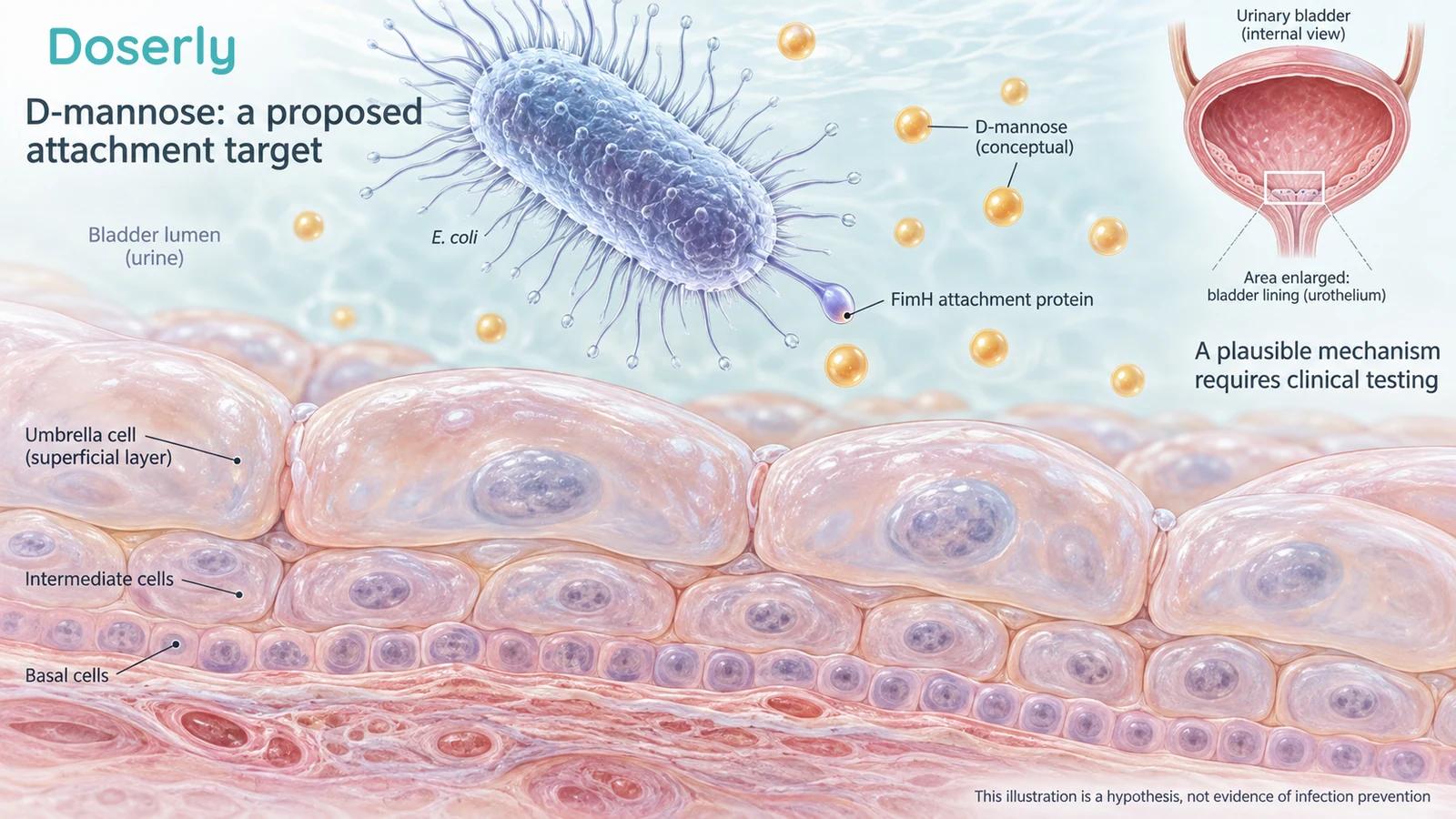
This distinction matters when a product advertisement moves directly from a molecular illustration to a claim about fewer UTIs. Several steps sit between those two statements: exposure after swallowing the product, the organisms involved, adherence over time and whether patients experience fewer clinically important episodes. A well-designed human comparison tests that combined real-world effect.
Why the earlier trial generated optimism
An influential trial published in 2014 enrolled 308 women after initial antibiotic treatment for acute cystitis. Participants had a history of recurrent UTIs and were assigned to D-mannose, preventive nitrofurantoin or no preventive treatment for six months.
Recurrence was reported in 15 of 103 women receiving D-mannose, 21 of 103 receiving nitrofurantoin and 62 of 102 receiving no prophylaxis. Those results were striking. They offered a reason to investigate D-mannose further and explain why older summaries could sound confident. The study did not, however, include a matched placebo group, and it was an open trial. People and clinicians could know which preventive approach was being used. Kranjčec and colleagues
A lower recurrence rate than a no-treatment group is informative, but the absence of blinding leaves more room for differences in symptom reporting, care seeking and management. The comparison with nitrofurantoin also should not be translated into a claim that the two were proven equivalent. Failing to detect a difference is not the same as meeting a prespecified noninferiority standard.
The 2022 Cochrane review reflected the uncertainty. It included seven randomized trials with 719 participants, but differences in interventions and comparisons prevented a useful overall meta-analysis. The reviewers judged key comparisons to provide very low-certainty evidence and concluded that there was insufficient evidence to establish D-mannose's benefit for preventing or treating UTIs. This review preceded the larger 2024 results. Cochrane review
What the larger primary-care trial tested
The MERIT study recruited 598 women from 99 primary-care centers in the United Kingdom. Participants were adults living in the community, with records of at least two UTI consultations in six months or three in the previous year. Their average age was 58, with an age range extending from young adulthood into the nineties.
Participants were randomly assigned to 2 g of D-mannose powder daily or a matched placebo powder for six months. The amount describes the tested intervention, not a recommendation to start, increase or continue that dose. The study was double-blind, so the comparison was designed to limit differences caused by knowing the assignment.
The main outcome was practical: whether a woman experienced at least one further clinically suspected UTI for which she contacted ambulatory care. It was not a laboratory count of bacterial attachment. It asked whether the preventive strategy changed an event important enough to prompt medical contact. This yes-or-no outcome counts a woman once even if she has several episodes; the number of repeat episodes is a separate question. Primary-outcome information was available for 583 participants, or 97.5% of those randomized. Trial design and primary outcome
That high outcome ascertainment deserves attention because stopping study powder is different from disappearing from follow-up. A trial can retain useful medical-record outcome data even when someone does not continue the intervention. The result is therefore not simply a comparison of a small group of enthusiastic long-term users with everyone else.
Reading the result without making it sound better or worse
Among women with primary-outcome data, 150 of 294 in the D-mannose group experienced a medically attended suspected UTI, compared with 161 of 289 in the placebo group. Those proportions were 51.0% and 55.7%.
The reported absolute risk difference was approximately −5 percentage points, with a 95% confidence interval from −13 to +3 percentage points. The interval includes no difference. The study therefore did not establish a preventive benefit; the lower numerical percentage is not enough to call the trial positive.
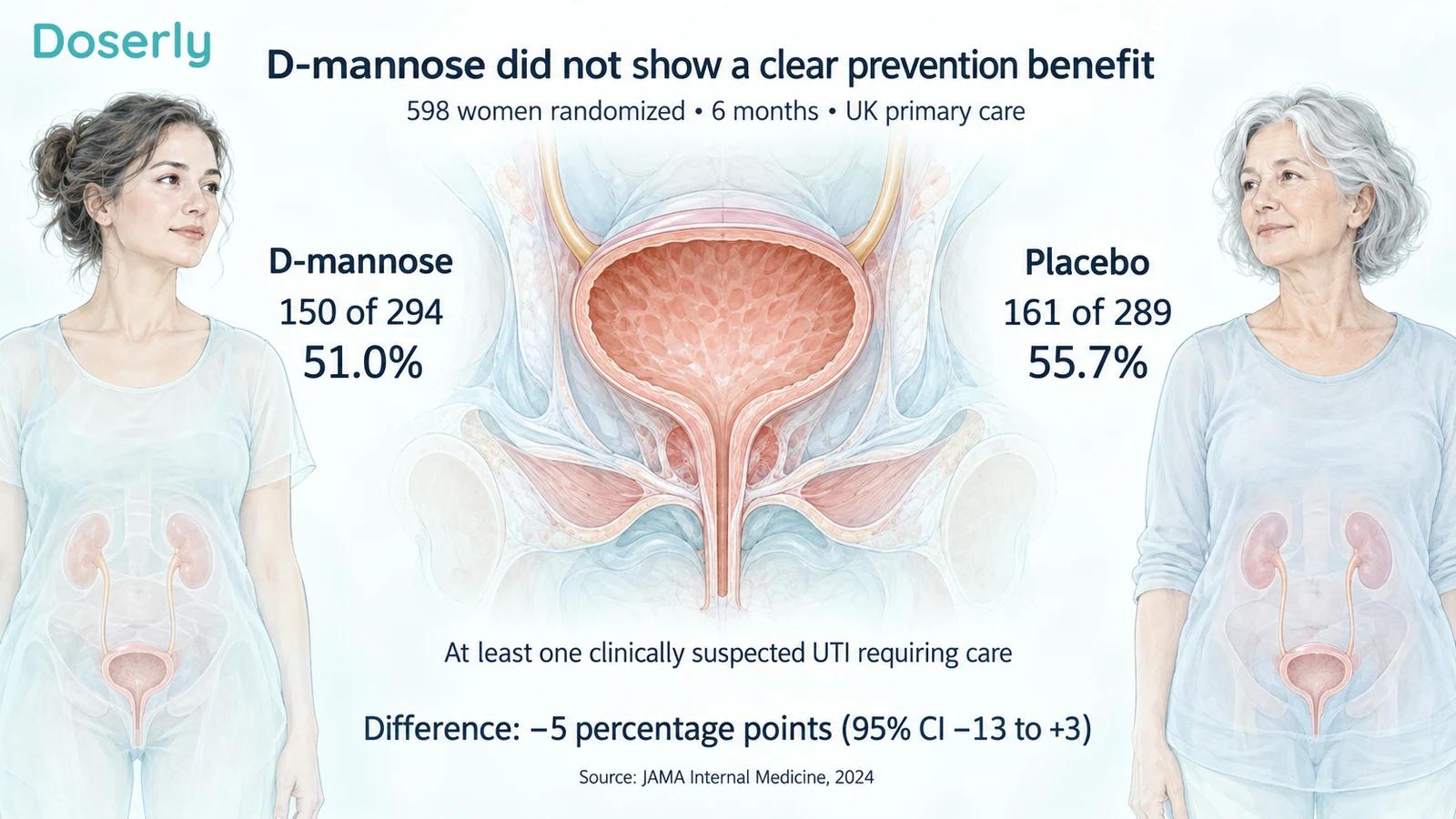
At the same time, “no statistically significant benefit” does not mean the study proved the true effect is exactly zero in every possible population. The confidence interval describes remaining uncertainty. It is reasonable to say the trial did not support routine D-mannose prevention for women like those studied; it is less defensible to turn that into a universal claim about every formulation, setting or future research question.
Secondary findings did not provide a persuasive rescue of the main result. There was no clear difference in time to the next medically attended UTI, microbiologically proven infections or prescribed antibiotic courses. One analysis of days prescribed antibiotics initially differed, but this was sensitive to a small number of unusually high-use participants; a sensitivity analysis did not retain that difference. The overall findings did not show a reliable antibiotic-sparing effect. Full results and sensitivity analyses
Could age, adherence or the outcome explain the result?
These are reasonable questions, and the investigators considered them. The trial included many postmenopausal women, whereas earlier studies involved younger participants. Prespecified analyses comparing premenopausal and postmenopausal participants did not identify a clear benefit, but subgroup analyses were not powered to settle small differences. The result does not establish a hidden success in younger women simply because the overall average age was higher.
Adherence was imperfect, as it often is during months of preventive treatment. Analyses restricted to participants reporting better adherence gave similar results. That makes it harder to explain away the finding solely as a failure to take the powder. It does not prove every person took precisely the intended amount every day.
The primary outcome used clinically suspected infections rather than requiring a positive culture for every episode. This reflects care-seeking burden but allows some diagnostic uncertainty. Cultures were obtained at more than 60% of clinical contacts for suspected infection, and microbiologically confirmed outcomes were also similar between groups. The culture limitation is real, but the available laboratory results do not establish an opposite conclusion. Strengths and limitations
Recruitment setting also matters. Women referred to specialist care may have different severity or underlying problems from a broad primary-care population. That is a reason to define the conclusion carefully and conduct targeted research if justified. It is not evidence that a specialist population already has a proven benefit.
What current guidance says
The 2025 AUA/CUA/SUFU amendment advises clinicians to inform patients with recurrent UTIs that D-mannose alone may not be effective for prevention. That is a meaningful change in the practical conversation: a product can remain widely available while the evidence supporting routine use weakens. AUA amendment summary
The word “alone” also matters. A mixture containing cranberry, D-mannose and other ingredients is a different intervention. Evidence for such a mixture cannot identify which ingredient contributed, and the larger D-mannose trial cannot automatically establish the performance of the mixture. Each formulation needs appropriate evidence; adding ingredients does not resolve a negative result by itself.
Research on synthetic mannosides or vaccines directed at bacterial attachment machinery is different again. Those approaches are not interchangeable with an over-the-counter D-mannose powder. A promising result for a different molecule or intervention would not validate the supplement by association. The 2024 paper discusses these as distinct research directions. Research implications
If it seemed to help you, bring the record
A long interval without an infection can be a real and important improvement. The uncertain part is attribution. Recurrences vary naturally, and people often start a new product after an unusually difficult cluster of episodes. The following months may be better even without an effective intervention. Other changes can occur at the same time, including medical treatment or a different prevention strategy.
A useful record preserves dates of symptoms, urine tests where available, clinician diagnoses, prescribed treatments and the exact supplement used. Include interruptions and adverse effects. This gives the appointment something more concrete than either “it works for me” or “the trial says it cannot work.” Your experience deserves discussion, while the controlled comparison remains the stronger tool for estimating average benefit.
Cost and burden belong in that discussion. A daily powder can be inconvenient and expensive even when it causes no obvious problem. Continuing it because it was once recommended is a different decision from continuing it after reviewing newer evidence and the alternatives appropriate to your history. There is no need to prove that a product harmed you before asking whether it still earns its place.
Keep an active-infection plan separate
Neither the 2014 nor the 2024 prevention story establishes D-mannose as a substitute for assessing current urinary symptoms. In the earlier trial, acute cystitis was initially treated with antibiotics before the prevention comparison. That detail disappears easily when the recurrence percentages are shared on their own. Earlier trial design
Contact a health professional for symptoms suggesting a bladder infection. Fever, chills, nausea or vomiting, and pain in the back, side or groin can signal kidney involvement and need prompt attention. Do not use a supplement trial as the reason to delay that assessment. NIDDK guidance
The Doserly D-mannose guide offers ingredient background. The newer evidence supports a more specific conclusion: for women with recurrent UTIs managed in primary care, the large placebo-controlled trial did not establish useful prevention. A clinician can help translate that result into a plan that addresses both future recurrences and what to do when symptoms return.
Sources
- Hayward and colleagues, 2024: MERIT randomized trial, full methods and results.
- Franssen and colleagues, 2021: MERIT protocol and biological rationale, not efficacy results.
- Kranjčec and colleagues, 2014: earlier open randomized comparison.
- Cochrane review, 2022: evidence before MERIT results.
- AUA/CUA/SUFU amendment summary, 2025: current prevention guidance.
- NIDDK bladder-infection symptoms: assessment and prompt-care guidance.