
Supplements
October 16, 2026
Cranberry for recurrent UTIs: prevention is a different decision from treatment
On this page
Cranberry has a plausible place in a conversation about repeated urinary tract infections. It has a much less defensible place as the reason someone waits out burning urination, fever or worsening pain. Those are different clinical situations, even though the same bottle may be marketed for both.
The distinction begins with timing. Prevention studies ask whether people who use a cranberry product experience fewer infections over the following months. Treatment studies would need to show that cranberry helps resolve an infection that is already present. A reduction in future episodes cannot answer how to manage symptoms today.
For women with recurrent UTIs, the prevention evidence is more encouraging than the familiar claim that cranberry is simply a myth. It is also more conditional than a promise that any cranberry capsule will work. Product composition, the population studied and the definition of a UTI all affect what the research can tell us. Cochrane prevention review
Why cranberry became a urinary-health ingredient
The bladder is lined by a specialized tissue called the urothelium. Some bacteria that cause UTIs can attach to this lining using structures on their surface. Cranberry contains plant compounds called proanthocyanidins, usually abbreviated PACs, which have been studied for their ability to interfere with bacterial attachment.
That proposed anti-attachment action helps explain the interest in prevention. It does not mean a glass of juice sterilizes urine, kills every urinary pathogen or repairs an infected bladder. Nor does an effect in an experimental model establish that an oral product reaches the right place in the right form to produce a useful clinical benefit. Human trials are needed to connect the laboratory idea to fewer infections. NCCIH cranberry overview
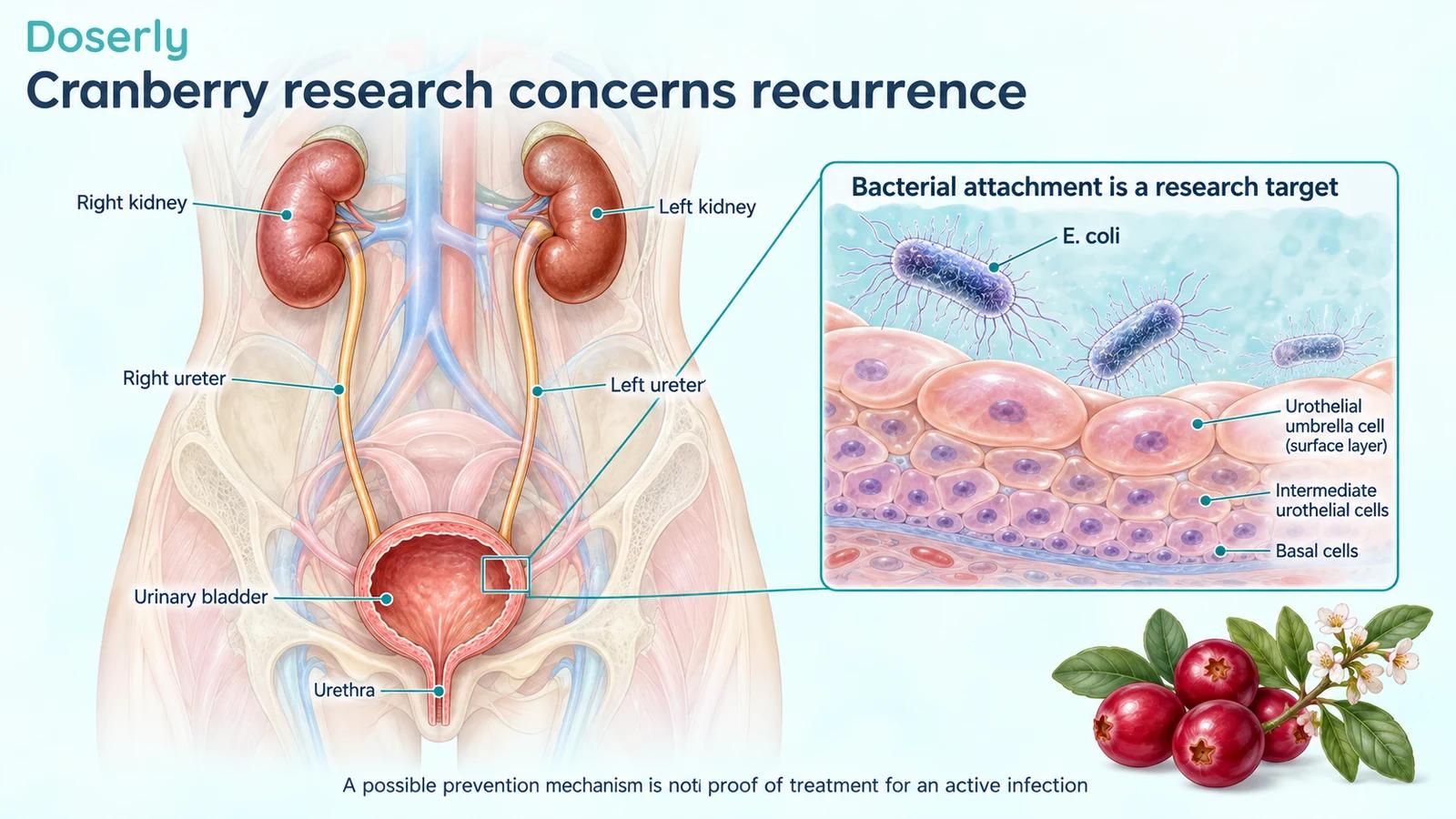
The anatomy also explains why the location and severity of symptoms matter. A bladder infection can spread to the kidneys. Fever, chills, nausea or vomiting, and pain in the back, side or groin need prompt medical attention. These are not signals to increase a supplement and wait for an anti-attachment effect. NIDDK symptoms and causes
What the prevention evidence actually supports
The November 2023 Cochrane review included 50 studies and 8,857 randomized participants. That large total covered several different populations; it was not a single trial of otherwise healthy women with recurrent UTIs.
The most relevant subgroup for many readers comprised eight studies with 1,555 women who had recurrent UTIs. Cranberry probably reduced symptomatic, culture-verified infections, with a pooled risk ratio of 0.74 and a 95% confidence interval from 0.55 to 0.99. This is a relative comparison, corresponding to an estimated 26% lower risk in that analysis. It does not mean 26 fewer infections in every 100 people, and it does not mean that most people become infection-free.
The absolute benefit depends on the untreated risk and follow-up period. To illustrate the arithmetic only, if an otherwise comparable group had a 40% recurrence risk, applying a risk ratio of 0.74 would give about 30%. If the starting risk were 10%, the corresponding estimate would be about 7%. These are teaching examples, not observed results from a particular cranberry trial or predictions for an individual.
The review also found that the evidence did not support the same conclusion in every population. Results did not establish a preventive benefit in pregnant women, institutionalized older adults or adults with neuromuscular bladder dysfunction and incomplete emptying. The reasons someone keeps getting infections can therefore matter more than the general phrase “urinary support.” Population-specific findings
Another distinction is whether a trial counts people or episodes. A person can have several UTIs during follow-up. A result describing the proportion with at least one recurrence answers a different question from the total number of episodes per year. A product might change one measure more clearly than another. When reading a claim such as “fewer UTIs,” look for the denominator and the time period, as well as whether symptoms were accompanied by a positive culture. That detail helps translate a research headline into the outcome that matters to the individual: fewer painful episodes, less disruption and a workable plan when an infection does occur.
How this fits current clinical guidance
The 2025 AUA/CUA/SUFU guideline amendment strengthened its cranberry recommendation: clinicians should offer it as an option for prevention in women with recurrent UTIs. “An option” is consequential language. It supports a discussion of cranberry within a prevention plan; it does not require every patient to use it, identify a universally superior brand or replace assessment of recurrent symptoms. AUA amendment summary
A useful appointment question is therefore, “Does my infection history fit the group for whom cranberry is a reasonable preventive option?” That is more specific than asking whether cranberry works in general. The answer may depend on whether past episodes were documented infections, whether symptoms fully resolved between them and whether a condition affecting bladder emptying or another complicating factor is present.
This matters when the history is uncertain. Someone may remember several courses of antibiotics but have no record of urine results. Another person may have repeated urgency or discomfort without a confirmed bacterial cause. Their symptoms deserve attention, but counting every uncomfortable day as another cranberry-preventable infection can send the conversation in the wrong direction. A prevention plan starts by clarifying what is recurring.
More PACs does not automatically mean better prevention
Cranberry labels can list fruit powder, extract mass, juice concentration or PAC content. These are not interchangeable quantities. A large number on the front of a bottle may describe the amount of plant material rather than the amount of a specified compound. Processing can also change PAC content. NCCIH product considerations
A 2021 randomized trial provides a useful test of the assumption that a higher standardized PAC amount must be better. It enrolled 145 adult women with recurrent UTIs and compared 37 mg of PACs per day with 2 mg per day for 24 weeks. These were research formulations, not a personal dosing recommendation.
The overall comparison did not show a statistically significant reduction in symptomatic UTIs: the incidence rate ratio was 0.76, with a confidence interval of 0.51 to 1.11. A favorable result appeared in a post-hoc subgroup of women who had fewer than five infections in the preceding year. Because that subgroup analysis was conducted after the main study framework, it is less secure evidence than a clear positive primary result.
This trial compared two cranberry doses, not cranberry against an inert placebo. It therefore answers whether the higher tested amount performed better than the lower one. It cannot, by itself, settle whether either dose outperforms taking no cranberry at all. The investigators also provided assessment and appropriate antibiotics for symptomatic episodes during follow-up. Prevention research did not require participants to leave active infections untreated. Babar and colleagues, 2021
For a product discussion, bring the actual label or a photograph of it. Record the serving size, extract amount, stated PAC amount and whether that information refers to one capsule or the full daily serving. If a manufacturer cites a trial, check whether the tested preparation matches the product being sold. A familiar ingredient name is not enough to establish that connection.
Why an active UTI changes the question
A separate Cochrane review addressed cranberry as treatment for existing UTIs. Its search extended to August 2023 and found no studies meeting all its inclusion criteria. Some candidate studies were excluded because of their design, mixed interventions or lack of relevant outcomes. That is a specific evidence gap, not proof that cranberry has no biological activity under any circumstances. It does mean the review could not establish cranberry as an effective treatment for an existing infection. Cochrane treatment review
The necessary outcomes would be different from those in a prevention trial: relief of current symptoms, resolution of infection, complications, adverse effects and the need for additional treatment. A person who takes a capsule for months and has fewer recurrences has not supplied evidence that taking extra capsules during an acute episode will make it resolve safely.
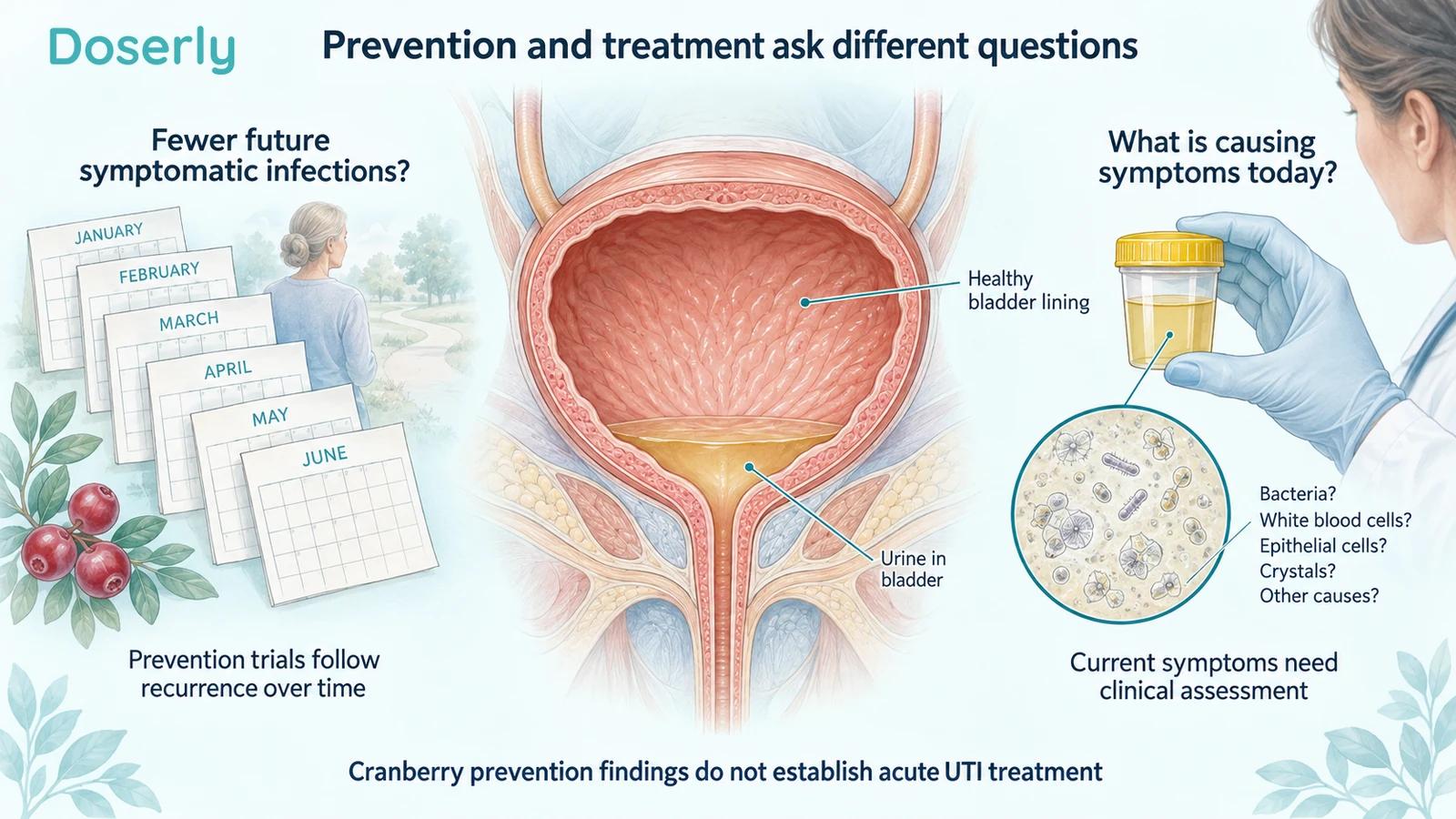
NIDDK advises contacting a health professional for bladder-infection symptoms, including burning urination, frequent or intense urges, lower-abdominal discomfort and cloudy, bloody or strong-smelling urine. Fever, chills, vomiting or flank-region pain raise concern for kidney involvement and make prompt care particularly important. When to seek help
If a clinician has already provided a plan for recurrent episodes, follow that plan rather than substituting a supplement experiment. If the current episode feels different, is worsening or does not resolve as expected, that change belongs in the clinical conversation. A previous history of uncomplicated infections does not make every future episode identical.
Safety and practicality still matter
Cranberry is generally considered safe when taken orally, but large amounts can cause gastrointestinal upset or diarrhea. A product that creates persistent digestive symptoms may not be a workable preventive option even if the average trial result is favorable. Juice, extracts and combination products also impose different practical demands, from taste and serving volume to the number of capsules taken. NCCIH safety information
Medication review matters. Evidence about an interaction with warfarin is conflicting, so a person taking warfarin should discuss cranberry use with the clinician or pharmacist managing treatment. “Conflicting” does not justify presenting the interaction as certain, but it also does not justify ignoring it. Pregnancy and breastfeeding deserve a separate discussion because ordinary food amounts and concentrated supplemental amounts are different exposures. NCCIH precautions
A combination product creates another interpretive problem. If cranberry is mixed with D-mannose, probiotics or several herbs, a change in symptoms cannot be assigned to cranberry alone. It may also become harder to identify which ingredient caused an adverse effect. The relevant question is whether the whole preparation has evidence for the intended use, rather than whether every ingredient has an appealing explanation.
What to keep in a recurrence record
A useful record is simple enough to maintain and specific enough to help at an appointment. Note when symptoms began, what they were, whether urine testing was performed, the result if available, what treatment was prescribed and when symptoms resolved. Keep fever or flank pain visible rather than burying them in a general discomfort score.
If cranberry is part of an agreed prevention plan, record the exact product and dates of use. Also record interruptions, adverse effects and major changes to other preventive measures. This makes it easier to distinguish “I tried cranberry” from a defined exposure that can be discussed meaningfully.
A symptom-free month is welcome, but it does not prove that the product caused the improvement. Recurrences naturally cluster and vary. Conversely, one infection during use does not necessarily contradict a trial showing a lower average risk; a preventive measure can reduce risk without eliminating it. The useful outcome is the pattern over an appropriate follow-up period, interpreted alongside the clinical history.
The Doserly cranberry extract guide provides additional ingredient context. For the decision itself, keep two plans explicit: what to do when symptoms appear, and what may reduce recurrence after the current episode is addressed. Cranberry can be considered in the second conversation without becoming an obstacle to the first.
Sources
- Williams and colleagues, 2023: updated Cochrane prevention review, November version.
- Babar and colleagues, 2021: randomized comparison of standardized PAC amounts.
- Cochrane treatment review, 2023: evidence for treating established UTIs.
- AUA/CUA/SUFU amendment summary, 2025: current prevention recommendations.
- NIDDK bladder-infection symptoms: symptoms and prompt-care guidance.
- NCCIH cranberry overview: mechanism, safety and product considerations.