
Peptides
October 16, 2026
GHK-Cu and copper nutrition: why the distinction matters
On this page
Copper is an essential nutrient. Enzymes use it in processes that include energy production, iron handling and connective-tissue formation. GHK-Cu contains copper too, but that chemical fact does not establish that it treats a nutritional deficiency. The question is not simply whether copper is present; it is whether a particular product delivers an appropriate amount in a form and route shown to help a particular patient.
That distinction matters in two common situations. Someone with fatigue or hair changes may wonder whether a copper peptide could correct a hidden deficiency. Someone considering GHK-Cu may calculate its copper content and compare it with a dietary upper limit to decide whether it is safe. Neither question can be answered by the ingredient name alone.
We will look at normal copper nutrition, the clinical situations in which deficiency becomes important, and why topical or injectable GHK-Cu requires separate evidence. For more background on the peptide itself, see our GHK-Cu guide.
What copper normally does in the body
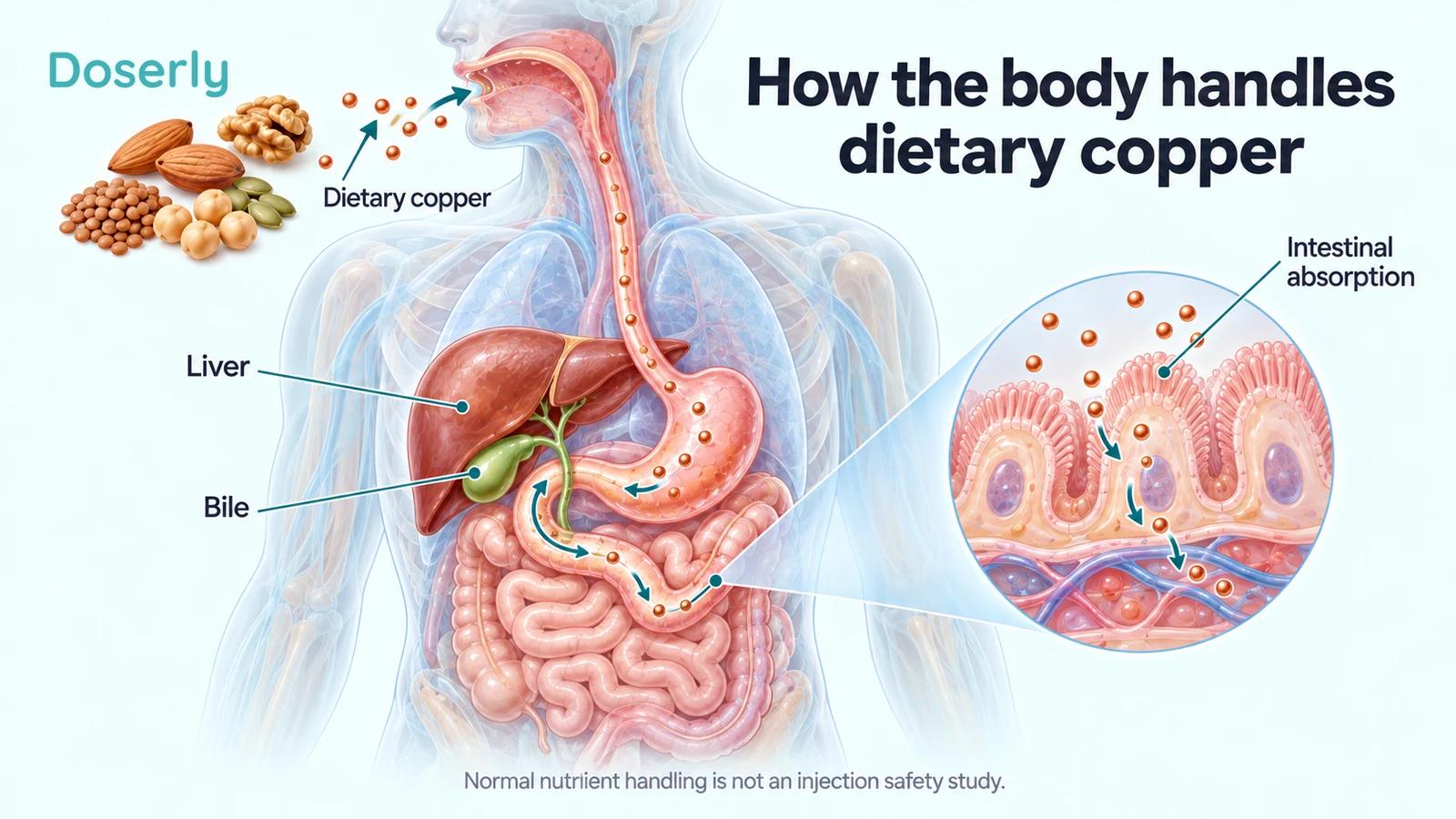
Dietary copper is mainly absorbed in the upper small intestine. The body transports it in association with proteins, and the liver helps manage its distribution and elimination. Much of copper excretion occurs through bile. These processes help explain why intestinal absorption and liver handling matter alongside intake. NIH copper fact sheet.
It helps to separate three questions. Intake is how much enters the digestive tract. Absorption is how much crosses into the body. Status concerns whether the body's supply and handling are adequate. A food label mainly addresses the first question. It cannot, on its own, tell you the other two.
For example, two people could consume similar amounts while having different risks if one has undergone surgery that changes nutrient absorption. Conversely, a low estimate from a short food diary does not necessarily establish a clinical deficiency. A clinician needs the person's history and appropriate measurements, rather than a single number taken out of context.
What the dietary numbers actually mean
For adults aged 19 and older, the US recommended dietary allowance is 900 micrograms daily, equivalent to 0.9 milligrams. Pregnancy and lactation have different requirements. The adult tolerable upper intake level is 10 milligrams daily from food and supplements for generally healthy people; medically supervised treatment is considered separately. These are nutritional reference values, not GHK-Cu treatment instructions. NIH copper intake tables.
The recommended allowance and upper limit serve different purposes. One helps plan an adequate diet; the other concerns the risk of excessive intake. The space between them is not a recommended supplement dose range, and the upper limit is not an intake target. A person does not become healthier simply by moving closer to it.
Units are an easy source of confusion. A milligram contains 1,000 micrograms. Equally important, the mass of a copper-containing compound is not necessarily the mass of copper itself. A product's name, total powder weight and stated elemental copper content answer different questions. If those details are unclear, a calculation can create an appearance of precision without establishing what was actually consumed.
These distinctions are useful for discussing ordinary nutrition. They become insufficient when someone uses them to evaluate a drug-like peptide exposure, especially by injection.
What GHK-Cu's chemical identity tells us
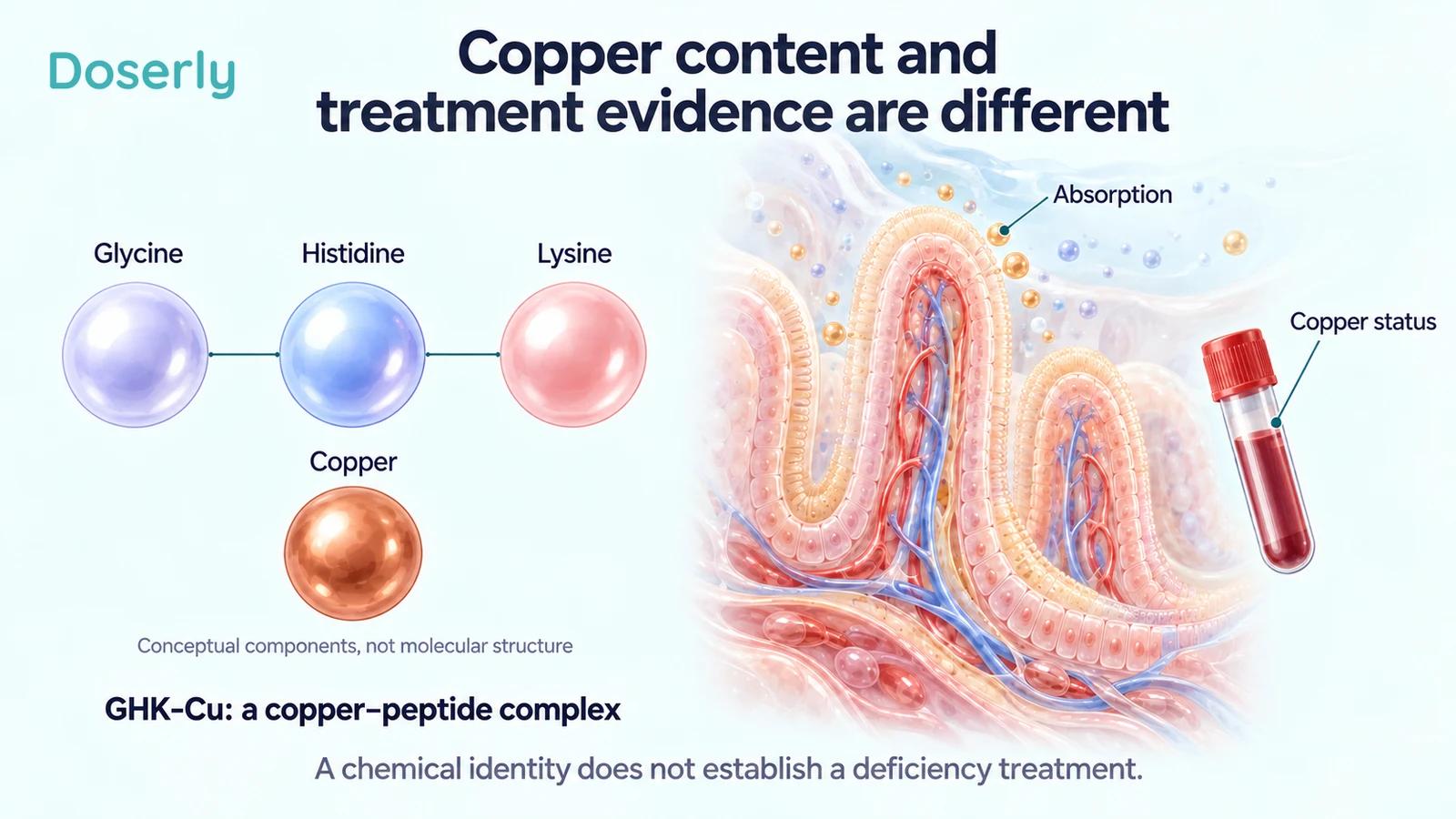
GHK refers to glycine, histidine and lysine, three amino acids joined into a short peptide. In GHK-Cu, the peptide is complexed with copper. FDA's substance registry lists prezatide copper and copper tripeptide-1 among the relevant names. The record is useful for identifying a substance; it explicitly states that a UNII identifier does not imply regulatory approval. FDA substance record.
A registry entry cannot establish how well a product corrects low copper, which symptoms improve, or what harms occur with repeated use. Those require treatment studies. The same applies to an impressive-looking chemical formula on a label: knowing what a compound is helps formulate a research question, but it does not answer the clinical question.
Even a correct theoretical copper-content calculation would leave several practical uncertainties. Does the supplied material match the named compound? Does the label refer to the complex or to elemental copper? What other ingredients are present? Most importantly, what happens to that formulation after it is applied, swallowed or injected? Arithmetic cannot replace measurements of exposure and outcomes.
Why an oral upper limit cannot certify an injection
An oral intake limit is based on a particular route of exposure. Injection bypasses the initial passage through the digestive tract and its absorption processes. The resulting distribution, clearance, local exposure and formulation-related risks need to be evaluated for that route. There is no sound conversion that turns “below the dietary upper limit” into “safe to inject.”
There is also more to injectable safety than the copper amount. FDA identifies potential immune-response risks associated with aggregation and peptide-related impurities in compounded injectable GHK-Cu, and notes limited human safety information. These concerns would not disappear merely because a theoretical copper quantity looked small beside a food-based limit. FDA safety-risk assessment.
This does not mean copper in every chemical form has identical toxicity, or that an adverse outcome is inevitable. It means that the proposed reassurance does not test the relevant hazards. The safety of an exposure depends on the whole product, route, recipient and duration, not one favorable comparison.
Similarly, a topical cosmetic experience cannot establish the safety of injection. Skin application and injection create different exposures. If a study measured skin appearance after a cream, its results should remain attached to that cream and that outcome. It cannot double as a nutritional replacement study.
When copper deficiency becomes a real clinical concern
Copper deficiency is a medical problem, not merely an online theory. One important setting is altered gastrointestinal anatomy. In a study of 136 patients attending follow-up after Roux-en-Y gastric bypass, 13 met the study's definition of copper deficiency, a prevalence of 9.6%. The researchers also followed a much smaller separate group longitudinally. Some deficient patients had blood-count or neurological abnormalities. Gletsu-Miller and colleagues.
That percentage describes the studied clinic population. It is not the probability that any person with fatigue has copper deficiency, nor a universal risk estimate after every form of weight-loss surgery. Its practical value is that it identifies a setting in which clinicians should think about nutrient absorption and follow-up.
For a patient with prior gastrointestinal surgery, the relevant discussion includes the operation performed, current supplements, eating pattern, symptoms and previous laboratory results. Substituting an unvalidated peptide for that evaluation could leave the underlying absorption problem unaddressed.
Treatment decisions also need to distinguish an abnormal laboratory result from the consequences already present. Restoring a nutrient measurement and recovering nerve function are different outcomes. A patient may need follow-up of both, with expectations based on the diagnosis and duration of illness rather than a promise that any copper-containing substance will reverse everything.
Excess zinc can change the copper question
Zinc and copper should not be considered in isolation when supplements are involved. NIH notes that zinc intakes of 50 milligrams or more for weeks can interfere with copper absorption. Such exposure is more likely to arise from supplements or excessive use of zinc-containing products than from ordinary food alone. NIH zinc fact sheet.
A primary clinical report described four patients with neurological abnormalities, low copper and high zinc who had chronically used very large amounts of zinc-containing denture adhesive. Investigators measured substantial zinc in the products. After stopping the exposure and receiving copper supplementation, two patients had mild neurological improvement. This was a case series, not a randomized trial or a study of GHK-Cu. Nations and colleagues, 2008.
The useful lesson is to identify the source of the imbalance. Adding a second product without reviewing the first may complicate the picture. A history should include multivitamins, stand-alone minerals, cold remedies and other products that may be overlooked when someone is asked only about prescription medicines.
These reports concern excessive use of particular products and should not be generalized to all current denture adhesives. Formulations differ, and zinc-free products exist. The reason to mention the example is that a detailed exposure history can reveal a correctable cause that a generic “copper optimization” plan would miss.
Too much tissue copper is a different problem
Wilson disease illustrates the other side of copper handling. It is a genetic disorder in which the body does not remove excess copper normally, allowing it to accumulate in organs. Diagnosis can involve blood and urine tests, eye examination and other investigations. Treatment aims to manage excess copper, including with chelating medicines or zinc under specialist care. NIDDK Wilson disease overview.
This is not a reason for everyone interested in a peptide to assume they have Wilson disease. It is a reason to avoid the idea that copper is always beneficial because it is essential. A nutrient can be necessary while excess or abnormal handling is harmful.
It also shows why self-treatment based on one laboratory value is unwise. Different disorders can require very different interpretations and treatments. A clinical evaluation asks why the measurement is abnormal and how it fits the rest of the picture, rather than automatically adding or removing copper.
What to bring to a clinician if you suspect deficiency
Start with the concern that prompted the question: persistent symptoms, a known absorption problem, a laboratory result or a high-dose supplement history. Bring the actual product labels and a dated list of what you have taken. Include the amount, frequency and route; a cosmetic serum, a mineral tablet and an injectable product should not be recorded simply as “copper.”
Useful questions include what evidence supports the diagnosis, whether an underlying cause needs treatment, and how improvement will be assessed. If replacement is needed, ask why the proposed formulation and route are appropriate and when reassessment should occur. The answer may depend on the severity of deficiency, the ability to absorb nutrients and other medical conditions.
Do not expect a symptom diary alone to settle causation. It can help establish timing, but fatigue, hair changes or tingling are not specific enough to identify copper deficiency by themselves. A record is most helpful when it supports an examination and laboratory interpretation.
If GHK-Cu is proposed specifically to correct deficiency, ask for human evidence of that use. A cosmetic study, a cell experiment and a chemical registry entry do not demonstrate nutritional recovery. The evidence should show that the actual formulation corrected the intended problem and that clinically important benefits outweighed harms.
The distinction to keep when considering GHK-Cu
Copper nutrition and copper-peptide research overlap in chemistry, but they ask different treatment questions. Nutritional care focuses on adequate intake, absorption, underlying causes of deficiency and appropriate replacement when needed. GHK-Cu research must establish the behavior and effects of a particular peptide formulation for a defined use.
You do not need to deny either area of science to keep them separate. A biological role for copper can be well established while a proposed GHK-Cu deficiency treatment remains unproven. A dietary upper limit can be useful while offering no assurance about injection safety. Keeping those distinctions clear helps turn a broad product claim into a specific, answerable health question.
Sources
- NIH Office of Dietary Supplements: Copper fact sheet.
- FDA: prezatide copper substance identity.
- FDA: potential safety risks in compounding.
- Gletsu-Miller and colleagues: copper deficiency after Roux-en-Y gastric bypass.
- NIH Office of Dietary Supplements: Zinc fact sheet.
- Nations and colleagues: excess zinc exposure and copper deficiency.
- NIDDK: Wilson disease.