
Supplements
October 16, 2026
Colostrum and the gut barrier: what the tests actually measure
On this page
Bovine colostrum is the early milk produced by cows after calving. It contains proteins and other biologically active components, which has led researchers to investigate whether preparations made from it can influence the intestinal lining. For someone with digestive symptoms, the claim that colostrum “supports the gut barrier” can sound directly relevant.
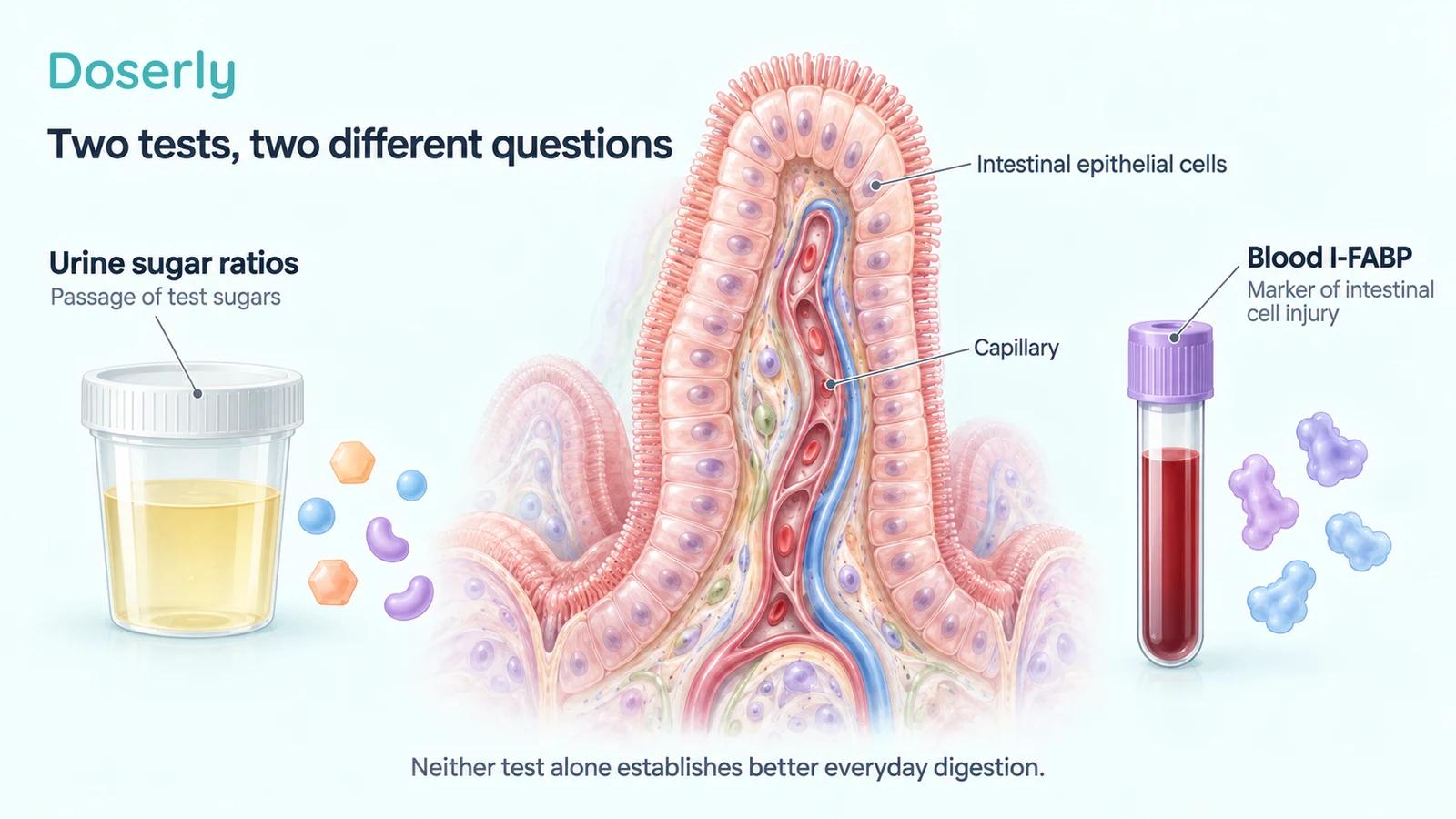
The difficulty is that gut-barrier research measures several different things. A urine test may estimate passage of swallowed sugars across the intestine. A blood test may detect a protein released during intestinal-cell injury. Neither result automatically establishes less bloating, better stool consistency or improved quality of life.
Some small colostrum trials found favorable changes in barrier-related measurements; others did not. To understand the practical meaning, we need to look at the tests, the conditions under which participants were studied and whether symptoms or performance improved. Our colostrum guide provides background on the supplement itself.
What is the intestinal barrier?
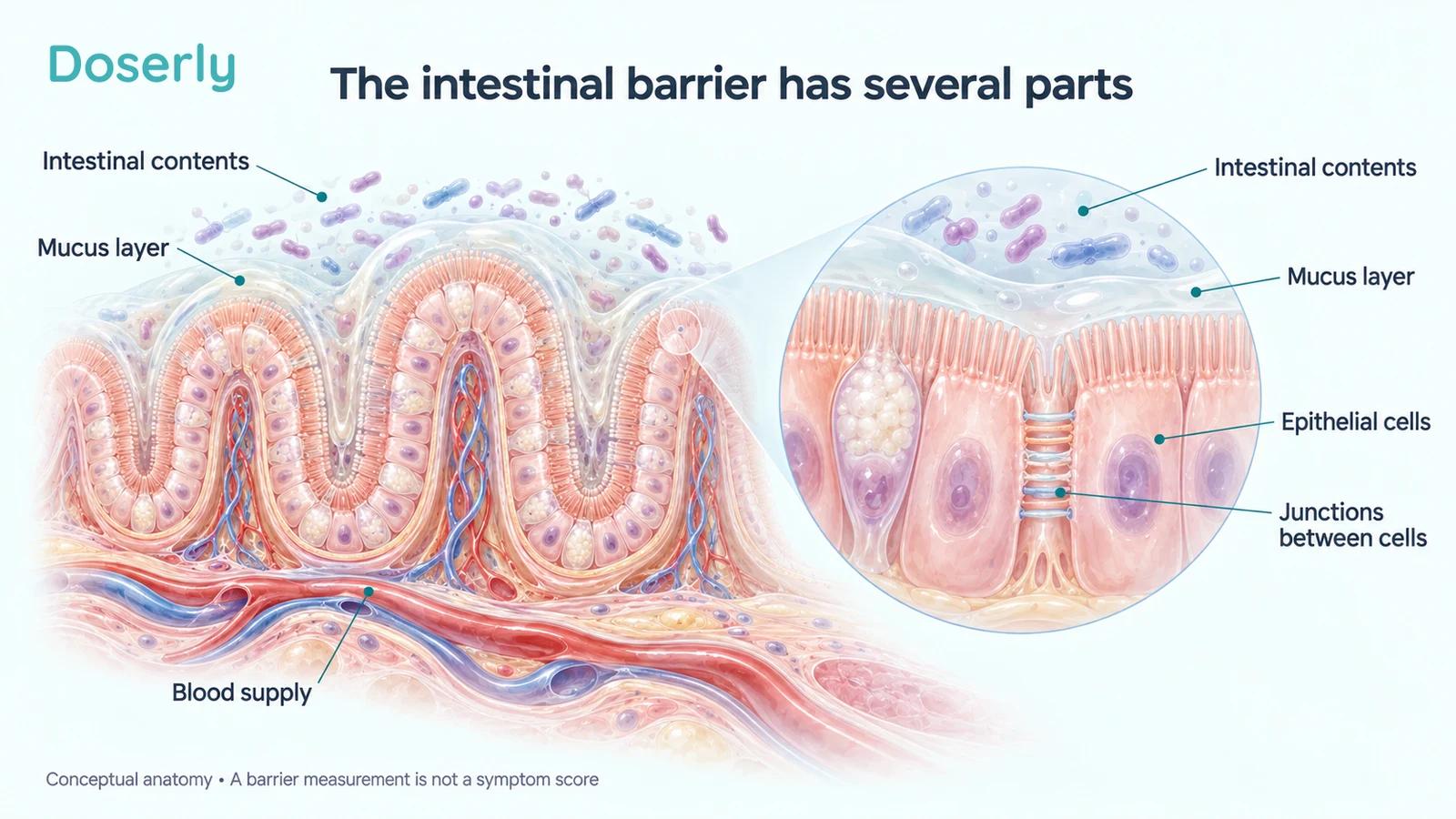
The intestinal lining allows the body to absorb useful substances while limiting inappropriate passage of material from the gut into underlying tissue. Its epithelial cells, the cells lining the surface, work with mucus and structures joining adjacent cells. Blood vessels below the surface carry absorbed material onward.
This is a selective system rather than a completely sealed wall. Different substances cross by different routes. Researchers therefore cannot describe its function with one universal “leakiness” number. The result depends on what is measured and under which conditions.
Exercise provides one research model. Strenuous activity and heat can place stress on the intestine, including through changes in its blood supply and temperature. Colostrum studies have used controlled exercise sessions to examine whether supplementation changes the intestinal response to that stress. This is a narrower question than whether a supplement treats unexplained digestive symptoms in ordinary daily life. March and colleagues, 2017
How do urine sugar tests assess permeability?
In several trials, participants swallowed test sugars such as lactulose and rhamnose, and researchers measured how much appeared in urine during a defined collection period. The ratio provides information about how the intestine handles those probes. A change in the ratio can indicate a change in permeability under that testing protocol. Marchbank and colleagues
The ratio is not a photograph of gaps in the intestinal lining. It also is not a measurement of how much “toxin” is circulating. It records the relative recovery of particular test substances after they have passed through the body. Changing the probes, timing or experimental conditions changes the question being asked.
This makes precision important when explaining a result. If a paper reports a lower lactulose-to-rhamnose ratio after an exercise challenge, the accurate statement concerns that ratio and challenge. Calling it “healing leaky gut” adds a diagnosis, a structural repair claim and often a symptom benefit that may not have been measured.
A person can reasonably ask whether a favorable test change might translate into less discomfort. That is a valuable next question, but it is not already answered by the urine result.
What does I-FABP in blood measure?
Intestinal fatty acid-binding protein, usually shortened to I-FABP, is found in intestinal epithelial cells. Researchers measure its concentration in blood as a marker of intestinal-cell injury. It is related to barrier research, but it is not the same measurement as urinary sugar passage.
A 2017 crossover study illustrates the distinction. Eighteen men received colostrum and placebo in separate 14-day periods, then completed an exercise assessment. The study used both a five-hour urinary lactulose/rhamnose ratio and blood I-FABP. Both measurements showed a more favorable exercise response during colostrum exposure, but their correlations were not consistent across assessments. The authors concluded that cellular injury could contribute to permeability changes while other factors also mattered. Primary study
The implication is not that one test is useless. Each contributes information about a different part of the problem. If one changes and the other does not, researchers should examine that difference rather than combine them into a vague statement that the barrier “improved.”
Neither test directly asks whether someone has less abdominal pain or can finish a training session more comfortably. Those outcomes need their own assessments.
What did the early exercise study find?
A study published in 2011 used a double-blind crossover design in 12 volunteers. Participants completed standardized exercise after 14 days of colostrum or placebo. Researchers assessed gut permeability using the five-hour urinary lactulose-to-rhamnose ratio. During placebo, the ratio rose approximately 2.5-fold after exercise. Colostrum attenuated that rise. Marchbank and colleagues
This was a biologically interesting finding under a controlled stress challenge. The same paper included experiments in human-derived intestinal cell lines exposed to increased temperature. Those laboratory experiments examined cell injury, protective-protein responses and electrical resistance across cell layers. They were not additional groups of people receiving treatment.
That distinction matters because the human and laboratory results can otherwise be blended into a stronger story than either supports. Cell experiments can suggest why a preparation might work. They cannot demonstrate that an adult's intestinal tissue regenerated or that chronic symptoms resolved.
The small human experiment also did not establish prevention of heat stroke or a general improvement in athletic performance. A favorable permeability response can justify a larger clinical study without already proving those outcomes.
What happened when men exercised in the heat?
A later crossover trial studied 12 men who completed an hour of treadmill running at 70% of maximal aerobic capacity in an environment of 30°C and 60% relative humidity. Each treatment period involved 14 days of colostrum or placebo. The researchers measured I-FABP and circulating bacterial DNA before exercise, immediately afterward and during recovery. March and colleagues
I-FABP rose substantially in both conditions. Immediately after exercise, it averaged 407% of the pre-exercise level with placebo and 311% with colostrum. These numbers describe levels relative to baseline: 407% of baseline means approximately four times baseline, not a 407% increase. Colostrum attenuated the rise; it did not prevent the marker from increasing.
The bacterial-DNA analysis told a different story. There was no treatment-by-time interaction, although overall levels were lower in the colostrum condition. In plain language, the study did not show that colostrum changed the temporal exercise response of that DNA measurement. Primary report
This is a useful example of why an article should preserve individual endpoints. Saying the supplement “blocked bacteria from entering the bloodstream” would be stronger than the data. The actual findings are more specific and leave important questions about mechanism and clinical relevance.
Were all the exercise trials positive?
No. A 2014 randomized crossover study included seven trained and eight untrained men exercising in the heat. Participants received colostrum or a corn-flour placebo for seven days before a demanding 90-minute cycling-and-running protocol. Researchers assessed physiology, exercise performance and intestinal-related measurements. They found no observable benefit of supplementation on physiology or performance in either fitness group. Morrison and colleagues
An earlier eight-week study in 30 healthy men produced a different permeability result again. Participants followed a running program while receiving colostrum, whey protein or no supplement. The urinary lactulose/rhamnose ratio increased more in the colostrum group. The authors discussed possible explanations involving transport across the intestinal lining, but those explanations were hypotheses rather than established mechanisms. Running-training study
These studies differed in amount, duration, preparation, exercise conditions and comparison. Their disagreement does not mean every result is interchangeable or that one can select only the favorable experiments. It means the effect is sensitive to context and remains difficult to generalize.
For an athlete, the most relevant unanswered issue is often practical: does a particular product reduce troublesome symptoms or support a meaningful training outcome under the conditions they face? A biomarker result from a different exercise model may be informative without settling that decision.
What does the 2024 meta-analysis add?
A 2024 meta-analysis included ten articles and pooled several barrier-related outcomes. Urinary lactulose/rhamnose and lactulose/mannitol ratios favored colostrum overall. The pooled I-FABP result did not show a clear difference from control. Hajihashemi and colleagues
The lactulose/rhamnose analysis had an I-squared statistic of 99%, indicating very large inconsistency among the included study results. I-FABP also showed substantial heterogeneity. These are not minor details: when studies produce very different estimates, an average may be a poor guide to what a new person using a new product should expect.
The review searched through March 2022, despite publication in 2024. Its publication date should not be confused with the date of its latest literature search. It also pooled measurements, not a single uniform clinical experience across identical participants.
The fair interpretation is that colostrum has some supportive permeability data, with important inconsistency and a lack of agreement across endpoints. The meta-analysis does not establish that every gut-barrier claim on a supplement label has been validated.
How does this relate to everyday digestive symptoms?
If your concern is bloating, abdominal pain or diarrhea, start with that concern rather than assuming an intestinal-permeability problem explains it. The trials above mostly used exercise as a controlled physiological stressor. They did not enroll a broad group of people with unexplained chronic symptoms and show that those symptoms resolved after taking colostrum.
The timing also differs. An immediate post-exercise blood measurement is not equivalent to better digestion over several months. The latter would require longer follow-up and outcomes such as symptom burden, ability to eat normally, daily functioning and treatment tolerance.
This is not a reason to dismiss the biology. Measurements can identify promising effects before larger clinical trials are available. But it is a reason to keep expectations aligned with what has actually been observed.
When reading “supports the barrier,” ask which population and measurement support the claim. A clear answer should identify a specific preparation, comparator and time frame. If the answer moves from an athlete's urine ratio to a promise of relief for any digestive complaint, the explanation has crossed beyond the study.
What should a useful treatment discussion include?
Bring the exact product and the symptom you hope to improve. Bovine colostrum is a mixture, and research on one preparation cannot establish that another has the same composition or effects. Check the complete ingredient list, particularly if milk-derived products are unsuitable for you, and discuss it with the clinician who knows your history.
Ask what would count as success. A proposed benefit should be recognizable in your life, not just a broad claim about intestinal health. If laboratory monitoring is suggested, ask what the result would change about care and whether the test is appropriate for your circumstances.
Keep a short record of symptom timing, exercise conditions, product use and other changes. For athletes, record whether symptoms occur during heat exposure, long sessions or ordinary meals. This helps describe the problem accurately without assuming the supplement caused every change.
The Doserly colostrum guide can help with background questions. The most defensible conclusion from barrier research is specific: certain preparations have altered certain measurements under particular conditions. Establishing better everyday digestion requires evidence that people actually felt or functioned better.
Sources
- Marchbank et al., 2011: exercise permeability experiment and separate cell-line work.
- March et al., 2017: paired urine-permeability and I-FABP assessments.
- March et al., exercise-in-heat trial: I-FABP and bacterial-DNA responses.
- Morrison et al., 2014: trained and untrained men exercising in heat.
- Running-training trial: increased urinary permeability ratio after eight weeks.
- Hajihashemi et al., 2024: pooled permeability and injury-marker evidence.