
Supplements
October 16, 2026
Cod liver oil: count the vitamins as well as the omega-3s
On this page
Cod liver oil can look like an uncomplicated way to add omega-3s to breakfast. But the same serving may also supply vitamin A and vitamin D. Those ingredients are useful nutrients, with separate requirements and separate limits. A product chosen for one purpose can therefore change three parts of a supplement routine at once. The amounts vary between products, which makes the actual label more informative than the traditional reputation of the oil. NCCIH’s omega-3 overview makes this distinction explicitly.
The practical question is not whether cod liver oil is inherently good or bad. It is whether this particular combination suits the person taking it. Someone seeking EPA and DHA may already get vitamin D from another supplement and vitamin A from a multivitamin. Someone seeking vitamin D may not need the other ingredients. A third person may have been advised to avoid retinol during pregnancy. Those are different decisions, even if the bottle is identical.
Three ingredients, three different reasons to use them
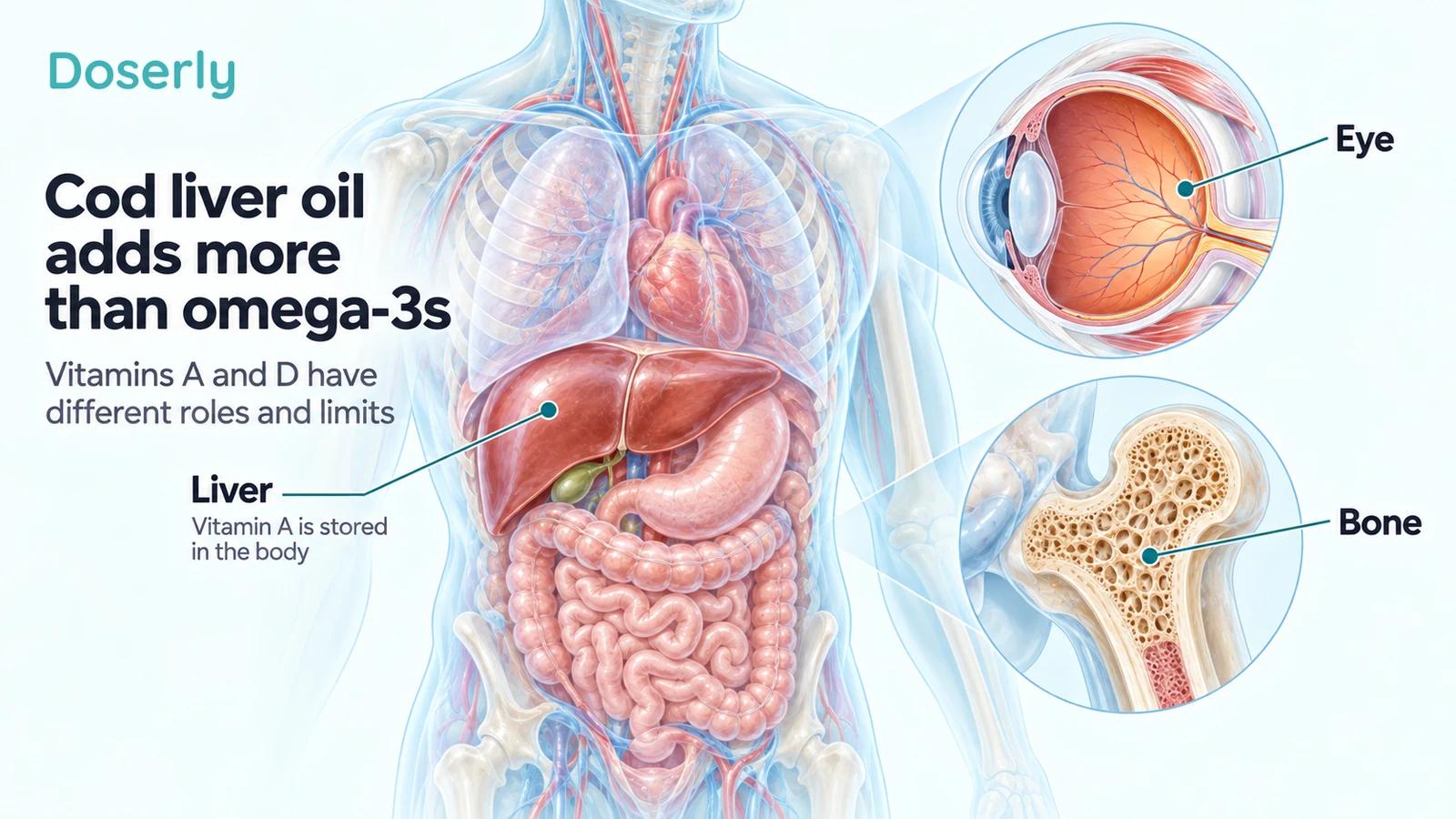
EPA and DHA are long-chain omega-3 fatty acids. They participate in cell membranes and other biological processes, and sufficiently high amounts can lower triglycerides. Vitamin A supports processes including vision and immune function; vitamin D supports calcium absorption and bone health. These normal roles explain why the nutrients matter. They do not establish that adding more through cod liver oil improves every related organ or prevents disease in someone whose needs are already met. NIH omega-3 fact sheet, vitamin A fact sheet, vitamin D fact sheet.
This distinction matters when a label uses language such as “supports immunity” or “supports healthy joints.” A biological role is a starting point for a clinical question. It does not tell us whether taking the product changes the outcome a reader cares about: fewer infections, less pain, fewer fractures, or fewer cardiovascular events. Those outcomes need their own trials.
The Doserly cod liver oil guide provides background on the ingredient. Here, the focus is the decision that often gets missed: evaluating the vitamins alongside the oil, then asking which human results apply to the intended use.
Start with the serving you actually take
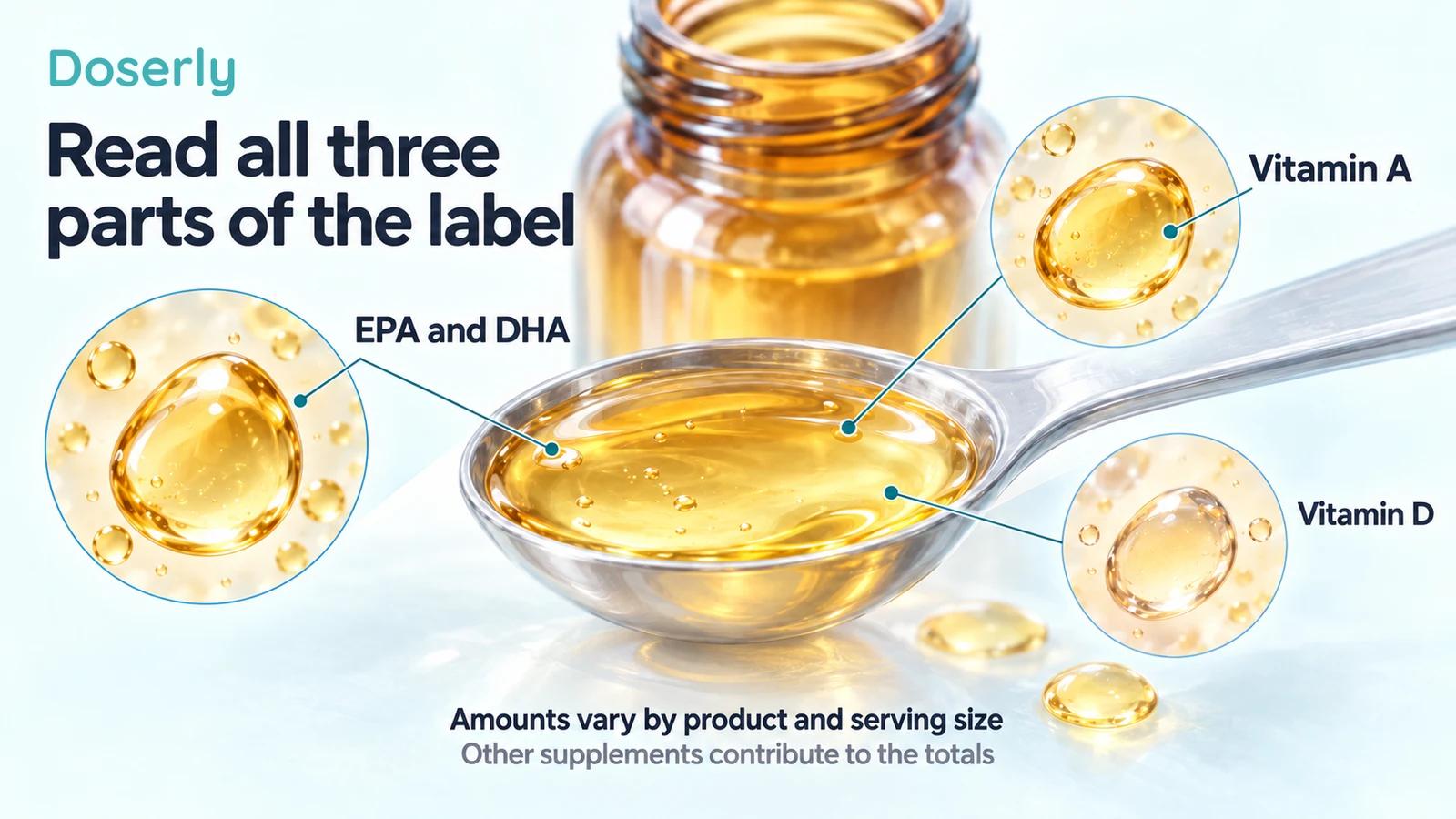
A front label might emphasize the total amount of cod liver oil. That is not automatically the amount of EPA plus DHA. On the nutrition or supplement panel, look for EPA and DHA separately, the amount of vitamin A, the form of vitamin A when listed, and vitamin D. Check whether those amounts apply to one capsule, several capsules, or a measured volume of liquid. NIH omega-3 fact sheet.
A simple inventory can prevent an avoidable mistake. Write down the serving size on each bottle and the number of servings actually used. Then place all products that contribute vitamin A together, and do the same for vitamin D. Include combination products rather than assuming that something marketed for bones, immunity, or general wellness belongs in a separate category. The marketing category does not change the arithmetic.
Consider an illustrative label, not a recommended dose: if a listed nutrient amount is for two capsules, taking four capsules supplies twice that amount. The same multiplication applies to all the listed ingredients, not only the omega-3 that motivated the increase. If someone doubles a serving to reach a desired EPA/DHA amount, they also double the vitamins delivered by that serving.
This is a reason to choose the formulation deliberately. It is not a reason to treat every combination product as excessive. A combined product may fit an agreed nutritional plan well; it simply offers less freedom to adjust its individual ingredients. If one component needs changing while the others do not, that becomes a product-selection question rather than an invitation to keep increasing the same oil.
Vitamin A requires attention to its form
Preformed vitamin A includes retinol and retinyl esters. The body can store it, and excessive intake can cause toxicity. This differs from treating all foods containing carotenoids as though they carried the same exposure. In US dietary reference values, the adult upper limit for preformed vitamin A is 3,000 micrograms retinol activity equivalents, or mcg RAE, per day. That is an upper limit, not an intake goal. NIH vitamin A fact sheet.
The distinction becomes relevant when a multivitamin lists vitamin A partly as beta-carotene and partly as retinol. A single headline percentage can hide the forms that matter for the calculation. Someone reviewing several products should bring the complete labels, not just a recollection that each contains “some vitamin A.” A pharmacist or clinician can resolve uncertain units and formulations before the amounts are added together.
There is no need to turn this into an elaborate self-diagnosis exercise. A daily upper limit cannot diagnose toxicity, and an amount below it cannot settle every individual safety question. It is a population reference used in the context of age, health, food intake, and other products. The useful action is to identify overlap and avoid assuming that a nutrient becomes harmless because it arrived in a familiar oil.
Pregnancy changes the product decision
The NHS advises people who are pregnant not to take cod liver oil or supplements containing vitamin A as retinol, because too much vitamin A can harm fetal development. Its pregnancy guidance discusses vitamin D separately; a need for vitamin D does not make cod liver oil an appropriate way to obtain it during pregnancy. NHS pregnancy vitamins and supplements.
This is an especially clear example of why an ingredient-by-ingredient review is better than a general “omega-3s are healthy” argument. Advice about seafood or DHA in pregnancy does not cancel a warning about accompanying retinol. Bring the specific product to the midwife, obstetric clinician, or pharmacist, including any prenatal supplement already being taken. If a dose has already been taken, seek individualized advice rather than inferring harm from a general warning or trying to calculate fetal risk from a label alone.
Vitamin D totals need their own calculation
Vitamin D labels may use micrograms or international units: 1 microgram equals 40 IU. For adults, the US upper intake level is 100 micrograms, or 4,000 IU, daily. Clinicians may use different regimens for particular medical reasons, but that does not turn the upper limit into a routine target. Excess vitamin D can cause excessive calcium in the blood. NIH vitamin D fact sheet.
For a purely arithmetic example, 10 micrograms on one label and 1,000 IU on another are not incomparable quantities. The second amount equals 25 micrograms, making the combined contribution 35 micrograms before other sources are considered. This example is not a suggested regimen; it illustrates why mixing units can obscure the total.
It also explains why the word “natural” does not resolve the issue. The question is the amount reaching the person across the full routine. If a clinician has prescribed vitamin D, adding cod liver oil should be part of that conversation. Keeping an accurate list of the products is more helpful than guessing which one deserves credit for a subsequent blood result.
The large respiratory-infection trial found no preventive benefit
An unusually large randomized trial provides a useful test of the idea that cod liver oil broadly protects against infection. In Norway, 34,601 adults were assigned to 5 mL of cod liver oil daily or a corn-oil placebo for up to six months. The oil provided 10 micrograms of vitamin D per day. Participants were adults who were not already taking daily vitamin D supplements. Brunvoll and colleagues, 2022.
Positive SARS-CoV-2 tests occurred in 227 participants receiving cod liver oil and 228 receiving placebo: about 1.3% in each group. The trial also found no significant reduction in serious COVID-19 or other acute respiratory infections. These were clinical outcomes, not simply measurements of nutrient status. The trial report therefore does not support using the tested regimen to prevent those infections.
That conclusion has a defined scope. It does not mean vitamin D deficiency should be ignored, nor does it establish what every formulation does in every population. It means that a large, relevant trial failed to show the proposed preventive benefit under its tested conditions. The normal role of nutrients in immune function cannot be used to explain away that result.
For the reader choosing a daily product, this changes the question from “Does it support immunity?” to “What problem am I trying to address, and did the trial measure that problem?” If the answer is prevention of common respiratory illness with a similar routine, this study deserves more weight than tradition or an ingredient’s biological plausibility.
The arthritis evidence answers a narrower question
A smaller trial in rheumatoid arthritis tested whether a cod-liver-oil-based preparation could reduce reliance on nonsteroidal anti-inflammatory drugs, or NSAIDs. Ninety-seven participants were randomized to the preparation, supplying 2.2 g of omega-3 fatty acids daily, or air-filled placebo capsules for nine months. After 12 weeks, participants were instructed to reduce their NSAIDs gradually. Galarraga and colleagues, 2008.
Nineteen of 49 people assigned the oil, versus five of 48 assigned placebo, reduced their NSAID use by more than 30%. However, only 58 participants completed the study, and there were no between-group differences in the reported disease-activity measures. The product and supervised medication-reduction design matter. The primary report does not show that an ordinary spoonful treats rheumatoid arthritis or prevents joint damage.
Reducing symptom-medication use is meaningful when achieved safely. It is also distinct from changing the underlying inflammatory disease. A person reading this result should not reduce prescribed treatment independently or assume that a supplement replaces disease-modifying care. The high attrition also leaves uncertainty about how confidently the finding transfers to routine use.
Together, the infection and arthritis trials illustrate why there is no single verdict called “cod liver oil works.” One tested infection prevention and found no benefit. Another tested a particular adjunctive medication-sparing strategy and found a signal with important limitations. Neither result eliminates the need to review the vitamins in the product actually being considered.
Match the product to the purpose
Before choosing cod liver oil, define the intended job. If the concern is nutritional intake, review the diet and existing supplements. If the concern is high triglycerides, ask about the treatment plan; prescription omega-3 products and retail oils are not interchangeable preparations. If the concern is joint disease, specify the diagnosis and the outcome being sought. NCCIH’s review distinguishes prescription formulations from typical supplements and emphasizes maintaining appropriate medical care.
A useful record includes the exact product, serving size, EPA, DHA, vitamin A and vitamin D amounts, and the date the routine changed. Keep the reason for taking it alongside those details. That makes a later review concrete: whether the original need remains, whether the formulation still fits, and whether another product has introduced overlap.
Cod liver oil’s combination of nutrients is its defining feature. It can also be the reason a different formulation fits a particular purpose better. The best comparison accounts for everything the serving delivers, rather than giving the omega-3s all the attention and leaving the vitamins out of the decision.
Sources
- NCCIH: Omega-3 Supplements—What You Need To Know.
- NIH ODS: Omega-3 Fatty Acids.
- NIH ODS: Vitamin A and Carotenoids.
- NIH ODS: Vitamin D.
- NHS: Pregnancy vitamins and supplements.
- Brunvoll et al. Cod liver oil and prevention of COVID-19 and acute respiratory infections. BMJ, 2022.
- Galarraga et al. Cod liver oil as an NSAID-sparing agent in rheumatoid arthritis. Rheumatology, 2008.