
Supplements
October 16, 2026
Chromium and blood sugar: what your starting health can tell you
On this page
Chromium supplements are often presented as a way to help insulin work better. That makes them sound appealing if you've been told your blood sugar is rising, or if you're wondering whether a mineral could make diabetes easier to manage. The useful question is more specific: does adding chromium improve glucose control in someone with your health history, using the preparation that was actually studied?
Research has produced different answers in different settings. A trial in people at risk of diabetes found no clear benefit, while a small recent study after steroid injections reported improvements. Neither establishes that high blood sugar means you lack chromium. In fact, there is no validated routine test that identifies a chromium deficiency needing supplementation. NIH chromium fact sheet
A baseline check is therefore about understanding your glucose levels, diagnosis and medicines. It isn't a reason to purchase a chromium panel. Our chromium guide provides background on the forms sold in supplements; here we'll focus on what the clinical research means for blood-sugar decisions.
Why researchers connected chromium with insulin
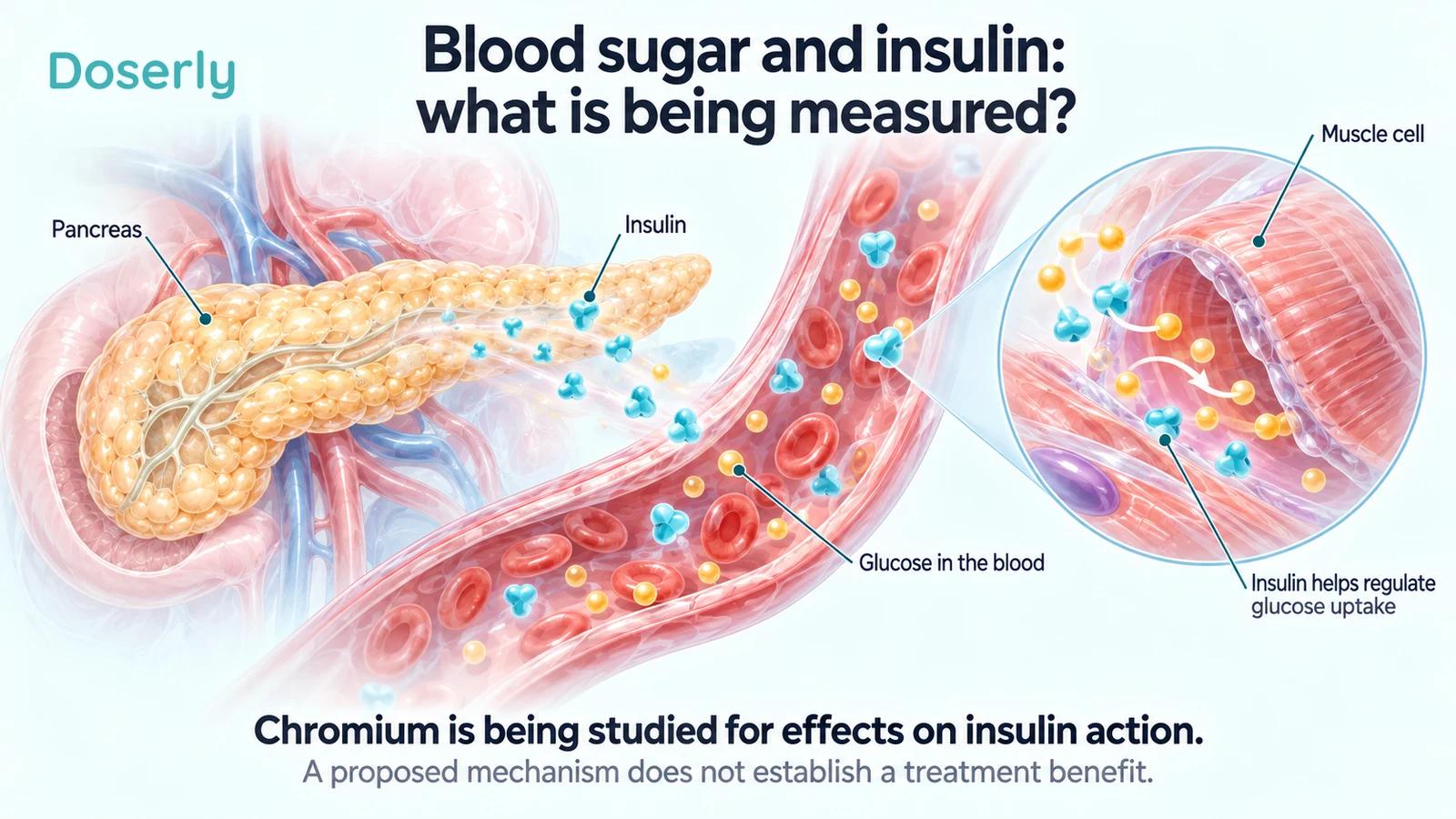
Insulin is a hormone made by the pancreas. It helps regulate how the body handles glucose, including glucose uptake by muscle. With insulin resistance, tissues respond less effectively, and the pancreas may initially compensate by producing more insulin. If that compensation becomes insufficient, glucose in the blood can rise. Prediabetes and type 2 diabetes describe glucose abnormalities; they are not diagnoses of a missing trace mineral. NIDDK: insulin resistance and prediabetes
Researchers have proposed that chromium affects insulin signaling. But the physiological role remains debated. In its 2014 assessment, the European Food Safety Authority concluded that an essential function and a human dietary requirement had not been established well enough to set chromium reference intakes. This is more uncertainty than the phrase “essential for glucose metabolism” suggests. EFSA scientific opinion
That distinction changes how a supplement should be discussed. Replacing a nutrient with an established deficiency is one kind of treatment. Giving a larger amount of a substance to alter glucose metabolism is another. A plausible signaling effect can motivate a trial, but it cannot tell us whether the effect is large enough, sustained enough or safe enough to help patients.
What “baseline status” should mean
Three people can buy the same chromium bottle for very different reasons. One has normal glucose and wants to prevent future problems. Another has prediabetes. A third has diabetes and has recently received a corticosteroid injection. Their starting physiology, existing care and reasons for a glucose change differ.
The most useful starting information is already part of clinical care: whether a diagnosis has been confirmed, which medicines are being used, and whether the concern is a persistent pattern or a temporary change. Bring previous results and dates, rather than just the highest number you remember. A clinician can decide which measurements need repeating and whether a recent illness or treatment changes their interpretation.
Chromium measurements don't solve that problem. NIH notes that urinary chromium reflects recent absorption more than body stores; it also reports no clinically defined deficiency state. A laboratory can measure a substance without that measurement being a validated guide to treatment. NIH: chromium status
This is particularly relevant to “personalized” supplement advice. A low-looking number on a report needs a defensible clinical interpretation, not just a reference interval. Ask what condition the test diagnoses, whether its result predicts a response, and what evidence supports the proposed treatment. Those questions are more useful than assuming every measured mineral has an established replacement target.
What happened in people at risk of diabetes?
A randomized, blinded trial published in 2011 enrolled 59 adults with impaired fasting glucose, impaired glucose tolerance or metabolic syndrome. It tested chromium picolinate at 500 or 1,000 micrograms daily, using six-month chromium and placebo periods in a modified crossover design.
Neither dose produced a significant advantage in fasting glucose, glucose after a glucose drink, insulin measurements or a calculated insulin-resistance measure. The investigators also found no improvement in the secondary outcomes, including A1C, compared with placebo. Ali and colleagues, 2011
This is directly relevant to someone considering chromium because glucose is mildly elevated. The study did not demonstrate improved glucose regulation in that setting. It was not a large, years-long diabetes-prevention trial, so it cannot establish the effect on future diagnoses or complications. It also doesn't prove that every possible preparation is ineffective. It does mean that the common prevention story lacks support from this particular controlled test.
If a product advertisement cites only the idea that chromium influences insulin, this trial asks the next practical question: did people with elevated metabolic risk actually improve? The answer here was no clear advantage over placebo, despite studying amounts far above the tiny quantities usually discussed in food.
Did people with established diabetes respond differently?
A 2010 trial examined chromium picolinate in people with type 2 diabetes, including detailed measurements of insulin sensitivity. The investigators reported no consistent improvement across the full range of participants. Those categorized as responders started with poorer insulin sensitivity and higher glucose and A1C than nonresponders. Cefalu and colleagues, 2010
That finding is interesting, but it is easy to overread. Defining responders by what happened after treatment and then examining their starting features can generate a hypothesis. It does not create a reliable rule that every person with a high A1C should take chromium. To establish such a rule, a future trial would need to specify the subgroup in advance and show a reproducible benefit.
Nor does a relationship with starting glucose establish chromium deficiency. “More insulin resistant” and “chromium deficient” are different claims. The former describes glucose physiology; the latter would require an accepted nutritional diagnosis.
Formulation also matters. A separate six-month randomized trial tested 400 micrograms daily as chromium yeast in people with type 2 diabetes already receiving oral glucose-lowering medicines. It found no advantage in A1C or the other measured metabolic outcomes. That provides another reason to avoid treating all chromium studies as interchangeable confirmations of benefit. Kleefstra and colleagues, 2007
For a patient, the question isn't whether any subgroup in any paper changed. It's whether adding a defined product to their current care has enough evidence to justify the additional expense, exposure and monitoring.
What does the 2026 steroid-injection trial add?
A small trial at Fayoum University Hospitals studied 60 people with diabetes undergoing sacroiliac joint steroid injections. Thirty received oral chromium at 200 micrograms daily for 45 days; the comparison group continued standard diabetes management. The published abstract describes the study as randomized and double-blinded.
The investigators reported better glucose control beginning on day six, along with reductions in glucose-lowering medication and analgesic use. This is a specific clinical setting: steroid exposure after a pain procedure, in people who already had diabetes. Mahmoud and colleagues, 2026
The abstract does not provide enough detail to independently assess the exact chromium preparation, how the control maintained blinding, or the magnitude and uncertainty of the glucose difference. Its medication-use percentages should not be read as instructions to reduce a prescription. Small numbers and a short supplementation period also limit conclusions about delayed harms.
This result is worth following, but it doesn't cancel the earlier negative trials. They studied different populations and circumstances. A treatment effect during steroid-related glucose disruption would need confirmation in that setting before being generalized to daily prevention, routine diabetes management or people with normal glucose.
If you are planning a steroid injection, tell the procedural clinician about diabetes and ask who will oversee any glucose changes afterward. That is a concrete planning question the supplement literature cannot answer for an individual.
Glucose tests measure different things
Fasting plasma glucose measures glucose at a particular time after fasting. An oral glucose tolerance test evaluates the response to a standardized glucose drink. These are laboratory tests used in diagnosing diabetes and prediabetes; a home glucose meter reading is not a substitute for a diagnostic assessment. NIDDK: diabetes testing
A1C, also written HbA1c, reflects glucose attached to hemoglobin in red blood cells and provides information about average glucose over approximately three months. It can be affected by conditions that alter red blood cells or hemoglobin, so it needs clinical interpretation when it disagrees with other measurements. NIDDK: the A1C test
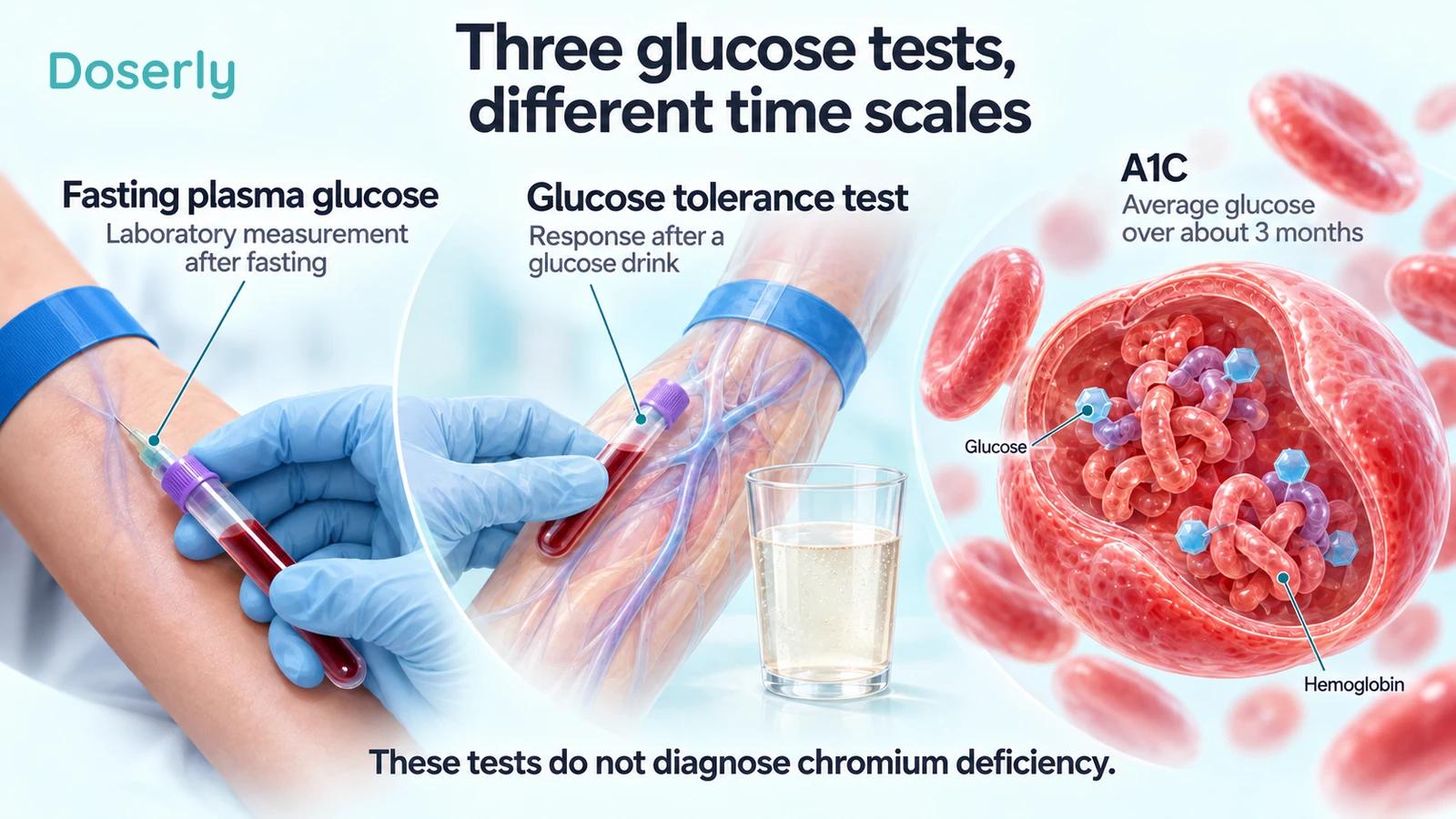
These distinctions help explain why a brief change on a glucose monitor doesn't establish a durable treatment benefit. If your concern is a long-term trend, the follow-up plan should match that time scale. If the concern is a temporary steroid effect, near-term monitoring may be more informative. A trial that measures one question cannot automatically answer the other.
It's also useful to separate a laboratory outcome from a complication outcome. An improvement in glucose control can matter clinically, but these chromium studies do not demonstrate fewer heart attacks, kidney failures or diabetes-related deaths. Those would require appropriately designed outcome trials.
Is a higher dose a reasonable way to resolve uncertainty?
Increasing the amount is not a substitute for knowing whether a product helps. The 2011 prevention-risk trial already included two substantial supplemental doses without clear benefit. Its dose range describes research exposure, not a recommended personal experiment.
The US Food and Nutrition Board did not establish a tolerable upper intake level for chromium because the safety evidence was insufficient. The absence of a numerical ceiling does not mean unlimited intake is safe. Its assessment specifically calls for better high-dose safety data and identifies pre-existing kidney or liver disease as a concern. National Academies chromium assessment
Medication interactions deserve attention. NIH describes possible additive glucose lowering with insulin or other diabetes medicines and reduced levothyroxine absorption when taken together with chromium picolinate. Tell your clinician or pharmacist about chromium even if it is included inside a multivitamin or a combined “glucose support” product. NIH: medication interactions
The practical issue is the whole routine. Photographing the actual labels can be more useful than remembering a product name, particularly when several products contain overlapping ingredients.
A useful conversation about your next step
Start with the health concern you want to improve. If you have an abnormal test, ask what it means, whether it needs confirmation and which established options fit your situation. If you already have diabetes, ask how any additional product would fit the treatment and monitoring plan you have.
Then make the proposed benefit specific. Does the supporting study involve prediabetes, established diabetes or steroid-related hyperglycemia? Did it test the same preparation? Was the improvement in A1C, an insulin-sensitivity measurement, medication use or something you would notice in daily life?
A dated record of glucose results, medication changes and supplement use can make that conversation clearer. It will not prove that chromium caused a change, but it can help the clinician interpret timing and avoid confusing several simultaneous changes.
Chromium remains an uncertain addition for blood-sugar management. Your starting glucose control helps judge which studies are relevant; it does not establish a chromium shortage. The most useful baseline check is a clear diagnosis and an agreed clinical goal, followed by evidence that addresses that goal.
Sources
- NIH Office of Dietary Supplements: Chromium — status testing, supplement forms and interactions.
- EFSA scientific opinion on chromium reference values, 2014 — assessment of essentiality.
- Ali et al., 2011 — randomized trial in adults at risk of diabetes.
- Cefalu et al., 2010 — metabolic-response trial in type 2 diabetes.
- Kleefstra et al., 2007 — chromium yeast trial.
- Mahmoud et al., 2026 — small steroid-injection trial; abstract-level assessment.
- NIDDK: insulin resistance and prediabetes.
- NIDDK: diabetes tests and diagnosis.
- NIDDK: the A1C test.
- National Academies: chromium, 2001 — upper-limit evidence and research gaps.