
Peptides
October 16, 2026
Can topical GHK-Cu evidence support injectable GHK-Cu claims?
On this page
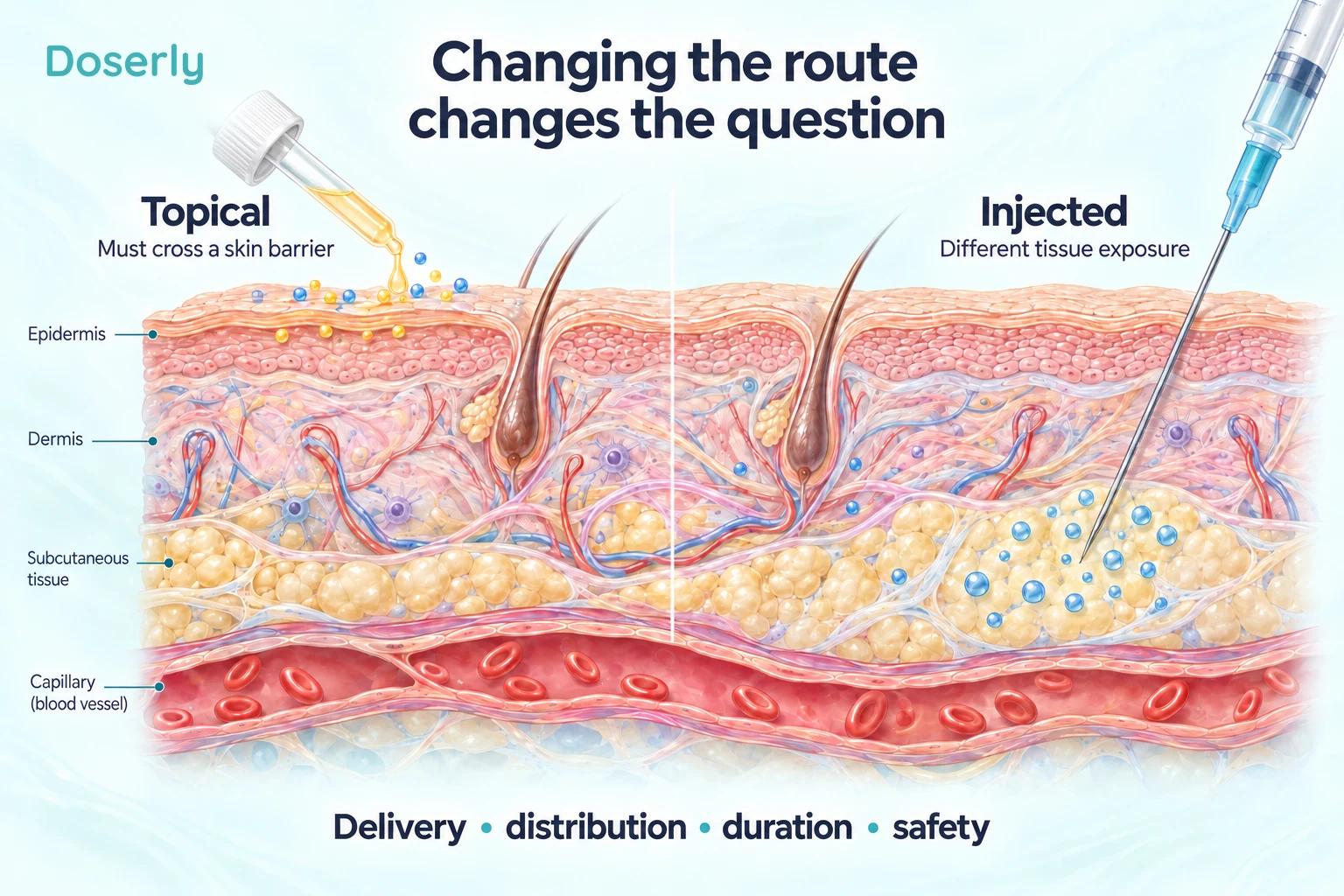
A study of a copper-peptide cream can help explain why researchers are interested in GHK-Cu. It cannot, by itself, tell someone what happens when the compound is injected. The ingredient’s name may stay the same while its delivery, tissue exposure, formulation requirements, and safety questions change.
This is the central problem with using skin-care research to support claims about injectable GHK-Cu for whole-body recovery, hair growth, or aging. The topical studies are not irrelevant. They answer narrower questions. Connecting them to an injection requires evidence for the intervening steps, not simply a statement that injections “absorb better.”
The distinction is especially important here because some papers measured copper passing through skin, others measured peptide, and others measured a clinical skin outcome. Those are three different kinds of evidence.
A route is part of the treatment
A topical formulation starts outside the body. Its carrier, concentration, the condition of the skin, and the time it remains in place can affect exposure. A substance applied to an open ulcer encounters a different barrier from a serum applied to intact facial skin. Delivery through microneedle-treated skin is different again.
An injection bypasses the outer skin barrier, but that does not automatically deliver the desired concentration to the desired cells. Investigators still need to establish what happens after administration: how the compound changes, how long relevant forms remain available, where they distribute, and what effects they produce. Bypassing one obstacle does not establish the rest of the treatment pathway.
Nor is “more exposure” necessarily the right goal. An effect in skin might depend on local exposure, whereas systemic administration can expose other tissues. Whether that changes benefit, toxicity, or both is an empirical question. It cannot be answered by treating every route as a more or less powerful version of the same cream.
Our GHK-Cu guide provides broader context. This article focuses on the evidence needed to connect topical results to injectable claims.
What the human topical trials actually contribute
The older diabetic-ulcer study tested a topical GHK-Cu gel alongside structured wound care. It was multicenter, randomized, evaluator-blinded, and placebo-controlled. The original abstract reported greater reduction in plantar-ulcer area with active treatment than with vehicle. Original trial
That gives researchers a reason to investigate a specific local treatment. It does not establish an injectable wound-healing regimen. The gel was applied to a wound, and participants also received debridement, pressure-relieving footwear, education, and other study care. Removing those features and replacing the route produces a different intervention from the one tested.
A small randomized study after carbon-dioxide laser resurfacing offers another useful example. Thirteen participants completed regimens with or without topical copper tripeptide. The investigators did not establish an added objective benefit for redness resolution or skin appearance, although satisfaction with overall skin quality favored the copper-peptide regimen. Original study abstract
This is neither a universal failure nor a universal success for GHK-Cu. It is a mixed result in a narrow postoperative setting. It is even further from demonstrating that injections improve hair, tendons, energy, or longevity. A claim should not expand as it travels away from the experiment supporting it.
The useful question is therefore not whether there is “human evidence” somewhere in the literature. It is whether the human evidence tests the route, preparation, population, and outcome being claimed.
Copper crossing skin is not necessarily intact GHK-Cu crossing skin
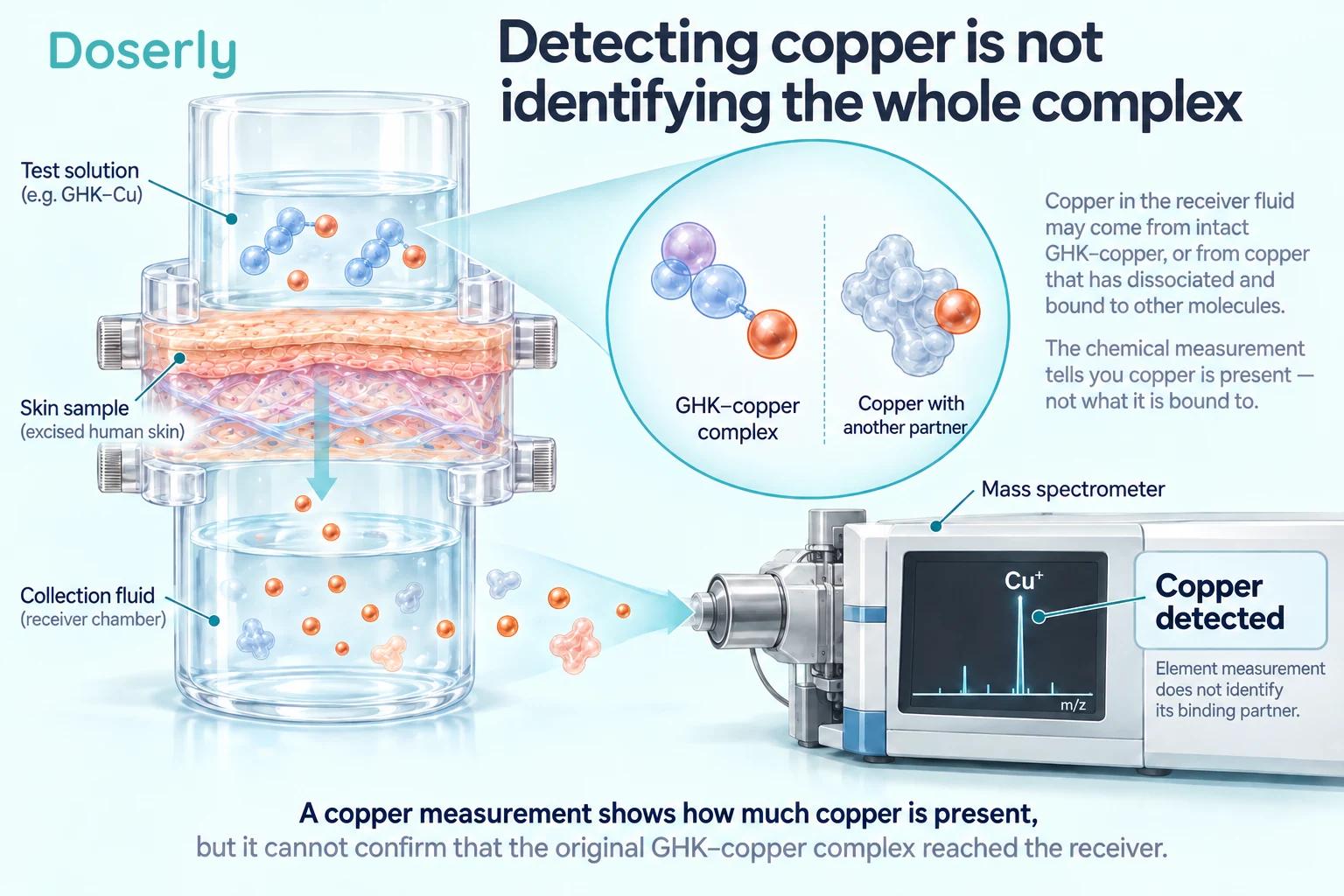
A frequently cited penetration experiment used human skin obtained after death, mounted in laboratory diffusion cells. Researchers applied a copper-tripeptide preparation, then measured copper retained in tissue and collected beneath it over 48 hours. The final 2010 paper used elemental analysis by inductively coupled plasma mass spectrometry. Final published study
That method can quantify copper. It does not, on its own, identify whether the copper remains bound to the original GHK peptide. Copper can exchange binding partners, and the authors discussed rearrangement and tissue retention. Finding the element on the other side of a membrane is therefore not equivalent to proving delivery of a fixed amount of intact GHK-Cu to a target in a living person.
The experiment also examined different isolated skin layers. Those preparations are useful for understanding barriers, but they are not interchangeable with intact living skin, circulation, or a clinical treatment course. Its discussion of possible anti-inflammatory delivery was a proposal for further development, not a patient outcome measured in that experiment.
There is a publication detail worth preserving when checking this reference: a later version of the paper was identified as a duplicate preliminary publication. The journal’s erratum directs readers to the revised final 2010 article linked above. Those records should not be counted as independent replications. Journal correction
Microneedles change the experimental barrier
A 2015 study tested whether polymeric microneedles could enhance copper-peptide delivery through skin. It used laboratory skin models, with additional cellular and porcine models for safety-related assessments. Penetration increased after microneedle pretreatment compared with intact skin under the study’s conditions. Original indexed abstract
The investigators reported peptide and copper separately in the material that passed through treated human skin. That separation matters. A copper measurement, a peptide measurement, and a measurement confirming the intact complex are not automatically the same result. The abstract supports enhanced transport in the tested system; it does not supply a human systemic pharmacokinetic study.
Its favorable irritation findings also have a defined scope. Laboratory and animal observations cannot establish the rate of infection, sensitization, or other adverse outcomes from repeated human injections. Nor does a microneedle experiment validate applying an ordinary cosmetic immediately after a home procedure. That would involve its own product, barrier disruption, and safety questions.
The study is useful formulation research. It shows why the delivery method deserves investigation instead of being treated as a minor detail. It cannot be used to calculate an injection dose or to claim that a different injected preparation has already passed clinical testing.
The bloodstream adds another chemistry question
GHK-Cu is often drawn as if it were a permanent package moving unchanged through the body. Laboratory chemistry suggests a more dynamic picture. A 2021 study demonstrated complexes involving copper, GHK, and human serum albumin, a major blood protein. The investigators proposed a possible role in transport of exchangeable copper and GHK. Original chemistry study
That observation helps explain why the chemical form in a vial may not be the only form relevant after administration. It does not establish a beneficial blood concentration, an effective half-life, a dosing interval, or a clinical safety margin for injected GHK-Cu. Those are separate measurements requiring appropriate studies.
Likewise, a naturally occurring peptide is not automatically equivalent to a manufactured injectable preparation. The relevant question is not merely whether the body encounters GHK or copper. It is whether the administered product, amount, route, and resulting exposure have been characterized and tested for the proposed purpose.
What current FDA documents actually say
As checked on October 15, 2026, FDA’s compounding safety page specifically identifies injectable GHK-Cu among substances whose nominations were withdrawn. It describes potential immune-response risks associated with aggregation and peptide-related impurities, and notes limited human data for safety assessment. These are stated concerns and evidence gaps, not a measured percentage of users who will experience a reaction. FDA safety information
The route distinction also appears in FDA’s May 14, 2026 update. That document places GHK-Cu except for injectable routes back in Category 1, meaning substances under evaluation. It explains that a nominator clarified its withdrawal applied to the injectable route. A statement that “GHK-Cu is Category 1” without the route qualification can therefore be misleading. FDA nomination update
Being under evaluation is not a finding that a product works. A nomination, an advisory review, and approval of a specific drug product are different actions. These documents should be used to understand the current review and safety context, not as endorsements of a commercial preparation.
This also explains why an older webpage can become inaccurate even if it once quoted an agency correctly. The substance name alone is insufficient: the route, document date, and exact administrative status all need checking.
What an appropriate injectable evidence package would need
A credible bridge would begin with a well-characterized preparation and route-specific exposure studies. Researchers would need to know what they are administering and what relevant forms reach the body afterward. Evidence about stability, impurities, and biological exposure would make the subsequent clinical question interpretable.
Then a trial would need to test a particular benefit in a defined population. “Recovery” is too broad: recovery from what, measured how, compared with which alternative, over what period? For a skin claim, validated skin outcomes might be relevant. For a wound claim, closure, recurrence, and complications could matter. For a broad aging claim, a change in a laboratory marker alone would not establish better health or longer life.
The study would also need follow-up and adverse-event reporting appropriate to repeated exposure. A trial can only inform risks it was capable of observing. Small samples and short follow-up cannot reliably exclude uncommon or delayed harms, even when no serious events are recorded.
None of these requirements is unique to GHK-Cu. They are the practical reasons a promising ingredient and an established treatment are different stages of research.
Product testing answers a different question from treatment testing
A product certificate may describe an identity or purity assay performed on a sample. Even when that information is accurate, it does not establish a clinical benefit. It also should not be treated as a substitute for all the characterization and safety work relevant to the intended route.
FDA's concerns about injectable GHK-Cu include aggregation and peptide-related impurities. Those concerns illustrate why “the molecule was identified” is only part of the assessment. Product quality, biological exposure, and clinical outcomes are connected questions, but evidence addressing one does not automatically answer the others. FDA safety information
When a commercial claim combines a certificate with a list of topical papers, read the two pieces separately. The certificate concerns the tested material; the publications concern their own preparations and experiments. Putting them on the same page does not establish that the marketed injection reproduces the published result.
A registered topical trial does not close the injection gap
The CuHeal registry describes a phase 2 study of topical GHK-Cu gel on paired small biopsy wounds in healthy adults. It specifies a vehicle comparison and wound-healing outcomes. As checked on October 15, 2026, the record had no posted results. CuHeal registry
Even a positive result would primarily inform that topical wound-treatment question. It would not retroactively turn the earlier penetration experiments into injectable trials. Trial registration is useful evidence of a study plan; the route and endpoint still determine what future results could establish.
For someone encountering an injection claim today, the most revealing question is simple: where is the controlled human study of this injected preparation for this claimed benefit? A list of skin-care papers may provide biological background, but it does not answer that question.
Topical GHK-Cu findings justify focused research and careful discussion of specific formulations. They do not establish the efficacy, exposure, or safety of injectable GHK-Cu. Changing the route creates a new treatment question, and that question needs its own evidence.
Sources
- Mulder et al. — Enhanced healing of ulcers in patients with diabetes (1994)
- Effects of topical copper tripeptide complex on CO2 laser-resurfaced skin (2006)
- Hostynek et al. — Human skin retention and penetration of a copper tripeptide (final 2010 publication)
- Journal erratum identifying the final publication (2011)
- Microneedle-Mediated Delivery of Copper Peptide Through Skin (2015)
- Ternary Cu2+ Complexes of Human Serum Albumin and Glycyl-L-histidyl-L-lysine (2021)
- FDA — Certain bulk substances that may present significant safety risks
- FDA — Compounding nominations update, May 14, 2026
- ClinicalTrials.gov — CuHeal, NCT07437586