
Peptides
October 16, 2026
Do survodutide liver findings apply to everyone with fatty liver?
On this page
Being told that you have fatty liver can leave you with more questions than answers. Was fat seen incidentally on an ultrasound? Are blood tests suggesting inflammation? Is there evidence of scarring? Those situations overlap, but they are not identical, and they don't necessarily match the people enrolled in a drug trial.
Survodutide has produced promising liver findings in human research. However, its studies have examined several different populations, using different tests and outcomes. The evidence cannot be applied to every person with liver fat as though they all had the same disease stage. MASH trial, SYNCHRONIZE-MASLD
The useful question is which study most closely resembles your clinical situation. This article explains the differences without asking you to diagnose or stage yourself. The survodutide guide covers the compound's broader mechanism, trials and safety context.
What does “fatty liver” leave unspecified?
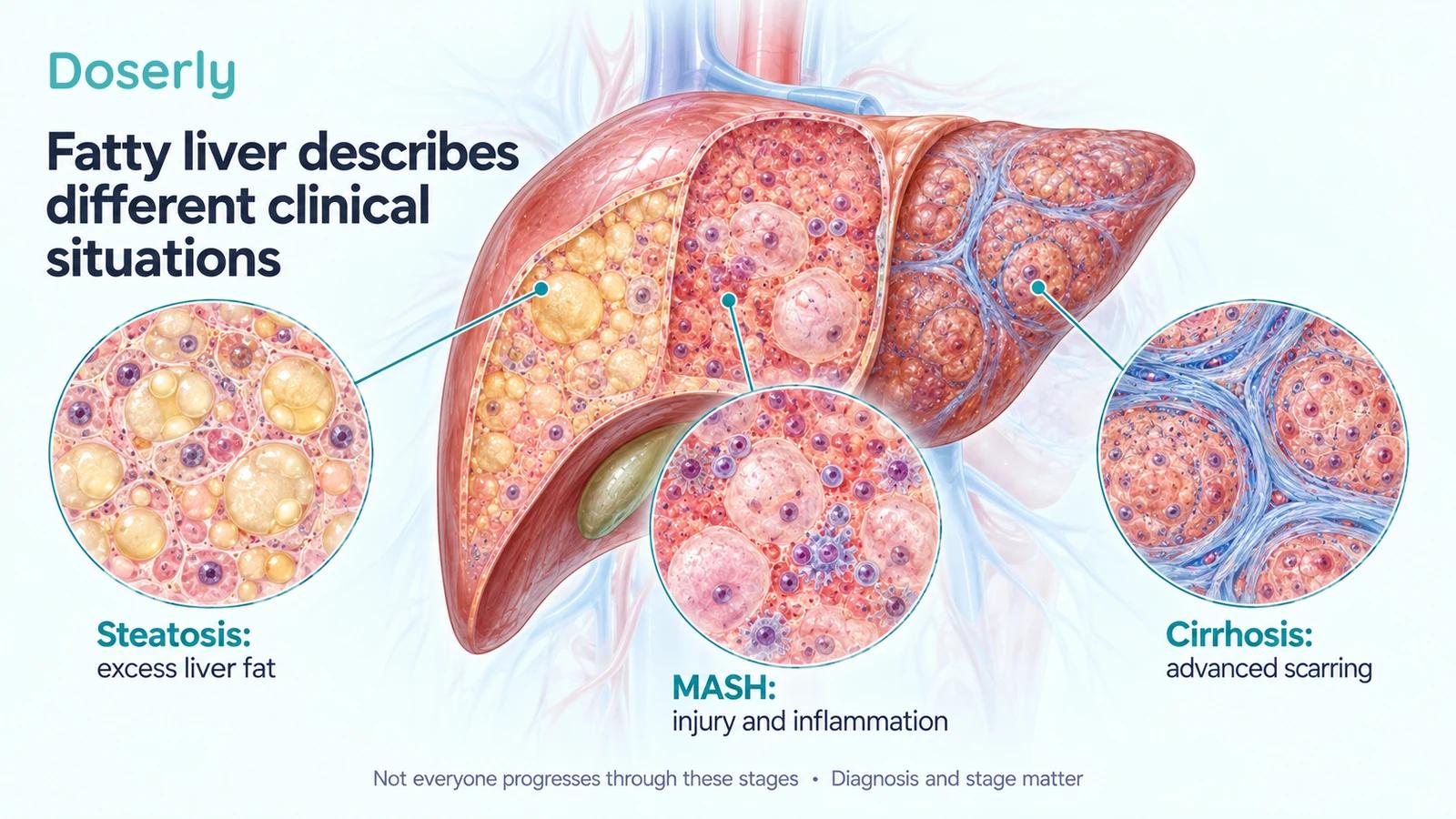
Steatosis means excess fat within liver cells. When it occurs with metabolic risk factors, the clinical terminology is metabolic dysfunction-associated steatotic liver disease, or MASLD. MASH, metabolic dysfunction-associated steatohepatitis, includes liver-cell injury and inflammation.
Fibrosis is scarring. Its stage gives information about how much and what pattern of scar tissue is present. Cirrhosis is an advanced form, conventionally designated F4 in the staging system used by these trials. The earlier stages are not interchangeable with cirrhosis.
The same phrase, “fatty liver,” can therefore hide substantial differences. Two people might both have fat visible on a scan, while only one has evidence of advanced fibrosis. Another person's liver fat may coexist with alcohol-related disease, viral hepatitis or a medicine-related problem that requires separate assessment. NIDDK diagnostic overview
A drug study's entry rules select particular combinations of these features. That selection helps researchers answer a clear question, but it also places limits on the answer.
The biopsy-confirmed MASH population
The phase 2 MASH trial studied adults with a tissue diagnosis of MASH and fibrosis stages F1 through F3. A liver biopsy provided the evidence of active steatohepatitis and the fibrosis stage. The study's 293 treated participants received survodutide or placebo for 48 weeks. Original trial
This was more specific than enrolling anyone with an elevated liver enzyme or an ultrasound report mentioning fat. The participants already had the combination of tissue injury and scarring that the study intended to investigate.
The primary endpoint was improvement in MASH without worsening of fibrosis. It occurred more frequently in the survodutide groups than with placebo. That supports a treatment effect on the defined histologic outcome in the selected population.
It doesn't mean the trial established a benefit in people with no fibrosis, advanced cirrhosis, or liver disease caused primarily by another condition. Those people may have biologically related problems, but they were not interchangeable with the enrolled group.
For someone with a biopsy report, the relevant comparison is therefore the diagnosis and fibrosis stage, not simply whether the report includes the word “fat.”
The phase 3 MASLD population was different
SYNCHRONIZE-MASLD enrolled adults with obesity, or overweight with a qualifying complication, and at-risk MASLD. The study treated 216 participants over 48 weeks, comparing survodutide with placebo. Participants were recruited in the United States and Spain. Original phase 3 report
Eligibility required at least 8% liver fat on MRI-PDFF, an MRI technique that estimates the liver's fat fraction, plus additional evidence suggesting inflammation or fibrosis. A qualifying history of biopsy-confirmed MASH within the preceding three years was another part of the entry framework.
Most participants qualified through noninvasive tests, meaning tests that do not require collecting liver tissue. Only 9.7% had a recent history of biopsy-confirmed MASH. The investigators described the group overall as having predominantly early disease, with absent or mild-to-moderate fibrosis suggested by the baseline measurements.
This broader, test-based approach can resemble how liver risk is identified in nonspecialist care. But it does not mean every participant had the same tissue diagnosis as those in the earlier biopsy trial.
It also doesn't establish that people with a normal BMI or an incidental finding of mild steatosis would have the same response. The obesity criteria and minimum MRI fat threshold remain part of the population definition.
What did the phase 3 trial establish for that group?
The trial's two primary outcomes were a relative reduction of at least 30% in MRI-measured liver fat and percentage change in body weight. In its primary treatment-regimen analysis, 68.5% of survodutide participants and 28.6% of placebo participants reached the liver-fat response threshold. Average weight changes were −8.7% and −1.4%, respectively. Primary results
Those findings are meaningful evidence of changes in fat and weight. They are not biopsy-confirmed proof that the same proportion had MASH resolution or fibrosis regression. The trial did not obtain the paired biopsies needed to make those statements directly.
The difference matters when applying the result to yourself. Someone whose clinical concern is advanced scarring needs evidence about that concern, not only a favorable fat measurement. Conversely, someone with earlier MASLD may find a liver-fat endpoint relevant without assuming they had the more advanced condition studied elsewhere.
The study also reported secondary markers of inflammation and fibrosis risk. Their interpretation depends on the test, and not every marker showed a statistically clear between-group change. A collection of noninvasive findings can inform a clinical picture without becoming a substitute for every possible tissue or clinical outcome.
Why can't a scan give every answer?
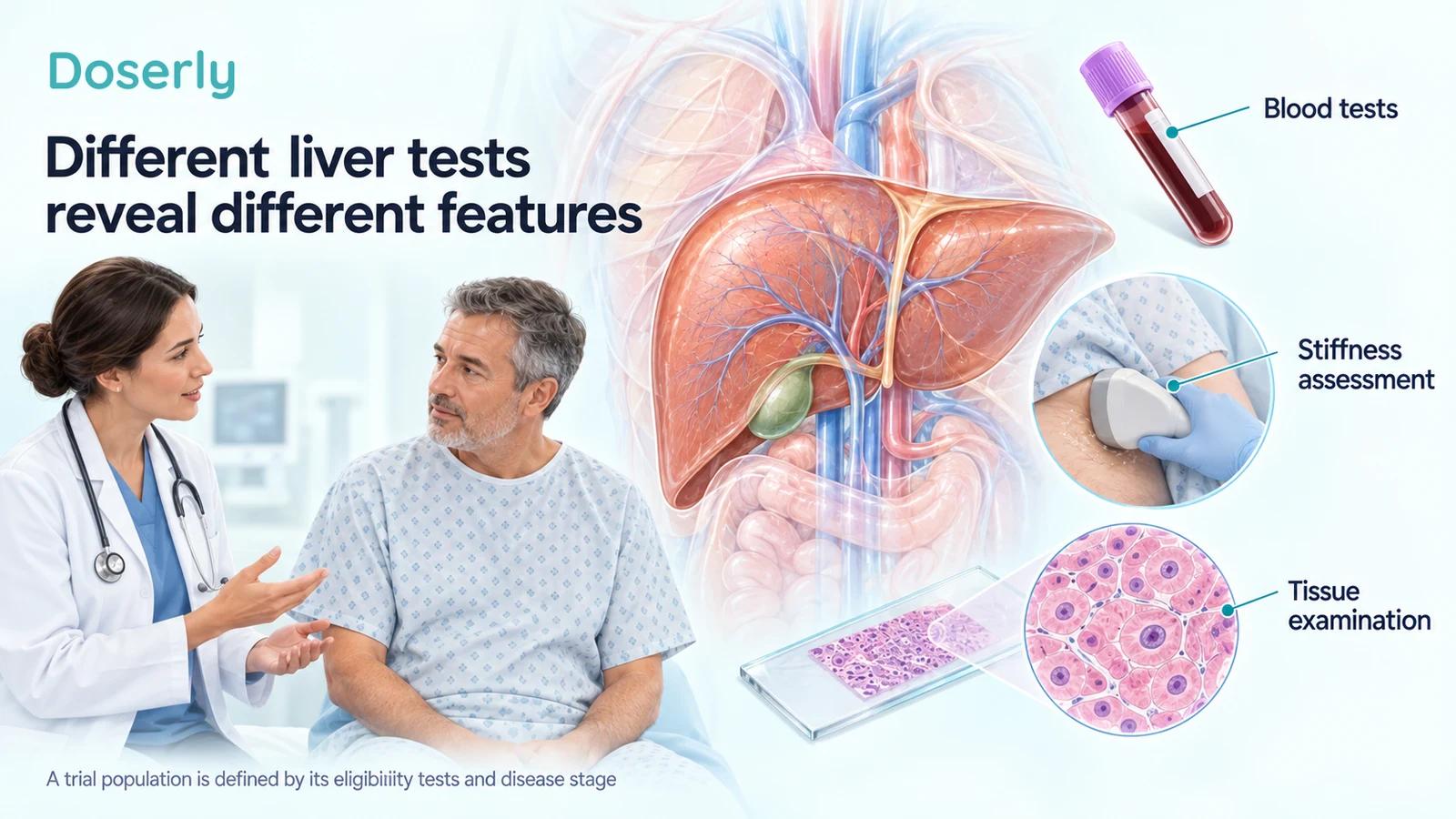
An ordinary imaging test can identify liver fat, but it doesn't provide the same information as microscopic examination of tissue. Elastography estimates stiffness, which can help assess fibrosis risk. Blood-based scores use laboratory and clinical measurements to estimate the likelihood of more advanced disease. Each test contributes a different kind of information. NIDDK explanation of diagnostic tests
This doesn't mean everyone needs a biopsy. Biopsy is invasive, and clinicians select it when its additional information is useful. It means a scan-based study and a biopsy-based study shouldn't be described as though they enrolled or measured exactly the same thing.
A biopsy also has limitations: it samples a small amount of tissue, and a pathologist interprets the sample. Its strength is that it directly examines features that other tests estimate indirectly. NIDDK liver biopsy
For a patient, knowing how the diagnosis was made helps explain why a clinician may request another test even after fat has already been seen. The additional test may answer a fibrosis or injury question that the first scan couldn't settle.
Cirrhosis requires its own evidence
Cirrhosis changes the clinical question. Researchers must consider advanced scarring, liver function, portal pressure and the risk of decompensation, when complications such as fluid accumulation or impaired brain function develop. A favorable fat result in earlier disease cannot establish safety or benefit in this setting.
Neither the F1–F3 phase 2 MASH trial nor SYNCHRONIZE-MASLD was a definitive trial of treatment for cirrhosis. The latter specifically excluded current or previous cirrhosis. MASH study, MASLD eligibility
There has been a separate phase 1 survodutide study in people with cirrhosis. Its existence is important, but its design must stay attached to its conclusions. It was nonrandomized and open-label, focused initially on how the body handled the drug and on tolerability.
The single-dose cohorts included 41 people, and the multiple-dose cohorts also included 41. The multiple-dose portion followed participants over 28 weeks. Some noninvasive liver and metabolic markers decreased, but the study wasn't a placebo-controlled test of whether survodutide prevents decompensation, transplantation or death. Cirrhosis phase 1 report
Drug exposure is not the same as clinical benefit
Pharmacokinetics describes how a medicine moves through the body: how much reaches the circulation, how concentrations change and how it is cleared. Liver disease can make these questions particularly important.
The phase 1 cirrhosis study found broadly similar exposure measures after a single dose in participants with cirrhosis and matched healthy comparators. That information helps researchers design later studies. It does not establish that every patient with severe liver disease can safely use the medicine without adjustment.
A pharmacokinetic conclusion answers a narrower question than a clinical-outcome trial. Similar blood concentrations don't guarantee identical effects on nutrition, muscle mass, symptoms or complications across disease stages.
The open-label design also matters for exploratory improvements. Without a concurrent randomized placebo comparison for the clinical question, changes over time can have explanations other than the drug. The findings justify further investigation, not a general recommendation for cirrhosis treatment.
What are the larger liver studies testing now?
The LIVERAGE trial is designed for MASH with moderate or advanced fibrosis. Its registered first part includes MASH resolution without fibrosis worsening and fibrosis improvement without MASH worsening. A later part follows a composite of clinical events over a longer period.
LIVERAGE-Cirrhosis is a separate trial in compensated MASH cirrhosis. Its planned primary outcome includes events such as death, transplantation, hepatic decompensation and worsening measures of disease severity or portal hypertension. LIVERAGE registry, LIVERAGE-Cirrhosis registry
The distinction between compensated and decompensated disease is deliberate. The cirrhosis trial's current entry rules exclude a history or current evidence of specified decompensation events. A planned study of compensated disease should not be presented as a trial encompassing all advanced liver failure.
When checked on October 15, 2026, both records were recruiting and had no posted results. The registrations tell us what researchers plan to test. They do not establish that the treatment already prevents the listed events.
What about alcohol, other diseases or a normal BMI?
The MASLD trial excluded secondary causes of liver-fat accumulation, significant alcohol consumption and other chronic liver diseases. Those restrictions reduce uncertainty about which condition is being studied. They also limit how far the findings can be extended. SYNCHRONIZE-MASLD methods
A person with substantial alcohol exposure and metabolic risk may have overlapping contributors to liver disease. Someone with viral hepatitis or autoimmune liver disease may need care directed at that cause even if liver fat is also present. The survodutide results don't erase those distinctions.
Likewise, an obesity-enriched trial provides less direct evidence for a person with MASLD at a lower BMI. That doesn't prove the drug would fail in such a person. It means the study wasn't designed to provide an equally precise answer for them.
Avoid turning an evidence gap into either a promise or a declaration of no possible benefit. The accurate statement is that applicability becomes less certain as the clinical situation moves away from the enrolled population.
How can you use this information at an appointment?
Start with what is known about your own diagnosis. Was the concern identified through liver enzymes, a scan, a fibrosis-risk score, elastography or biopsy? Has a clinician assessed the possibility of advanced fibrosis or other causes of liver disease?
Then connect the proposed benefit to a measurement. Lower liver fat, a better fibrosis-risk estimate and fewer clinical complications are related goals, but the evidence for one doesn't automatically establish the others. Ask which study supports the specific benefit being discussed.
It can help to bring the actual laboratory and imaging reports, including dates, rather than only remembering that a result was “high.” Different tests use different units and answer different questions. A change in one may require interpretation alongside the others.
Survodutide's liver findings are promising for the populations studied. Their value increases when the diagnosis, stage and endpoint stay visible. The survodutide guide offers additional background, while your clinician can relate that research to the disease features that matter for you.
Sources
- Sanyal and colleagues, biopsy-confirmed MASH and F1–F3 fibrosis trial, 2024.
- Kaplan and colleagues, SYNCHRONIZE-MASLD, 2026.
- Lawitz and colleagues, survodutide pharmacokinetics and tolerability in cirrhosis, 2024.
- NIDDK, diagnosis of fatty liver and steatohepatitis.
- NIDDK, liver biopsy.
- LIVERAGE registered study.
- LIVERAGE-Cirrhosis registered study.