
Peptides
October 16, 2026
PT-141 in men: what the human studies actually tested
On this page
PT-141 has been studied in men, but the best-known approval trials do not establish its use for male low desire. Bremelanotide, the molecule behind the PT-141 name, is approved in the United States as Vyleesi for a specific form of hypoactive sexual desire disorder in premenopausal women. Early male experiments mainly investigated erections, often using laboratory instruments over a short observation period. Vyleesi prescribing information, early male intranasal study
That leaves a more useful answer than either “it works for both sexes” or “there are no human studies in men.” There are direct male data, but they answer narrower questions than the broad libido claims made online. Understanding those questions helps explain what can reasonably be learned from the women's trials and what still needs its own evidence.
The question changes when the population changes
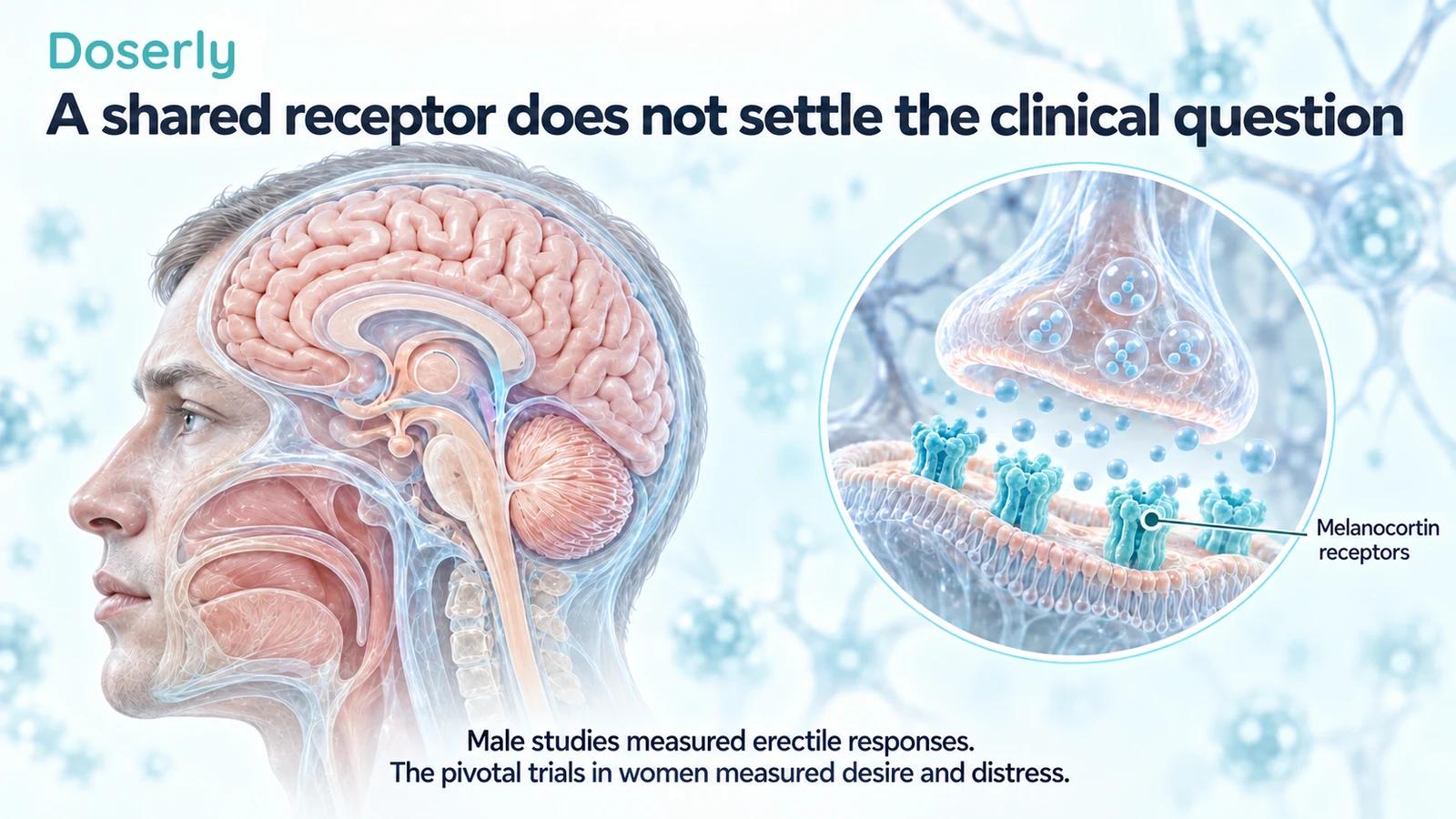
The pivotal RECONNECT studies enrolled premenopausal women with acquired, generalized HSDD: persistent, unwanted low desire across situations, with associated distress. Their main outcomes were changes in reported desire and distress. The study publication describes 1,267 women randomized, with 1,247 in the safety population and 1,202 in the efficacy analysis. RECONNECT report
A man asking whether PT-141 might help can have a different concern. Interest may be normal while erections are unreliable. Alternatively, erections may be possible but interest has declined. Both may be affected, or the change may coincide with medication, illness, fatigue, or a relationship difficulty. A common word such as libido does not make these identical treatment questions.
Biology offers reasons to study a molecule in more than one population. Shared receptor systems can make an effect plausible. But a shared receptor is not an estimate of benefit, a safety profile, or a validated dose for another group. Those require observations under conditions relevant to that group.
What the early nasal studies measured
A 2004 publication evaluated intranasal PT-141 in healthy male volunteers and men with erectile dysfunction who responded to Viagra. Researchers used RigiScan, an instrument that records penile rigidity and circumference-related changes. Healthy volunteers were assessed without visual sexual stimulation; the erectile-dysfunction participants were assessed with it. Original intranasal study
The abstract reports a statistically significant erectile response compared with placebo at the higher amounts tested, with the first erection occurring at approximately 30 minutes. It also describes flushing and nausea as common adverse events and reports no clinically significant changes in the monitored vital signs, laboratory tests, electrocardiograms, or examinations under those study conditions.
This is evidence of a short-term physiological response. It is not a trial showing sustained improvement in male HSDD, satisfaction over months, or a reliable benefit from a currently sold nasal spray. The exact preparation and supervised assessments are part of the experiment. The timing of a laboratory erection is also not a guarantee of what a person will experience in everyday sexual activity.
A finding that vital signs did not show a clinically significant change in one early study does not override later cardiovascular warnings for the approved product. Different amounts, routes, populations, and monitoring methods can reveal different aspects of risk. A full development program is interpreted across studies, not by choosing the most reassuring sentence from one abstract.
The subcutaneous study asked another male question
Another 2004 report evaluated subcutaneous PT-141 in healthy men and in men reporting an inadequate response to Viagra. In that study, inadequate response meant an erection suitable for vaginal penetration on no more than half of attempts while taking the specified sildenafil regimen. That was a study eligibility definition, not a universal definition of treatment failure. Original subcutaneous study
The erectile-dysfunction group received placebo and two PT-141 amounts in a crossover design, meaning participants received different treatments at separate visits. RigiScan measurements during visual sexual stimulation showed significant erectile responses at both active amounts studied. Healthy participants were tested differently, without visual stimulation. Those details keep the populations and conditions from being blended together.
The abstract does not provide a clinically useful percentage of men with lasting, satisfactory improvement in their sex lives. It reports an instrument-based response. We should not invent a personal success rate or infer that the experimental amounts are appropriate for routine use. They were also different from the approved Vyleesi autoinjector regimen developed for women.
The result is a reason male research continued, not a complete treatment recommendation. It suggests pharmacological activity in the selected men and supports further testing of patient-important outcomes, tolerability, and the conditions under which an effect is useful.
Route is part of the evidence
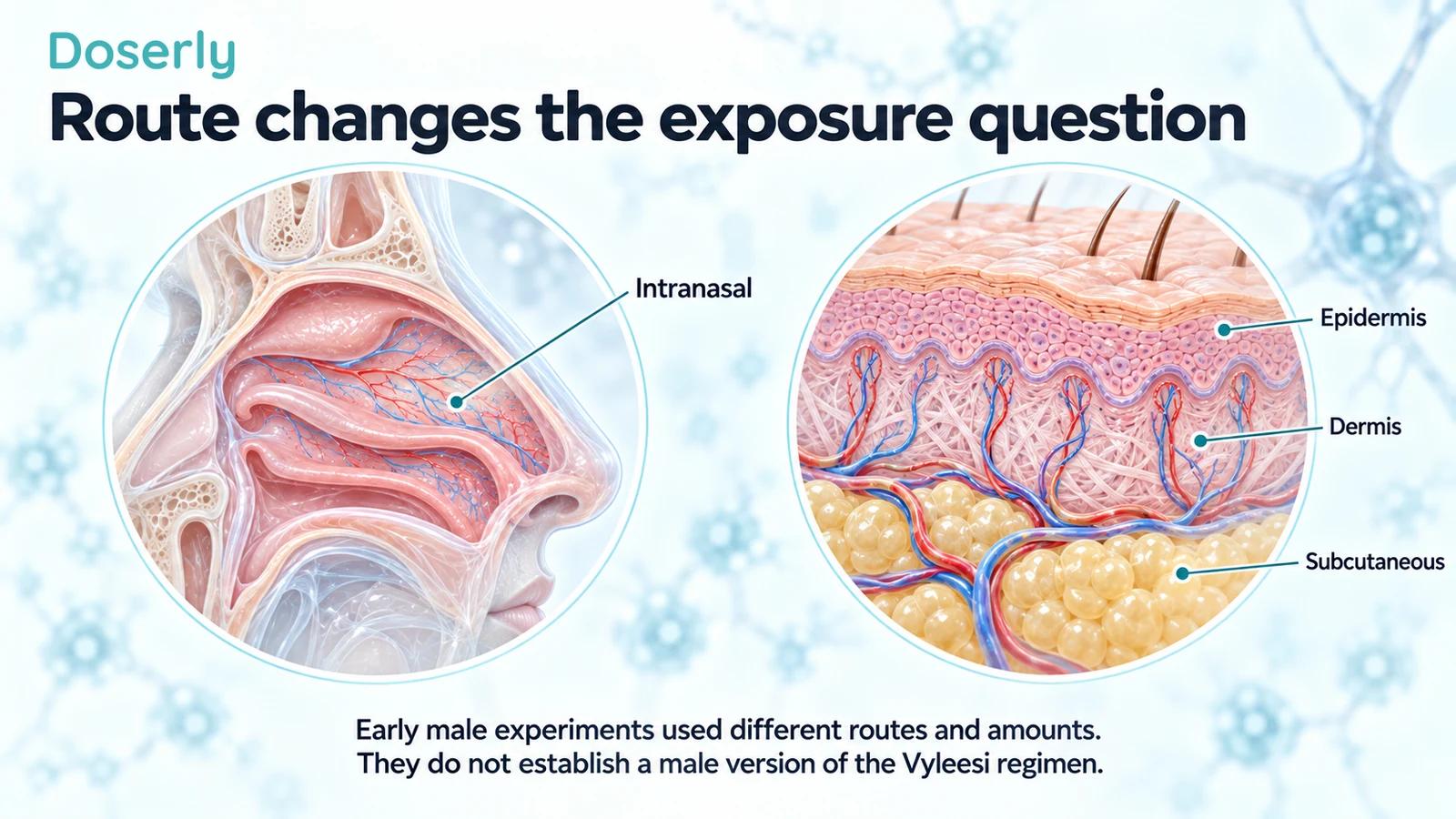
Intranasal means delivered through the nose; subcutaneous means delivered beneath the skin. The tissues through which a drug is absorbed differ. The same number of milligrams given by two routes should not be assumed to create the same concentration in the body or the same effect.
The nasal study measured drug concentrations and described its own absorption time course. The approved Vyleesi label describes pharmacokinetics for its subcutaneous product. Neither supports calculating a male nasal-to-injection conversion from a social-media schedule. Intranasal study, Vyleesi pharmacokinetics
Route differences also matter when someone claims that a trial “used PT-141,” without specifying how. The chemical name is only part of the intervention. The formulation, delivered amount, timing, and product quality determine what was actually tested. A research vial or a separately prepared spray does not become equivalent to a trial product through its label alone.
The combination experiment was small and specific
A 2005 crossover experiment tested intranasal PT-141 together with sildenafil in 19 men who described themselves as responders to Viagra or Levitra. The comparison included sildenafil with placebo nasal spray and double placebo. Investigators measured erections over six hours, including two periods of visual sexual stimulation. Combination study
The combination produced a greater measured erectile response than sildenafil alone. The authors reported good tolerability within this experiment. The selected sample and short follow-up cannot establish the safety of routine combinations, uncommon adverse effects, or a durable benefit for male low desire. It also should not be described as a study exclusively of men who had failed PDE5 inhibitors: the abstract says they were self-reported responders.
This distinction matters because a plausible combination is easily turned into a recommendation. Different mechanisms can justify a hypothesis, but they do not prove that the added benefit is worth the added exposure. A laboratory comparison with a particular sildenafil amount is not a full comparison with optimized clinical care.
One larger male report needs a prominent qualification
A 2008 randomized study reported bremelanotide treatment in men with sildenafil failure. In 2023, the journal issued an expression of concern about that paper. The original report should therefore not be presented as unqualified confirmation that PT-141 rescues sildenafil nonresponse. Original report, editorial notice
An expression of concern is distinct from a retraction, and this article does not invent the details of the underlying editorial investigation. Its practical consequence is that the paper's claimed efficacy cannot be used confidently to reassure a reader about expected success. We identify the report but do not use its response percentage as a treatment estimate.
This leaves a male evidence base with genuine early physiological signals and meaningful gaps. It is more accurate to describe those gaps than to fill them with the women's phase 3 results. A trial in another population can provide background and identify risks worth considering; it cannot supply the missing male clinical comparison.
What can the women's trials contribute?
The women's trials are informative about the studied drug's pharmacology, adverse effects, and performance under their conditions. For example, the approved label describes nausea, temporary pressure increases, skin darkening, and effects on absorption of some oral medicines. Those findings are relevant concerns when the molecule is considered elsewhere. Vyleesi safety information
What cannot be transferred directly is a precise male benefit-to-harm estimate. A 40% nausea rate from a selected female safety population is not a measured male incidence for a different product and amount. Likewise, improvement on the Female Sexual Function Index desire domain is not a validated numerical forecast for men's desire.
The distinction is between using evidence to recognize a possible concern and using it to calculate a personal result. The first can be reasonable across populations when the pharmacology is relevant. The second needs data that fit the population, condition, formulation, and outcome.
Approval is a separate issue as well. The Vyleesi label explicitly excludes men from its indication. That does not prove no male could experience a pharmacological effect; the early studies already suggest otherwise. It means the approved use does not establish a male treatment regimen or a general performance claim.
What would a more useful male trial look like?
For men with distressing low desire, a useful trial would recruit that condition specifically and assess desire, distress, and meaningful daily outcomes using appropriate measures. For erectile dysfunction, it would need to assess erectile outcomes and patient satisfaction, with a suitable comparator and enough follow-up to judge continued use. Those are different research programs even if the drug candidate is the same.
A trial would also need to describe prior treatment, relevant medical conditions, concomitant drugs, and the exact preparation. Reporting withdrawals and adverse events would help distinguish an effective treatment that people can use from a physiological effect that is difficult to tolerate. This is a description of unanswered research needs, not a proposed self-treatment experiment.
For the reader, the corresponding clinical questions are straightforward. What condition is being treated? Was that condition studied in men? Was the same route and product used? Did the study measure an outcome you would notice and value? Which safety information comes directly from men, and which is being extrapolated?
Start with the symptom that changed
Men with persistent erectile symptoms should receive a medical and sexual-health assessment rather than assuming they need a different peptide. European guidance emphasizes clinical history, underlying causes, cardiovascular context, and correct use of licensed treatment. Low desire may require a different assessment from an erection problem even when both are present. EAU guidance
The early male PT-141 studies make the research interesting. They do not turn the women's approval trials into male efficacy evidence. The most honest answer is that male erectile-response experiments exist, while a routine male low-desire indication and regimen cannot be supplied by simply generalizing RECONNECT. Our PT-141 human research guide provides the wider context for that distinction.
Sources
- Vyleesi prescribing information.
- RECONNECT trials in women.
- Intranasal male study, 2004.
- Subcutaneous male study, 2004.
- Sildenafil combination study, 2005.
- Sildenafil-failure study, 2008, with 2023 expression of concern.
- EAU erectile-dysfunction guidance.