
Supplements
October 16, 2026
Can phosphatidylserine calm the stress response without dulling performance?
On this page
Phosphatidylserine is often described as a way to soften the stress response while keeping the useful part of being switched on. For someone who feels tense before a presentation or exhausted after training, that sounds like an attractive combination.
Small human studies have found changes in stress-related hormone responses under particular conditions. But a lower cortisol measurement, a calmer experience and better performance are three different outcomes. The research does not establish that phosphatidylserine reliably delivers all three together.
The most informative studies are the ones that measured more than a hormone. They show why the ingredient deserves a more careful explanation than “lowers cortisol.”
Cortisol is not a substance to minimize
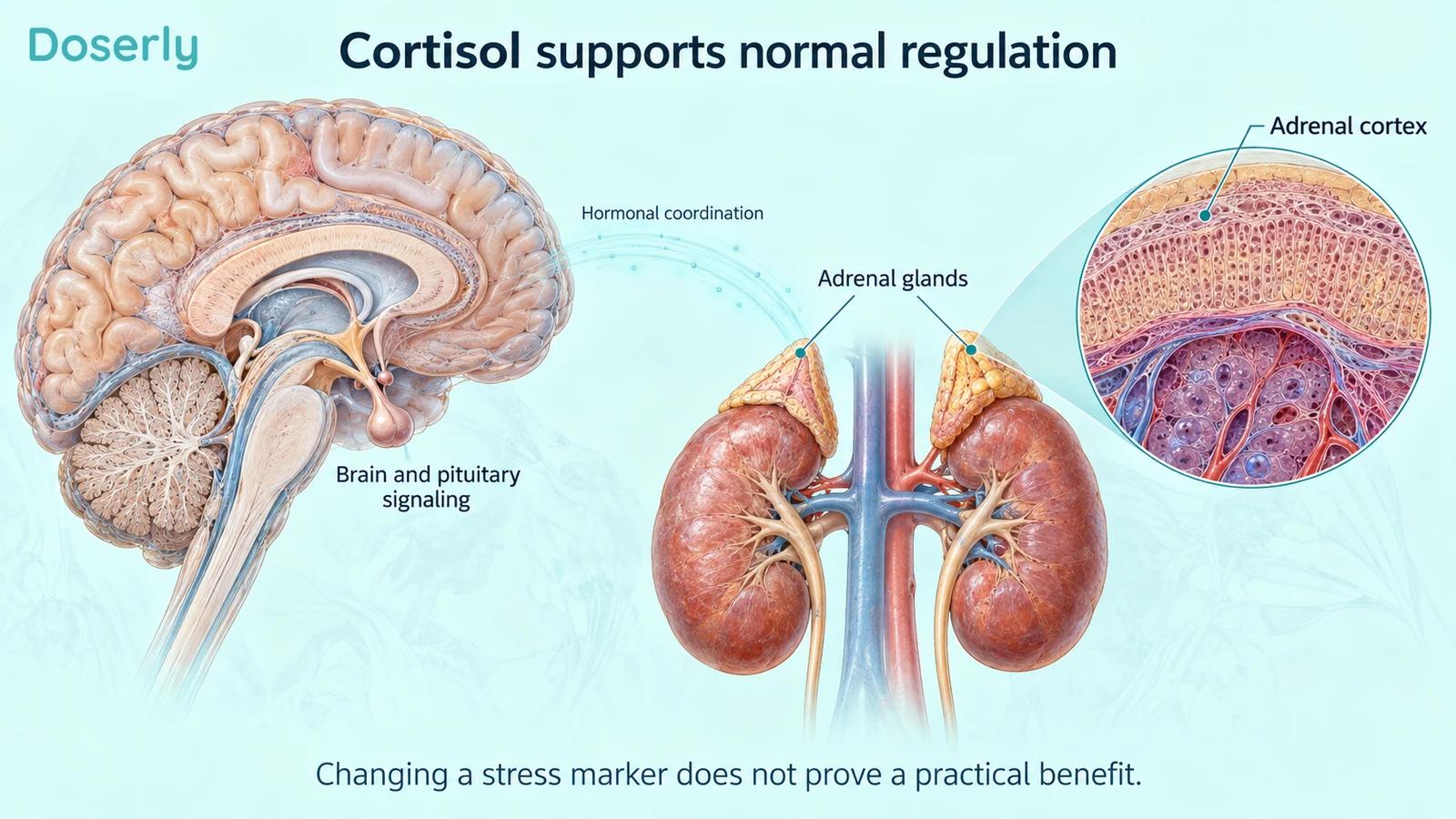
Cortisol is produced by the adrenal glands and helps regulate metabolism, blood sugar, inflammation and blood pressure. Its secretion is controlled through the hypothalamus, pituitary and adrenal system, often called the HPA axis. The Endocrine Society emphasizes that cortisol has essential functions beyond its familiar connection to stress. Adrenal hormone overview
That makes “less cortisol” an incomplete goal. A physiological response to exercise or a stressful task is not automatically a disorder. Too little cortisol can also be a serious medical problem, while pathological excess has causes that require assessment rather than a supplement workaround.
A trial can ask whether an intervention changes the response to a standardized challenge. That question is different from diagnosing high cortisol in someone who feels tired, anxious or unable to sleep. Symptoms alone do not tell us what their hormone pattern is.
The Doserly phosphatidylserine guide covers the ingredient more broadly. Here, the question is whether the stress-response findings translate into useful function without a performance cost.
Phosphatidylserine is a membrane component, not cortisol
Phosphatidylserine, or PS, is a phospholipid found largely on the inner side of cell membranes, where it participates in structural and signaling functions. The background to the exercise research describes this biology as a reason to investigate its effects on stress responses. It does not make supplemental PS a direct replacement for, or antagonist of, a hormone. Exercise endocrine study
Formulation is also important. Research has involved different sources of PS and combinations with other phospholipids. A trial of a soy-derived PS preparation should be described that way. A trial of PS plus phosphatidic acid, or PS plus ginkgo, cannot identify PS's independent contribution merely because its name appears on the label.
The familiar abbreviation can make these products look interchangeable. They are not identical interventions. Dose, ingredient source, other active compounds and treatment duration all affect how closely a commercial product resembles an experiment.
What the 2008 cortisol experiment actually tested
Ten healthy men participated in a double-blind crossover study comparing 600 mg of soy-derived PS daily with placebo for ten days per condition. Researchers collected blood before and after a 15-minute staged cycling protocol and during recovery. Starks and colleagues, 2008
Peak cortisol and cortisol exposure across the sampling period were lower after PS. Growth hormone and lactate did not change significantly. The study also reported an increase in the testosterone-to-cortisol ratio, which should not be translated into an equivalent increase in testosterone.
The experiment was designed around hormonal responses. It did not establish less burnout, better sleep, more muscle growth or prevention of overtraining. Those claims would require their own clinical or performance measurements.
The small sample, short intervention and specific exercise challenge limit generalization. The tested amount is a research detail, not a suggested routine. Most importantly, a hormonal change after a short cycling test does not itself tell us whether someone feels or functions better in everyday life.
Why the ratio can sound more impressive than the result
A ratio changes when its numerator changes, its denominator changes, or both change. If cortisol falls while testosterone stays similar, the testosterone-to-cortisol ratio rises. That arithmetic does not establish a large anabolic effect.
This matters because supplement summaries sometimes present a dramatic percentage increase in a ratio as if it were the same increase in muscle-building capacity. Even a correctly calculated ratio remains a surrogate measure. The relevant outcomes for a trainee would include strength, training consistency, recovery and adaptation over time.
Likewise, the area under a hormone curve combines concentrations across sampled time points. It does not measure the amount of psychological stress a person experienced or the quality of the next night's sleep. Understanding the measurement prevents a narrow endocrine finding from becoming a much broader promise.
A cycling study found performance improvement without lower cortisol
A 2006 trial in 14 active men tested 750 mg of soy-derived PS daily for ten days. Participants completed staged cycling followed by an effort continued until exhaustion. Time to exhaustion improved in the PS group, while the placebo group remained similar. Serum cortisol, oxygen-uptake kinetics and feeling-state measures did not change significantly. Cycling-capacity trial
That is useful evidence because it breaks the assumed chain: a performance signal occurred without a significant cortisol effect. It does not show that cortisol reduction is the necessary explanation for every potential benefit of PS.
Time to exhaustion is also a specific exercise-capacity test. It is not the same as a faster race, a better strength session or sustained gains over a training season. The trial was small and short, so replication and more practical performance outcomes would strengthen the case.
Taken together, the cycling studies support further research rather than a dependable formula in which lower cortisol automatically produces better training.
Recovery did not consistently improve
Another 2006 crossover study tested soy-derived PS around downhill running in eight recreationally active men. The protocol was designed to produce soreness and measurable muscle damage. Researchers assessed perceived soreness and blood markers after exercise and over the following two days. Downhill-running recovery trial
The running challenge increased soreness and several markers of muscle damage, inflammation and oxidative stress. PS supplementation did not significantly reduce those responses compared with placebo.
This does not prove that PS has no recovery effect under any circumstances. It does mean a claim that it reliably prevents exercise-related deterioration is stronger than these findings support. Negative studies are especially relevant when the promised benefit is recovery rather than a laboratory hormone change.
The type of exercise matters too. Eccentric downhill running and moderate staged cycling stress the body differently. A result from one cannot simply be assumed for the other, which is why describing the actual protocol is more useful than calling both “athlete research.”
Psychological stress research tested a combination
A 2014 randomized study enrolled 75 healthy men and tested a soy-derived complex containing both PS and phosphatidic acid. Participants received placebo, 200 mg of each component or 400 mg of each daily for 42 days before a standardized psychosocial stress challenge. PS/phosphatidic-acid trial
The higher-dose combination altered ACTH and cortisol responses in the subgroup with higher chronic stress, but not in the lower-stress subgroup. The lower-dose combination did not produce the same significant endocrine findings. Importantly, the study did not find significant effects on the psychological stress response, heart rate or pulse transit time.
This is not evidence that everyone taking PS feels calmer. The result involved a combination, a selected subgroup and hormonal measures. Calling the effect “normalization,” as the paper does, should not be expanded into a general claim that PS balances anyone's hormones.
The subjective null result is central to the headline question. A change in hormone reactivity can occur without a demonstrated change in the person's reported stress experience.
Newer blend research still needs ingredient-level caution
Two exploratory randomized trials published in 2026 examined a standardized ginkgo extract associated with phosphatidylserine. They assessed cognitive performance and mood over acute testing and four-week supplementation periods; a second study enrolled adults with moderate stress. The paper reported selected positive findings but also described more modest cognitive results in the second study than expected. Ginkgo-plus-PS trials, 2026
These studies are relevant to a combined product. They do not settle whether PS alone calms stress, whether a cortisol change explains the findings, or whether a different PS formulation has the same effects.
That is a recurring limitation in this literature. Combining ingredients may be a reasonable research strategy, but it changes the question. Evidence for the blend belongs to the blend unless the design can isolate individual contributions.
Can it calm you without dulling you?
The available studies do not give a confident yes. They also do not demonstrate that PS necessarily dulls performance. Some small experiments show favorable endocrine or exercise-capacity findings; others show no meaningful improvement in psychological stress or recovery.
To answer the full question, a study would need to assess both the desired calming effect and preservation of relevant performance in the same participants. For a presentation, that might mean perceived anxiety alongside accuracy, recall or speech performance. For training, it might mean readiness and exertion alongside actual work completed and subsequent recovery.
A lower hormone result alone leaves the practical question open. A performance benefit without a subjective calming effect leaves part of it open too. The goal is not to make every study answer everything, but to avoid claiming the combined outcome when no suitable experiment has demonstrated it.
What short-term safety research can say
A randomized study in 120 older adults with age-associated memory impairment compared placebo with 300 or 600 mg of soy-derived PS daily for 12 weeks. Laboratory safety measures, blood pressure, heart rate and adverse events did not differ significantly between groups after the reported statistical correction. Soy-derived PS safety trial
That is useful tolerability information for the tested preparation, population and duration. It does not establish safety for every formulation, combination, medical condition or longer period. A modest study cannot reliably exclude uncommon harms.
People considering a supplement while taking medicines or managing an endocrine condition should review the exact product with a clinician or pharmacist. A claim about “cortisol support” should not prompt changes to prescribed steroid treatment or other hormonal care. The product label and actual ingredient amounts are more useful than the marketing category.
Measure the problem you want to solve
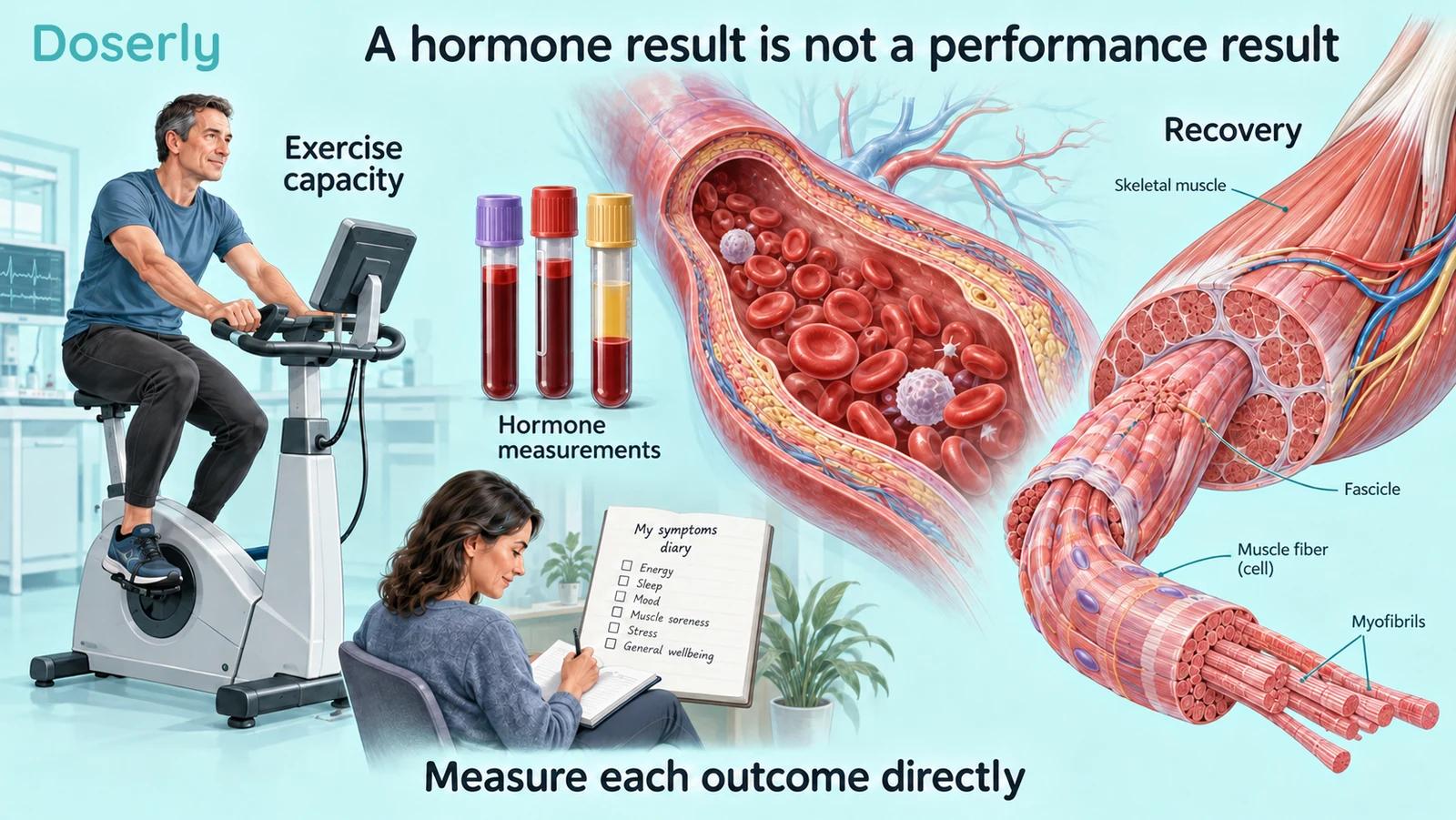
Before interpreting a supplement response, describe the problem in ordinary terms. Is it worry before a specific task, poor sleep, prolonged soreness, declining performance or persistent exhaustion? These may overlap, but one hormone explanation should not be assumed for all of them.
A simple record can track the event, perceived stress, performance and any unwanted effects. For exercise, include the training load and recovery interval. For a work task, note whether accuracy or completion actually changed. Record other simultaneous changes, including caffeine, sleep and new supplements, so a single improvement is not attributed too confidently.
Tracking cannot diagnose abnormal cortisol or prove a supplement mechanism. It can make a clinical conversation more concrete and help distinguish a transient feeling from a useful pattern.
Persistent symptoms deserve assessment rather than an escalating attempt to suppress the stress response. PS has interesting human research, but the strongest practical reading remains limited: some small trials changed selected outcomes, while reliable calming with preserved performance has not been established.
Sources
- Endocrine Society: adrenal hormones
- PS and endocrine response to exercise (2008)
- PS and cycling exercise capacity (2006)
- PS and recovery after downhill running (2006)
- PS/phosphatidic-acid complex and psychosocial stress (2014)
- Ginkgo-plus-PS exploratory trials (2026)
- Soy-derived PS safety in older adults (2002)