
Peptides
October 16, 2026
Can oxytocin improve relationships? What human trials actually measure
On this page
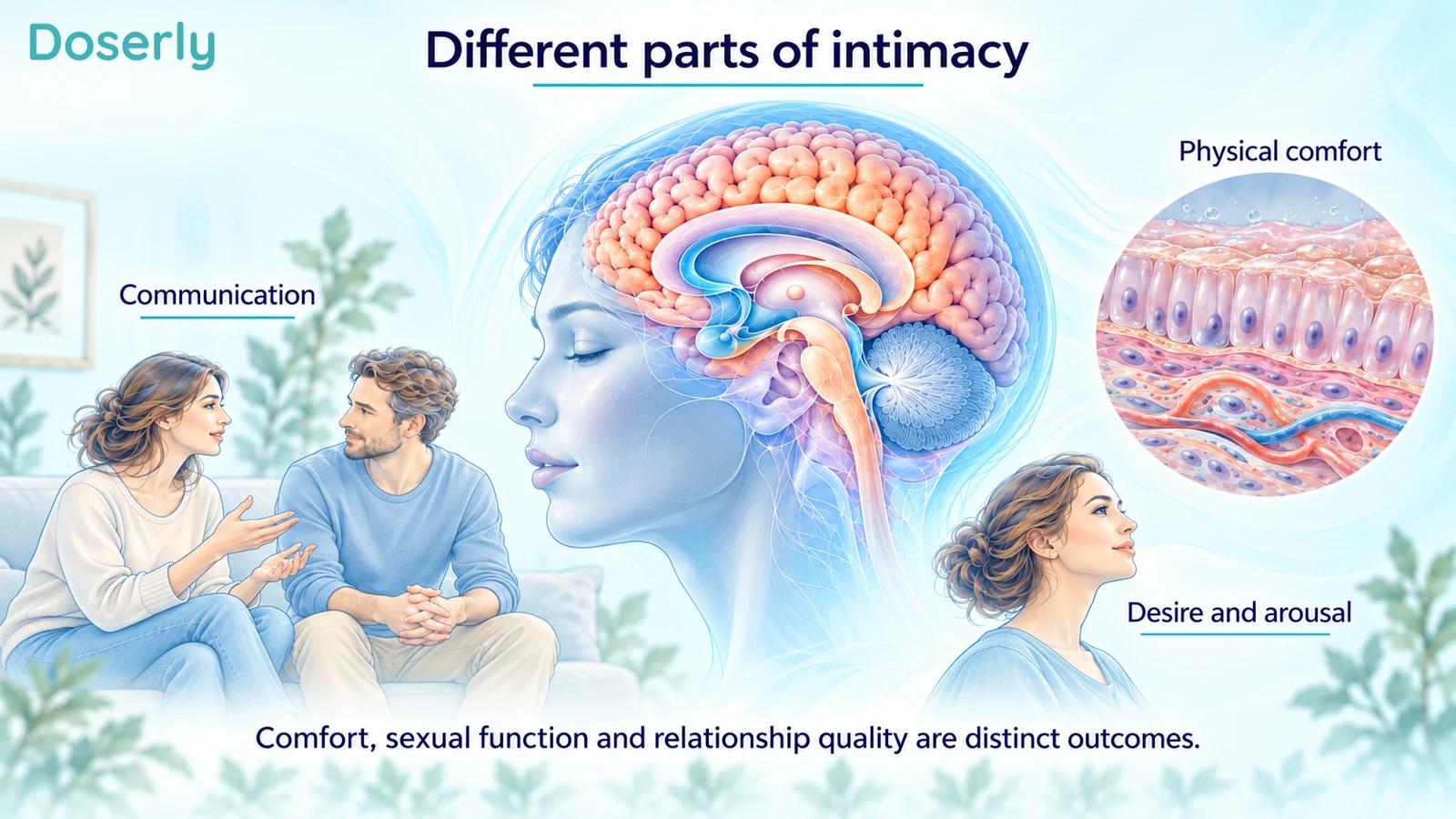
Oxytocin is involved in human reproductive physiology and has been studied in social behavior, so interest in it as a way to feel closer to a partner is understandable. But “improving a relationship” can mean many things: communicating more comfortably, enjoying sex, feeling less distressed, or rebuilding trust after a difficult period.
Clinical research has examined parts of that picture. Some small experiments found changes in specific interactions or sexual experiences. Other trials found no advantage over placebo. A 2025 trial that added oxytocin to alcohol behavioral couple therapy found no additional benefit at the end of treatment, including on relationship functioning. Couples-therapy trial.
The useful question is therefore not whether oxytocin is associated with bonding. It is whether a particular treatment helps a particular relationship problem, and whether that improvement lasts. Our oxytocin guide supplies the broader biological and safety context; this article examines the human outcomes.
What would count as a relationship benefit?
A couple might want fewer hostile exchanges, more satisfying intimacy, or better support during recovery from illness. These goals overlap, but none can stand in for all the others. A change in a hormone sample doesn't tell us whether either partner feels heard. An improvement in physical comfort during sex doesn't necessarily change communication.
A useful trial needs to define its goal before treatment begins. If it is testing sexual function, it should measure the relevant aspects of sexual function. If it claims better relationships, it needs relationship outcomes and follow-up beyond a single encounter.
It also needs to consider both partners. A couple is not simply two unrelated participants whose responses can be counted independently. One person's behavior affects the other's experience, and their reports may differ. A change that one person welcomes may be neutral or unwelcome to the other.
These distinctions aren't reasons to avoid studying intimacy. They make the results more useful. A trial can identify a narrow benefit without needing to claim that one hormone solves the wider relationship.
A short conflict discussion produced an interesting early signal
A 2009 placebo-controlled experiment involved 47 heterosexual couples, or 94 participants. Researchers gave intranasal oxytocin or placebo before a standardized conflict discussion in the laboratory. They examined observed communication and saliva cortisol, a hormone often measured in stress research.
The study reported more positive communication relative to negative behavior and lower cortisol after the discussion with oxytocin. Ditzen and colleagues.
That is a specific experimental finding. It does not show that the couples resolved their recurring disagreements, became more satisfied over subsequent months, or needed less relationship support. Lower cortisol is a physiological observation, not a direct measure of relationship quality.
The controlled setting helped investigators compare a defined interaction. Everyday conflict differs in timing, intensity and history, and it doesn't occur under a research team's instructions. A favorable response during one discussion is a reason to investigate further, not a complete treatment result.
What happened when researchers studied couples' sexual experiences?
A 2014 study involved 29 healthy heterosexual couples, with 58 participants, in a more naturalistic setting. It examined acute oxytocin effects on sexual experiences and partner interactions using questionnaires and physiological measures.
The report did not find changes in sexual drive, arousal, erection or lubrication. It did report changes in some orgasm-related experiences, contentment after intercourse and selected partner-interaction measures. Findings varied with the statistical analysis and sex, and reported effect sizes were small to moderate. Couples experiment.
A naturalistic setting makes the study more relatable, but it doesn't make all outcomes equally secure. Many measurements create more opportunities for a positive result, and a subgroup finding should not become a universal promise.
The participants were healthy couples, not a representative group seeking treatment for relationship distress or sexual dysfunction. The result cannot establish that oxytocin repairs a strained partnership. It also shouldn't be summarized as a general increase in libido when the study didn't find increased sexual drive.
For someone reading about this research, the precise benefit matters. A change in satisfaction immediately after one experience and a reliable improvement in an ongoing sexual difficulty are different claims.
Repeated use in women with sexual dysfunction did not outperform placebo
A 2015 randomized, blinded crossover trial studied 30 premenopausal and postmenopausal women with sexual dysfunction. Participants used intranasal oxytocin or placebo during an eight-week period, then switched treatments after a washout.
Researchers used questionnaires covering sexual function, distress, desire and sexual quality of life. Scores improved over time with both treatments, but there was no statistically significant treatment advantage for oxytocin. Muin and colleagues.
This is an important distinction because a before-and-after improvement can sound convincing on its own. Participants might improve during a trial for several reasons, including attention to the problem, expectations, natural variation or changes associated with participation. A placebo comparison asks whether the active treatment adds something beyond those shared influences.
The result does not make participants' improvement imaginary. It means that the study did not establish oxytocin as its specific cause. Reporting only the percentage improvement during the oxytocin period would omit the comparison needed to interpret it.
The sample was small, and the trial doesn't rule out every possible use in every subgroup. It nevertheless directly tested repeated use in women with a relevant clinical complaint, making its negative comparison more informative than an isolated anecdote.
A laboratory study separated feelings from physiological arousal
Another crossover experiment examined 27 healthy women and included both subjective sexual measures and vaginal photoplethysmography, a method that measures changes related to genital blood flow. The physiological measurements responded to the sexual-arousal setting, but oxytocin did not significantly alter the measured subjective or physiological outcomes. 2018 laboratory trial.
This helps clarify another common confusion. A study can successfully create an arousal response without showing that the drug enhances it. Researchers need to compare oxytocin with placebo within that setting, rather than treat the presence of any response as evidence of treatment efficacy.
The laboratory context also differs from intimacy with a partner. The appropriate conclusion is about the tested setting and outcomes, not that all possible experiences have been exhaustively studied.
Taken with the repeated-use trial, this study leaves no basis for a broad assurance that intranasal oxytocin reliably increases women's desire or sexual function.
Local physical comfort is a separate treatment question
Oxytocin has also been investigated in a vaginal gel for postmenopausal vulvovaginal symptoms. This is a local formulation question, not evidence about a nasal spray's effect on bonding.
A 2020 randomized trial assigned 157 women to a hypromellose-based gel with oxytocin or the corresponding gel without the hormone for 12 weeks. Both groups improved in the severity of their most bothersome symptom, but improvement did not differ significantly between groups. Vaginal-gel trial.
The gel itself matters. A nonhormonal comparison can have moisturizing or comfort-related effects, so “both groups improved” is not proof that the added hormone worked. The comparison asks whether oxytocin supplies an extra benefit.
Pain, irritation or dryness can affect intimacy, and they deserve assessment as symptoms in their own right. They shouldn't automatically be interpreted as low attraction or a relationship problem. Conversely, a local symptom improvement would not demonstrate a change in emotional closeness.
This is also why formulation cannot be omitted from a study summary. A vaginal gel, a nasal preparation and an obstetric injection are different interventions with different purposes.
A newer trial tested an addition to actual couples therapy
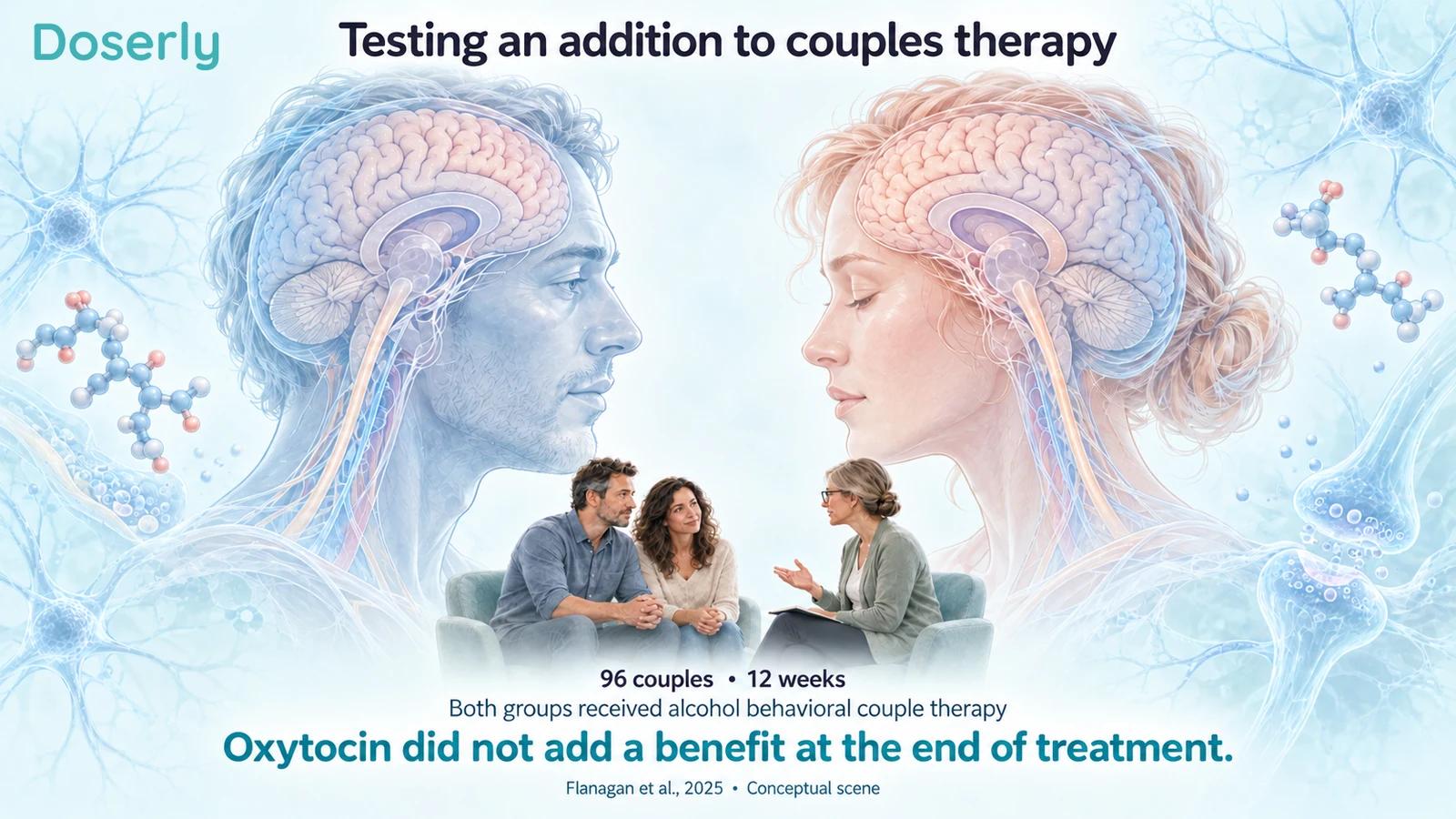
The 2025 study moved beyond a single interaction. It randomized 96 couples to oxytocin or placebo alongside a 12-week alcohol behavioral couple therapy program. Each couple included an identified patient with alcohol use disorder; some partners also had the disorder. Both members of a couple received the same assigned condition.
Primary outcomes included alcohol consumption and relationship functioning. Alcohol outcomes improved in both groups, but there was no added oxytocin benefit at treatment's end on drinking, alcohol-problem severity or relationship functioning. Flanagan and colleagues.
This is more directly relevant to a treatment claim than a brief laboratory task. It also has a defined clinical setting: couples receiving a particular therapy in the context of alcohol use disorder. It doesn't answer every question about other therapies or populations.
The result means the tested addition did not improve the reported end-of-treatment outcomes beyond the comparison program. It does not mean that behavioral treatment was useless, or that the couples' improvements should be attributed to the spray.
What a convincing future trial would need to measure
A future study should begin with a specific problem rather than a broad promise of bonding. For example, reducing distress during difficult conversations would require different measures from treating painful intercourse or improving sexual desire.
Both treatment groups should receive comparable attention and background care. Otherwise, the effect of a spray can become tangled with extra counseling, encouragement or monitoring. Random assignment and masking help separate these influences, although no design removes every source of uncertainty.
Follow-up also needs to match the claim. If the promise is a better relationship, investigators should ask whether changes persist during ordinary life and after treatment ends. Reports from both partners, meaningful functioning and unwanted experiences matter alongside questionnaire averages.
The study should identify its main outcome in advance. Searching across many scales and subgroups can suggest future questions, but it cannot carry the same weight as a successful planned primary comparison. A change in a stress marker could help explain a result; it should not replace the relationship outcome.
These are research requirements, not an invitation to run an unsupervised experiment with a partner. Personal expectations and shared decisions are part of the setting, and neither partner's wishes should be treated as a biological obstacle to overcome.
A useful starting point for care
If intimacy or communication has become difficult, describe the problem in ordinary language. Is sex uncomfortable? Has desire changed? Are arguments harder to recover from? Is alcohol use affecting the relationship? A specific description makes it easier to seek appropriate help.
A dated account of medication changes, symptoms and major life events can clarify timing without proving a cause. Both partners may have useful perspectives, but private discussion with a clinician can also matter when someone doesn't feel comfortable speaking openly together.
The studies reviewed here do not establish oxytocin as a general treatment for improving relationships. They show some acute signals, several negative comparisons and a newer therapy trial without added benefit. That is a more useful basis for decisions than the familiar phrase “bonding hormone.”
The oxytocin guide explains how these experimental uses differ from established medical uses and why the exact formulation and safety context belong in any discussion.
A couple can also disagree about whether an interaction improved. A study that measures only one partner's rating may miss that disagreement. For a relationship claim, reporting whose experience was measured—and whether both partners benefited—helps distinguish an individual response from a shared outcome. That is a useful question to bring to any proposed relationship-focused treatment.
Sources
- Ditzen et al., 2009: couple-conflict experiment.
- Couples' sexual experiences, 2014.
- Muin et al., 2015: repeated-use sexual-dysfunction trial.
- Healthy-women laboratory study, 2018.
- Vaginal-gel comparison, 2020.
- Flanagan et al., 2025: alcohol behavioral couple therapy.