
Peptides
October 16, 2026
Hexarelin and muscle strength: what human studies actually measured
On this page
Hexarelin can make the pituitary gland release growth hormone. That is a real physiological effect, and it explains why the peptide attracts interest from people hoping to build muscle or preserve strength as they age. The next question is more practical: does the hormone response help someone lift more, climb stairs more easily or recover lost physical ability?
The human hexarelin studies reviewed here do not establish that benefit. They mainly investigated hormone secretion, with a longer study also measuring body composition. Those findings are useful, but they leave a substantial gap between stimulating growth hormone and improving muscle performance. Longer-term hexarelin study
Understanding that gap doesn't require dismissing the biology. It requires separating three things that are often discussed together: hormone levels, the amount of tissue classified as lean mass, and the force a muscle can produce. We'll look at each, including human trials of other treatments that show why the distinction matters. For a broader introduction to the compound itself, see our hexarelin guide.
What hexarelin makes the body do
Hexarelin is a synthetic peptide, a short chain of amino acids. Researchers developed it as a growth hormone secretagogue: a substance that prompts the body to secrete growth hormone rather than supplying the hormone directly. In a 1994 double-blind experiment, 12 healthy male volunteers received single intravenous test doses and placebo. Their growth hormone concentrations rose, peaked around 30 minutes and returned toward baseline within four hours. Imbimbo and colleagues
The timing is worth understanding. A blood sample taken near the peak can show a large response. A later sample can look much less impressive, even after the same exposure. Neither sample measures strength. The experiment established that hexarelin could provoke hormone release under the study conditions, not that it produced new contractile muscle or improved lifting performance.
The frequently repeated approximately 55-minute figure in this paper describes the decline of the measured growth hormone response. It should not be presented as a directly measured elimination half-life for hexarelin itself. Confusing the drug with the hormone it releases makes it easy to build an unsupported schedule around a correct but misidentified number. Dose-response report
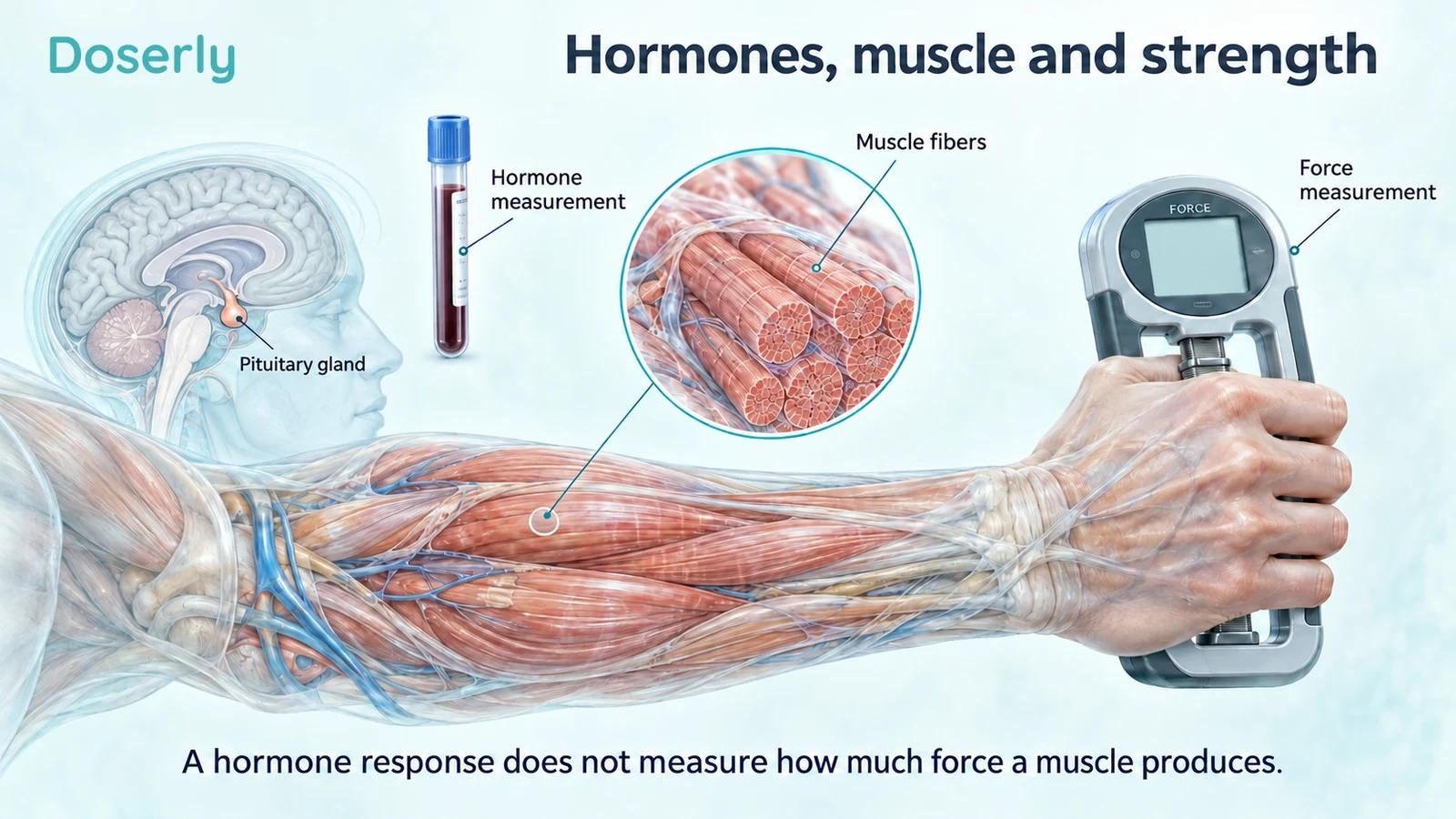
Conceptual anatomy and measurement illustration. The blank display avoids implying a participant result; hormone secretion and muscle force require different measurements.
Muscle size, lean mass and strength answer different questions
Muscle strength means the ability to generate force. Researchers can measure it with a grip dynamometer, a controlled knee-extension test or the maximum load someone can lift using a specified movement. These are performance measurements. A blood test provides a different kind of information, even when the measured hormone participates in muscle biology.
Body-composition testing sits between those two ideas. It estimates how much of the body belongs to categories such as fat, lean tissue and bone. A larger lean-tissue estimate is not a direct count of newly formed muscle fibers. Water and noncontractile tissues contribute to the measured compartment. A trial can therefore find more fat-free mass without finding stronger muscles.
That is not just a theoretical concern. In a randomized study of 23 sedentary older men, adding growth hormone to 16 weeks of resistance exercise increased fat-free mass and total body water more than exercise with placebo. Yet the groups had similar improvements in measured muscle strength and muscle protein synthesis. The investigators proposed fluid and noncontractile protein as possible contributors to the extra fat-free mass. Yarasheski and colleagues, 1995
This was a growth hormone trial, not a hexarelin trial. It cannot estimate hexarelin's benefits or side effects. Its relevance is narrower: it demonstrates why an increase in a body-composition measurement cannot stand in for a strength result.
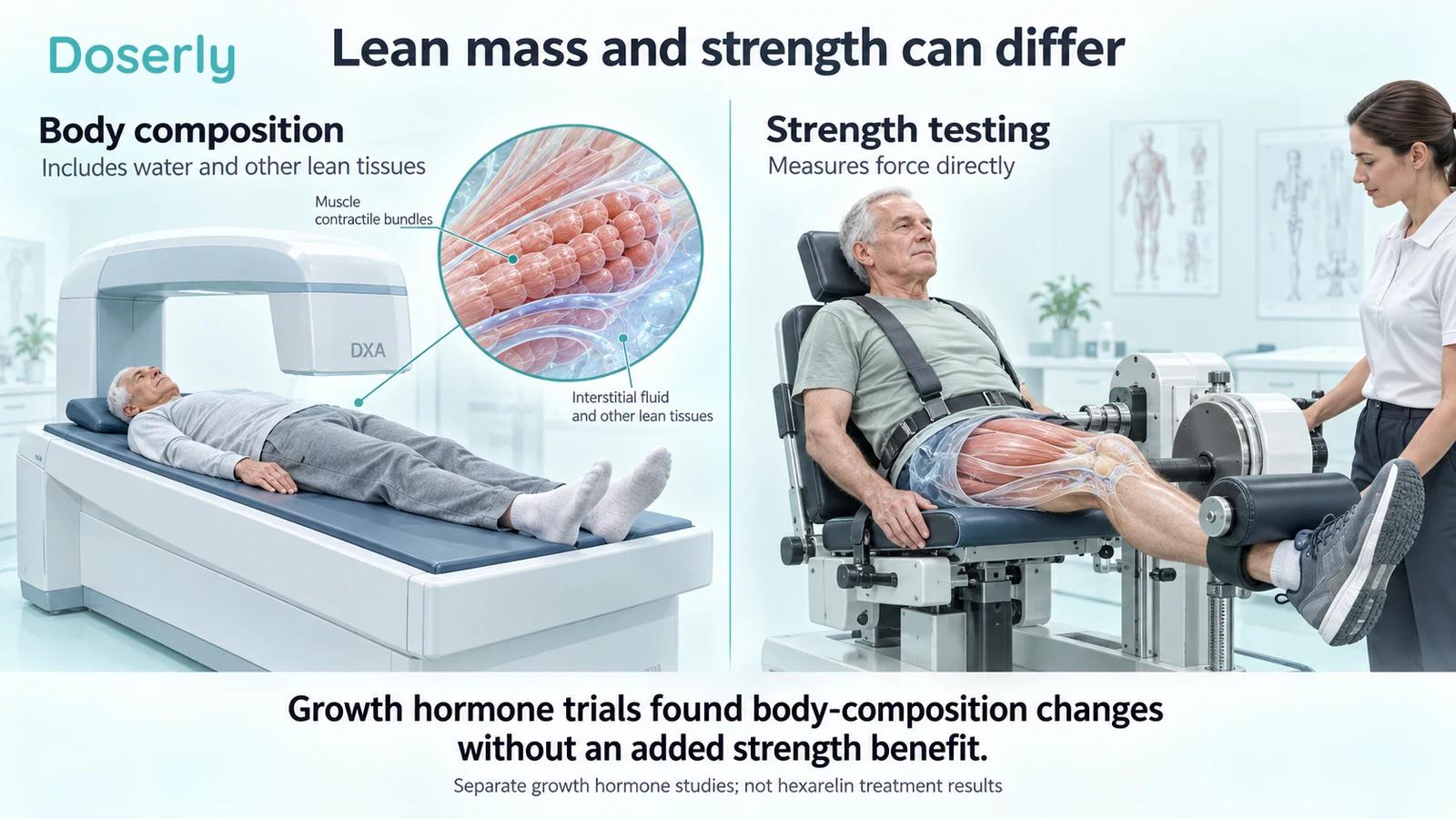
Conceptual testing scenes, not actual participants. Separate growth hormone trials found body-composition changes without an additional strength benefit; these are not hexarelin efficacy results. Yarasheski and Taaffe.
What happened with repeated hexarelin exposure?
The 1998 study examined twice-daily subcutaneous hexarelin for 16 weeks and reassessed the hormone response four weeks after treatment stopped. The growth hormone response became smaller during treatment and recovered after withdrawal. Serum insulin-like growth factor 1, usually shortened to IGF-1, and its binding protein IGFBP-3 did not change significantly. Neither did lean body mass, total body fat or bone mineral density at week 16. Rahim and colleagues
That is a considerably different picture from simply extending the first injection's hormone peak across four months. Repeated exposure did not maintain the same stimulation, and the measured downstream outcomes did not show significant improvement.
It is equally important not to overstate the negative finding. This small study does not prove that every possible hexarelin regimen has no biological effect. It also doesn't establish a useful strength treatment. The clinically relevant question remains unanswered because demonstrating a reliable change in physical performance requires a study designed around that outcome.
The recovery after withdrawal is sometimes used to justify cycling schedules. But recovery of a hormone response is not evidence that a particular on-and-off routine builds muscle safely. A trial comparing those routines and measuring meaningful benefits would be needed before that conclusion could be drawn.
Do studies of other secretagogues fill the gap?
A related but distinct example is MK-677, also called ibutamoren. It stimulates growth hormone secretion through the ghrelin receptor system, but it is a different molecule with a different route of administration and exposure pattern. We cannot substitute its results for hexarelin's.
In a randomized, placebo-controlled study of 65 healthy adults aged 60–81, MK-677 increased growth hormone and IGF-1. After one year, average fat-free mass had risen by 1.1 kg in the treatment group and fallen by 0.5 kg in the placebo group. The increased fat-free mass did not translate into demonstrated improvements in strength or function. The authors also noted that the study was not adequately powered to resolve functional outcomes in this healthy population. Nass and colleagues, 2008
This makes the result informative without making it definitive. A trial may show an effect on tissue measurements and still leave uncertainty about the benefit people care about. That uncertainty should not be replaced with either a promise that strength will follow or a claim that it never could.
The same trial reported reduced insulin sensitivity and an average rise in fasting glucose, along with appetite changes, mild leg swelling and muscle pain. These findings belong to MK-677. They illustrate the need to measure harms alongside body-composition changes; they are not hexarelin-specific risk estimates.
What if growth hormone is combined with serious training?
Another study helps answer a common objection: perhaps the participants simply needed to train harder. Eighteen men aged 65–82 first completed 14 weeks of progressive weight training. They were then assigned to growth hormone or placebo while continuing training for another 10 weeks. Growth hormone raised IGF-1 and changed body composition, but it did not add a measurable strength advantage. Taaffe and colleagues, 1994
Here the distinction was particularly clear because the investigators measured the training outcome directly. A hormone could move in the expected direction without producing the hoped-for extra performance improvement. Again, this was administered growth hormone, not hexarelin, and the participants were older men rather than young competitive athletes.
These related trials make it harder to defend a simple rule that more growth hormone automatically means more strength. They don't answer every question about every population. Someone with diagnosed hormone deficiency, someone recovering from illness and someone trying to improve an already demanding gym program have different clinical starting points. A finding in one group needs justification before it is applied to another.
Why route and timing matter when comparing claims
Early human research tested intravenous, subcutaneous, intranasal and oral hexarelin. A 12-volunteer study found hormone responses across those routes, but the amounts administered and the measured biological availability differed substantially. Ghigo and colleagues, 1994
An intravenous test delivers the compound directly into circulation. A subcutaneous injection must be absorbed from tissue, and an oral product faces additional barriers before reaching the bloodstream. A hormone response from one route therefore cannot validate a marketed amount given by another route. Nor does demonstrating some oral activity establish that any particular capsule or vial contains an equivalent, reliable preparation.
The important practical distinction is between a supervised research exposure and a proposed everyday treatment. The former may be enough to examine a mechanism for a few hours. The latter needs evidence about repeated use, product consistency, physical outcomes and adverse effects. The early route-comparison study supplies physiological information; it does not supply a bodybuilding protocol.
What would a convincing strength study look like?
For a reader trying to evaluate the next promising report, a few concrete details would make it much more useful. First, the trial would identify the people it is meant to help. Preventing loss of independence in older adults is different from adding weight to an experienced lifter's squat. The chosen measurement should reflect that purpose.
Second, the comparison groups would receive similar training support. If the hexarelin group starts supervised exercise while the comparison group carries on as usual, the study cannot isolate what the compound adds. A blinded placebo comparison with the same exercise program in both groups would answer that question more directly.
Third, investigators would choose their main strength or function outcome before seeing the results. A grip test, a leg-strength test and a walking test provide different information. Testing many outcomes and highlighting whichever looks best can produce an appealing story without a reliable overall benefit.
Finally, the report would show the size and uncertainty of the difference between groups, as well as withdrawals and adverse events. “Participants improved” is not enough if participants taking placebo improved similarly. Conversely, an inconclusive result in a very small trial should be described as inconclusive, with an explanation of what range of effects remains plausible.
These are proposed requirements for answering the question, not features of an existing successful hexarelin strength trial.
Making a useful plan for a real strength concern
If everyday tasks have become harder, it helps to describe the change specifically: rising from a chair, carrying groceries, managing stairs or completing a familiar exercise. That gives a clinician or physiotherapist a meaningful problem to assess. A request to “optimize growth hormone” starts with a laboratory pathway and may miss the reason physical ability changed.
Resistance exercise has a much more direct connection to strength outcomes. The National Institute on Aging describes research supporting strength training for maintaining muscle and mobility as people age, with programs adapted to a person's abilities and health. That does not make every exercise safe for every person, but it offers a practical starting point for a plan with measurable goals. NIA explanation
Keeping a dated record can make follow-up more useful. Record the task, how it was performed, any pain or limitation, and relevant changes in exercise or treatment. A consistent account of function is more informative than a collection of unrelated numbers. It still won't prove that a single intervention caused an improvement, particularly when several things changed together.
For hexarelin, the most useful question remains straightforward: what human result shows an improvement in the strength or function I want to improve? The studies reviewed here show that hormone release is possible. They do not establish a strength benefit, and the related growth hormone literature explains why that additional evidence matters. Our hexarelin research section provides broader context for the human studies without making a hormone response equivalent to better performance.
Sources
- Imbimbo et al., growth hormone dose-response study, 1994: acute intravenous hexarelin in healthy men; hormone endpoints.
- Rahim et al., long-term hexarelin therapy, 1998: repeated exposure, endocrine response and body composition.
- Ghigo et al., comparison of administration routes, 1994: acute human pharmacology.
- Yarasheski et al., growth hormone plus resistance exercise, 1995: a separate intervention showing why fat-free mass and strength differ.
- Taaffe et al., growth hormone and resistance-training response, 1994: strength testing after an initial training period.
- Nass et al., MK-677 in healthy older adults, 2008: a different secretagogue, with body-composition and functional outcomes.
- National Institute on Aging, strength training and healthy aging: practical context for maintaining physical ability.