
Peptides
October 16, 2026
Can GHRP-2 studies establish a muscle-building benefit?
On this page
GHRP-2 can raise growth-hormone secretion in human experiments. Whether it builds useful muscle is a different question, requiring measurements of muscle tissue, strength or physical function over time. The studies most often used to support muscle-building claims generally measured hormones, appetite or metabolic responses in small and very specific groups.
That does not make those experiments unimportant. They help explain how the peptide acts. It does mean that a higher growth-hormone or IGF-I result cannot be presented as the equivalent of a successful muscle-building trial.
For someone considering GHRP-2 because training progress has slowed, the useful question is what evidence connects the substance to the desired outcome. This article follows that connection through the human research, including what studies in older adults and critically ill patients can and cannot tell us. The GHRP-2 guide covers its broader pharmacology and clinical context.
What would count as a muscle-building benefit?
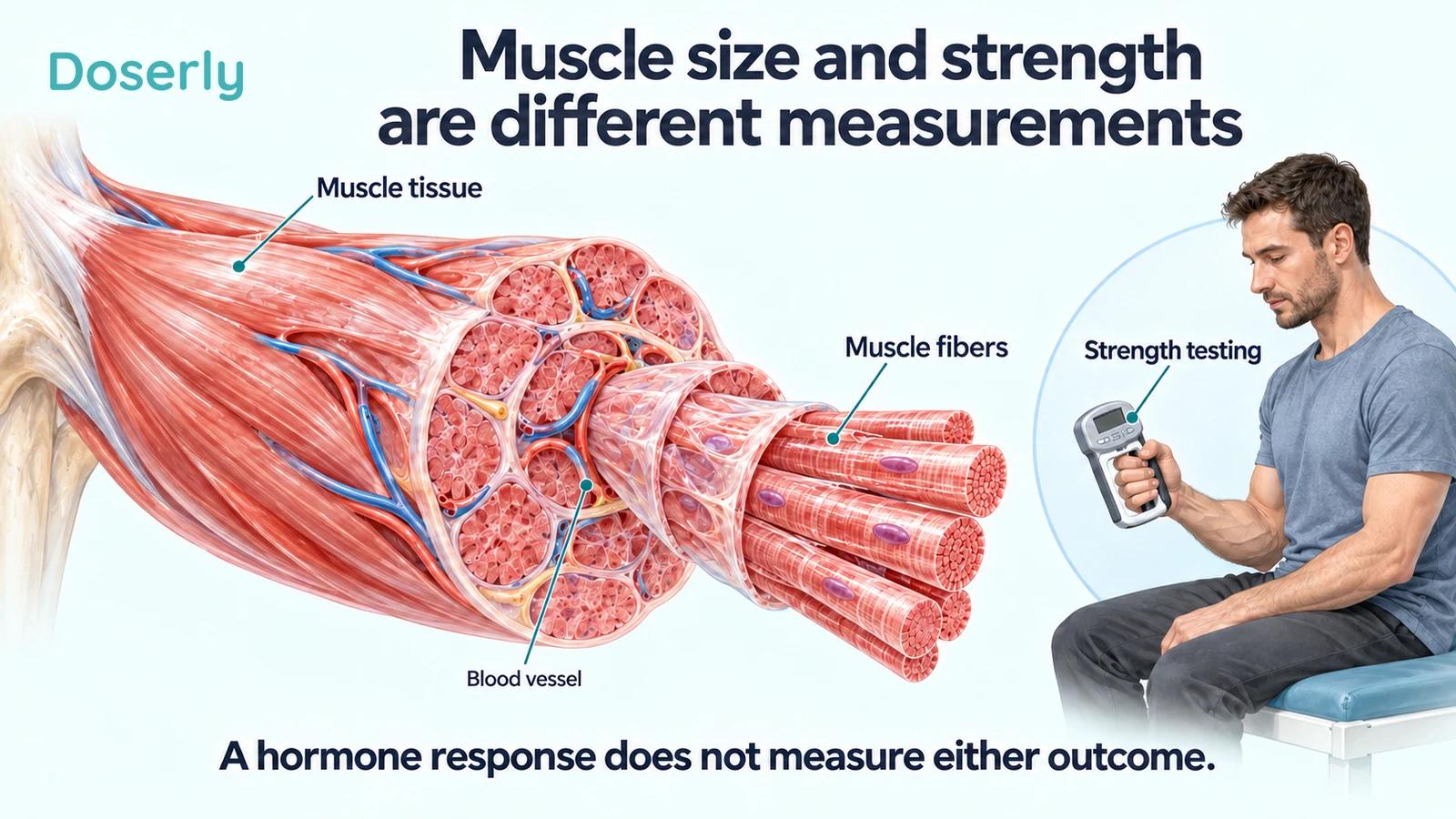
“Builds muscle” can refer to several outcomes that are related but not interchangeable. A study might measure muscle size with imaging, estimate lean body mass, test how much force a person can produce, or assess the ability to perform daily tasks.
Lean body mass is a body-composition category, not a direct count of skeletal-muscle fibers. A change in that category should therefore be described with the method used, rather than automatically renamed muscle growth.
Strength is also a separate outcome. It can be tested directly, such as by measuring the maximum weight lifted in a standardized exercise. Functional benefit asks another question: does the person become better able to do something important, such as getting up from a chair or carrying out an activity?
A convincing GHRP-2 trial would identify which outcome it aims to improve, measure it at baseline and follow-up, and compare changes against an appropriate control. Training, nutrition and other treatments would need attention because they can also influence the result.
The five-day study showed a changing hormone response
A 1998 experiment administered GHRP-2 to nine healthy young men over five consecutive days. Growth-hormone peaks and total measured hormone exposure were lower on days three and five than on day one. IGF-I did not increase significantly during the experiment. Five-day study
This was a useful observation about repeated stimulation. It showed why the first hormone response should not automatically be assumed to represent every later response.
The study did not establish whether participants gained muscle, became stronger or recovered faster from exercise. Five days of hormone measurements cannot answer a longer-term training question, particularly when the relevant outcome was not measured.
Nor should the finding be turned into an untested workaround. Changing timing, combining substances or escalating exposure to overcome a smaller hormone response would introduce new interventions. Their effectiveness and risks require evidence of their own.
Thirty days in older adults demonstrated sustained hormonal effects
A 2004 study investigated GHRP-2 physiology through several experimental conditions. One part involved continuous subcutaneous infusion for 30 days in 17 older men and women.
Growth-hormone secretion remained elevated during that period, and IGF-I increased and reached a plateau. The authors reported that the safety screening measurements they assessed remained normal. Older-adult infusion study
These results differ from the five-day study, but that is not necessarily a contradiction. The participants and exposure pattern were different. A continuous infusion in older adults is not interchangeable with repeated injections in young men.
The important limitation for the muscle question is more basic: the reported hormonal response did not establish increased muscle strength. Normal results on the monitored safety tests also cannot establish long-term safety for a broad population.
This study supports the statement that sustained endocrine stimulation was possible under its conditions. It does not support a promise about the amount of muscle a healthy adult could gain from another preparation or schedule.
Why IGF-I is relevant but insufficient
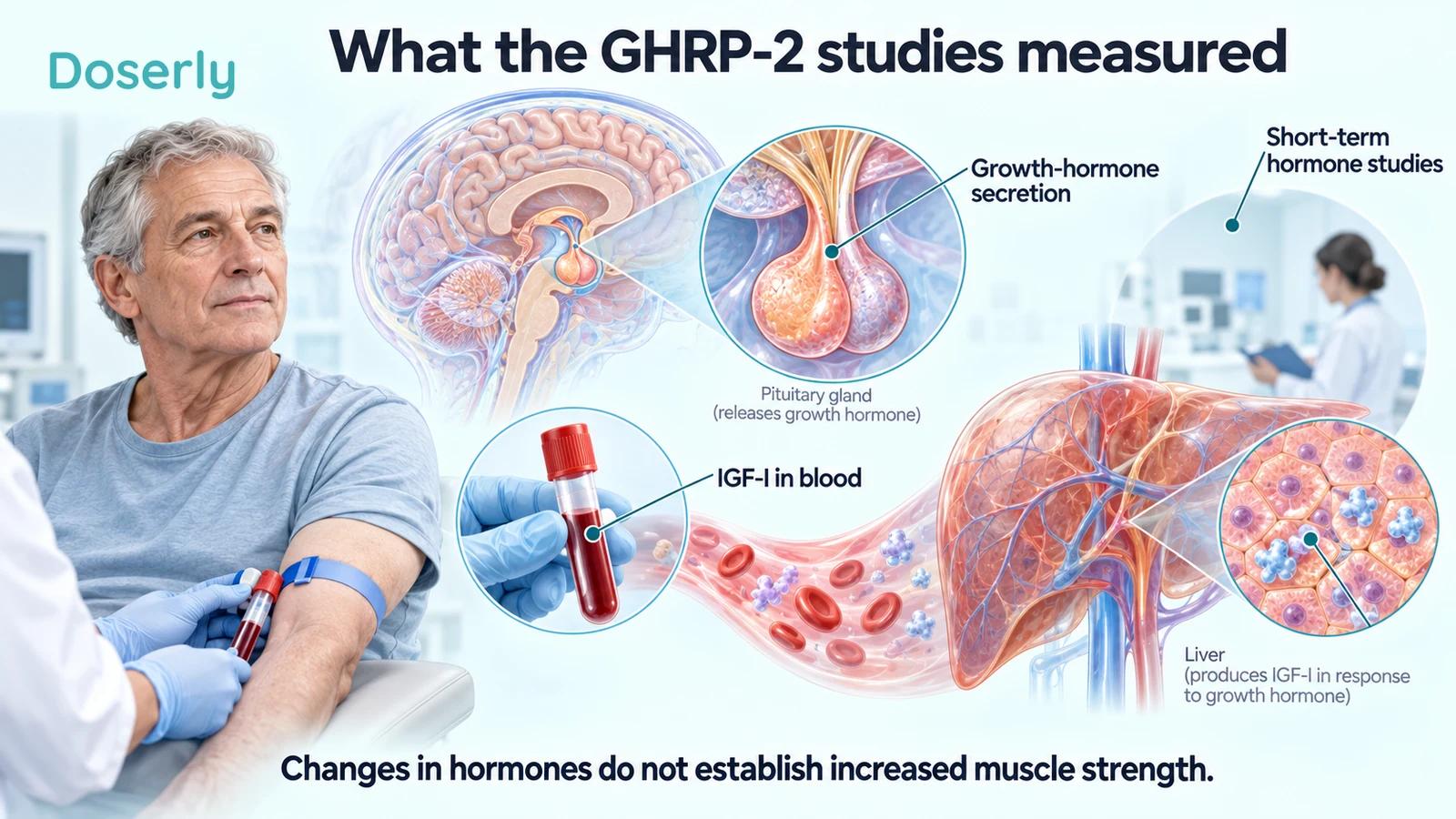
Insulin-like growth factor I, usually written IGF-I, is part of the biological response to growth hormone. Its measurement can help researchers determine whether an intervention affects more than a brief growth-hormone peak.
That makes it a useful intermediate measurement. It does not make it a direct strength test. The claim “IGF-I increased” describes a blood result; the claim “participants became stronger” describes a different observation.
A trial of growth hormone itself illustrates why the distinction matters. Eighteen healthy older men first completed 14 weeks of progressive resistance training, then received growth hormone or placebo during a further ten weeks of training. Growth hormone raised IGF-I and increased lean body mass, but it did not add a strength advantage over placebo. Resistance-training trial
This was growth hormone, not GHRP-2. It cannot determine GHRP-2's effectiveness by substitution. Its value here is narrower: it provides a human example in which favorable hormone and body-composition changes did not translate into the additional strength outcome being tested.
The same care should apply when interpreting any secretagogue study. The outcome must be measured, rather than inferred from the name of the hormone.
The critical-illness study addressed a different problem
Muscle loss during prolonged critical illness has a very different context from a healthy person trying to improve a training program. Severe illness affects multiple hormonal and metabolic systems at the same time.
A small randomized study involved 33 men with prolonged critical illness. Over five days, researchers compared placebo, GHRP-2 alone, GHRP-2 combined with TRH, and a combination also including GnRH. These additional substances stimulate other hormonal pathways. Critical-illness trial
GHRP-2 restored growth-hormone and IGF-I concentrations toward the comparison range described by the investigators. However, reduced ureagenesis occurred with the combination regimens, not with GHRP-2 alone.
Ureagenesis means urea production. It can provide information about nitrogen metabolism and protein breakdown in a study, but it is not itself a measurement of muscle size, strength or survival.
The report therefore cannot be summarized as “GHRP-2 prevents muscle loss.” That wording assigns a combination finding to one component and replaces a metabolic endpoint with a broader clinical claim. It also moves from critically ill patients to a different population.
The study is better understood as an investigation of several endocrine abnormalities during severe illness, with preliminary metabolic results. It provides a reason for further clinical research, not a bodybuilding protocol.
A case report about weight restoration is not a training trial
A published case described a woman with a long history of anorexia nervosa and persistent gastrointestinal difficulties. During prolonged intranasal GHRP-2 treatment, the authors reported improvements in hunger and early satiety, weight gain, and improvements in fatigue and strength. Case report
Those changes mattered to the patient, and a carefully described case can identify a potential clinical question. However, one person's course does not isolate the treatment's contribution. There was no randomized comparison, and recovery from severe undernutrition is not the same situation as adding muscle in a healthy adult.
The reported weight gain also does not specify how much was skeletal muscle. Body weight combines multiple tissues and fluids; without the relevant measurement, its composition cannot be assumed.
The strength observation should therefore remain a finding in that individual case. Turning it into a general claim about training performance would go beyond the design and population.
Increased food intake is a separate result
GHRP-2 has also increased food intake in short human experiments. In a crossover study of seven lean men, intake at a buffet meal was about 36% higher during GHRP-2 infusion than during saline infusion. Controlled meal study
That is a measured appetite-related result. It does not tell us whether the extra energy would support muscle gain, increase fat mass, or be offset by changes in later meals over a longer period.
For someone struggling to eat enough, an appetite effect may sound directly relevant. The research question still needs to match the clinical problem: sustained nutritional intake, body composition and function would need to be measured in comparable people.
The meal study did not include a long-term resistance-training program or quantify subsequent muscle growth. It should not be used as if it did.
Why personal progress is difficult to attribute
Someone who begins a peptide while changing training, diet and sleep may notice progress. The observation is real, but the contribution of each change remains uncertain.
For example, an increased training load might improve performance while greater food intake changes body weight. A new exercise program may also make early gains easier to notice. Without a suitable comparison, the peptide's independent contribution cannot be separated from those changes.
Similarly, a blood test obtained after administration can demonstrate a hormone response without explaining the person's progress. A laboratory result and a training improvement occurring together do not by themselves establish that one caused the other.
This is why controlled outcome studies are useful. They are designed to reduce those alternative explanations and estimate how much difference the intervention makes on average.
What a useful future trial would need to measure
A trial aimed at healthy adults seeking muscle gain should enroll that population and describe prior training experience. A study in untrained adults may answer a different practical question from one in experienced lifters.
It should compare the exact GHRP-2 preparation against an appropriate control while keeping the training and nutrition plans sufficiently comparable. The duration should allow the proposed tissue or performance change to emerge.
Measurements should include the promised benefit. If the claim is muscle growth, researchers need a defensible muscle assessment. If the claim is strength, they need standardized strength testing. Recovery claims require a clear definition rather than a vague sense of feeling better.
Adverse effects and withdrawals belong in the same assessment. An intervention is not fully evaluated by reporting only the laboratory result that moved in the desired direction.
These are criteria for judging future evidence, not a claim that the existing studies already meet them.
Where that leaves a decision today
The human GHRP-2 studies reviewed here demonstrate endocrine activity, an acute food-intake effect and several exploratory clinical observations. They do not establish a muscle-building benefit in healthy adults undertaking resistance training.
GHRP-2's Japanese diagnostic use concerns assessment of growth-hormone secretion deficiency. That regulatory role is separate from treatment for muscle gain. PMDA diagnostic label
If unexplained weakness or loss of muscle is the concern, the useful clinical starting point is evaluation of the cause. If the concern is a training plateau, a promise based only on growth-hormone or IGF-I changes is missing the outcome evidence needed to support it.
The most accurate conclusion is specific: GHRP-2 can stimulate the hormonal system, but these studies have not shown that this produces the muscle size, strength or functional improvement a reader may be seeking.
Sources
- Five days of GHRP-2 in healthy young men.
- Thirty-day GHRP-2 infusion in older adults.
- Growth hormone and resistance training in older men.
- GHRP-2 and combined endocrine stimulation in critical illness.
- GHRP-2 case report in anorexia nervosa.
- GHRP-2 and food intake in seven lean men.
- PMDA pralmorelin diagnostic label.