
Peptides
October 16, 2026
Can a sleep tracker validate a DSIP experiment?
On this page
A sleep tracker can make a night feel unusually precise. You wake up to a total sleep time, a deep-sleep estimate and perhaps a recovery score. If those numbers improve after taking DSIP, it's understandable to wonder whether the device has confirmed that the peptide worked.
It hasn't confirmed causation. A tracker may provide useful observations, but two separate questions remain: Did the device measure the night accurately, and did DSIP cause the change? Even a perfectly accurate measurement would not answer the second question on its own.
DSIP, or delta sleep-inducing peptide, has a small and inconsistent human sleep literature. A personal recording can help describe an experience, but cannot supply the comparison missing from an uncontrolled experiment. Our DSIP guide covers the wider evidence; this article explains how to use sleep information without asking it to prove more than it can.
What is the tracker actually sensing?
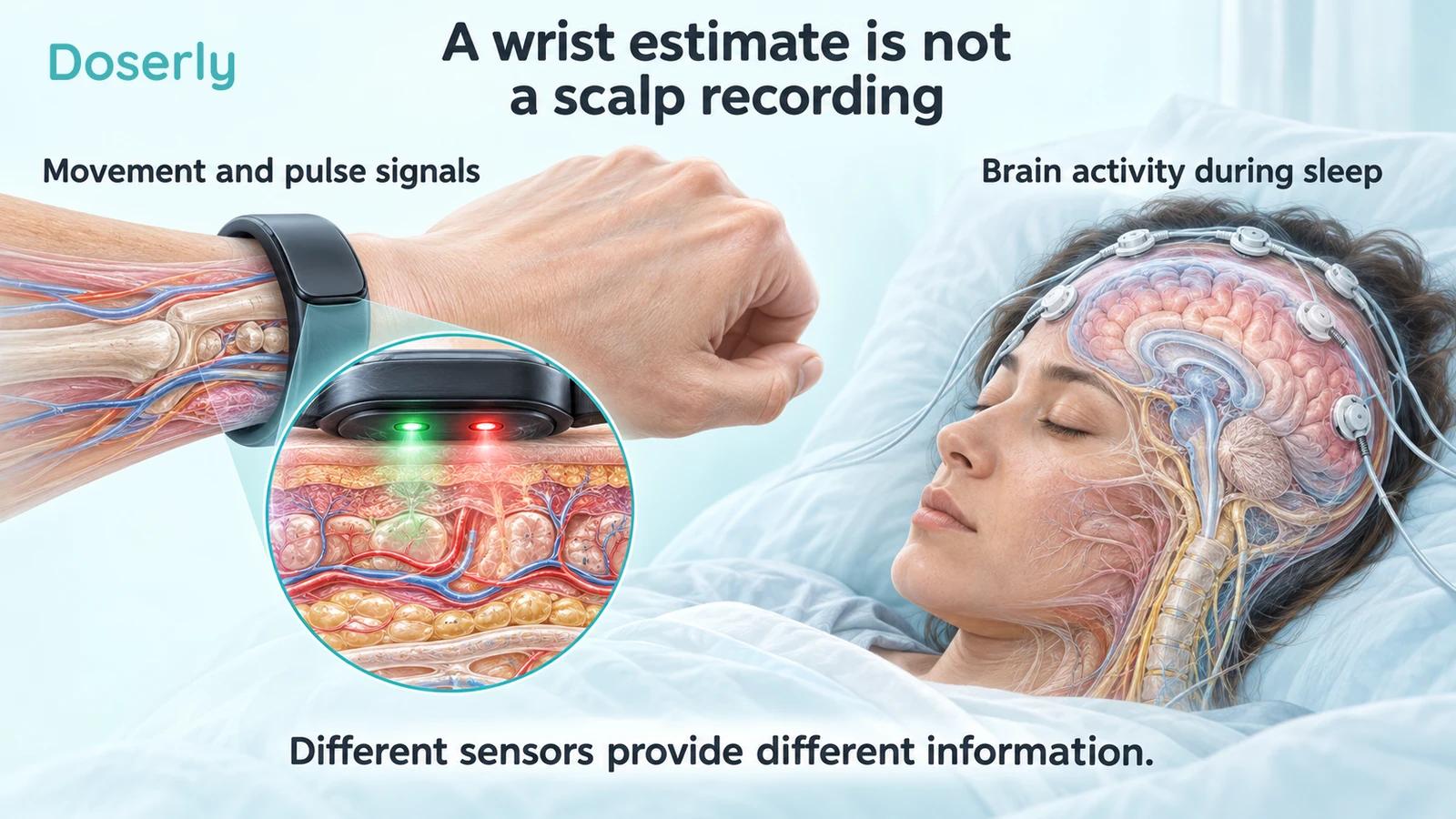
Many wrist devices estimate sleep from movement and physiological signals such as pulse patterns. They use algorithms to translate those signals into sleep or wake estimates and, in some cases, stages. A stage label on a screen is an inference from the available sensors, not necessarily a direct recording of brain activity.
Polysomnography, the standard laboratory sleep assessment, combines scalp EEG with other physiological measurements. EEG records electrical activity from the brain; eye, muscle, breathing and oxygen measurements provide additional context. A wrist movement sensor and a scalp electrode therefore begin with different information. NHLBI sleep studies
This does not make every wearable result useless. A device can be useful for following patterns even when it cannot replace a clinical study. The important question is whether the particular measure is sufficiently valid for the intended use. Estimating a bedtime trend is a less demanding claim than diagnosing a sleep disorder or demonstrating a drug's effect on deep sleep.
What a direct device-comparison study found
Chinoy and colleagues tested seven consumer sleep-tracking devices against polysomnography in 34 healthy young adults over three laboratory nights, including a disrupted-sleep condition. The devices included wearables and nonwearables available at the time. Primary validation study
The devices generally detected sleep well: sensitivity was at least 0.93. Detecting wakefulness was more difficult, with specificity ranging from 0.18 to 0.54. Sleep-stage comparisons were inconsistent, and performance tended to worsen during poorer or disrupted sleep. Some devices performed as well as or better than the actigraphy comparator on sleep–wake measures.
Those results should stay attached to the tested models, algorithms, population and setting. They do not give a universal accuracy rating for every current wearable. Nor do results in healthy young adults automatically describe performance in people with chronic insomnia.
The study is useful because it demonstrates why “accurate at detecting sleep” is not the same as “accurate at identifying every awake period or sleep stage.” A person can lie still while awake, and an algorithm may have difficulty distinguishing that from sleep. That limitation is particularly relevant when the complaint is spending long periods awake in bed.
A good-looking average can hide individual disagreement
Device validation needs more than a close average total sleep time. Suppose a device overestimates one person's sleep by an hour and underestimates another person's by an hour. The average error could be zero even though both individuals received an inaccurate estimate. This is a hypothetical example, not a result from the DSIP studies.
Researchers therefore assess agreement at several levels, including differences in whole-night measures and agreement across individual recording intervals. A published framework for evaluating sleep trackers emphasizes such comparisons against a reference method. Sleep-tracker validation framework
For an individual user, the implication is practical: a device may perform reasonably across a group while still making errors on a particular night. A small apparent improvement can fall within that uncertainty. Without knowing the relevant validation and variability, a precise number on a screen can give an exaggerated impression of certainty.
A deep-sleep percentage can change for several reasons
Deep-sleep percentage is a ratio. It depends on both the estimated deep-sleep time and the estimated total sleep time. If either estimate changes, the percentage can move. A higher percentage does not necessarily mean more minutes of deep sleep.
Consider a hypothetical example: 60 minutes out of six hours is about 17%; the same 60 minutes out of five hours is 20%. The deep-sleep percentage rises while total sleep falls. This is arithmetic, not a claim that DSIP produces either pattern.
There is also the question of classification. If an algorithm reassigns some intervals from light to deep sleep, the displayed stage totals can change even if the underlying physiology is not known to have improved. The useful question is what was actually measured and how reliably the method detects the change being claimed.
AASM's position statement on consumer sleep technology emphasizes appropriate validation and distinguishes consumer data from tools intended for clinical diagnosis and treatment. It recognizes potential usefulness while warning against substituting unvalidated outputs for medical evaluation. AASM position statement
Why an accurate tracker still cannot prove DSIP caused improvement
Imagine someone begins DSIP after a particularly difficult week of sleep. During the following week, the tracker reports longer sleep. At the same time, work pressure eases, bedtime becomes more regular and the person stops drinking alcohol in the evening. Which change caused the difference?
The tracker cannot isolate them. It records signals during the nights that occurred. It cannot show the otherwise identical nights that would have occurred without DSIP. That missing comparison is often called the counterfactual.
Even if the person deliberately changes nothing else, sleep naturally varies. Starting an intervention after unusually bad nights creates another problem: later nights may be closer to that person's usual pattern simply because the starting period was unusually poor. This is regression toward the mean, a statistical explanation that does not depend on a treatment having any effect.
Expectations can also affect perceived sleep and behavior. Someone hoping an intervention will work may change their routine or notice positive experiences more readily. A device does not remove those influences merely because its output is numerical.
What the controlled DSIP studies contribute
Controlled trials try to make the counterfactual more credible by comparing treatment with placebo under similar conditions. They are not perfect, but they answer a different question from a personal before-and-after chart.
In a 1987 blinded crossover study, DSIP did not produce significant improvements in several important sleep measures compared with baseline or placebo. Slow-wave sleep and REM sleep were unchanged, and stage 2 differences were complicated by baseline differences. The authors judged the overall improvement clinically limited. Monti and colleagues
In a 1992 double-blind trial of 16 people with chronic insomnia, some objective measures favored DSIP, but effects were weak and subjective sleep quality did not improve. The researchers did not consider major short-term benefit likely. Bes and colleagues
These findings do not prove that a particular person's better night is imaginary. They mean that an uncontrolled tracker change should not be treated as stronger evidence of a reliable treatment effect than the available controlled comparisons. Personal experience and causal evidence have different roles.
What a useful record can contribute
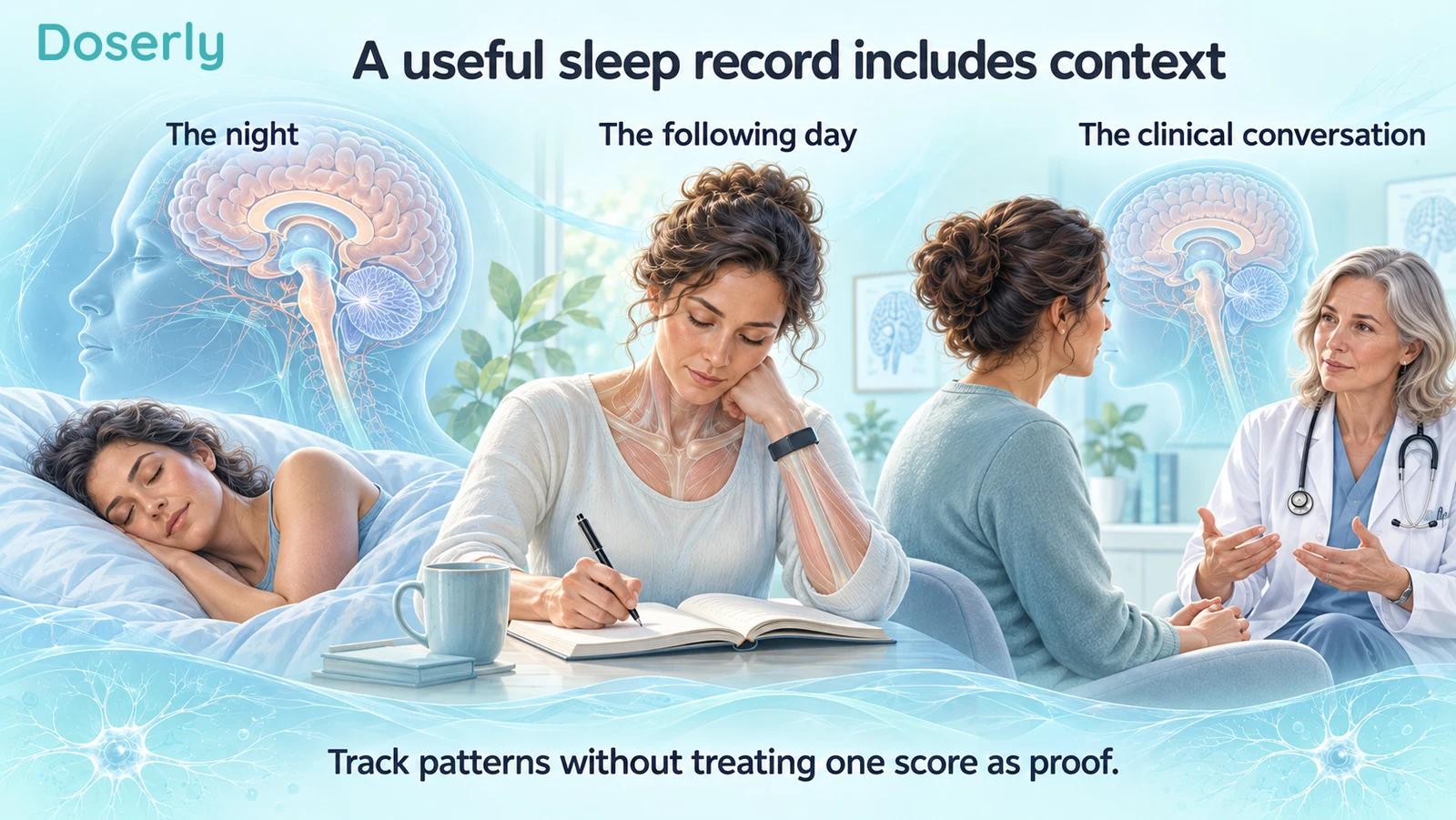
A sleep record can help make a clinical conversation more concrete. The Consensus Sleep Diary was developed through collaboration among insomnia researchers and potential users to standardize prospective sleep reporting. It includes a way to record the experience of sleep rather than relying entirely on retrospective impressions. Consensus Sleep Diary
A practical record can include the approximate time you went to bed, how long falling asleep seemed to take, prolonged awakenings, final wake time and how you felt during the day. Relevant changes in medicines, work schedule, illness or other circumstances can be noted alongside those observations. The aim is a usable timeline, not a minute-by-minute reconstruction.
If you also use a tracker, keep its estimates identified as device estimates. They can sit beside your reported experience without replacing it. If the device says you slept well but you feel significantly impaired, that disagreement is information worth discussing, not a reason to dismiss the symptom.
Recording already-occurring symptoms is different from designing a self-administered peptide challenge. There is no need to start, stop or repeatedly reintroduce DSIP to produce a better-looking record. Treatment decisions and adverse symptoms belong in the clinical discussion.
Make the record interpretable
When sharing a tracker report, include the device model, the dates covered and whether you changed devices or settings. Mark nights when the device was not worn, lost contact or produced no estimate. Missing nights are not zero minutes of sleep, and silently dropping difficult nights can make a trend look better than the experience was.
Keep reported and calculated values distinguishable. If you manually corrected a bedtime, note that correction rather than presenting it as an untouched sensor observation. If the app summarizes a week, compare it with the same dates in your diary. These simple details help a clinician see whether an apparent difference concerns sleep itself, the recording process or how the app assembled its summary. They improve the usefulness of the record without turning it into proof of a drug effect.
What about a carefully planned personal experiment?
A formal single-person trial can sometimes be informative when the intervention is suitable and the design is supervised. But a series of nights labeled “on” and “off” is not automatically such a trial. Treatment order, blinding, carryover effects, an appropriate control and a prespecified outcome all affect interpretation.
For DSIP, unresolved questions about formulation, exposure and duration of any effect complicate the design further. A brief pause cannot simply be assumed to remove every relevant influence. Increasing the number of nights improves the amount of observation, but does not by itself solve a biased comparison.
A personal experiment also cannot characterize uncommon harms or establish effectiveness for other people. Even a convincing result within one individual would have a narrower meaning than a replicated clinical trial. This is why a tracker should not be used to justify escalating an unvalidated regimen.
When tracking becomes another source of sleep pressure
Tracking can be helpful for some people and stressful for others. A published case series described three patients whose concern about tracker results complicated their sleep-related behavior and treatment. The authors used the term orthosomnia for an excessive pursuit of ideal sleep numbers. Original case series
Three cases do not establish how often this happens or prove that wearables generally cause insomnia. They do illustrate a recognizable problem: the score can become the goal, while the person's comfort and functioning receive less attention.
If checking the result leaves you anxious, changes your day before you have noticed how you feel, or encourages repeated treatment changes, raise that pattern with a clinician. The right amount of monitoring is the amount that helps answer a useful question. More data is not automatically better care.
A sleep tracker can document trends and provide material for a thoughtful discussion. It cannot, by itself, validate a DSIP treatment effect. The strongest interpretation keeps the device's measurement limits, the missing comparison and the person's actual symptoms visible at the same time.
Sources
- NHLBI, sleep studies and their measurements.
- Chinoy and colleagues, seven devices compared with polysomnography, 2021.
- Standardized framework for evaluating sleep trackers, 2021.
- AASM, consumer sleep technology position statement, 2018.
- Monti and colleagues, controlled DSIP insomnia study, 1987.
- Bes and colleagues, double-blind DSIP insomnia study, 1992.
- Consensus Sleep Diary, 2012.
- Baron and colleagues, orthosomnia case series, 2017.