
Supplements
October 16, 2026
Calcium for bones: count food before choosing a supplement
On this page
A calcium tablet can look like a straightforward investment in stronger bones. But the decision starts before the supplement aisle: how much calcium does the person already get, and what problem is the supplement supposed to solve?
Meeting a nutritional requirement, improving a bone-density measurement and preventing a fracture are related goals. They are not interchangeable. A trial can improve bone density without clearly reducing fractures, and an intervention that helps older residents with low intakes may not have the same effect in well-nourished adults living independently.
This is why a useful calcium plan begins with food, age and fracture risk. The supplement amount, if one is needed, fills a defined gap rather than automatically adding another full day's requirement. The Bone Health and Osteoporosis Foundation recommends obtaining calcium from food and supplementing as needed to reach the recommended total. BHOF calcium guidance
The total matters more than the tablet number
U.S. reference intakes generally call for 1,000 mg of calcium daily in adults through age 50. Women aged 51–70 need 1,200 mg, while men in that age range remain at 1,000 mg; both sexes need 1,200 mg after age 70. These amounts include food and supplements together. NIH calcium fact sheet
An illustrative example makes the distinction clear. Suppose a person's agreed target is 1,200 mg and their usual food pattern provides roughly 900 mg. The estimated gap is 300 mg. Adding a 1,200 mg supplement would bring the total to about 2,100 mg, not 1,200 mg. This arithmetic illustrates intake accounting; it is not a personal dosing recommendation.
The estimate does not have to be perfect to become useful. The important mistake to avoid is counting the target once as food and again as tablets. Our calcium guide provides more background on forms and uses; this article focuses on how the evidence informs that starting calculation.
Count actual foods and actual portions
A brief record of several typical days can reveal whether calcium intake is consistently low or whether it varies with breakfast, dairy alternatives or meals eaten away from home. Include the portion actually consumed. A product's label may describe a larger serving than the amount poured into coffee or added to a bowl.
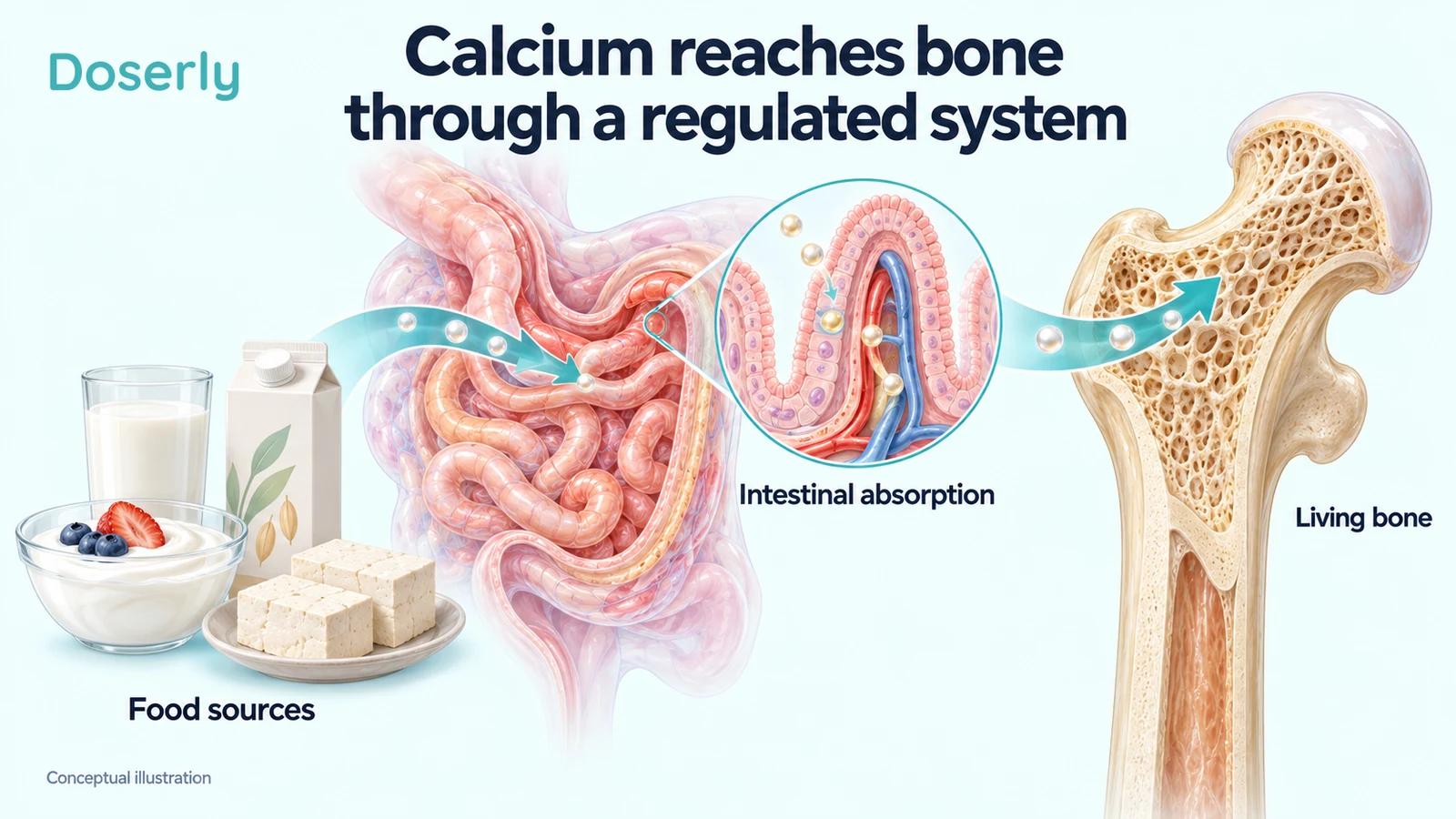
Milk, yogurt and cheese can contribute substantially. Fortified plant beverages and some other fortified foods can also contribute, but products differ. Calcium-set tofu is another example where the production method matters: a food name alone does not establish the calcium content. NIH food sources
Use the calcium amount in milligrams on the current package when available. Do not assume that every fortified beverage has the same amount, or that an old percentage-daily-value conversion applies to every country's label. If the product changes, the estimate may need to change too.
Also count calcium-containing antacids, multivitamins and combination bone products. An occasional antacid and a daily calcium supplement are different exposure patterns, but both belong in the history. This is not an argument for micromanaging every meal. It is a way to discover whether a proposed supplement solves an actual shortfall.
A normal blood calcium result does not settle the intake question
Blood calcium is tightly regulated. NIH explains that serum calcium does not reflect nutritional status well because the body maintains that circulating concentration through physiological control, including the skeleton's role as a calcium reservoir. A normal blood result therefore does not prove that the diet is adequate. NIH calcium status
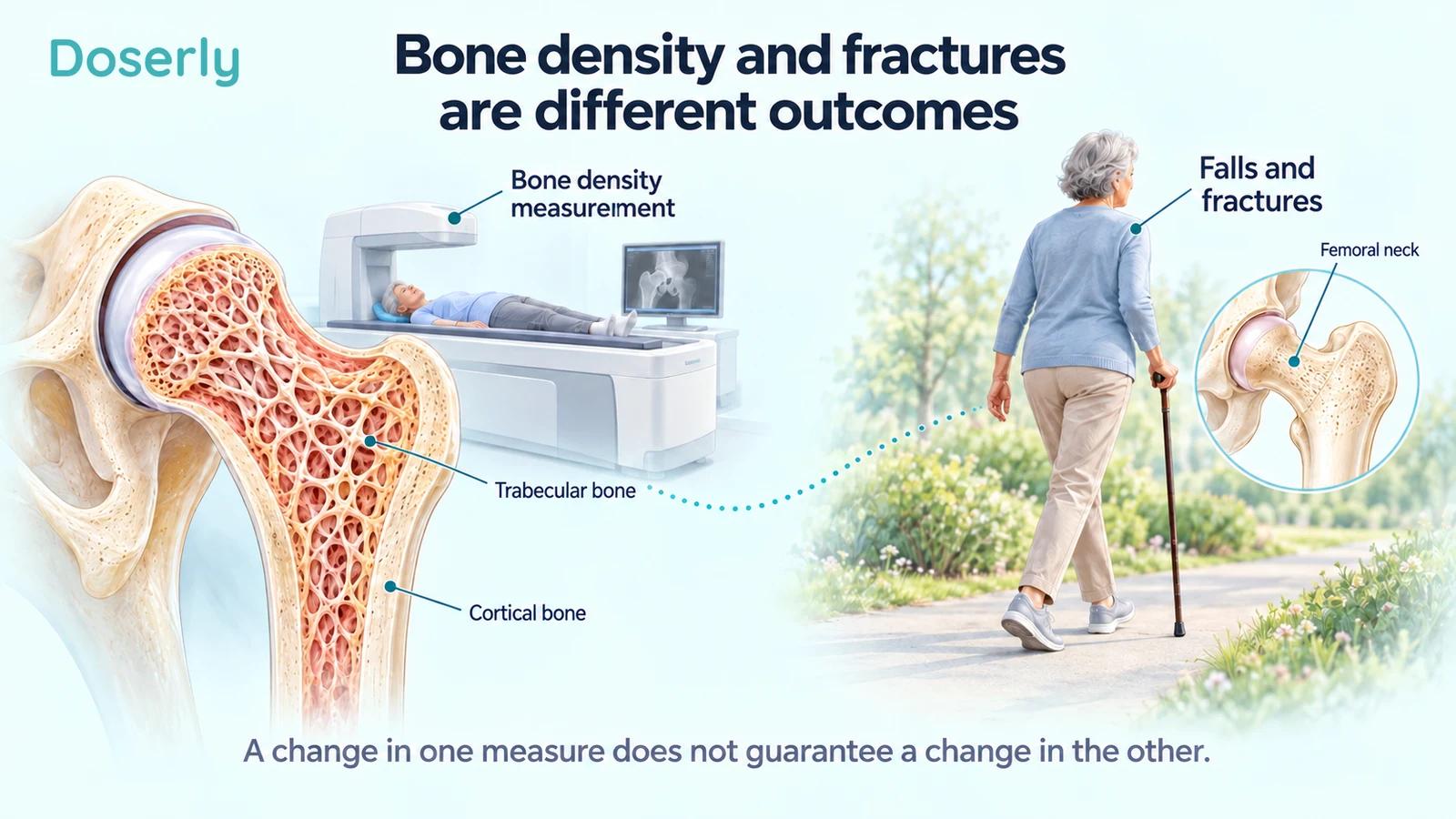
A bone-density scan answers a different question. DXA measures bone mineral density, commonly at the hip and spine, and helps clinicians assess osteoporosis and fracture risk. It is not a direct measurement of yesterday's calcium intake. Blood testing, dietary assessment and bone-density testing provide different pieces of information. NIAMS osteoporosis assessment
For the same reason, an abnormal blood calcium result should not be self-treated simply by changing a supplement amount. It may require investigation of a medical cause. The relevant plan depends on what was measured and why, rather than a general belief that calcium is good for bones.
The large Women's Health Initiative trial separated density from fractures
In 2006, the Women's Health Initiative reported results from 36,282 postmenopausal women aged 50–79. Participants were assigned 1,000 mg of elemental calcium plus 400 IU of vitamin D3 daily, or placebo, with an average seven years of follow-up. WHI calcium and vitamin D trial
Hip bone density was modestly higher in the supplement group. However, the main randomized analysis did not show a statistically significant reduction in hip fractures: the hazard ratio was 0.88, with a 95% confidence interval from 0.72 to 1.08. Kidney stones were more frequent in the supplement group, with a hazard ratio of 1.17.
These findings resist two easy headlines. The trial did not show that calcium has no biological role in bone. It also did not establish that adding the tested regimen reliably prevented hip fractures in this population.
Analyses focused on adherence were more favorable, but they answer a less straightforward question than the original randomized comparison. Once people are separated by continued use, other differences between adherent and nonadherent participants can matter. The main result deserves to remain visible.
A primary-care trial also tested a practical prescribing strategy
A 2005 open randomized trial enrolled 3,314 women aged at least 70 with one or more hip-fracture risk factors. One group received 1,000 mg calcium plus 800 IU vitamin D3 daily and an information leaflet; the comparison group received the leaflet alone. It did not establish a reduction in clinical fractures. Porthouse primary-care trial
Adherence was an important feature of this pragmatic study. At two years, 69% of questionnaire responders reported still taking supplements, but the figure was 55% when all randomized participants known to be alive were included. The denominator changes how successful the routine looks.
That does not justify disregarding the trial. It explains what the trial tested: offering a regimen in everyday primary care, with the real difficulties of sustaining it. A product can only deliver its biological effects when taken, but a recommendation also has to be tolerable and manageable enough to follow.
For an individual, the lesson is to discuss constipation, pill burden or missed doses rather than quietly continuing a plan that exists mainly on paper. The record of actual use is part of interpreting the plan.
Why some older-adult studies found benefit
An earlier trial, published in 1992, enrolled 3,270 older women with a mean age of 84. It tested 1,200 mg elemental calcium with 800 IU vitamin D3 daily for 18 months. The investigators reported fewer hip and other nonvertebral fractures with the combined intervention. Chapuy calcium and vitamin D trial
This result came from a different population and context from WHI. It supports the importance of considering older adults' nutritional circumstances, rather than treating every calcium study as though it enrolled the same people. It also remains evidence for the combination: the design cannot assign the benefit entirely to calcium while ignoring vitamin D.
Comparing trials is not a contest to select whichever result matches a preferred supplement. Age, baseline nutrition, living circumstances, dose, follow-up, adherence and the outcome being measured all affect what a study can tell the next patient.
An older person with limited intake and a high fracture risk may have a different potential benefit from correcting nutritional gaps than a younger adult already meeting requirements. That difference is a reason for targeted assessment, not a promise that any particular tablet will prevent a fracture.
Food-based evidence is encouraging, but it is not a calcium-only experiment
A 2021 Australian cluster-randomized trial involved 7,195 older residents across 60 residential-care facilities. The intervention added milk, yogurt and cheese to menus, increasing both calcium and protein. Residents were vitamin D replete, but their initial calcium and protein intakes were relatively low. Residential-care food trial
The intervention was associated with fewer fractures and falls. The reported relative reduction in all fractures was 33%, with 121 fractures in intervention facilities and 203 in control facilities. This is a clinically meaningful outcome, not merely a change in a blood marker.
However, the study changed several nutritional features together. It cannot prove that calcium alone produced the benefit, or that a calcium pill would reproduce the food intervention. Facilities, rather than individual residents, were randomized, and the residential-care setting matters when applying the findings elsewhere.
The practical value is broader: improving a low-intake food pattern can address several needs at once. A calcium discussion that ignores protein, meal access and the ability to eat comfortably may miss much of the actual problem.
If a supplement fills a gap, the formulation still matters
The Supplement Facts panel lists elemental calcium, the amount used when comparing intake with a target. The weight of the entire calcium compound is different. Calcium carbonate and calcium citrate contain different proportions of calcium, so comparing tablet weights alone can mislead. NIH supplement forms
Carbonate is best taken with food; citrate is less dependent on stomach acid and can be taken without food. The BHOF also advises taking calcium in amounts of 500–600 mg or less at one time for better absorption. These details help organize an indicated regimen; they do not establish a reason to take a supplement in the first place. BHOF practical calcium guidance
Check the serving size before setting reminders. Two tablets may supply the amount printed prominently on the bottle. Conversely, a combination product may add vitamin D that is already present elsewhere in the routine. The product name is not a substitute for the ingredient amounts.
Calcium can also interfere with absorption of medicines, including levothyroxine and certain antibiotics. Ask a pharmacist to check the exact combination and timing rather than applying one universal spacing rule to every medication. NIH medication interactions
Calcium belongs inside a fracture-prevention plan
For someone with osteoporosis, a previous fragility fracture or substantial risk factors, adequate calcium is one part of care. NIAMS describes a broader approach that can include exercise, fall prevention and medications selected for the individual's risk. A supplement does not replace that assessment. NIAMS treatment guidance
This changes the questions worth asking at a review. Is the food estimate credible? Is the supplement closing a gap? Is it being taken and tolerated? Are other fracture risks being addressed? Has a change in health, diet or medication altered the original plan?
Doserly can help record the product, elemental calcium amount, schedule and actual use alongside other medicines and supplements. Recording a reason and review date can make it easier to revisit a routine that started years earlier.
Calcium is necessary for bone health. The useful decision is how to meet that need within the person's broader care, rather than how to add the largest possible supplement.
Sources
- NIH Office of Dietary Supplements: Calcium
- Bone Health and Osteoporosis Foundation: Calcium and vitamin D
- NIAMS: Osteoporosis diagnosis and treatment
- Jackson and colleagues: WHI calcium plus vitamin D trial, 2006
- Porthouse and colleagues: Primary-care calcium and vitamin D trial, 2005
- Chapuy and colleagues: Calcium and vitamin D in older women, 1992
- Iuliano and colleagues: Dietary calcium and protein in residential care, 2021