
Supplements
October 16, 2026
Broccoli-sprout supplements: why the conversion step matters
On this page
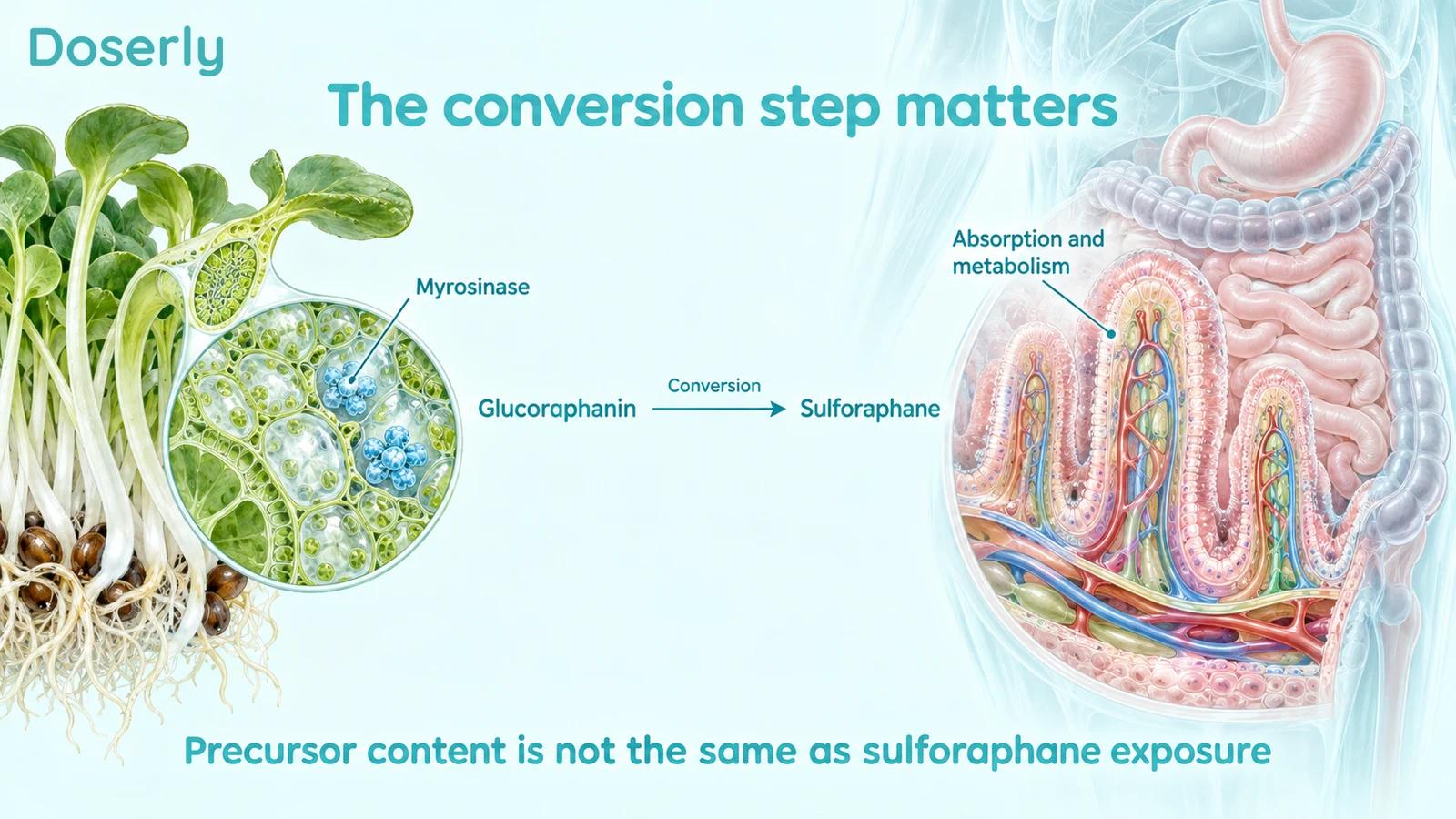
Two broccoli-sprout products can list similar amounts of plant material while delivering quite different exposure to sulforaphane. The difference often begins before absorption: the plant compound glucoraphanin must be converted into sulforaphane, and the enzyme myrosinase helps carry out that conversion.
This makes broccoli-sprout research unusually sensitive to preparation. Fresh sprouts, heated extracts, products containing active myrosinase and preparations containing already formed sulforaphane are not automatically interchangeable. Neither are the label terms “broccoli extract,” “glucoraphanin” and “sulforaphane yield.”
Understanding that chemistry helps explain apparently inconsistent human studies. It also prevents a second mistake: assuming that a product with better absorption must prevent disease. Our sulforaphane guide covers broader uses; this article follows the chain from product composition to human exposure and then to clinical outcomes.
Three names describe different things
Glucoraphanin is a glucosinolate found in broccoli and its sprouts. It is a precursor, meaning it can be transformed into another compound. Myrosinase is an enzyme that helps break down glucoraphanin. Sulforaphane is an isothiocyanate produced through that process.
In plant tissue, preparation and disruption can bring the relevant components together. Processing that inactivates plant myrosinase changes the conditions for conversion. Gut microbes can also participate, but conversion without active plant enzyme can be lower and more variable. Human bioavailability experiments have demonstrated these differences directly. Myrosinase study
The distinction isn't merely terminology. A label stating the amount of precursor describes what enters the process. A measurement of sulforaphane or its metabolites describes something further along it. Comparing those amounts as though they were the same substance can produce a misleading impression of product strength.
What does active myrosinase change in humans?
A 2015 investigation compared glucoraphanin-containing preparations with and without active plant myrosinase. Preparations retaining the enzyme produced roughly three- to fourfold greater sulforaphane bioavailability, assessed through urinary metabolites, than glucoraphanin delivered without active plant enzyme. The experiments also documented variation within and between people. Fahey and colleagues
That is strong evidence that the conversion step matters. It is not a universal multiplication factor that can be applied to any product. The starting material, enzyme activity, preparation and measurement conditions all belong to the experiment.
A label that lists myrosinase therefore provides potentially useful information, but the word alone doesn't establish how much enzyme activity remains at consumption. Evidence from the actual formulation is more informative than assuming all enzyme-containing products reproduce one published result.
The same caution applies to “stabilized” sulforaphane. Stability is a formulation property that needs evidence; it does not itself demonstrate a clinical benefit. Researchers still need to establish what participants receive and what happens after they receive it.
The 2015 absorption study was not a disease-prevention trial
Another 2015 human study compared fresh broccoli sprouts with a myrosinase-treated broccoli-sprout extract. Both were designed to provide 200 micromoles of sulforaphane daily, either at once or divided into two administrations. Researchers measured sulforaphane metabolites in blood and urine and examined several molecular targets. Absorption and target study
Sprout consumers had approximately three times higher metabolite levels than extract consumers. Dividing administration changed the time course of blood exposure. However, the study did not find corresponding dose responses in the measured molecular targets, including heme oxygenase-1, histone deacetylase activity and p21.
This is a particularly useful reminder that an apparently matched nominal amount need not produce matched exposure. It also shows that more exposure does not guarantee a detectable response in every proposed target.
The study's title includes “chemopreventive targets,” but it did not show that participants developed fewer cancers. Molecular targets can help investigate a cancer-prevention hypothesis. Demonstrating prevention requires an appropriate clinical design and outcomes, usually over a much longer period. The study schedule describes the experiment; it is not a recommendation to divide personal supplement doses.
Cooking changes the experiment, but food safety still matters
A small crossover study in eight men compared raw and cooked crushed broccoli. Sulforaphane appeared more rapidly and at higher levels after the raw preparation. The reported bioavailability estimates were 37% after raw broccoli and 3.4% after cooked broccoli under those particular study conditions. Raw-versus-cooked study
Those figures should not become a rule that all cooked broccoli is ineffective or all raw preparations are equivalent. Cooking methods differ, and the study measured one compound's kinetics rather than the overall health value of a meal. Food has nutritional roles beyond maximizing a single phytochemical.
Raw sprouts also carry a separate food-safety issue. The FDA advises people at greater risk of foodborne illness—including children, older adults, pregnant people and those with weakened immune systems—to avoid raw or lightly cooked sprouts. Bacteria can multiply during sprouting even when home growing conditions appear clean. FDA produce guidance
An absorption advantage does not cancel that risk. Nor should someone try to recreate a study preparation at home without considering the safety controls used in research. A supplement and a raw food have different quality questions, and neither should be assumed safe solely because it comes from broccoli.
What do researchers learn from urine measurements?
Sulforaphane is metabolized after exposure. Measuring its metabolites in collected urine can help estimate how much of a preparation was converted, absorbed and processed. Repeated collections can also show how exposure changes over time.
This differs from measuring a downstream biological response. For example, researchers can measure urinary compounds formed when the body processes certain pollutants. Those compounds answer a question about metabolism of the pollutant, not simply whether sulforaphane reached the body.
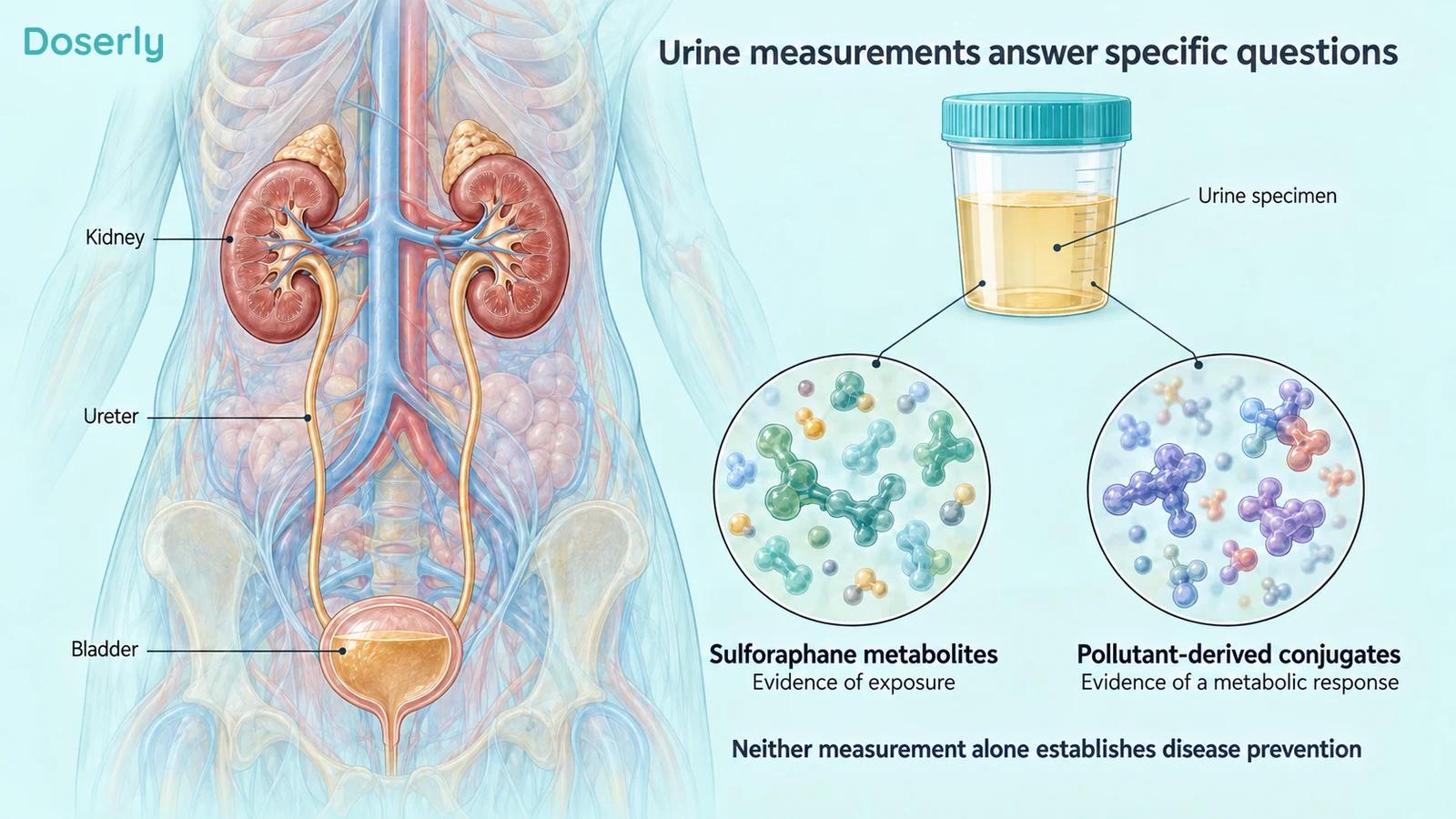
Both kinds of measurement can be scientifically useful. Neither is a universal “detox score.” Their meaning depends on the exact compound, collection period, exposure conditions and comparison group. A higher urine measurement is not automatically good or bad without knowing what was measured and why.
The air-pollution studies tested a defined metabolic response
A 2014 randomized trial recruited 291 adults in a region of China with substantial airborne-pollutant exposure. Over 12 weeks, a broccoli-sprout beverage increased urinary excretion of glutathione-derived conjugates of benzene and acrolein, compared with placebo. The corresponding effect was not found for crotonaldehyde. Pollutant-metabolism trial
The findings support enhanced processing and excretion of particular compounds under those conditions. They do not show that the beverage removes every environmental chemical, makes polluted air safe, or reduces cancer incidence. Those broader claims go beyond the outcomes measured.
A later 2019 trial randomized 170 participants to graded beverage concentrations or placebo for 10 days. The highest concentration significantly increased the urinary benzene-derived biomarker; the lower concentrations did not significantly differ from placebo. Dose-response trial
That follow-up helps connect preparation, exposure and a specific biological response. It does not establish a general supplement dose for people with different exposures or products. Nor does a short-term biomarker study replace reducing pollutant exposure where possible.
The careful distinction is between a measured detoxication pathway and the expansive commercial promise to “detox the body.” The former names a chemical and an outcome. The latter often leaves both unspecified.
What the 2025 prediabetes trial adds
A 2025 randomized, double-blind trial tested broccoli-sprout extract for 12 weeks in people with prediabetes who were not taking glucose-lowering drugs. The reported treatment comparison included 35 extract recipients and 39 placebo recipients. The study did not meet its prespecified primary outcome of a 0.3 mmol/L reduction in fasting glucose compared with placebo. Prediabetes trial
The overall estimated difference was a smaller 0.2 mmol/L reduction, which was statistically significant in the reported analysis. Gastrointestinal side effects occurred; no severe adverse events were reported. Those findings warrant further investigation without being described as established prevention of diabetes.
Exploratory analyses linked response to metabolic characteristics and gut-microbiome features involved in precursor conversion. That is consistent with the idea that people can process the same preparation differently. However, these analyses do not yet provide a validated method for selecting a supplement from a consumer microbiome test.
A subgroup can help generate a future trial design. It cannot retroactively replace an unmet prespecified outcome or establish that every person with similar characteristics will respond.
Why statistical significance is only part of the result
A trial can find a statistically detectable difference while falling short of the effect it was designed to consider important. That is what makes the prediabetes result more nuanced than either “it worked” or “it did nothing.” The estimated size, uncertainty and predefined goal all matter.
Likewise, a blood or urine change can be convincingly real without answering whether someone feels better, avoids disease or needs less medication. Biological evidence and clinical evidence complement each other, but one does not automatically substitute for the other.
For a reader with prediabetes, the relevant outcome is sustained health improvement within an overall care plan. A short extract trial does not establish that the product should replace dietary changes, physical activity, monitoring or prescribed treatment. Any supplement use needs to fit the person's medical context.
How to compare a product with a published study
Begin with the ingredient description. Is the product supplying broccoli powder, a standardized glucoraphanin amount, active myrosinase, already formed sulforaphane, or a combination? A large extract weight can coexist with an unclear amount of the compound studied.
Next, examine what the quoted number represents. Milligrams of plant material, milligrams of precursor and micromoles of sulforaphane are different quantities. “Potential yield” may describe a laboratory conversion estimate rather than measured human exposure. The conversion conditions and testing method matter.
Then ask whether research used the same preparation. A study of fresh sprouts does not automatically validate a heated extract. A trial of an extract with active enzyme does not establish equivalence to precursor alone. Even matched exposure would not prove matched clinical outcomes without further evidence.
Finally, look beyond the favorable mechanism. Was the study measuring absorption, a molecular target, a pollutant metabolite or a patient outcome? Did the principal result succeed, and were attractive subgroup findings exploratory? These questions are more useful than selecting the product with the largest number on the front label.
Keeping a practical record
If a clinician agrees that a product fits your circumstances, record its exact formulation and ingredient amounts rather than only “broccoli supplement.” A change of brand can also be a change of precursor, enzyme activity or delivery method, making comparisons over time difficult.
Record the reason for use and the outcome that would matter, along with any gastrointestinal symptoms or other changes. For medically monitored outcomes such as glucose, use the agreed clinical plan rather than interpreting day-to-day fluctuations as evidence of success or failure.
Broccoli-sprout research shows that preparation can change exposure substantially. It also shows why exposure, biological response and clinical usefulness need to remain separate. Understanding the conversion step makes the studies easier to interpret without making their conclusions larger than the evidence allows.
Sources
- Active myrosinase and bioavailability
- Sprouts versus myrosinase-treated extract
- Raw-versus-cooked broccoli kinetics
- FDA produce and sprout safety
- 2014 pollutant-metabolism trial
- 2019 dose-response trial
- 2025 prediabetes trial