
Peptides
October 16, 2026
Bremelanotide trials: what desire and distress scores mean
On this page
Bremelanotide, the peptide also called PT-141, is used in the prescription product Vyleesi for a specific form of distressing low sexual desire. Its pivotal studies found improvements in reported desire and distress, but did not find a significant increase in the number of satisfying sexual events compared with placebo. Both parts of that statement matter. They describe different aspects of a person's sexual life, not contradictory versions of the same result. US prescribing information
If you've seen a headline saying the treatment “worked,” you may reasonably want to know what changed. Did people want sex more often, feel less upset about low desire, or have more satisfying experiences? This article explains the measurements and the findings so you can connect them with the benefit you actually care about. Our PT-141 guide covers the medicine's broader background and safety.
Why researchers asked more than one question
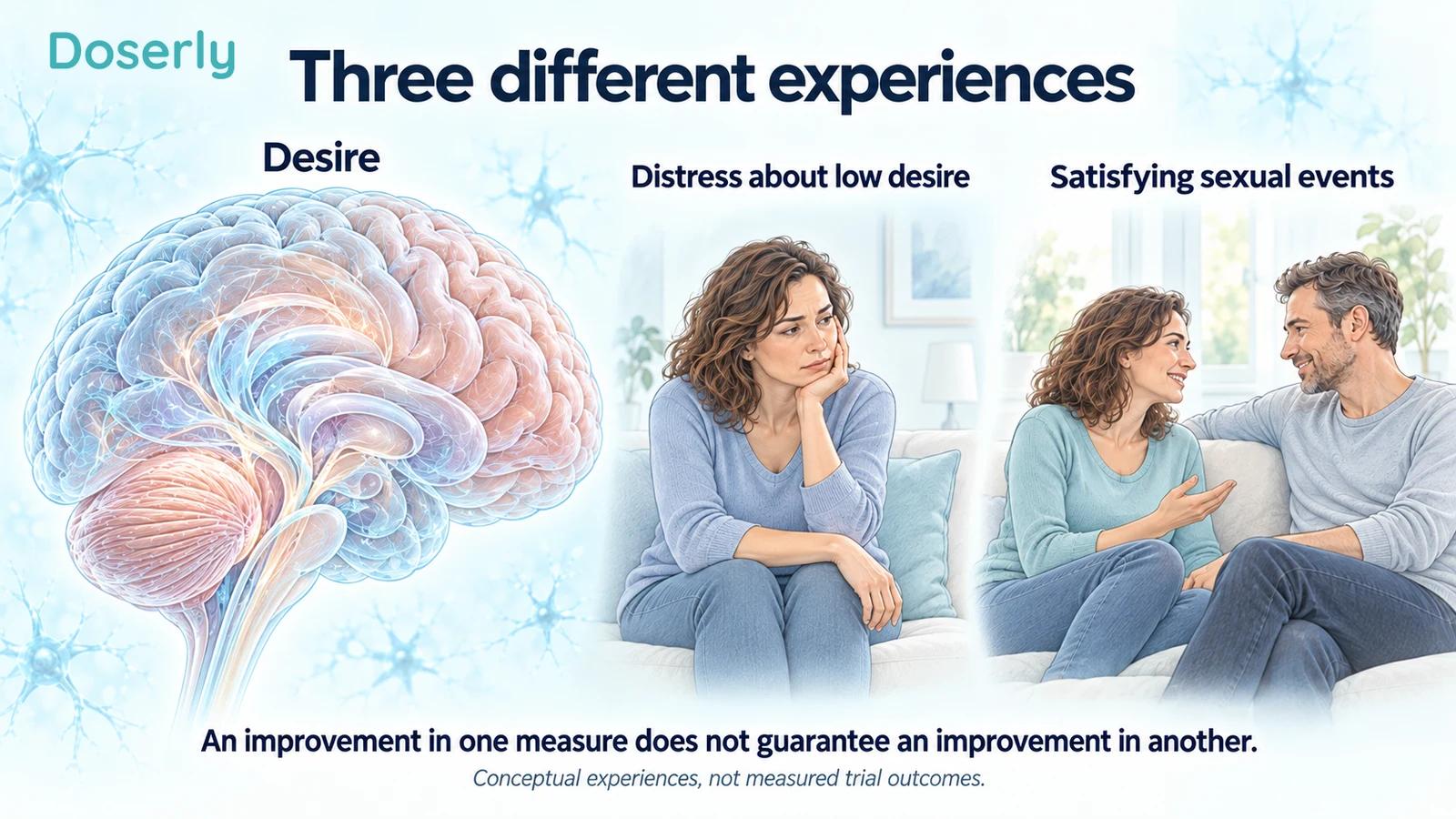
Desire is an interest in sexual activity. Distress is the trouble or emotional burden associated with low interest. A satisfying event is an experience that a participant identifies as satisfying. You can imagine one improving without the others changing at the same time.
For example, a person might feel more interested but have few opportunities for sexual activity because a partner is away. Another might become less troubled by their current interest without having more sexual events. A third might enjoy the same number of events more. These examples are hypothetical, but they explain why a single count cannot represent all of sexual well-being.
The RECONNECT trials selected premenopausal women with acquired, generalized hypoactive sexual desire disorder, or HSDD. This is an unwanted change in desire across situations, accompanied by distress, rather than a judgment that someone should want sex a certain number of times. Professional assessment also looks for contributing medical, psychological, relationship, or medication factors. ISSWSH process of care
The two main measurements
An endpoint is the outcome researchers use to evaluate an intervention. RECONNECT had two coprimary endpoints: changes in a desire score and a distress item. Coprimary means both were central to the planned test. This was not a trial that counted events and then simply relabeled an unsuccessful result as success on an unrelated measure. The published methods identify desire and distress as the main outcomes. Original RECONNECT report
The desire measure used the desire domain of the Female Sexual Function Index, or FSFI. Two questions asked about the frequency and strength of desire during the previous four weeks. Their responses were combined into a score ranging from 1.2 to 6, with higher scores representing greater desire. The number is a standardized questionnaire score, not a hormone concentration, a percentage, or the number of times someone wanted sex.
The distress measure used item 13 of the Female Sexual Distress Scale–Desire/Arousal/Orgasm, abbreviated FSDS-DAO. It asked how often the participant felt bothered by low sexual desire during a 30-day recall period. Scores ran from 0 to 4, with higher numbers indicating more frequent distress. Improvement therefore meant a decrease, whereas improvement on the desire scale meant an increase. Label description of the instruments
Keeping those directions straight is helpful. A negative distress change can be favorable; a positive desire change can be favorable. Neither can be compared directly with an event count because the units differ. It also matters that the distress endpoint was one specific item, rather than every aspect of emotional well-being or relationship satisfaction.
How large were the changes?
The label reports rounded mean changes separately for the two trials:
Measure
Desire score
- Trial
- Study 1
- Bremelanotide
- +0.5
- Placebo
- +0.2
Measure
Desire score
- Trial
- Study 2
- Bremelanotide
- +0.6
- Placebo
- +0.2
Measure
Distress item
- Trial
- Study 1
- Bremelanotide
- −0.7
- Placebo
- −0.4
Measure
Distress item
- Trial
- Study 2
- Bremelanotide
- −0.7
- Placebo
- −0.4
These are changes from each group's starting score. Subtracting the rounded values gives an additional desire improvement of approximately 0.3–0.4 points and an additional distress reduction of approximately 0.3 points with treatment. The trial's statistical analyses, rather than arithmetic on rounded table entries, establish the reported significance. Label, Tables 2 and 3
A common mistake is to describe the entire improvement in the treated group as the drug's effect. The placebo groups also improved. The comparison between groups is the estimate relevant to adding the medicine under these study conditions. Improvement while taking a treatment can include influences other than its pharmacological action.
Another mistake is turning a score change into a percentage benefit. A 0.5-point change on this questionnaire does not mean desire increased by 50%. Its interpretation depends on the scale, the starting value, and whether the change reflects something the participant values. Numbers make experiences comparable across groups; they do not replace a conversation about the experience itself.
What happened to satisfying sexual events?
The number of satisfying sexual events was a secondary endpoint. The label reports no significant difference between groups in its change from baseline to the end-of-study visit. Mean changes rounded to 0.0 in both bremelanotide groups, −0.1 in the first placebo group, and 0.0 in the second. The reported p-values were 0.76 and 0.70. Label, Table 4
This finding does not show that no participant ever had an additional satisfying event. Group averages can contain people who improved, worsened, or stayed the same. It means these trials did not demonstrate that assignment to bremelanotide produced a greater increase in that count than assignment to placebo.
It would also be wrong to dismiss the result as irrelevant. A reader whose main goal is more satisfying sexual experiences should know that this particular outcome did not show a clear benefit. A reader whose priority is feeling interested again may place more weight on the desire result. Both interpretations can respect the data while recognizing different personal goals.

Why an earlier study can sound more positive
A 12-week dose-finding trial randomized 397 premenopausal women with desire and/or arousal disorders to placebo or several subcutaneous bremelanotide doses. Its pooled higher-dose groups showed an increase of 0.7 satisfying events per month compared with 0.2 with placebo. That earlier finding is real, but it came from a different study, with different eligibility, dose groups, duration, and analysis. Original phase 2b trial
A dose-finding study helps decide what to test next. Its positive result does not erase a later, larger confirmatory program's nonsignificant event-count result. If a summary quotes the early increase without identifying the study, a reader can easily assume it describes the pivotal trials. Keeping the studies separate gives a more accurate account of how the evidence developed.
The distinction also prevents a practical misunderstanding: the phase 2 pooled finding is not evidence that increasing the dose will produce extra satisfying events for an individual. A comparison of trial groups is not a personalized dose-response curve, and adverse effects belong in any treatment decision.
What counts as a meaningful response?
An average can conceal varied experiences. Researchers therefore also examine responders, participants whose improvement meets a specified threshold. The label describes thresholds of at least a 1.2-point increase in desire or at least a 1-point decrease in the distress item, anchored to participants' assessments of meaningful change. Label responder analyses
A responder threshold is a rule for classifying outcomes; it is not a universal definition of success. One person's priorities may not fit neatly into it. It also matters whether a reported response percentage includes everyone who began treatment, only those with follow-up data, or only those who finished. Those choices can produce different numbers without any arithmetic error.
This is why an isolated claim that a certain percentage “responded” is incomplete. Useful reporting names the measurement, the cutoff, the denominator, and what happened to people who left the study. It should also include the placebo comparison. Otherwise, a result that sounds like a personal chance of success may actually answer a narrower statistical question.
Dropout changes the practical interpretation
The two trials ran for 24 weeks, but not every participant stayed that long. In the label's modified intention-to-treat populations, premature discontinuation occurred in 40% versus 13% in Study 1 and 39% versus 25% in Study 2 for bremelanotide and placebo, respectively. These are all-cause discontinuation figures, not nausea rates. The label consequently presents exploratory analyses that consider completing treatment alongside improvement. Clinical-study analysis
A reader may naturally hear “24-week result” and picture every participant being measured at week 24. In the label, end of study refers to the last study visit during the blinded period; only completers necessarily reached the planned final week. That distinction matters when thinking about durability and the experience of remaining on treatment.
Side effects help complete this picture. In the controlled safety population, nausea occurred in 40% of bremelanotide recipients, and 18% discontinued because of adverse reactions overall. A meaningful benefit should be considered alongside the effort and discomfort needed to obtain it, rather than in a separate conversation after enthusiasm has already formed.
Using these findings in a treatment conversation
Start with a goal you can recognize in your own life. “I want to feel interested again” and “I want to feel less distressed” are clearer than an undefined wish for improvement. If frequency or satisfaction is the priority, say so; those outcomes should not be substituted without explanation.
Then ask how improvement will be assessed, when the plan will be reviewed, and which unwanted effects would change the decision. A brief private record can distinguish interest, distress, experiences, and side effects without turning sexual life into a performance target. The purpose is to describe what matters to you, not to produce a score for someone else.
Bremelanotide's trial findings support improvement on two specific patient-reported measures in the studied population. They do not establish improvement in every sexual outcome. Keeping desire, distress, and satisfying events separate makes the result more useful, because it lets you match the research to the question you brought to it. The PT-141 research guide provides the wider clinical context.
Sources
- Vyleesi prescribing information: instruments, trial tables, response thresholds and attrition.
- RECONNECT phase 3 report, 2019: prespecified outcomes and randomized design.
- Clayton and colleagues, dose-finding trial, 2016: earlier event-count finding in a different study.
- ISSWSH process of care, 2018: assessment and patient-centered treatment goals.