
Longevity
October 17, 2026
Can lifestyle protect thinking and memory? Reading the US POINTER trial
On this page
When people ask about protecting their brain, they usually mean something concrete: remembering conversations, following a recipe, managing money or remaining confident in unfamiliar places. They are rarely asking whether a laboratory score can move a fraction of a point. That is why a positive brain-health trial deserves both attention and a careful translation into everyday terms.
The US POINTER trial, published in 2025, tested whether a structured lifestyle program helped older adults at increased risk of cognitive decline more than a less intensive, self-guided program. The structured group did better on a composite measure of cognition over two years. The difference was statistically significant but small, and the study did not establish that the program prevented dementia. Baker and colleagues, JAMA
This is useful evidence for sustained support around movement, food, cognitive and social activity, and cardiovascular health. It is not evidence that anyone can guarantee a future without dementia by following a perfect routine. The most helpful reading sits between those two interpretations.
What POINTER actually compared
POINTER enrolled 2,111 adults aged 60 to 79 at five US sites. Participants had a sedentary lifestyle, a suboptimal diet and additional features associated with cognitive risk. Mean age was about 68, and roughly 69% were women. Most completed the two-year assessment. This was a prevention-oriented population, not a treatment trial for established dementia. Primary trial report
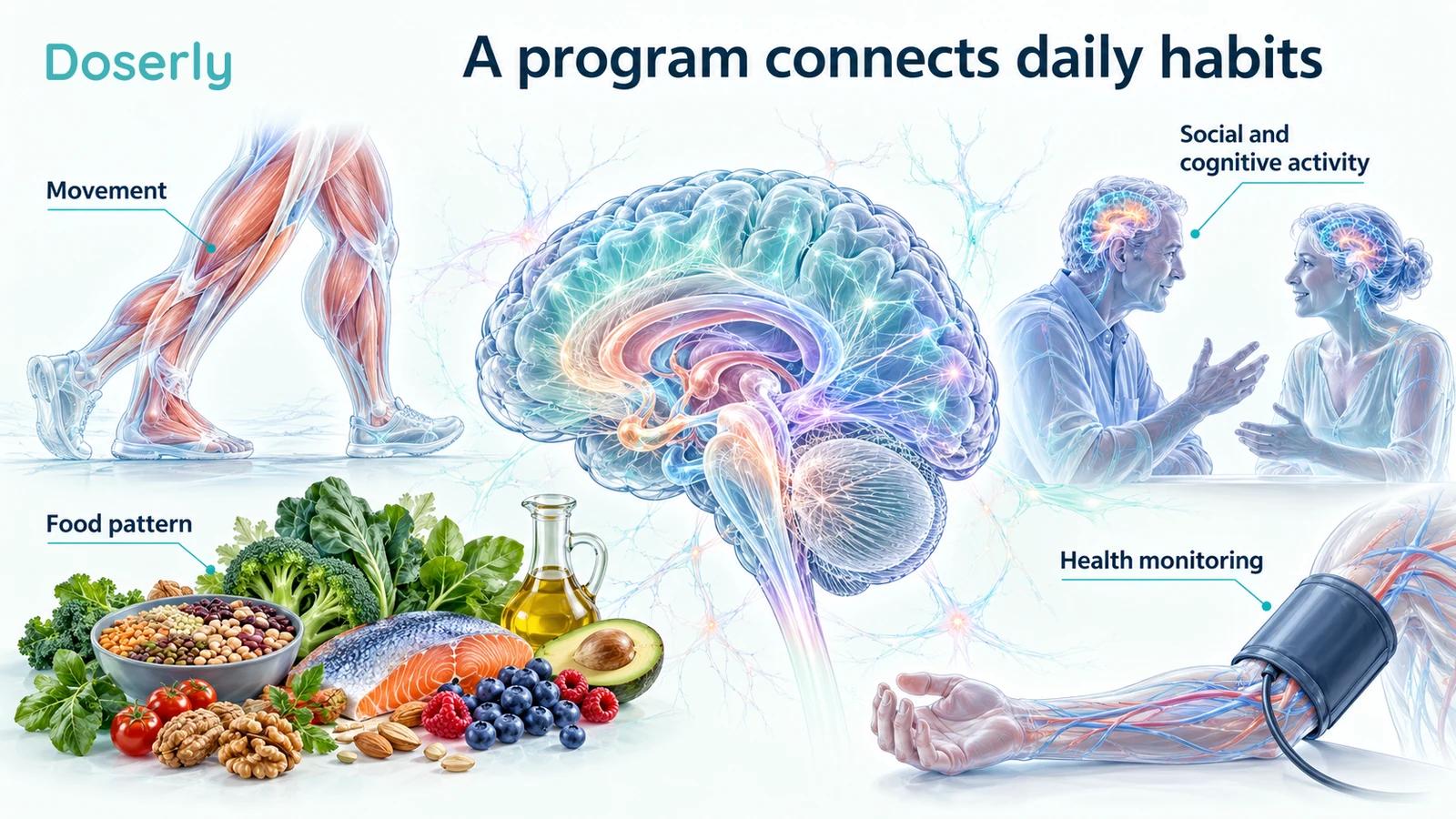
Both groups were encouraged to improve physical activity, diet, cognitive activity, social engagement and cardiovascular monitoring. The difference was the structure, intensity and accountability of the support. The structured group had a more demanding, facilitated program, while the self-guided group received lower-intensity assistance. POINTER design and methods
That comparator is easy to lose in a headline. POINTER did not randomly assign one group to healthy living and the other to neglect its health. It asked whether a more organized approach added something beyond a lighter-touch approach aimed at many of the same behaviors.
For a community service, that is a valuable question. A leaflet is inexpensive, but knowledge is not always the main obstacle to changing a routine. Someone may need accessible exercise facilities, help choosing affordable food, encouragement after illness or a regular meeting that turns a solitary intention into a shared commitment.
The size of the cognitive result
The annual improvement in the global cognitive composite was 0.243 standard deviations in the structured group and 0.213 in the self-guided group. The adjusted between-group difference was 0.029 standard deviations per year, with a 95% confidence interval of 0.008 to 0.050. POINTER results
A standard deviation expresses a score relative to the spread of scores in a population. It is not a percentage of the brain preserved, a number of memories retained or a count of dementia cases prevented. Describing the structured group as improving approximately 14% more can be mathematically defensible, but it is a relative comparison between two modest score changes. It should not be mistaken for a 14% reduction in dementia risk.
The fact that both groups improved also needs care. Repeated testing can produce familiarity, and both groups received an intervention. Without an untreated comparison, improvement within either group cannot be assigned entirely to lifestyle change. The randomized difference between groups is the more informative result.
A small average difference could still matter if it persists, reaches many people or accompanies benefits in other areas of health. Those possibilities are reasons to continue studying the program. They are not a license to convert the result into a precise number of extra independent years for an individual.
What the tests were trying to capture
The primary composite combined executive function, episodic memory and processing speed. POINTER's baseline cognitive work examined this composite and the characteristics of the enrolled population before interpreting change. Baseline cognition study
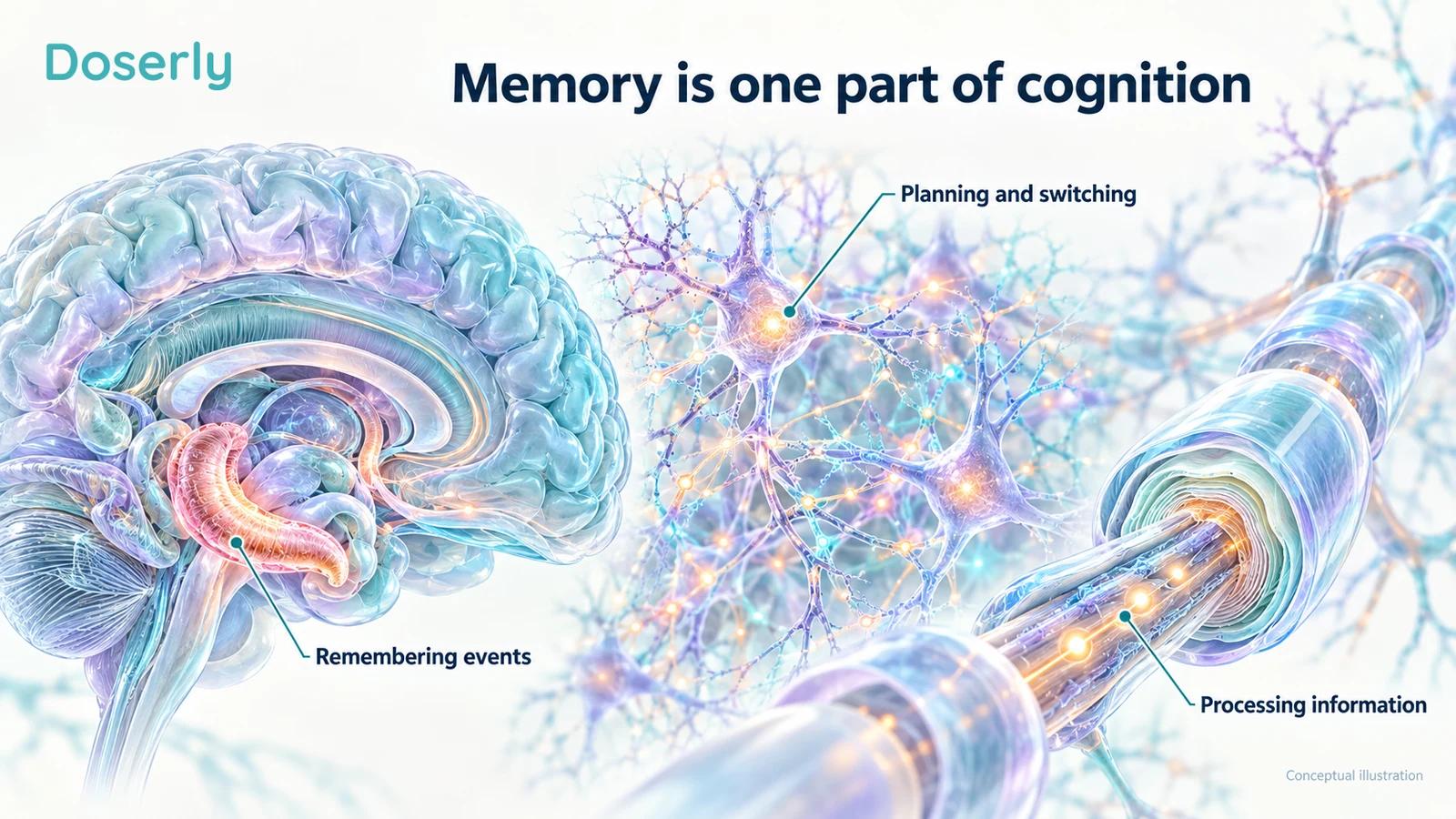
Episodic memory helps us remember events and experiences: what happened during an appointment, where we parked or what a friend said yesterday. Executive function includes skills used to plan, switch between tasks, inhibit an unhelpful response and keep a goal in mind. Processing speed concerns how efficiently information is handled. They overlap in daily life but are not interchangeable.
Imagine preparing a meal. Remembering the ingredients, switching between a pan and an oven, and responding quickly when something starts to boil involve different demands. A person may notice difficulty in one area while doing well in another. A combined research score summarizes several tasks so the trial is not dependent on one narrow test.
That advantage comes with a tradeoff. The composite is not a direct demonstration that shopping, medication management or driving became easier. Those functional outcomes need their own assessments. It is reasonable to value a cognitive signal while still asking whether people and families can notice a durable benefit.
How the Finnish FINGER trial fits
The original FINGER trial provided an important precedent. In Finland, 1,260 adults aged 60 to 77 with elevated dementia risk received a two-year multidomain intervention or general health advice. The intervention combined diet, exercise, cognitive training and vascular-risk monitoring. The annual between-group difference in the neuropsychological composite was 0.022, with a confidence interval of 0.002 to 0.042. Ngandu and colleagues, Lancet
FINGER therefore supported the idea that addressing several domains together could improve or maintain cognition in an at-risk population. It did not prove that a specific food, exercise type or brain-training task was responsible. Musculoskeletal pain was among the intervention-related practical costs, a reminder that intensive lifestyle programs still need tolerable progression.
POINTER extends this general approach into a US setting, with a different participant mix and a different comparison. It is better understood as supporting a research strategy than as reproducing one universal effect size. A standardized score from one test battery is not automatically interchangeable with a score from another.
The international work also raises a constructive question: how can a program keep its useful ingredients while adapting to different languages, food traditions, neighborhoods and health services? Requiring every community to reproduce the same menu or meeting arrangement could make an intervention less accessible without preserving the reason it worked.
Newer findings do not all point in one direction
A 2026 follow-up from J-MIND-Diabetes examined older adults with type 2 diabetes and mild cognitive impairment. At 42 months, the analyzed sample included 42 participants. There was no significant between-group difference in the overall cognitive composite, although some individual executive-function tests favored the intervention. The original program combined metabolic care, exercise, nutrition counseling and social activity. J-MIND-Diabetes follow-up
This is not a clean contradiction of POINTER. Participants were older, already had cognitive impairment and had diabetes; the follow-up sample was small. But it is a useful counterweight to the idea that any multidomain program reliably produces a global cognitive benefit in any population. A favorable result on selected tasks should not replace a nonsignificant primary composite in the headline.
The 2025 Maintain Your Brain study provides a different implementation example: an online, personalized, multidomain intervention improved cognition over three years in at-risk older adults. It tested a digital delivery model rather than assuming that every effective program requires the same in-person structure. Maintain Your Brain primary report
Taken together, these studies invite a more detailed question than whether lifestyle works. Which people, which support, which outcomes and how long? A program can be feasible and help some domains without settling its effect on eventual dementia diagnoses. That distinction is particularly important when a commercial service presents itself as equivalent to a research trial.
Blood vessels belong in a brain-health discussion
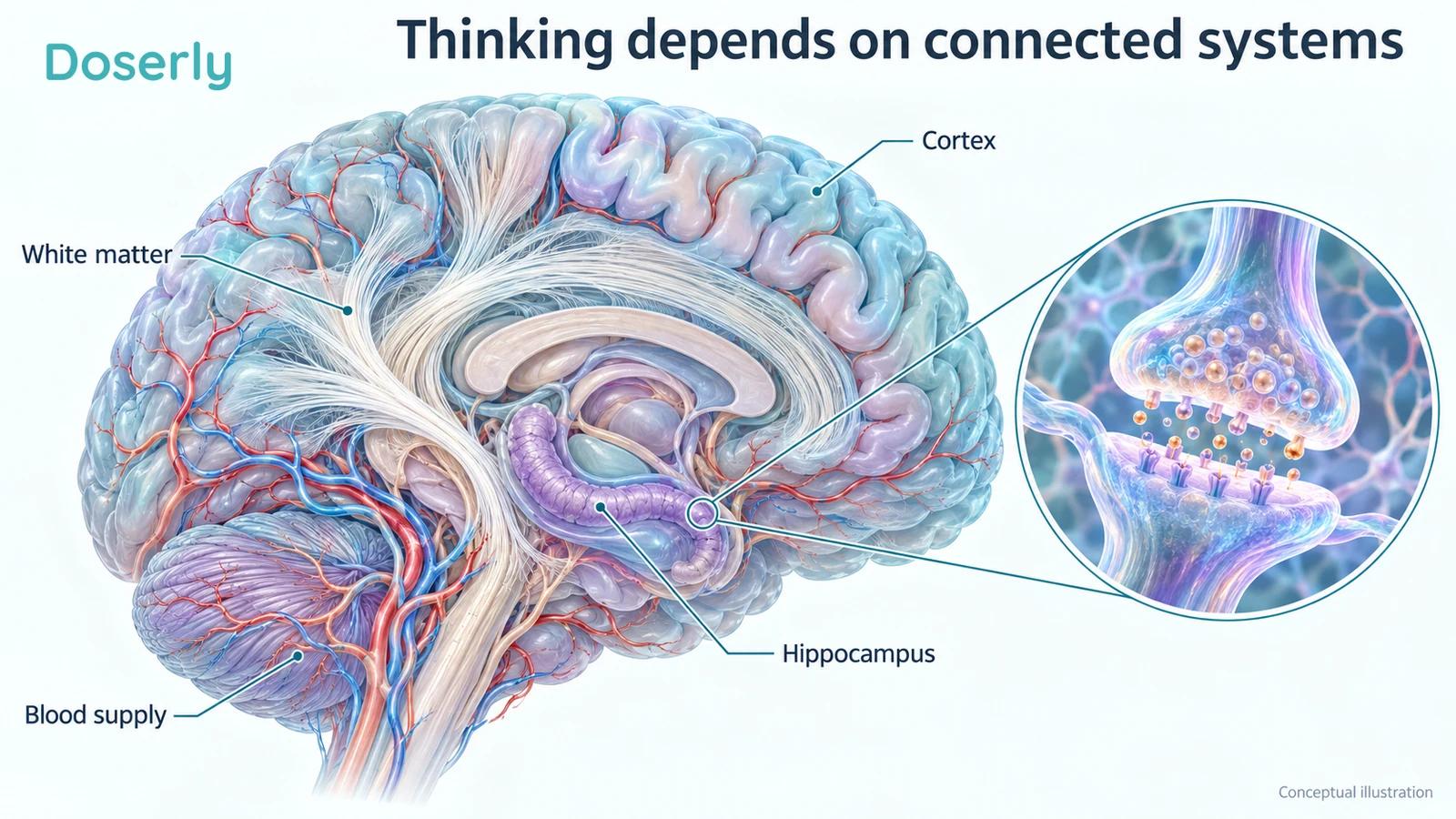
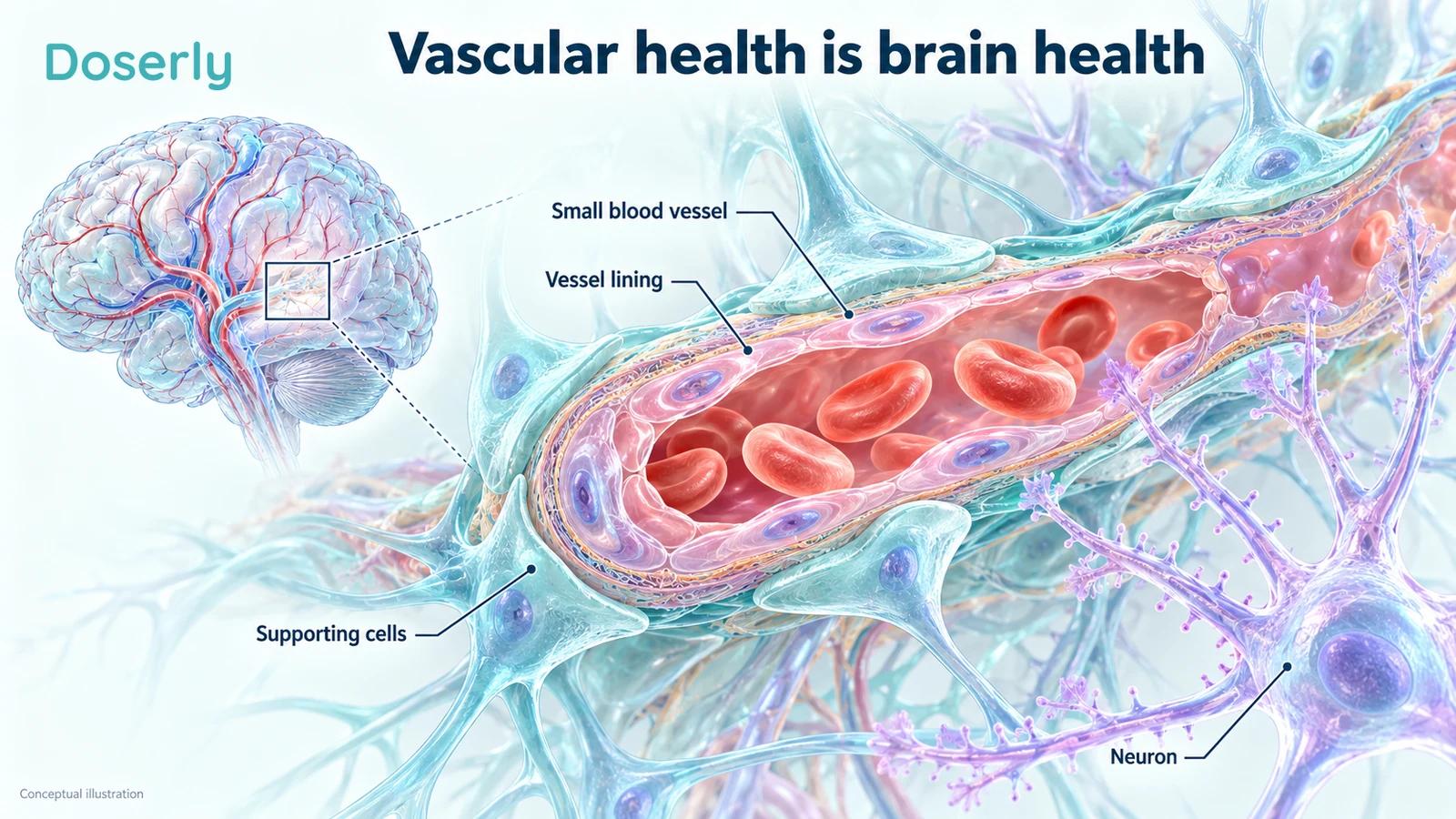
The brain depends on a continuous blood supply. Large vessels and a network of small vessels deliver oxygen and nutrients, while vessel-lining cells and supporting cells help regulate the local environment. Vascular disease and neurodegenerative processes can coexist; brain health is not solely an amyloid question.
In a POINTER imaging baseline study, cardiovascular risk was associated with less favorable brain structure and cognition. Because those were baseline associations, they did not show that the intervention reversed an imaging abnormality. They did explain why vascular health was a relevant part of the trial's design. POINTER imaging cohort
Separate randomized evidence comes from SPRINT MIND. Intensive blood-pressure management reduced mild cognitive impairment, while the result for probable dementia was not statistically significant in the original analysis. The trial's selected population and medical monitoring matter; its blood-pressure strategy is not a target for everyone to adopt independently. SPRINT MIND
For a reader, the useful implication is ordinary but consequential: a discussion about cognition should not overlook blood pressure and other cardiovascular care already indicated for health. A new brain supplement is not a substitute for finding out whether an established risk factor is being managed well.
A healthy food pattern is not a proven memory cure
POINTER included dietary change within a broader package. That means its positive result cannot isolate the contribution of the diet. A separate randomized MIND-diet trial tested that question more directly in 604 older adults without cognitive impairment, comparing a MIND diet with mild calorie restriction against a control diet with mild calorie restriction. Over three years, cognitive and brain-MRI changes did not differ significantly between groups. MIND diet trial
This does not make food irrelevant. It means that the specific comparative claim was not established under those conditions. Both groups received dietary attention, and the intervention was evaluated in a particular population over a particular period.
In practice, food choices affect more than a cognitive test. A sustainable pattern needs to fit appetite, budget, cultural preferences and other health conditions. A person with poor intake may need help eating enough; another may need support reducing reliance on highly processed convenience foods. Neither problem is solved by treating a single berry, oil or supplement as a brain treatment.
The useful question about a program's diet component is whether it helps people eat a nutritionally adequate pattern they can maintain. That is more concrete than asking whether every ingredient has a laboratory mechanism related to neurons.
Hearing and social participation deserve their own attention
Conversation is cognitively demanding. When hearing is difficult, participating can become tiring or embarrassing, and a person may withdraw from situations they previously enjoyed. Hearing care therefore matters for daily functioning regardless of whether it prevents dementia.
The ACHIEVE trial randomized 977 older adults with hearing loss to a hearing intervention or health education. Its overall primary analysis did not find a significant difference in three-year cognitive change. A prespecified analysis found that effects differed between the higher-risk established cohort and newly recruited volunteers. ACHIEVE primary trial
The result is more nuanced than either hearing aids prevent dementia or hearing care has no value. It also illustrates why baseline risk matters in prevention trials. If one population changes very little over the observation period, detecting a difference can be difficult.
For someone planning social or cognitive activities, practical access comes first. Can they hear the discussion, see the material, use the technology and reach the venue? A program advertised as mentally stimulating may become isolating if its format excludes the people it is meant to help.
Genes are relevant, but they do not supply a personal forecast
POINTER's prespecified subgroup analysis did not find that the structured intervention's benefit differed between APOE ε4 carriers and noncarriers. That is reassuring in a limited sense: the trial did not show that this genetic risk factor made the intervention ineffective. It is not a demonstration that lifestyle cancels genetic risk. POINTER subgroup results
A genetic risk marker and a cognitive trajectory answer different questions. The marker may help describe vulnerability across populations, while the trajectory describes repeated performance. Neither one alone tells a person exactly when symptoms will develop or whether they will develop at all.
There is also no requirement to purchase a genetic test before making ordinary health improvements or seeking care for a concern. Testing can have emotional and family implications, and the meaning depends on the context. A person who already knows a result can discuss it with a qualified clinician without turning every forgotten name into evidence that a prediction is unfolding.
Where supplements fit, and where they do not
A lifestyle trial does not validate a supplement stack. POINTER's comparison involved coordinated changes and support, not a capsule marketed as reproducing exercise, social connection and vascular care. Products promoted for focus often rely on different studies, different populations and much shorter follow-up.
A nutritional deficiency is a separate clinical issue. The National Institute on Aging notes that vitamin deficiencies, medication effects and other medical conditions can contribute to memory problems and may need evaluation. Correcting an identified problem is different from assuming that extra nutrients enhance cognition in everyone. NIA assessment guidance
A useful review starts with the person's medicines, supplements, sleep, symptoms and diet together. Adding another product before understanding the problem can complicate that picture. A supplement's plausible effect on a neurotransmitter or cellular pathway does not tell us whether it improves the daily task the person is struggling with.
Turning the trial into a workable routine
The Alzheimer's Association's description of POINTER emphasizes the combined domains and the value of structured support. That is a reasonable starting point for implementation, while remembering that the association funded and helped conduct the trial. The primary paper remains the place to check the size and limits of the result. Trial-group results summary
For an individual, a workable routine may begin with one obstacle. A walking group can combine movement and conversation. A cooking session can combine a useful skill, social contact and attention to food. Learning something enjoyable can be more sustainable than repeatedly completing tasks solely to improve an app score.
Those examples are practical translations, not substitutes proven equivalent to the research intervention. Their value is that they connect a health intention to something a person can actually attend and repeat. Starting with a meaningful activity also makes it easier to identify what support is missing.
A brief plan can specify the activity, the setting, the person who can help and a way to revisit difficulties. The review should include enjoyment and feasibility, not just compliance. If a plan repeatedly fails because transport is unavailable, a more forceful reminder does not solve the problem.
Choosing a program without buying a guarantee
A credible program should be able to explain who it serves and what it helps participants do. Ask whether its staff adapt activities for joint pain, sensory impairment or limited digital confidence. Ask how it coordinates with existing medical care and whether someone reviews difficulties after enrollment. These details reveal more about usability than a promise to optimize brain age.
It is also useful to ask what the advertised outcome means. A service may measure attendance, a proprietary app score, a short screening test or everyday function. Those are different kinds of information. Improving a practiced task can be encouraging without demonstrating that the benefit transfers to unfamiliar tasks outside the program.
Costs deserve a similarly concrete discussion. Are travel, equipment, food changes or subscription renewals included? Can a participant pause during illness? Is there an accessible alternative to a group meeting? A program that only works when life is unusually orderly may be hard to sustain for the people carrying the greatest caregiving or health burden.
For someone joining with a partner or family member, it can help to agree on what support is welcome. Sharing a walk or helping arrange transport may be useful; repeatedly testing someone's memory at home may make participation feel like surveillance. The purpose of a supportive routine is to make worthwhile activities easier to continue. It should preserve the participant's choices and dignity while giving them a clear way to ask for help.
None of these questions requires a person to become a trial statistician. They help connect a research result to a service that can realistically support the person who is considering it.
When a memory concern needs assessment
A trial about prevention should not delay evaluation of a current problem. Difficulty managing familiar tasks, repeated confusion or changes noticed by others deserve a discussion with a health professional. The National Institute on Aging distinguishes ordinary age-related forgetfulness from more substantial impairment and describes several possible contributors beyond dementia. NIA memory guidance
Bringing concrete examples is often more useful than saying memory feels worse. What changed, when did it begin, and how is it affecting daily life? A family member or trusted friend may help describe the pattern. An assessment can then address causes and support needs instead of assuming that every concern is either normal aging or Alzheimer's disease.
POINTER adds a credible reason to invest in sustained lifestyle support for people at risk of decline. Its promise is measured: a modest advantage in cognitive performance over two years, within a program people could follow. The next important questions concern durability, daily function and dementia outcomes, while the current opportunity is to make healthy routines more accessible and less lonely.