
Peptides
October 16, 2026
BPC-157's infusion pilot: what two participants can tell us
On this page
A study can report no observed side effects and still leave most safety questions unanswered. BPC-157's 2025 intravenous infusion pilot is a particularly clear example: two adults received infusions on two consecutive days, with laboratory tests and vital signs followed through the third day.
The authors reported that the infusions were tolerated and that no side effects were reported. Those are useful observations about two people during a short period. They do not establish that BPC-157 is safe for a wider population, for repeated use or by other routes. Original pilot, full text
The distinction matters because a phrase such as “human safety study” can sound much more comprehensive than the study behind it. Here is what the researchers measured, what the results mean and which questions require different evidence. The BPC-157 guide places this pilot alongside the broader experimental literature.
Who participated—and who did not
The study took place at a private clinic in Florida. It included a 58-year-old man and a 68-year-old woman. Both had previously received intravenous BPC-157 without reported problems. Neither had an acute musculoskeletal injury at the time of the study.
This is important context for interpreting tolerability. The participants were not receiving their first-ever exposure. Selecting people who had already tolerated an intervention can provide information about those individuals, but it does not tell us how a first exposure would affect an unselected group.
The protocol also excluded people with several conditions, including chronic kidney disease, diabetes, hypothyroidism, liver failure and heart conditions, as well as pregnancy. A study that excludes a population cannot establish safety within that population. The participants' older ages do not make the results representative of all older adults, particularly those with multiple illnesses or complex medication regimens.
The paper described ethics approval and informed consent. Those protections matter, but they answer a different question from whether the resulting data are sufficient to support a broad safety claim. Approval to conduct a small study is not approval of the experimental treatment.
The participants paid for the treatment and laboratory work, and the authors reported no research funding. These details describe how the pilot was conducted. Its central limitations remain the two-person sample, selection of previously exposed participants and short observation window.
What was measured over three days
The researchers collected baseline blood work and vital signs, administered infusions on days one and two, and repeated assessments through day three. They also asked about symptoms during and after treatment.
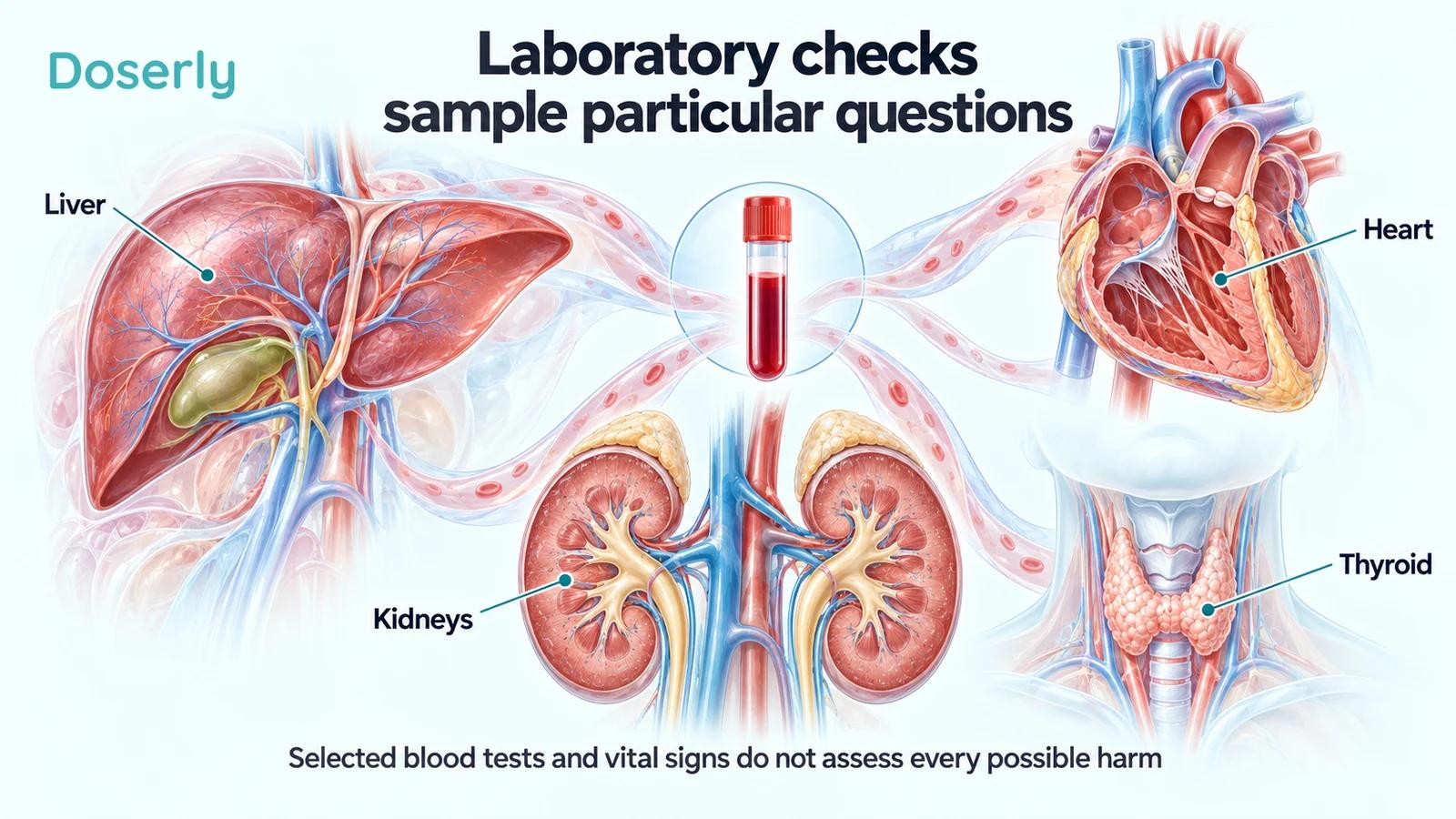
The laboratory panel included blood counts, a comprehensive metabolic panel, thyroid-stimulating hormone and selected cardiac or inflammatory markers. Blood pressure and pulse were recorded. The paper provides individual laboratory values rather than a large-group comparison.
These measurements can identify certain changes during the period observed. They do not amount to a complete examination of every organ or every possible adverse effect. A blood test associated with one organ is not the same as a comprehensive assessment of that organ's structure, function and long-term health.
The published conclusion described no measurable adverse effects and no reported side effects. That wording should not be simplified to “nothing changed.” The individual results did vary. For example, one participant's creatinine rose from 0.6 to 0.9 on the second day and returned to 0.6 on the third; her reported estimated kidney filtration value changed in parallel. The authors suggested dehydration as a possible explanation. Study methods, tables and discussion
Those observations neither prove kidney injury nor establish that the peptide had no kidney effects. With two people, no control group and limited follow-up, the cause of a transient laboratory change cannot be settled. The accurate account preserves the actual measurements and the authors' interpretation without turning either into certainty.
Why zero reported events is not a risk estimate
Imagine an entirely hypothetical adverse event that occurs in one out of every 100 independently treated people. If only two people were observed, the chance of seeing no such event would be 98.01%: 0.99 multiplied by 0.99. In that example, a zero-event pilot would be the expected result even though a real risk existed.
This calculation is an illustration of sample size, not an estimate of any BPC-157 risk. The pilot is too small to tell us the frequency of uncommon harms. It also cannot provide a reliable comparison with an established treatment whose safety has been studied in much larger groups.
Observing the same two people more intensively helps answer some questions, but it does not create additional independent participants. A large number of laboratory results should not be mistaken for a large safety population. Nor does repeating an infusion establish what would happen across months or years of exposure.
Drug-development guidance treats the number of people exposed and the duration of exposure as separate elements of a safety program. A large short study and a smaller long study reveal different kinds of information. The infusion pilot had very little of either. FDA/ICH guidance on population exposure
An event and a treatment-related reaction are different
Safety reports need to distinguish an adverse event from an adverse reaction. An event is something unfavorable observed during a study; calling it a reaction adds a judgment that the treatment caused it. A comparison group and a clear assessment process help make that judgment more reliable.
This matters in both directions. A laboratory fluctuation should not automatically be blamed on the peptide, but a reassuring explanation offered after the fact does not prove that the peptide played no role. In this pilot, the appropriate account is the observed values, the investigators' interpretation and the design's inability to settle causation. Preserving that distinction avoids overstating either safety or harm.
Some questions need time, not just another blood draw
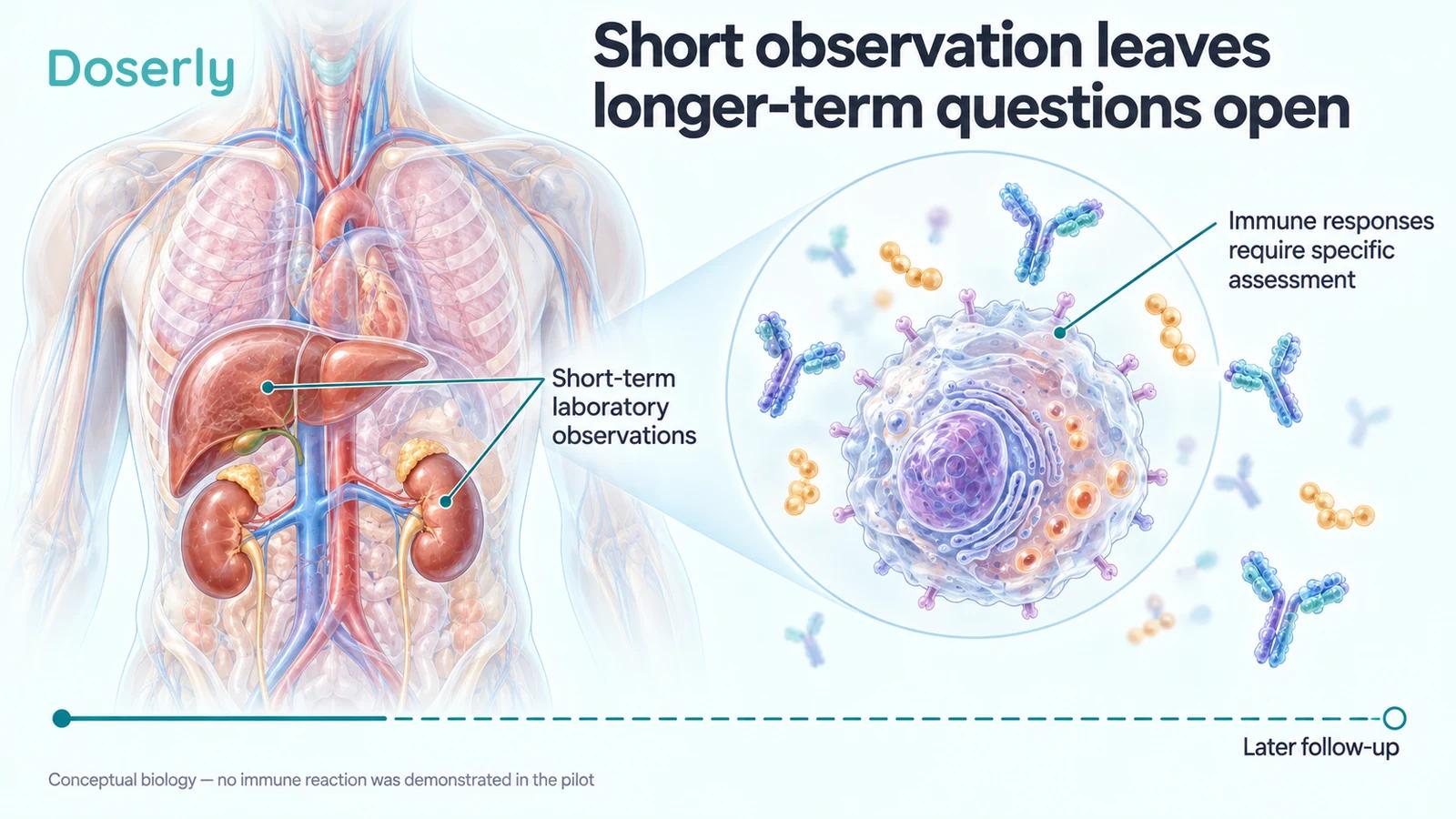
A three-day observation window is suited to noticing certain immediate reactions or short-term laboratory changes. It cannot describe adverse effects that first appear later, changes associated with sustained exposure or outcomes that require longer observation to recognize.
It also cannot establish how BPC-157 interacts with a broad range of medications or medical conditions. Such interactions may depend on the particular combination, the person's organ function and the duration of use. Two selected participants do not represent those possibilities.
This is not evidence that a specific delayed harm occurs. It is a limit on what the study could detect. A careful reading should avoid both extremes: declaring long-term safety from a short reassuring result, or treating every unmeasured possibility as a demonstrated danger.
A more useful question is what follow-up would be needed to evaluate the concern. Some outcomes require repeated clinical assessments, some need targeted laboratory testing, and some require enough participants for a pattern to become visible. “More research” becomes meaningful when it identifies what the next study must actually observe.
Immune responses need their own assessment
A peptide product may raise questions about immune responses to the peptide, its aggregates or impurities. FDA's 2026 scientific briefing reported that it had not identified formal BPC-157 immunogenicity studies and discussed particular concerns with parenteral and nasal administration. That is a statement about potential risk and missing evidence, not a measured rate of allergic reactions. FDA BPC-157 briefing
Routine blood counts or a general inflammatory marker do not substitute for a dedicated immunogenicity assessment. The infusion pilot did not demonstrate that immune responses had been comprehensively excluded. Prior uneventful exposure also does not provide that demonstration.
FDA's broader guidance describes immunogenicity assessment as a risk-based process that considers the product and its clinical context. It is relevant background for understanding why a small collection of routine laboratory values cannot resolve this question. It should not be interpreted as proof that BPC-157 behaves like every therapeutic protein. FDA immunogenicity guidance
The practical distinction is between “no reaction was reported in these two participants” and “this product cannot provoke a harmful immune response.” Only the first statement describes what the pilot observed.
The product and route stay attached to the result
The researchers used a product obtained from a compounding pharmacy and described a certificate of analysis and endotoxin testing. These details concern the preparation used in the study. They cannot establish the identity, concentration, purity or sterility of every vial sold as BPC-157.
A product can have a familiar name while differing in formulation, impurities, storage history or manufacturing controls. A claim based on one preparation should not automatically transfer to a different seller's product. “Research use only” labeling does not turn a product into a clinically validated medicine.
Compounded drugs are not FDA-approved; FDA does not review their safety, effectiveness or quality before marketing in the way it reviews an approved drug. Compounding can meet legitimate medical needs, but that fact should remain separate from evidence about a particular experimental ingredient. FDA explanation of compounded-drug risks
The route also matters. An intravenous study cannot establish the safety of injecting into a joint, injecting under the skin or taking an oral product. Each route changes the exposure and introduces different questions. The pilot should not be turned into a dosing or administration guide for any of them.
What the animal safety research contributes
A 2020 preclinical study investigated BPC-157 toxicity in several animal species. It reported generally reassuring findings under the conditions studied, including no serious toxicity, while noting mild local irritation and a creatinine change in one repeated-dose setting. Original preclinical safety study
These experiments are relevant to deciding whether and how human research should proceed. They are not a substitute for human safety data. Species, formulation, exposure and measured outcomes all affect how far a result can be carried.
It would also be inaccurate to summarize the animal paper as “no effect of any kind.” Its value lies in the specific experiments and observations, not an absolute safety slogan. Neither favorable animal findings nor a two-person human pilot can establish that repeated use is harmless across a broad patient population.
Safety without established benefit is an incomplete decision
The infusion pilot was not designed to demonstrate injury healing or pain relief. Neither participant had an acute musculoskeletal injury at the time. The absence of reported side effects therefore cannot be paired with an assumed repair benefit to produce a favorable benefit–risk conclusion.
For a treatment decision, both sides need evidence: what benefit is expected for a defined condition, and what risks accompany it. An experiment that measures short-term tolerability answers part of one side. It does not establish efficacy, identify the best route or show that the intervention is preferable to standard care.
A useful next study would enroll an appropriately defined population, use a well-characterized product, specify which adverse events and laboratory changes will be sought, and follow participants for a period suited to the intended use. Comparative and larger studies would then be needed to evaluate benefit and less common harms.
The 2025 pilot provides a small, short-term human observation that can inform that research. Its most defensible message is precise: two previously exposed adults tolerated the studied infusions without reported side effects during the observed period. The wider safety questions remain open.
Sources
- Safety of Intravenous Infusion of BPC157 in Humans: A Pilot Study
- E1A: population exposure to assess safety
- FDA briefing: BPC-157-related bulk drug substances
- Immunogenicity Assessment for Therapeutic Protein Products
- Understanding the Risks of Compounded Drugs
- Preclinical safety evaluation of body protective compound-157