
Peptides
October 16, 2026
BPC-157 arginate versus acetate: what the formulation evidence shows
On this page
A capsule has to do more than contain the ingredient printed on its label. The ingredient must remain intact during storage, be released from the capsule and reach the place where it is supposed to act. Those steps help explain why BPC-157 is marketed in different chemical forms, including acetate and arginate.
The practical question is whether choosing arginate gives someone a more reliable treatment or a better health outcome. The primary material reviewed for this article does not establish that oral BPC-157 arginate is clinically superior to acetate. There is a genuine formulation question to investigate, but chemical stability, absorption and benefit are three different claims.
This matters for someone comparing capsules for digestive symptoms or injury recovery. “More stable” can sound like “works better,” even when the supporting test never involved a person swallowing the finished product. Let's separate what the names mean, what the original patent describes and what a useful human comparison would need to measure.
What changes when a peptide is made into a salt?
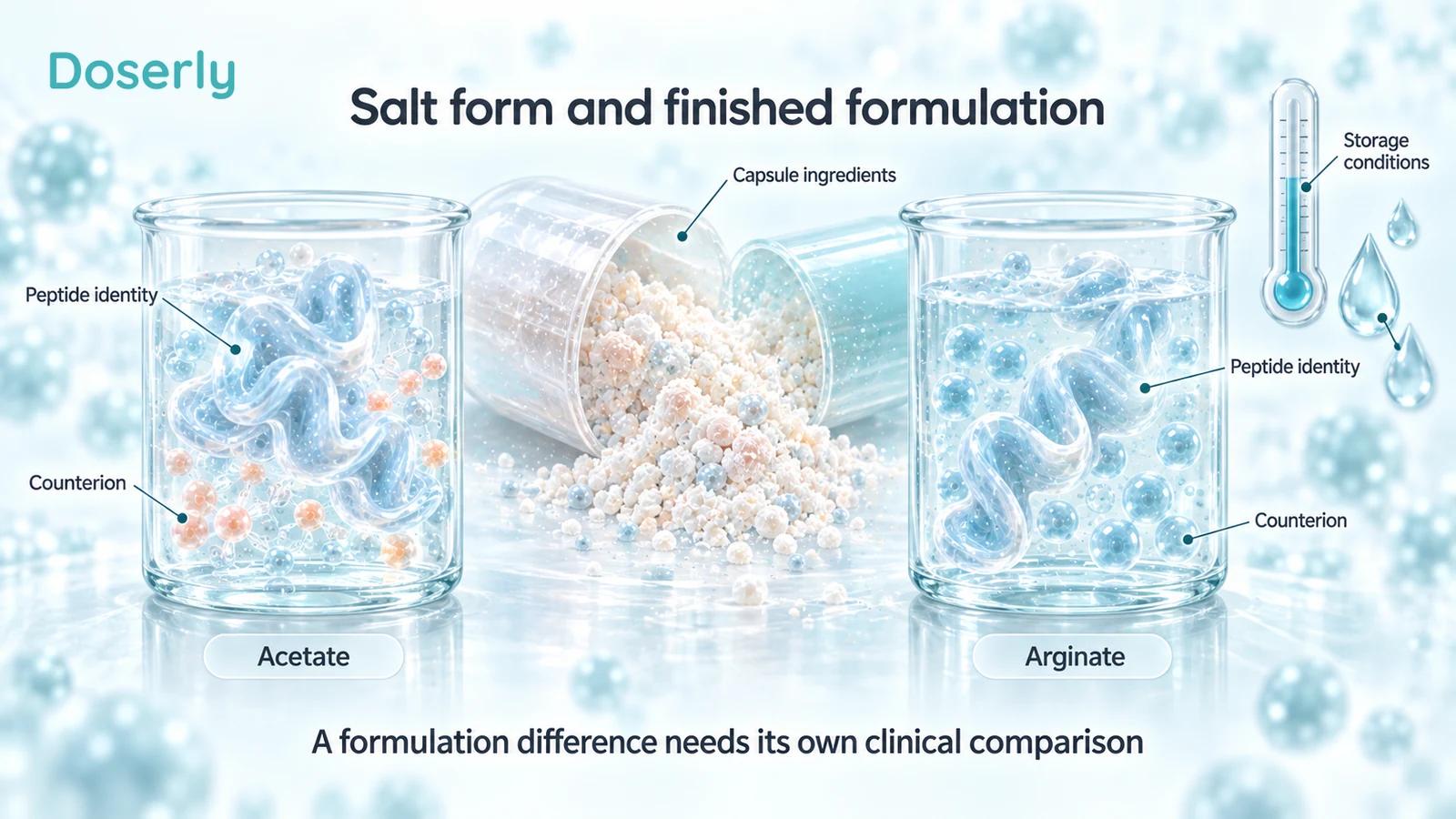
BPC-157 is a peptide made from 15 amino acids. A salt form involves charged chemical groups and accompanying ions, sometimes called counterions. The terms acetate and arginate refer to different chemical associations; they are not new clinical indications. Formulation can affect properties such as solubility and stability without establishing that a product treats a disease.
FDA's 2026 BPC-157 briefing considered the free base and acetate separately. It explains why distinct forms can have different physical, chemical or pharmacokinetic characteristics and why information about one form cannot automatically settle another's quality or performance. FDA BPC-157 briefing.
The name also doesn't describe the whole capsule. Two products carrying the same salt name could differ in the amount of peptide, accompanying ingredients, manufacturing process, packaging or release behavior. Conversely, a product with a more elaborate name does not necessarily have better characterization.
A useful comparison therefore starts with the exact product. Is the claimed amount the amount of peptide itself or the total mass of a salt mixture? What confirms the identity? Which other ingredients are present? These questions do not imply that every label is wrong. They identify what must be held constant before a comparison can mean much.
Where the arginate stability claim comes from
An original patent for stable pentadecapeptide salts describes formulations involving basic amino acids, including L-arginine. It includes laboratory stability work and preparation examples. These are primary documents for what the inventor claimed and tested; they are not randomized trials of commercial capsules in patients. US9850282B2.
For example, a tablet preparation in the patent underwent stability testing over 18 months under specified temperature conditions, with the peptide measured by high-performance liquid chromatography, or HPLC. The patent also discusses solution testing and gastric conditions. Those experiments concern particular preparations, not every product subsequently sold with an arginate label.
It would be inaccurate to dismiss the document as containing no testing. It would be equally inaccurate to describe it as proof that arginate heals a tendon better or provides a defined percentage increase in human absorption. The clinical comparison isn't present simply because a formulation has a patent.
When a seller cites this kind of document, the useful follow-up is to connect the marketed product to the tested preparation. Different excipients, concentrations and packaging can change the question. A stability claim needs to identify the material, test conditions, measurement and duration it actually describes.
Stability is specific to the conditions
“Stable” is not a single property that applies under every circumstance. Dry powder in a sealed container, peptide dissolved in water, a capsule on a shelf and material exposed to digestive conditions are different environments. Temperature, moisture, light, acidity and other ingredients can all be relevant to a stability assessment.
A meaningful laboratory test asks how much intact material remains after a specified period under specified conditions. It also needs a method capable of distinguishing the intended substance from breakdown products. A result obtained in one solution should not be turned into a universal storage instruction for another product.
That is why this article does not give a shelf life or home storage protocol based on the patent. Such advice would need evidence about the finished formulation and container. The wider BPC-157 guide's route discussion explains why capsules, joint injections and other preparations should not be treated as equivalent exposures.
A further question is whether intact material retains the biological activity relevant to the intended use. A chemical assay and a biological assay can provide complementary information. Neither, on its own, answers whether a patient experiences a worthwhile improvement.
Surviving digestion is only one part of oral delivery
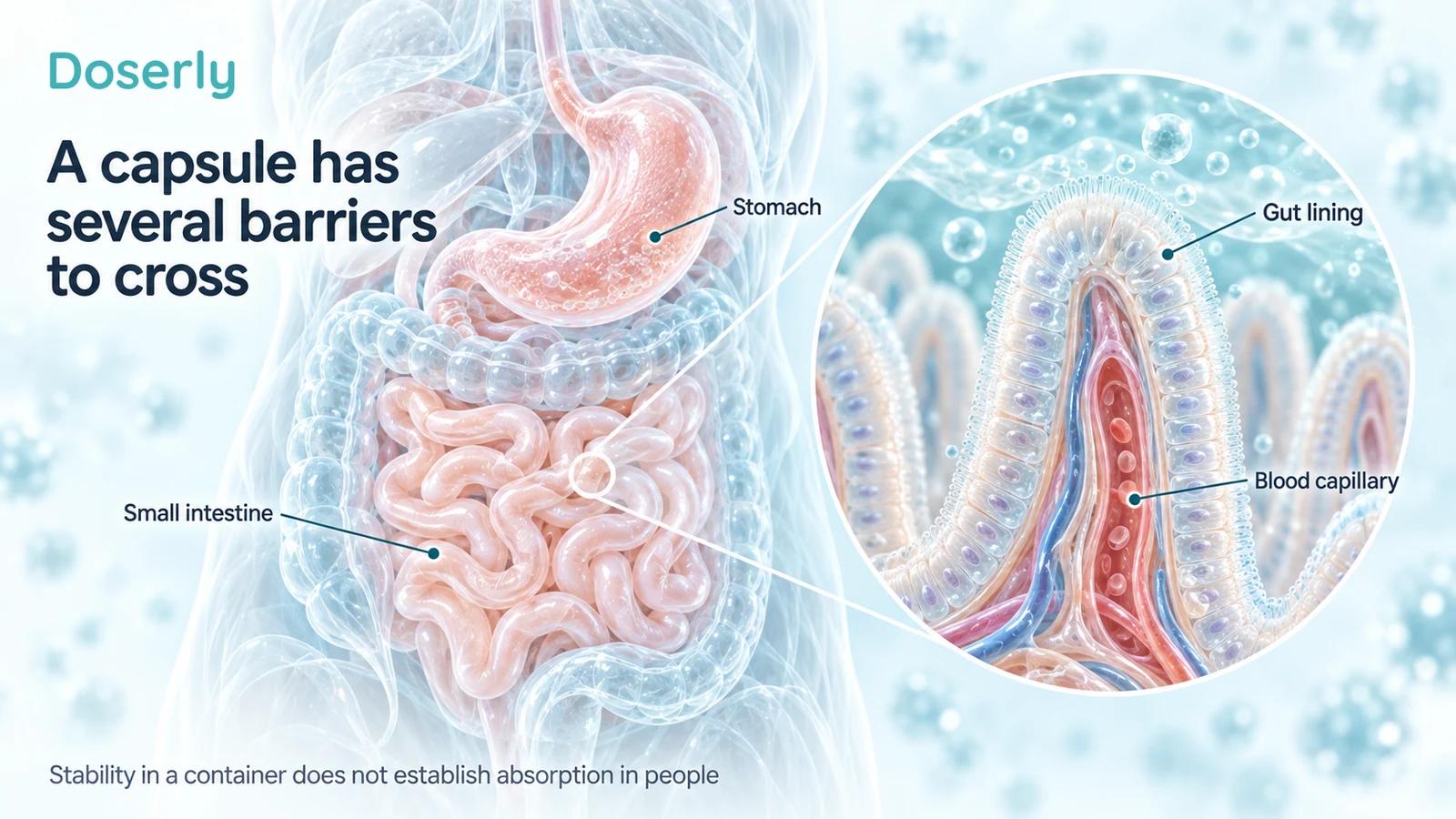
The digestive tract releases and breaks down material while selectively absorbing substances across its lining. The small intestine is a major site of absorption, and the blood circulation carries many absorbed nutrients onward. NIDDK: how digestion works.
For a peptide intended to act beyond the gut, remaining intact in a laboratory solution is only an early step. Researchers still need to establish how much intact peptide crosses the gut lining, how variable that amount is between people and what exposure reaches the target tissue. Material can survive one condition without passing efficiently through the next barrier.
A local intestinal effect is a separate possibility. A treatment intended to act in the bowel might not require the same systemic exposure as a treatment intended for a shoulder tendon. But that doesn't make a local benefit automatic. The intended bowel condition and patient outcome would still need to be studied directly.
For example, a claim about less abdominal discomfort, a claim about healing intestinal inflammation and a claim about tendon strength involve different outcomes. None can be inferred from a single stability percentage. Clarifying the intended destination and benefit makes the formulation discussion far more useful.
What measured BPC-157 pharmacokinetics show
Pharmacokinetics describes how a substance enters, moves through and leaves the body. A 2022 primary study measured BPC157 after intravenous and intramuscular administration in rats and dogs. Intramuscular bioavailability was approximately 14–19% in rats and 45–51% in dogs. These percentages describe exposure after injection into muscle, not after swallowing a capsule. Primary rat-and-dog study.
The difference between species is useful context. Even a carefully measured value does not become a human value simply because the peptide has the same name. It also doesn't become an oral value when the route changes. There is no defensible conversion from those figures into an arginate-versus-acetate capsule recommendation.
Bioavailability concerns how much of a dose reaches circulation in the form being measured. A comparative human study could examine blood concentrations over time, peak concentration and overall exposure. Those measures would address delivery; a separate efficacy study would address clinical benefit.
FDA's briefing reported no human pharmacokinetic data for oral BPC-157 in its review. It also noted that some human reports did not clearly specify whether the material was free base or a particular salt. That uncertainty makes retrospective comparisons of marketed forms especially weak. FDA review.
Does the older oral trial registration answer this?
The PCO-02 record on ClinicalTrials.gov is a phase 1 safety and pharmacokinetics registration. As checked on October 15, 2026, it listed an estimated enrollment of 42, an unknown overall status and no posted results. Its planned measurements include peak concentration, time to peak, overall exposure and elimination half-life. PCO-02 trial record.
The distinction between planned and completed measurements matters here. The record shows that these are research questions investigators intended to ask. It does not supply measured absorption values, demonstrate that all planned participants were enrolled, or establish a clinical advantage for arginate.
An old estimated completion date is not itself a result. For a formulation decision, the missing information would be the actual methods and findings, including the precise product used. A registration should remain a registration in the discussion until results are available.
What would a fair comparison look like?
A useful arginate-versus-acetate study would begin with analytically characterized products and comparable amounts of peptide. The researchers would describe accompanying ingredients, release properties and administration conditions. If those differ substantially, any observed difference might be due to the whole formulation rather than the salt alone.
For absorption, blood sampling would need to be frequent enough to describe the exposure over time, using an assay that identifies the intended peptide. Reporting only the highest observed value could miss differences in duration. Reporting only an average could hide substantial variability between participants.
For benefit, the study would need a specific population and outcome. People with a defined gastrointestinal condition would need a relevant clinical comparison. People recovering from a tendon injury would need functional and structural assessment appropriate to that injury. A product that changes exposure more reliably has not necessarily improved either outcome.
Safety would be assessed alongside benefit, because greater exposure is not inherently better. These are research-design requirements, not instructions to select a dose or experiment with different preparations yourself.
What to ask before paying for a formulation claim
The most useful questions are concrete: what exact formulation was tested, was it given to people, what was measured, and did the result improve the outcome you care about? Ask whether the evidence concerns the product being offered or only a related ingredient in a patent.
If digestive symptoms are the reason you're considering BPC-157, the diagnosis matters more than choosing a salt name. If injury recovery is the goal, the relevant question is whether the treatment adds benefit to appropriate care. Our BPC-157 human-evidence guide places the small clinical reports in context.
There is a plausible reason to study salt forms and finished formulations. There is not yet a verified human comparison in the sources reviewed here that justifies promising arginate will work better than acetate. The chemistry question is real; the clinical answer remains to be demonstrated.
Explore the research
- FDA BPC-157 briefing, 2026: distinct substances, formulation concerns and gaps in oral human pharmacokinetics.
- US9850282B2, stable pentadecapeptide salts: original patent, laboratory stability and formulation examples; not clinical superiority evidence.
- He and colleagues, 2022: measured pharmacokinetics in rats and dogs after injection.
- PCO-02 registration: planned phase 1 study; no posted results at the research date.
- NIDDK digestive-system explanation: anatomy and absorption background.