
Peptides
October 16, 2026
BPC-157 and gut healing: start with the diagnosis
On this page
“Gut healing” sounds like a treatment goal, but it does not identify a disease or a measurable outcome. It might mean less bloating, fewer urgent bowel movements, healing of inflamed tissue or better nutrient absorption. Those are different problems, and evidence for one does not establish a treatment for all of them.
BPC-157 is often discussed in this broad language. Much of the relevant research involves experimental injury in animals. The human ulcerative-colitis evidence includes a small study reported as a conference abstract, using a rectal preparation rather than an ordinary oral supplement or a subcutaneous injection. FDA's 2026 review considered that evidence inadequate to establish the studied treatment's efficacy and safety. FDA BPC-157 scientific review
The useful starting point is therefore the diagnosis: what is causing the symptoms, which tissue is involved and what outcome would show that treatment helped? The BPC-157 guide explains the peptide's broader evidence and safety limitations.
The digestive tract is not one interchangeable surface
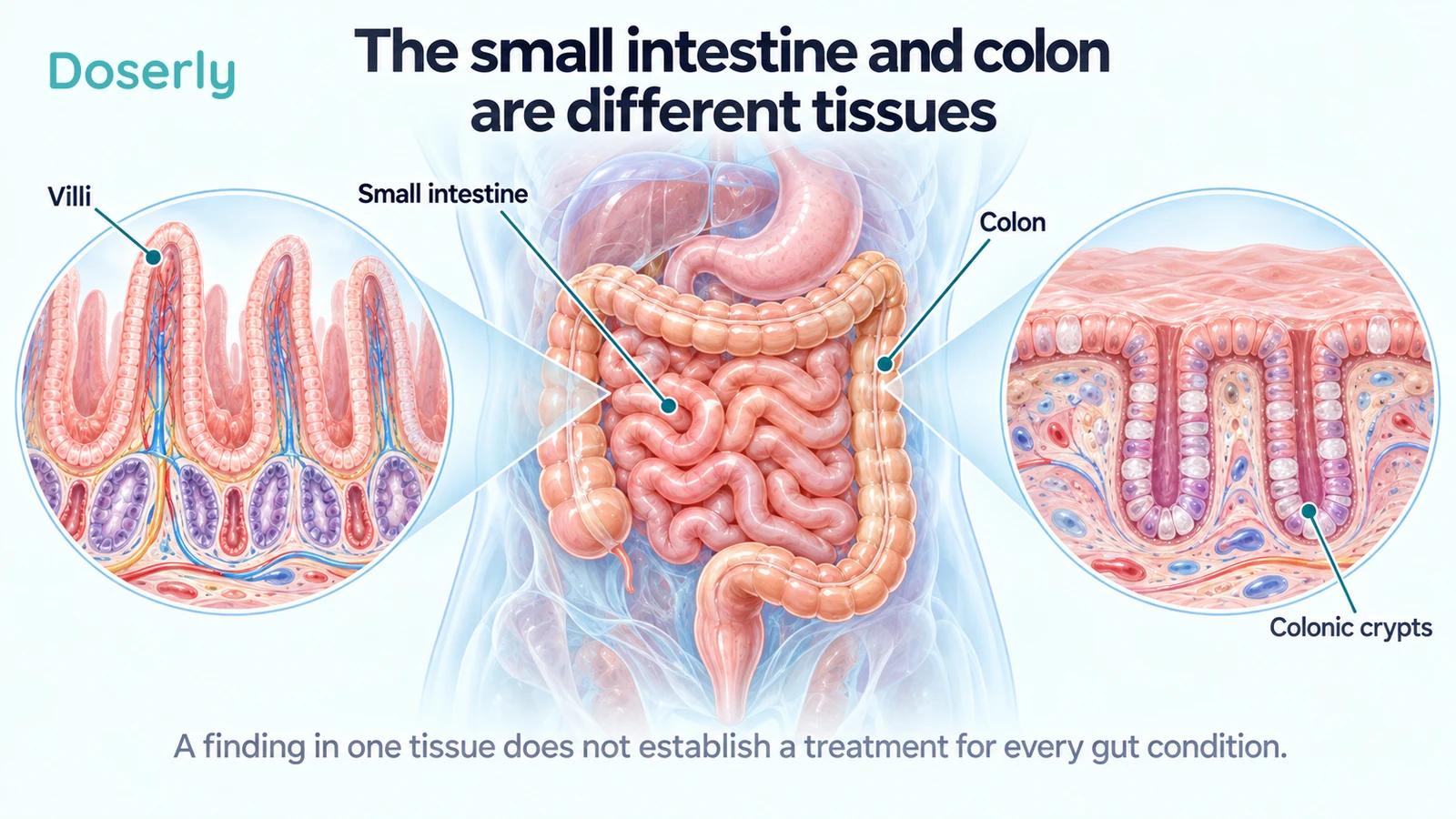
The small intestine and colon have different structures and jobs. The small intestine's villi increase its absorptive surface. The colon has a different mucosal architecture, with inward glands called crypts rather than the same projecting villi. A finding about one location should not be casually relabeled as repair of the entire gut.
Disease location also affects treatment questions. A preparation delivered to the rectum is not automatically equivalent to a swallowed preparation or a medicine entering the circulation. The relevant tissue may receive different exposure, and the formulation itself can matter.
Even within one diagnosis, the amount of bowel affected and the severity of disease can influence care. For ulcerative colitis, NIDDK describes treatment choices as depending on both severity and how much of the large intestine is involved. A generic promise to heal the gut leaves out these clinically important distinctions. NIDDK ulcerative-colitis treatment overview
Four diagnoses that should not be collapsed into “gut damage”
Ulcerative colitis is a chronic inflammatory bowel disease involving inflammation and ulcers in the inner lining of the large intestine. Its course can include flares and remission. A useful treatment needs to address the disease and help maintain control over time, rather than simply change one day's symptoms. NIDDK definition of ulcerative colitis
Crohn's disease is also an inflammatory bowel disease, but it can affect any part of the digestive tract. It commonly affects the small intestine and the beginning of the large intestine. A study in ulcerative colitis does not automatically establish a treatment for Crohn's disease, even when the symptoms overlap. NIDDK definition of Crohn's disease
Celiac disease is an immune disorder triggered by gluten that damages the small intestine. It is different from wheat allergy and from symptoms described as gluten sensitivity. A claim about protecting cells in an experimental injury model does not show that a peptide removes this disease trigger or replaces diagnosis-specific care. NIDDK definition of celiac disease
Irritable bowel syndrome, or IBS, involves recurrent abdominal pain and changes in bowel movements without the visible damage that defines some other digestive diseases. It is described as a disorder of gut–brain interaction. The symptoms are real, but “repairing damaged tissue” is not an adequate explanation of the condition or an established treatment strategy. NIDDK explanation of IBS
This distinction is useful when reading testimonials. Two people may both report diarrhea or abdominal discomfort while having different conditions. Improvement in one person's symptoms cannot identify the cause of another person's symptoms, and it cannot establish that the same intervention will address both.
What the small human ulcerative-colitis study involved
The frequently cited human study was reported by Ruenzi and colleagues in a 2005 meeting abstract. FDA's 2026 briefing summarizes it as a randomized, double-blind, placebo-controlled trial involving 53 participants with mild-to-moderate ulcerative colitis, treated for two weeks with a BPC-157 preparation called PL 14736 administered as an enema or with placebo.
According to that review, 46 participants completed the study. Five withdrew because of adverse events, described mainly as progression of ulcerative colitis, and two were lost to follow-up. The reported disease-activity comparison was uncertain, and the abstract lacked important details about the endpoint, eligibility criteria, statistical methods and later follow-up. FDA's account of the original abstract
The original full trial report was not accessible for this article. These details are therefore attributed to FDA's review rather than presented as an independent reanalysis of participant data. The absence of a detailed report matters: readers cannot fill in the missing methods by assuming that every element followed a modern trial standard.
Randomization and blinding are strengths of the described design. They do not remove the limitations of a small sample, short treatment period and incomplete reporting. Nor does the label “phase II” itself establish that the treatment worked.
The study also does not test the products most commonly discussed in general gut-healing claims. It cannot establish the effectiveness of a capsule, a subcutaneous injection or a different rectal formulation. A treatment's name should travel with its route and preparation when the evidence is summarized.
Improvement within a group is not the same as benefit over placebo
A disease-activity score can improve over time in both an experimental-treatment group and a comparison group. To estimate the treatment's added benefit, the important comparison is the difference between groups, with its uncertainty—not simply whether the treated group changed from its own baseline.
For the study summarized by FDA, the reported confidence interval for the between-group difference included no difference. That does not prove the treatments were equivalent. It means the estimate did not clearly establish superiority in the reported data, and the reporting limitations make the interpretation more difficult.
This distinction prevents a common numerical shortcut: quoting an improvement in the treatment arm while leaving out improvement in the placebo arm. It also prevents the opposite shortcut of treating an inconclusive small study as proof that no effect could exist. The reasonable conclusion is that better evidence is needed before claiming a clinically useful benefit.
A longer, adequately reported trial would need to specify who was enrolled, what outcome defined success, how missing results were handled and whether any improvement persisted. Those details are particularly important for a chronic condition that fluctuates over time.
What the animal research actually models
One original BPC-157 study examined colitis associated with experimentally interrupted blood supply in rats. Researchers manipulated blood vessels supplying a segment of colon and studied tissue and vascular responses. The paper reported favorable findings in the treated animals. Original rat ischemic-colitis experiment
This research addresses a specific experimental injury. It is not a trial of people with IBS, celiac disease or ordinary unexplained bloating. A chemically or surgically produced injury can help investigators explore biological mechanisms, but it does not reproduce every feature of a human chronic disease.
The distinction is especially important when a paper's introduction refers to clinical development. A study can mention human ulcerative-colitis research while presenting new results only from rats. The species and model in the methods determine what that experiment actually demonstrated.
Animal findings can help identify questions for human research. They do not establish a patient benefit merely because the experiment involves bowel tissue. A useful translation would require a defined human condition, a characterized product, an appropriate comparison and outcomes meaningful to people living with that condition.
Symptoms, inflammation and mucosal healing are different outcomes
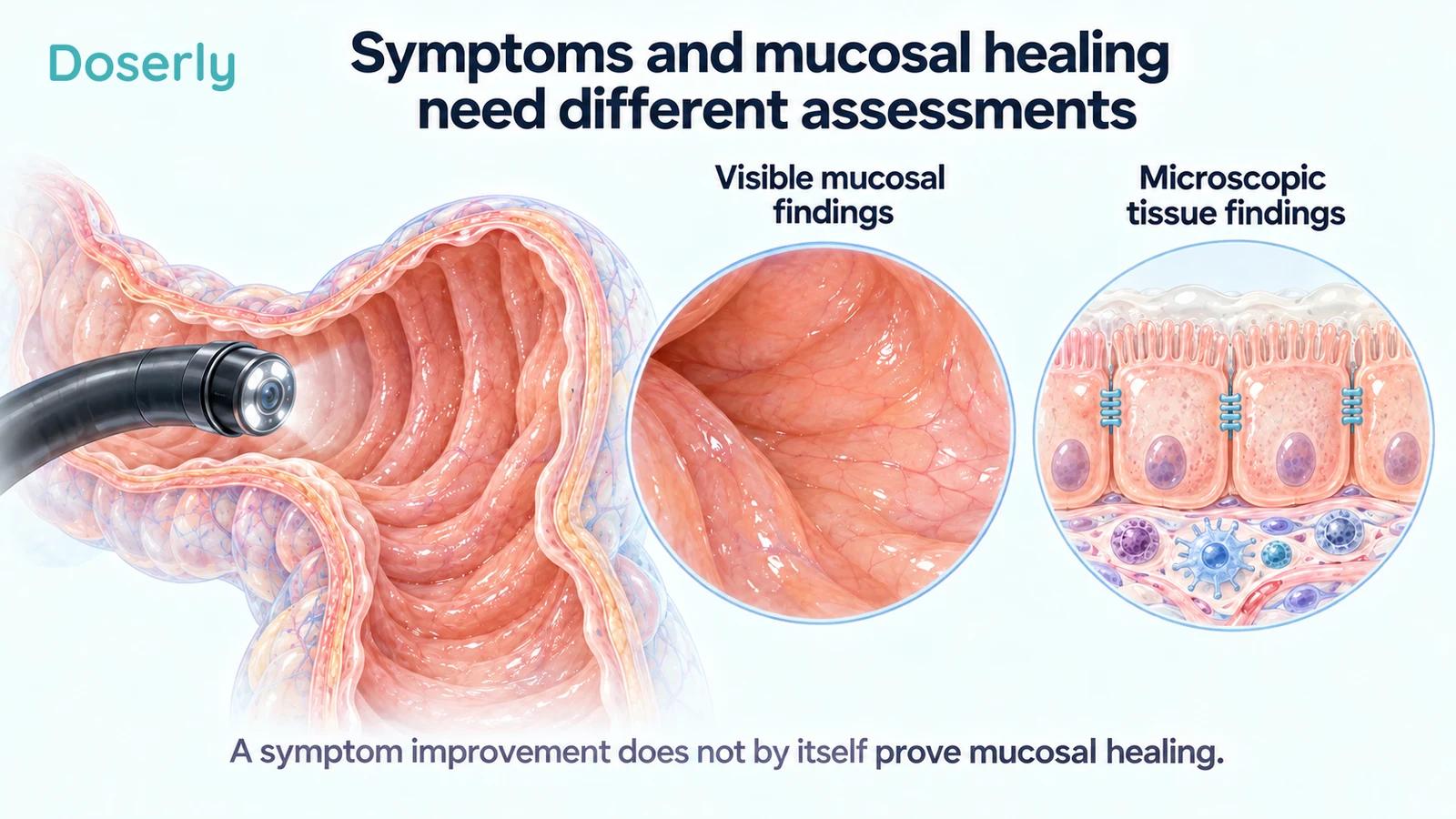
Less abdominal pain, fewer bowel movements and improved daily function are valuable patient outcomes. Mucosal healing concerns the condition of the bowel lining. Microscopic findings examine tissue at another level. One type of result should not silently replace another.
FDA's 2022 draft ulcerative-colitis drug-development guidance describes clinical-remission assessments that combine patient-reported symptoms with endoscopic findings. The reason for combining information is practical: neither a symptom impression nor a single tissue measure gives a complete picture of treatment benefit. FDA ulcerative-colitis development guidance
The same draft advises against using “mucosal healing” as a trial term without a shared definition and distinguishes endoscopic improvement from remission. For a claim of “healing,” ask what was actually measured. Was it a symptom questionnaire? A blood or stool marker? An endoscopic assessment? A tissue biopsy? These tests answer different questions and should be selected according to the diagnosis and clinical context.
An individual's feeling of improvement cannot prove that inflammation has resolved. Conversely, a meaningful symptom improvement should not be dismissed merely because the study did not establish tissue repair. Accurate reporting keeps the outcomes separate and explains which ones are still unknown.
Why “leaky gut” does not solve the diagnostic question
Intestinal permeability describes movement across the intestinal barrier. Turning that biological concept into a broad explanation for every digestive symptom skips the question of which disease, if any, is present.
A proposed barrier mechanism would still need to connect several steps: a reproducible abnormality in a defined population, a treatment-induced change in that abnormality and a meaningful improvement in health or function. An attractive cellular explanation cannot establish all three steps on its own.
The BPC-157 evidence discussed here does not supply that chain for people seeking a general gut-healing product. An experimental effect in a specific injury model should not be presented as proof that an undefined syndrome has been diagnosed or corrected.
This is also why a personal trial of a product is a poor substitute for diagnosis. Symptoms can change with meals, bowel habits, other treatments and the natural course of an illness. Feeling better after an intervention does not establish which explanation was responsible, especially when several changes occurred together.
Diagnosis can change what should happen next
Celiac disease provides a concrete example. NIDDK explains that symptoms alone do not establish the diagnosis and that blood tests and small-intestinal biopsies are commonly used. It also advises against starting a gluten-free diet before diagnostic testing because doing so can affect the results. NIDDK celiac-disease diagnosis guidance
That is a different clinical task from choosing a product marketed for gut repair. The sequence of assessment can matter. Someone with persistent symptoms benefits from a discussion of the likely causes and appropriate testing, rather than assuming that one general mechanism explains everything.
For established ulcerative colitis, treatment is chosen to control inflammation and maintain remission, with decisions shaped by severity and disease extent. Experimental BPC-157 claims should not displace that diagnosis-specific plan. A change in symptoms is information to discuss with the treating clinician, not a reason to assume the underlying disease no longer needs care.
What would make a future BPC-157 gut study useful?
A useful study would name the disease precisely and define the population before treatment begins. It would describe the product and route, compare the intervention with an appropriate control and specify which symptoms, disease measures and safety outcomes are being assessed.
It would also distinguish short-term improvement from durable control. For a chronic illness, two weeks cannot answer whether benefit persists, whether treatment can be continued or what happens after it stops. Adverse-event reporting and follow-up need to match the intended use.
Until such evidence is available, the most useful question is not whether BPC-157 “heals the gut.” It is whether a defined preparation has demonstrated a meaningful benefit, with acceptable risks, for a particular diagnosis. The current evidence does not justify replacing that question with a broad healing promise.
Sources
- FDA BPC-157 briefing.
- Treatment for Ulcerative Colitis.
- Definition and Facts of Ulcerative Colitis.
- Definition and Facts for Crohn's Disease.
- Definition and Facts for Celiac Disease.
- Definition and Facts for IBS.
- BPC157 in treatment of colitis and ischemia/reperfusion in rats.
- Ulcerative Colitis: Developing Drugs for Treatment.
- Diagnosis of Celiac Disease.