
Peptides
October 16, 2026
BPC-157 and blood-vessel growth: what it means for cancer questions
On this page
Blood vessels deliver the oxygen and nutrients that living tissue needs. Growing new vessels can be part of repairing an injury, but it can also support a growing tumor. That shared biology explains why discussions of BPC-157 often move quickly from possible recovery benefits to cancer concerns.
BPC-157 is an experimental peptide, a short chain of amino acids, investigated in laboratory and animal models of injury. Some experiments show that it changes how blood-vessel cells behave. Those findings give researchers a reason to investigate cancer-related safety; they do not establish that BPC-157 causes cancer, prevents cancer or is safe for someone with a history of cancer. The missing piece is research that actually measures those outcomes with an appropriate product, comparison and follow-up.
Understanding the difference is useful whether you're considering BPC-157 for an injury, worried about past exposure, or trying to make sense of contradictory claims. The question isn't whether blood-vessel growth is always good or always bad. It's what happens in a particular tissue, under a particular exposure, and whether that translates into a meaningful change in human health.
What angiogenesis does in the body
Angiogenesis means the formation of new blood vessels from existing ones. Endothelial cells, which line vessel walls, respond to local signals by moving, multiplying and organizing into structures that can become vessels. One important signal is vascular endothelial growth factor, usually shortened to VEGF. It interacts with receptors on cells; VEGFR2 is one of those receptors.
The process is relevant to normal growth and healing. It also matters in cancer because tumors can stimulate a blood supply that supports their growth. Some cancer medicines interfere with angiogenesis. The National Cancer Institute explains both the normal process and why it is a treatment target. NCI: angiogenesis inhibitors.
That does not mean a substance influencing VEGF signaling necessarily creates a tumor. Nor does normal wound healing prove that every intervention affecting the pathway is harmless. These are different propositions. A pathway helps explain how an effect might occur; a cancer study asks whether the effect actually occurs, how often, and in whom.
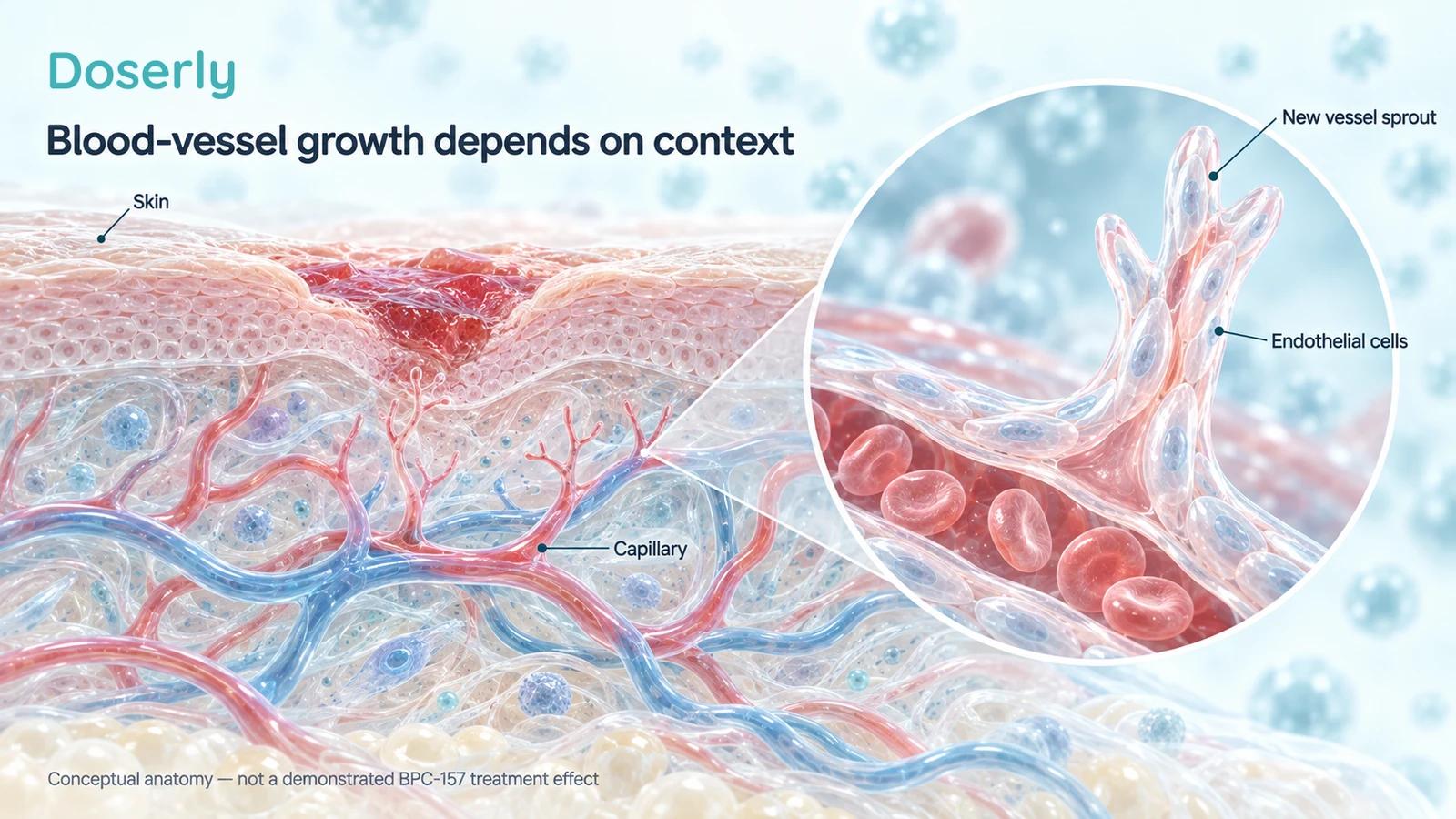
What the older BPC-157 vessel study measured
A study published online in 2016 and in a 2017 journal issue examined several experimental systems. These included a chick membrane assay, cultured human endothelial cells and rats with reduced blood supply to a hind limb. The researchers reported increased vessel-forming behavior and, in the rat model, improved recovery of blood flow and increased vessel counts. Hsieh and colleagues.
The cell experiments connected the response with increased VEGFR2 expression and activation of a signaling pathway involving Akt and eNOS. The investigators did not report increased VEGF-A expression in those endothelial-cell experiments. This distinction matters: saying that BPC-157 “raises VEGF everywhere” would be broader than the result. The paper concerns particular measurements in particular experimental conditions.
“Human endothelial cells” also does not mean that people received the treatment. Cells can be human in origin while the experiment takes place in a dish. Likewise, recovery of circulation in a rat's experimentally injured limb is not a trial of cancer incidence in people.
The useful conclusion is that BPC-157 can influence vascular biology under those conditions. A claim about treating a human injury, or about the safety of repeated exposure over years, requires additional evidence. For broader background on the peptide and its proposed repair mechanisms, see our BPC-157 guide.
What the newer BACH1 paper adds
A 2026 study proposed a more detailed molecular explanation. Its experiments linked BPC157 with FBXO22, a protein involved in marking other proteins for disposal, and BACH1, a protein that influences gene activity. The authors reported that BPC157 reduced BACH1 breakdown, allowing it to accumulate, and connected that change with endothelial-cell proliferation and tube formation. Primary paper: FBXO22 and BACH1.
You don't need to memorize those names to understand the advance. The researchers were trying to identify the molecular steps between exposure to a peptide and a change in cell behavior. That is more specific than observing that vessels increased, and it creates hypotheses that other laboratories can test.
It still doesn't produce a human cancer-risk estimate. A protein can have different effects depending on the cell type and surrounding conditions. The paper itself discusses this context dependence. A pathway involving a protein also studied in cancer cannot be translated directly into “this treatment causes cancer.” Equally, describing the pathway as regenerative doesn't establish safety.
The next questions are concrete: can independent researchers reproduce the finding, at what exposure does it occur, which tissues receive that exposure, and what happens in disease models? Clinical relevance depends on those answers as well as on eventual human outcomes.
Three cancer questions that should stay separate
When someone asks whether BPC-157 “causes cancer,” they may mean several things. One question concerns whether a substance damages genetic material in a way that could initiate disease. Another concerns whether it helps an already abnormal population of cells grow. A third concerns recurrence or progression in someone who has already had cancer.
These questions need different experiments. A test looking for mutations does not directly measure the blood supply to an existing tumor. A short observation of liver enzymes doesn't measure cancer recurrence. A vessel-growth experiment doesn't determine how many exposed people will develop cancer years later.
Consider two hypothetical research programs. One follows people without cancer and counts newly diagnosed cancers over a long period. The other enrolls patients with a defined cancer and measures progression while carefully accounting for their anticancer treatment. Even if both are well conducted, they answer different clinical questions. Neither can be replaced by a photograph of endothelial cells forming tubes.
This separation is especially useful when a discussion presents a single reassuring result as a universal answer. Ask which cancer-related process was studied. If that process isn't the one you're concerned about, the result may still be scientifically interesting without resolving your decision.
What animal safety tests can and cannot tell us
A 2020 preclinical safety report tested BPC157 in several animal species and included genetic-toxicity assessments. The investigators reported no genetic or embryo-fetal toxicity in the tests they performed and described generally reassuring findings in their experimental safety program. These are animal and laboratory findings, rather than long-term follow-up of treated patients. Xu and colleagues, preclinical safety evaluation.
FDA's 2026 briefing examined the available package separately. It described negative mutagenicity findings but also identified limitations in the duration and scope of toxicology studies. Crucially, the agency said it had not identified carcinogenicity studies for the BPC-157 free base or acetate substances under review. FDA briefing, particularly pages 38–40.
Those statements can coexist. A compound can have reassuring results in selected genetic tests while still lacking research needed to evaluate cancer risk more broadly. “Not mutagenic in these tests” and “shown not to affect cancer risk in people” are not interchangeable conclusions.
The briefing was prepared for a compounding advisory committee. It is a dated regulatory assessment, not an approval of BPC-157 and not a prediction that an individual exposed person will develop cancer. Its importance here is that it identifies the specific safety evidence that was missing.
Why the small human reports don't settle this
One 2025 intravenous pilot involved only two adults, both of whom had previously received BPC-157. The investigators reported no adverse effects and no meaningful changes in the measured laboratory markers. That tells us what was observed in those two people during that study; it cannot establish uncommon or delayed outcomes. Intravenous BPC157 pilot.
A separate retrospective report concerned knee pain after injections into the joint. It was a small, uncontrolled clinical experience focused on symptoms, not cancer surveillance. Knee-pain report.
Imagine trying to answer a ten-year question by checking how someone feels shortly after treatment. The absence of an immediate problem is useful for that immediate period, but it contains little information about events that take much longer to appear. Increasing the number of blood tests doesn't automatically solve that mismatch; the chosen tests still need to measure something connected to the outcome of interest.
The same applies to personal accounts. Someone saying that they felt well after using BPC-157 is describing their experience. It is not a controlled estimate of future cancer risk. Someone developing cancer after exposure also does not, by timing alone, establish that the exposure caused it. Both observations could contribute to carefully collected safety information without answering causation on their own.
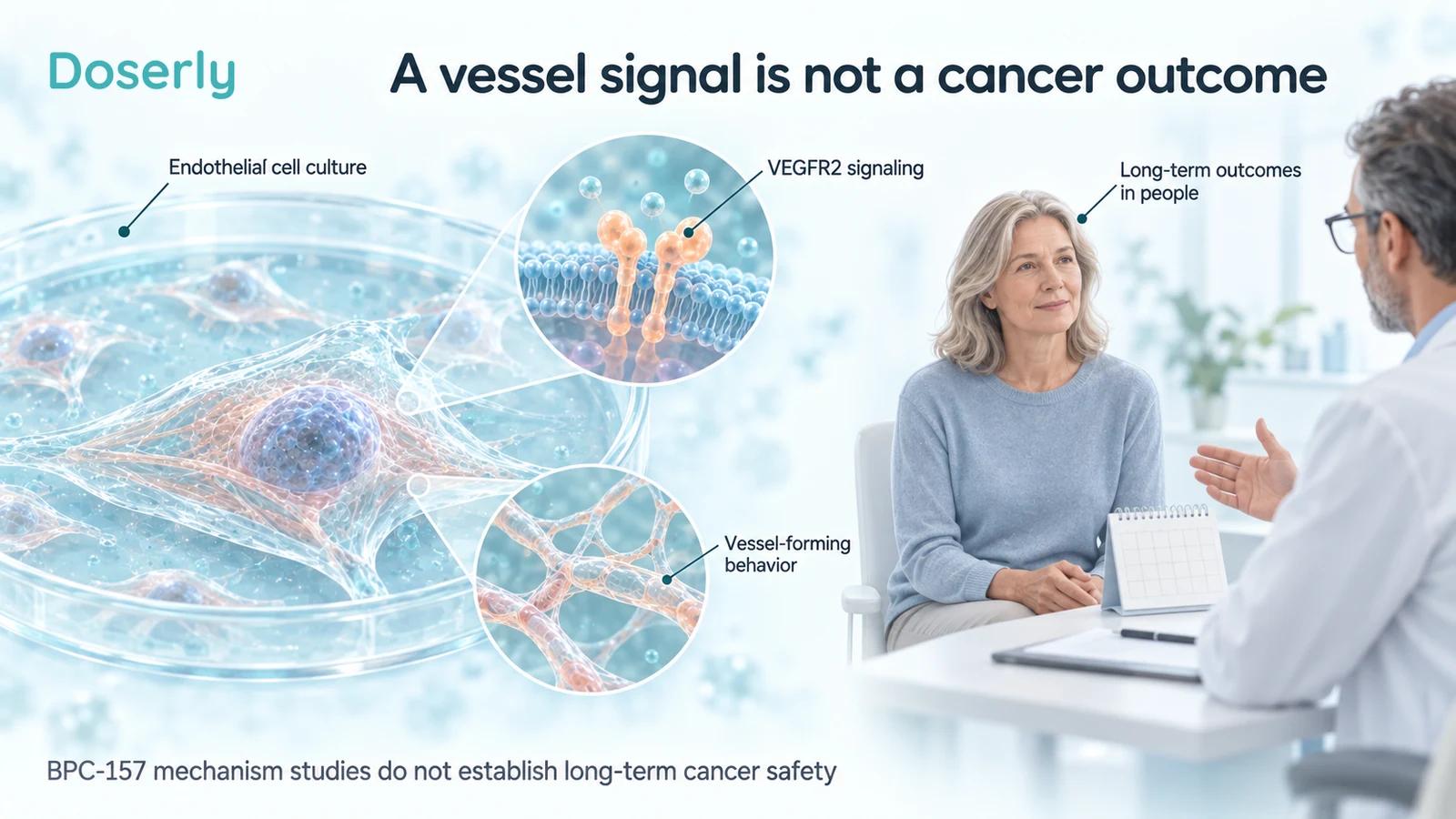
What would make a cancer-safety answer stronger?
A useful research program would characterize the actual substance and formulation first. Researchers would need to know what was administered, how much reached relevant tissues and how long exposure lasted. Otherwise, apparently conflicting results might involve products or exposures that are not comparable.
The biological work would then need to address the concern directly. If the concern is promotion of an existing tumor, studying only wound closure leaves that question unanswered. If it is delayed cancer development, the observation period must be long enough to detect delayed effects. Appropriate comparators and independent replication help distinguish a reproducible effect from an isolated finding.
Human studies would also need meaningful denominators: how many people were exposed, how many remained under observation, and how outcomes were found. Cancer occurrence depends on age, prior disease, other exposures and many additional factors. A comparison group helps researchers avoid attributing ordinary background events to a treatment or missing a real increase because nobody looked systematically.
These are proposed requirements for a more informative answer, not a description of completed BPC-157 trials. They explain why neither a favorable cell experiment nor a small safety pilot supplies a reliable percentage for personal cancer risk.
Bringing the question to a clinical conversation
If you have a current cancer diagnosis, a previous cancer or an ongoing evaluation for a suspicious finding, that context belongs at the center of the discussion. A clinician needs to know about experimental products alongside prescribed medicines. An oncologist can address how uncertainty relates to your specific disease and treatment, rather than treating all cancer histories as equivalent.
If you've already used BPC-157, bring the product name, route, dates and any available packaging or batch information. That makes the exposure easier to understand. The studies reviewed here do not establish a special screening schedule that can certify BPC-157 safety, and ordinary bloodwork cannot retrospectively prove that an exposure had no long-term effect.
For an injury, keep the treatment goal specific: less pain, improved function, a healed surgical repair or a return to activity. Those benefits deserve their own evidence before being weighed against unresolved risks. Our guide's human-evidence section describes what the small clinical reports actually measured.
The most accurate answer available is measured: BPC-157 has vascular effects in experimental systems, and its long-term human cancer implications remain unresolved. That uncertainty should neither be turned into a prediction of cancer nor replaced with reassurance that the evidence hasn't earned.
Explore the research
- Hsieh et al., 2017: VEGFR2 and angiogenesis. Endothelial-cell and animal experiments; not a human cancer study.
- BPC157, FBXO22 and BACH1, 2026. Molecular and cell-behavior findings; clinical safety not established.
- Xu et al., 2020: preclinical safety. Animal toxicology and genetic tests with defined experimental scope.
- FDA BPC-157 briefing, 2026. Regulatory evaluation of free base and acetate, including missing carcinogenicity research.
- Intravenous pilot, 2025. Two participants; inadequate for uncommon or long-term harms.
- Knee-pain report, 2021. Retrospective uncontrolled symptom report.
- National Cancer Institute: angiogenesis inhibitors. Background on vessel formation and cancer biology.