
Supplements
October 16, 2026
Boswellia for joint symptoms: the extract details deserve the headline
On this page
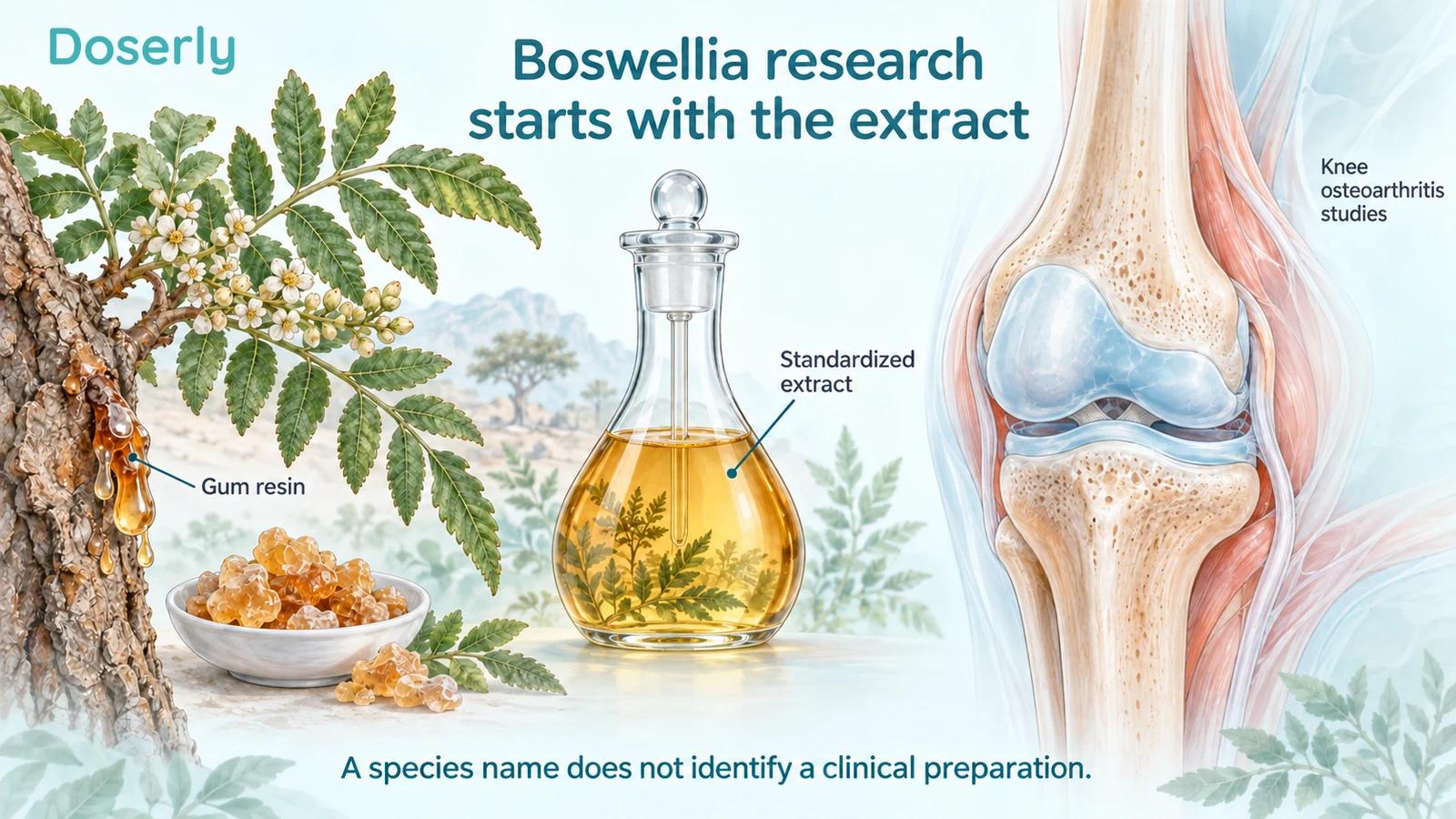
“Boswellia helped knee pain” sounds like a result you could apply to any bottle bearing the plant’s name. In practice, the preparation can be one of the most important details in the study. Researchers have tested different extracts of Boswellia serrata gum resin, with different concentrations of selected compounds and, sometimes, additional resin-derived components.
Several human trials have reported improvements in knee osteoarthritis symptoms. That is a reason to examine the evidence carefully. It does not establish that every Boswellia product works, that a higher percentage on a label is necessarily better, or that symptom improvement means damaged cartilage has been restored.
The useful question is more specific: what exact preparation was tested, in which people, against what comparator, and for how long? Once those details are visible, the research becomes easier to interpret and harder to turn into an exaggerated promise.
Start with gum resin, not just a plant name
Boswellia serrata is a tree whose gum resin is used to make extracts. Frankincense also comes from Boswellia resins, but an oral standardized extract is not interchangeable with an aromatic oil, a topical product, or raw resin. The route and preparation used in a clinical trial matter. NCCIH Boswellia overview
Many studied extracts are characterized by their boswellic acids. One often discussed compound is acetyl-11-keto-beta-boswellic acid, abbreviated AKBA. A statement about total boswellic acids and a statement about AKBA describe different measurements. A product reporting one cannot be assumed to match a study reporting the other.
The 2010 comparison of two proprietary preparations illustrates the issue. The authors described 5-Loxin as enriched to at least 30% AKBA. Aflapin combined an AKBA-enriched extract with a non-volatile oil portion of the resin and was standardized to at least 20% AKBA. Those are not simply two strengths of an otherwise identical substance. Preparation details
A lower percentage of one marker therefore does not automatically imply a weaker preparation, just as a higher percentage does not prove a better clinical effect. Composition, formulation, and the actual human comparison still need to be considered.
An early trial offered a small clinical signal
A 2003 randomized crossover trial enrolled 30 people with knee osteoarthritis. Participants received Boswellia serrata extract or placebo for eight weeks, underwent a washout, and then crossed over to the other intervention. The investigators reported improvements in pain, knee flexion, walking distance and swelling during active treatment. Radiological findings did not change. Kimmatkar and colleagues
That is an early human symptom signal, not evidence of cartilage regrowth. The sample was small, and the crossover design means that treatment order, washout and the possibility of persistent effects deserve attention. A short, small study cannot determine how a preparation performs over years of use or identify uncommon adverse effects reliably.
The report also noted minor gastrointestinal adverse reactions. That detail belongs alongside the positive findings. “Well tolerated in this study” is more informative than an unconditional statement that a botanical is harmless.
The trial is useful historically because it tested people with a defined joint condition. It does not justify carrying its conclusions over to every painful joint, a different Boswellia species, or a different route of administration.
What the 5-Loxin trial actually tested
A 2008 trial randomized 75 people with knee osteoarthritis to 100 mg or 250 mg of 5-Loxin daily, or placebo, for 90 days. Seventy completed the study. Researchers assessed pain and physical function with established instruments and also measured matrix metalloproteinase-3, or MMP-3, in joint fluid. MMP-3 is an enzyme relevant to tissue breakdown. 5-Loxin primary trial
The investigators reported improvements in pain and function with both active regimens, along with a reduction in the measured enzyme. The higher-dose group showed some improvements early in follow-up. These findings concern a specific enriched extract and a relatively small, short trial.
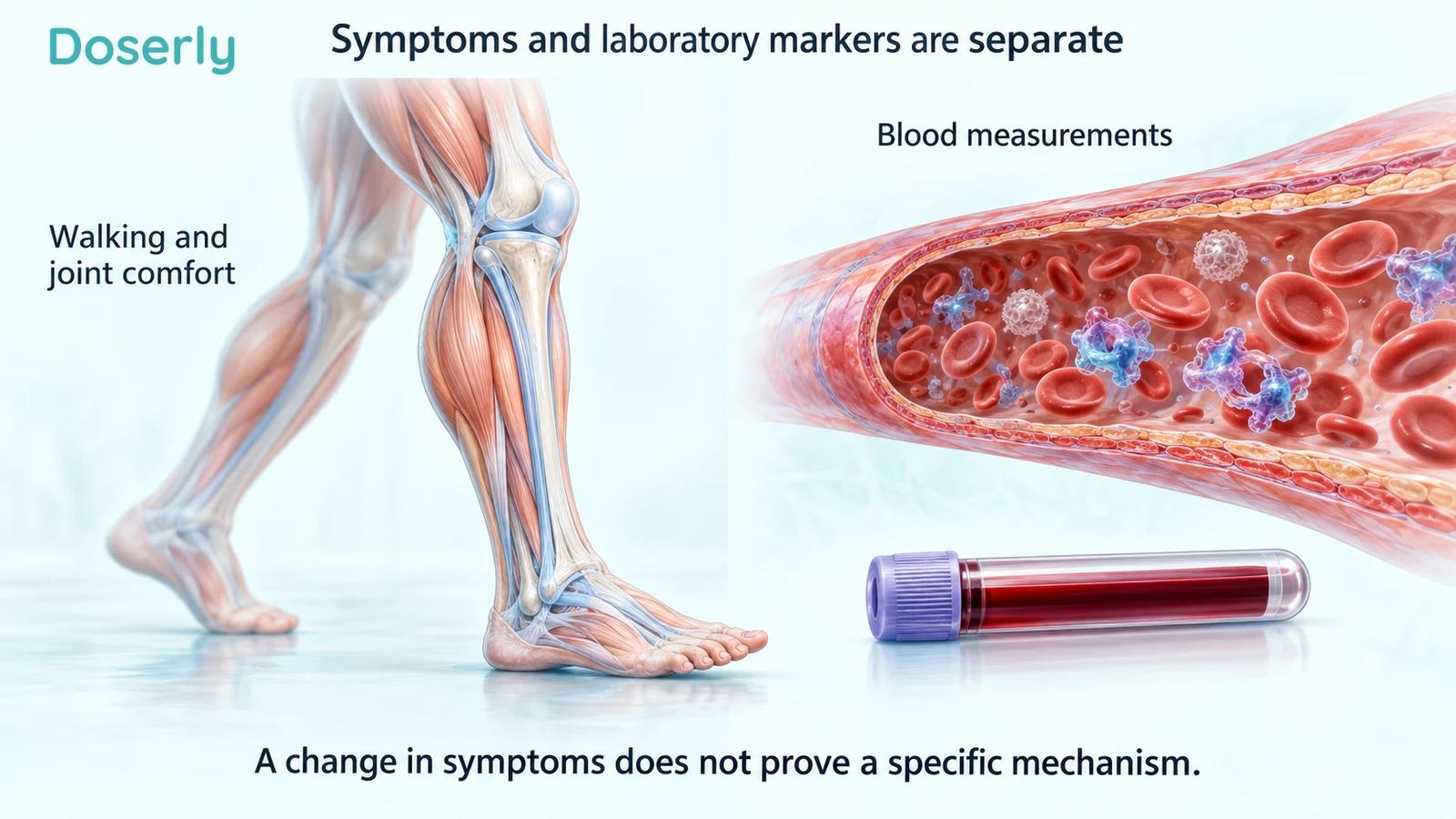
An enzyme result does not independently prove that cartilage was repaired or that the enzyme change caused the symptom change. Those are additional hypotheses. A trial can collect a clinical outcome and a biological marker without demonstrating that one mediates the other.
The studied amounts are useful for identifying the experiment. They should not be treated as a dosing menu for an unrelated product whose composition may be substantially different.
Equal extract weight can conceal different interventions
The 2010 trial compared 100 mg daily of 5-Loxin, 100 mg daily of Aflapin, and placebo in 60 people with knee osteoarthritis over 90 days. The authors reported symptom and function improvements with both preparations and more favorable results with Aflapin. Each group initially contained only 20 participants. Comparative trial
The equal total extract weight did not mean equal composition. The preparations differed in AKBA standardization and the inclusion of the non-volatile oil component. The finding is therefore a comparison of those products, not a general demonstration that a 20% AKBA label outperforms a 30% label.
This is an important distinction for anyone comparing supplements by milligrams. Milligrams tell you the mass of what was measured. They do not tell you that two mixtures contain the same constituents or behave identically after ingestion.
Even this direct comparison needs replication. Small treatment groups provide limited precision, and product-associated research should be evaluated with attention to disclosed relationships and independent confirmation. A favorable proprietary-extract result does not establish a ranking of every product on the market.
Animal absorption and cultured cells are not patient outcomes
A 2011 mechanistic paper examined Aflapin and the related enriched extract in several experimental systems. The reported increase in systemic AKBA availability was measured in experimental animals. Anti-inflammatory experiments included a rat model, while other experiments used cultured human cartilage or synovial cells. Mechanistic study
“Human cells” does not mean “a clinical trial in humans.” Cells grown under laboratory conditions can help researchers investigate a pathway, but they do not reproduce every step between swallowing an extract and obtaining a useful change in a person’s joint.
Likewise, improved availability in an animal experiment should not be advertised as a verified percentage increase in human absorption. Species, preparation and experimental conditions remain part of the result. The appropriate inference is that the formulation has a mechanistic rationale worth testing clinically.
This separation is particularly important when a mechanistic paper discusses protection from cartilage damage. Laboratory protection under a specific experimental insult is not the same as restoring cartilage in a person with established osteoarthritis.
A newer trial adds evidence—and a useful reading lesson
A 2024 study randomized 105 people with knee osteoarthritis to placebo or two regimens of Boswellin Super for 90 days; 98 completed follow-up. The intervention used tablets containing 150 mg or 300 mg of extract taken twice daily, making the daily extract amounts 300 mg and 600 mg. Primary report and methods
The study reported favorable symptom and physical-function results. Its headline emphasized improvement within five days. Early within-group changes, however, should not be mistaken for a demonstrated placebo advantage on every endpoint at that time. The detailed results describe later between-group differences for several outcomes.
The blood-marker findings also deserve care. Despite decreases from baseline in some measurements, the report states that changes in TNF-alpha, IL-6 and high-sensitivity C-reactive protein were not statistically significant compared with placebo. Several authors were employed by Sami-Sabinsa or Sabinsa.
A positive symptom result can stand on its own without overstating the marker evidence. The study’s short radiographic observations also do not establish durable cartilage regeneration. Confirmation would require rigorous structural measurement and longer follow-up.
A 2026 pain experiment asked a different question
A recent crossover pilot recruited 12 healthy volunteers and used a capsaicin model to provoke experimental pain. Participants received Boswellia extract or placebo for 28-day periods separated by washout. The primary spontaneous-pain comparison was not statistically significant. 2026 experimental-pain trial
This is not a negative knee osteoarthritis trial: the volunteers were healthy, the pain was experimentally induced, and the study was exploratory. It should not be used to erase the osteoarthritis findings.
It does, however, limit a broad claim that Boswellia has already been shown to reduce pain across settings. A preparation that may help symptoms in one clinical context need not alter an acute experimental pain response in another. The reverse is also true: success in a laboratory pain model would not by itself establish sustained benefit in osteoarthritis.
Keeping the population and model visible allows the newer study to add information without forcing it into a question it did not test.
Read the preparation and the endpoint together
A useful product-to-study comparison starts with the species, the plant material, the named extract when applicable, the standardization method, and the complete ingredient list. Then check whether the quantity describes one capsule, one serving, or a full day. The twice-daily regimens in the 2024 trial show how easily a shortened summary can halve the reported daily amount.
Next identify what improved. A pain scale, a function questionnaire, walking distance and an inflammatory marker are different outcomes. The findings should retain their measurement names instead of being collapsed into “better joint health.” A patient may care most about walking comfortably; a mechanism paper may never measure that.
Combination products create another problem. If Boswellia is combined with other active ingredients, a result for the whole product cannot be assigned to Boswellia alone. Nor does a trial of one standardized extract validate a different blend merely because both include the plant name.
The Doserly Boswellia serrata guide provides a companion overview of preparations and evidence. Use it alongside the actual product details rather than treating the ingredient name as a complete description.
Safety and a realistic place in joint care
NCCIH concludes that more high-quality research is needed before Boswellia’s usefulness for health conditions can be established confidently. Its safety discussion describes apparently acceptable use in limited-duration trials, while noting that medicinal-use information during pregnancy and breastfeeding is limited. People taking medicines should discuss herbal products with their healthcare team. NCCIH guidance
That is a more defensible position than “natural, therefore safe.” A short trial with reassuring laboratory tests cannot exclude every interaction, uncommon reaction or problem with long-term exposure. The exact product matters for safety as well as efficacy.
For osteoarthritis, a supplement decision should fit within a broader plan. NICE recommends tailored therapeutic exercise and, where appropriate, weight management. Those measures address function and overall care rather than relying on an extract to solve the whole problem. NICE osteoarthritis recommendations
If you and a clinician are evaluating a supplement, make the desired change concrete: a particular daily activity, an agreed symptom measure, and a planned reassessment. Record other treatment and activity changes so that improvement is not automatically credited to the newest bottle. Persistent or changing symptoms deserve clinical reassessment rather than repeated product substitution.
Boswellia research offers encouraging preparation-specific signals for knee symptoms. Its useful promise remains bounded by those preparations, populations, outcomes and follow-up periods. Keeping the extract details in the headline makes the evidence more relevant—and makes it much harder to mistake a small symptom trial for proof of universal pain relief or joint repair.
Explore the research
- Early Boswellia crossover trial
- 5-Loxin randomized trial
- 5-Loxin and Aflapin comparison
- Aflapin mechanistic animal and cell experiments
- Boswellin Super randomized trial
- 2026 experimental-pain pilot in healthy volunteers
- NCCIH Boswellia overview and safety
- NICE osteoarthritis care recommendations