
Supplements
October 16, 2026
Bifidobacterium and mood: promising biology, uneven clinical results
On this page
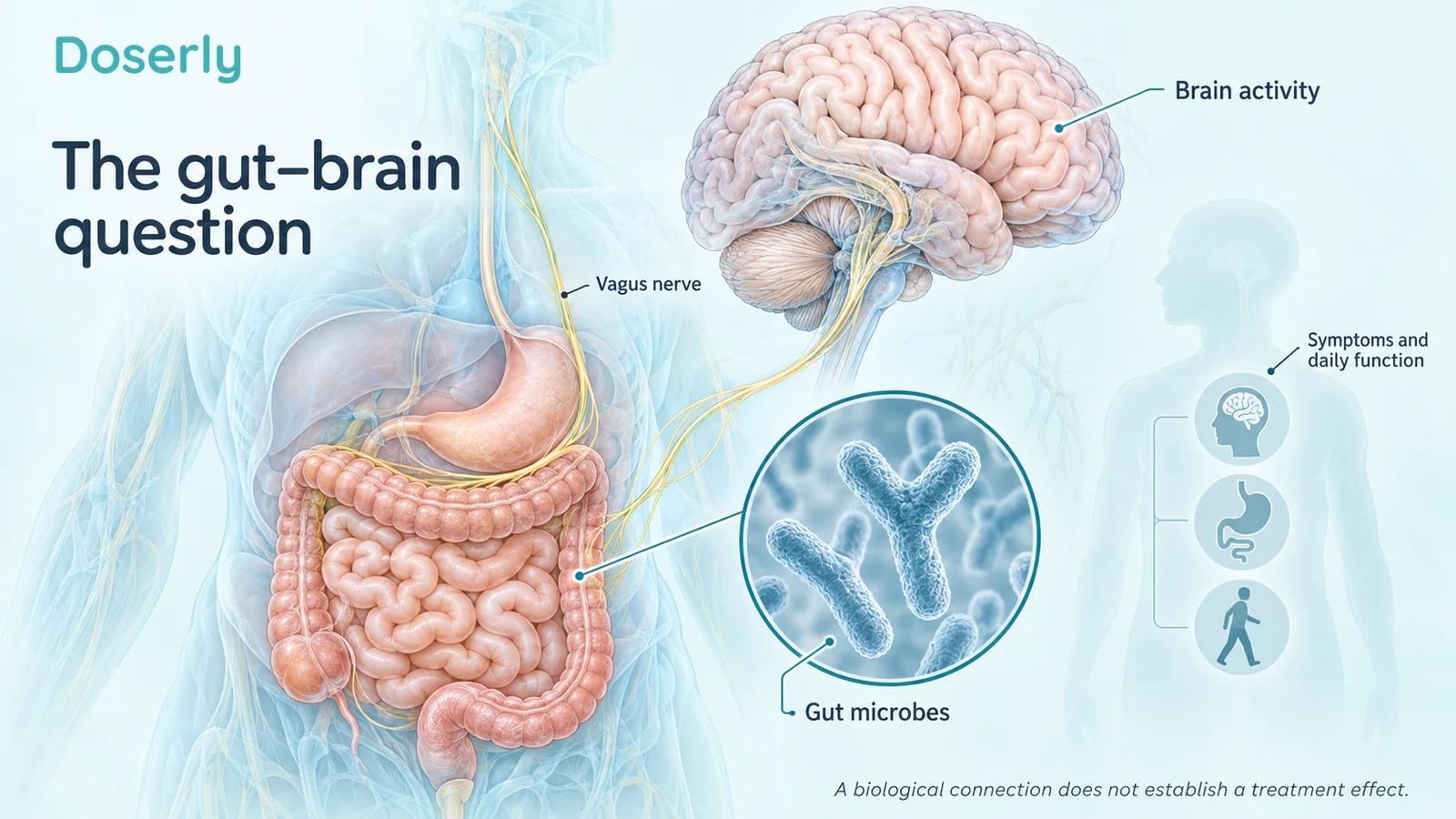
The gut–brain connection is a real area of human research. It is also an easy place for a supplement claim to outrun the evidence. A change in brain activity, a lower stress score, better sleep, and successful treatment of depression are different findings. They should not be merged into one promise that a probiotic improves mental health.
Bifidobacterium research illustrates that distinction particularly well. A small trial of B. longum NCC3001 in people with IBS found an improvement in depression scores. More recent work with a different strain, B. longum 1714, includes a 2026 trial that did not meet its primary depression endpoint. Both findings belong in an honest account of the field.
The practical question is not whether gut microbes can interact with the nervous system. It is whether a named preparation produces a meaningful benefit in a person with your clinical situation, beyond the comparison treatment. Our Bifidobacterium guide provides the broader supplement context. Here, the focus is what mood research has actually measured and what it leaves unresolved.
The IBS pilot was specific—and genuinely interesting
A 2017 randomized pilot enrolled 44 adults with IBS and diarrhea or a mixed stool pattern, along with mild to moderate anxiety and/or depression symptoms. Participants received B. longum NCC3001 or placebo for six weeks. Fourteen of 22 people in the probiotic group had at least a two-point reduction on the depression portion of the Hospital Anxiety and Depression Scale, compared with seven of 22 receiving placebo. IBS pilot
The result did not extend to every outcome. Anxiety and IBS symptoms did not improve significantly compared with placebo. Brain imaging showed differences in responses to negative emotional stimuli, but the groups had similar fecal microbiota profiles and measured serum neurotransmitter levels. The study was a small pilot in a defined IBS population, not a demonstration that any Bifidobacterium product treats major depressive disorder. IBS pilot
This is a useful example of how to preserve a positive finding without enlarging it. The measured depression-score response deserves attention. The unchanged anxiety and bowel outcomes deserve equal visibility. Calling the whole study a broad improvement in the gut–brain axis would hide information that matters to someone deciding what problem they are trying to address.
A newer, larger trial missed its primary mood endpoint
In 2026, researchers reported an eight-week randomized trial of B. longum 1714 in 168 adults with mild to moderate depression. The primary outcome was change in Beck Depression Inventory-II scores. The probiotic did not produce a statistically significant advantage over placebo at either four or eight weeks. At eight weeks, the estimated between-group difference was about 1.4 points in favor of the probiotic, with a confidence interval that included no difference. 2026 trial
Some secondary measures, including sleep quality and a different depression questionnaire, favored the probiotic at week four but not week eight. Selected well-being measures also improved. These signals may guide further research, but they do not turn the missed primary outcome into a demonstrated antidepressant effect. This trial studied strain 1714, so it is not a direct replication or refutation of the NCC3001 IBS pilot. 2026 trial
The distinction between primary and secondary outcomes is practical, not merely statistical. A trial usually identifies its main question in advance. When many other measurements are collected, some can look favorable even if the main question is not answered positively. The appropriate response is to describe those findings as secondary and consider their consistency, timing, and need for confirmation.
A reader should not have to reconstruct that hierarchy from a supplement headline. If the central depression measure was negative, it belongs near the beginning of the explanation, even when the paper's conclusion emphasizes possible benefits elsewhere.
Stress and sleep studies ask related but different questions
A six-week exploratory trial of NCC3001 in 45 healthy adults with mild to moderate stress found lower perceived stress and better subjective sleep quality compared with placebo. Physiological results were less straightforward: the cortisol awakening response was not affected, and the reduction in the cortisol response to an acute stress test was greater with placebo. The trial supports further investigation of subjective stress outcomes, not a simple claim that the strain “lowers cortisol.” Stress trial
A separate eight-week study of strain 1714 enrolled 89 adults with impaired sleep quality. Both groups improved on the global sleep-quality measure. Some subjective components favored the probiotic at selected time points, but objective actigraphy measures did not show a significant effect, and overall improvement at eight weeks was similar. Sleep trial
These findings are not irrelevant to mood. Sleep and stress can matter greatly to daily life. But the question being tested still matters. A study in otherwise healthy adults with poor sleep cannot establish treatment of a depressive disorder. A subjective improvement also should not be rewritten as an objective change in sleep architecture when the study did not show that.
For someone considering a supplement, naming the goal helps prevent that drift. Are you hoping for less perceived stress, fewer depressive symptoms, better sleep, or easier functioning during the day? A product may have research touching one of those outcomes without supporting all of them.
What brain imaging adds—and what it cannot establish
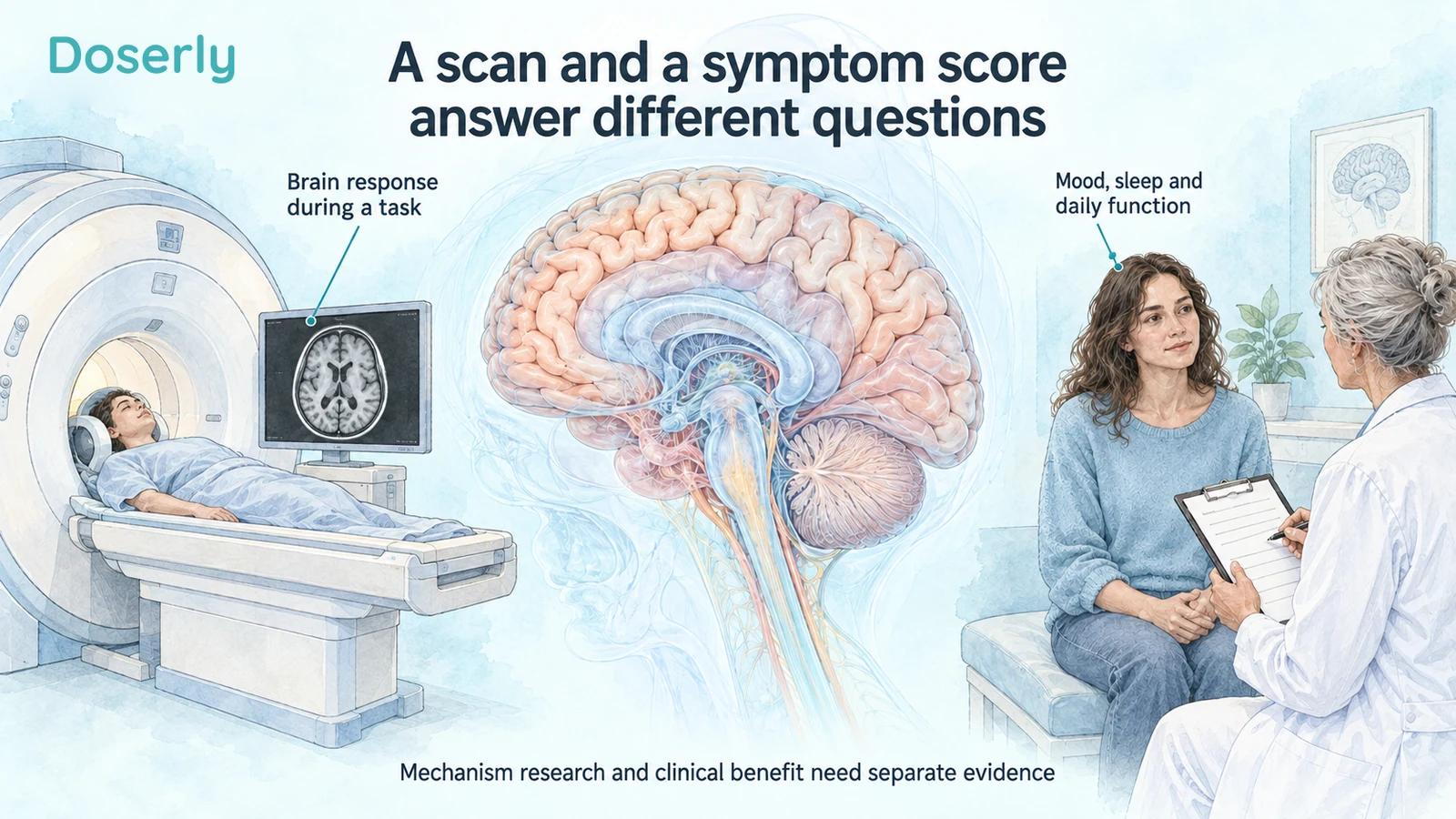
In a 2019 randomized study, 40 healthy volunteers received B. longum 1714 or placebo for four weeks. Researchers measured neural activity during rest and a social-stress task using magnetoencephalography. The study found changes in neural oscillations, but no corresponding group effect on the behavioral social-stress response. It was a mechanism-oriented experiment in healthy people, not a depression-treatment trial. Neural-response study
A scan can help researchers ask where or how an intervention might influence a response. It does not automatically indicate that the person feels better, functions better, or needs less established treatment. Those outcomes must be measured directly. A brain image is especially persuasive visually, so it deserves careful wording when used to explain supplement research.
The same caution applies to proposed chemical explanations. A gut-derived metabolite, a blood measurement, and a brain neurotransmitter are not interchangeable observations. The IBS pilot did not find a between-group difference in the measured serum neurotransmitters. It therefore cannot be cited as proof that the probiotic raises brain serotonin. IBS pilot
A mixture containing Bifidobacterium is another intervention
A 2017 randomized trial assigned 79 participants selected for low mood to a combination containing Lactobacillus helveticus and Bifidobacterium longum or placebo for eight weeks. Participants were not taking psychotropic medication. The study found no significant difference in psychological outcomes or measured blood biomarkers. This is another reason not to treat the presence of Bifidobacterium on a label as sufficient evidence of a mood benefit. Combination trial
Even when a combination trial is positive, the result belongs to that complete preparation. It does not identify which organism produced the effect, whether each component is necessary, or whether a different blend would work. A single-strain study has a different attribution question, but it still requires matching the strain and clinical setting.
The word “psychobiotic” does not solve these problems. It describes an area of interest, not a standardized product with one established clinical effect. Two products using the term may contain different organisms and cite different types of research. Reading the actual preparation and endpoint remains necessary.
Why an adjunct claim still needs evidence
“May help alongside treatment” is more restrained than “replaces treatment,” but it is still a claim. An adjunctive trial needs to examine what happens when the intervention is added to a defined background of care. A study in people who are not taking psychotropic medication cannot directly answer whether a probiotic adds benefit to an antidepressant.
Similarly, a participant's improvement during a study is not automatically an effect of the probiotic. Symptoms can change over time, and placebo groups often improve. The relevant comparison is the difference between groups, interpreted with the study's uncertainty and design. This is why a striking before-and-after story is weaker evidence than a controlled comparison.
An individual's experience can still matter for care. If someone feels better after a change, that deserves to be heard. But it should not be used to conclude that the same product will treat another person's depression, or that established treatment can safely be reduced. The personal observation and the broader causal claim are different questions.
Keep mental-health care at the center of the decision
Depression can affect sleep, appetite, concentration, work, relationships, and safety. It is not simply a deficiency of one gut bacterium. NIMH describes multiple biological, psychological, and environmental contributors and established treatment approaches including psychotherapy and medication. Persistent symptoms or difficulty functioning warrant assessment rather than a prolonged sequence of supplement experiments. NIMH depression information
If you are already receiving care, discuss a probiotic as a possible supplement to that plan rather than changing prescribed treatment on your own. Bring the exact product and the study behind the claim. It is reasonable to ask whether the research involved a similar diagnosis, whether the main outcome was positive, and whether the expected benefit is meaningful enough to justify the cost and effort.
Live microbial products also have their own safety considerations. Severe illness or impaired immune function can increase risk, and safety cannot be assumed from a healthy-volunteer study. NCCIH recommends considering the person's health situation when discussing probiotic use. NCCIH safety information
If you feel at risk of harming yourself or cannot stay safe, seek urgent help rather than waiting for a supplement effect. In the United States, call or text 988; elsewhere, use your local crisis or emergency service. NIMH support information
What is worth tracking if a clinician agrees to a trial?
Choose the intended outcome before starting. A brief record of mood, sleep, daily functioning, and unwanted effects is more useful than trying to infer success from a microbiome report. Keep the product name, strain, amount, and start date with that record so the intervention is identifiable.
Agree on a review point with the clinician. Note other meaningful changes, such as therapy, medication, sleep schedule, or a major life event. The goal is not to eliminate every influence on mood; that is impossible. It is to avoid attributing a complex change entirely to a capsule.
The evidence supports continued research into named Bifidobacterium strains and carefully defined outcomes. It currently provides a mixed clinical picture, including positive pilots and larger studies with negative primary results. Keeping those findings visible is more useful than either dismissing the gut–brain field or presenting its biological promise as an established treatment.
Sources
- Pinto-Sanchez and colleagues: NCC3001 IBS pilot, 2017
- B. longum 1714 and low mood, 2026
- NCC3001 and perceived stress in healthy adults, 2023
- B. longum 1714 and sleep quality, 2024
- B. longum 1714 and neural responses to social stress, 2019
- Romijn and colleagues: combination probiotic and low mood, 2017
- NIMH: depression
- NCCIH: probiotics usefulness and safety