
Supplements
October 16, 2026
Beetroot and endurance: why your starting fitness matters
On this page
Beetroot contains dietary nitrate, a compound the body can use in a pathway that produces nitric oxide. Nitric oxide helps regulate circulation and muscle function, and researchers have investigated whether nitrate-rich beetroot juice can reduce the oxygen needed for exercise or improve endurance performance.
Some trials have found faster cycling times. Others have found higher blood nitrite, showing that the supplement affected the intended pathway, without a faster performance. One reason for the difference may be the athlete's starting fitness. Another is that the studies do not all use the same event, preparation or supplementation period.
For someone considering beetroot before a race, the most useful answer is therefore conditional: dietary nitrate can improve some exercise outcomes, but the size and consistency of the response depend on the setting. A positive result in club cyclists is informative without being a prediction for an elite competitor or a recreational runner.
The pathway begins with bacteria in your mouth
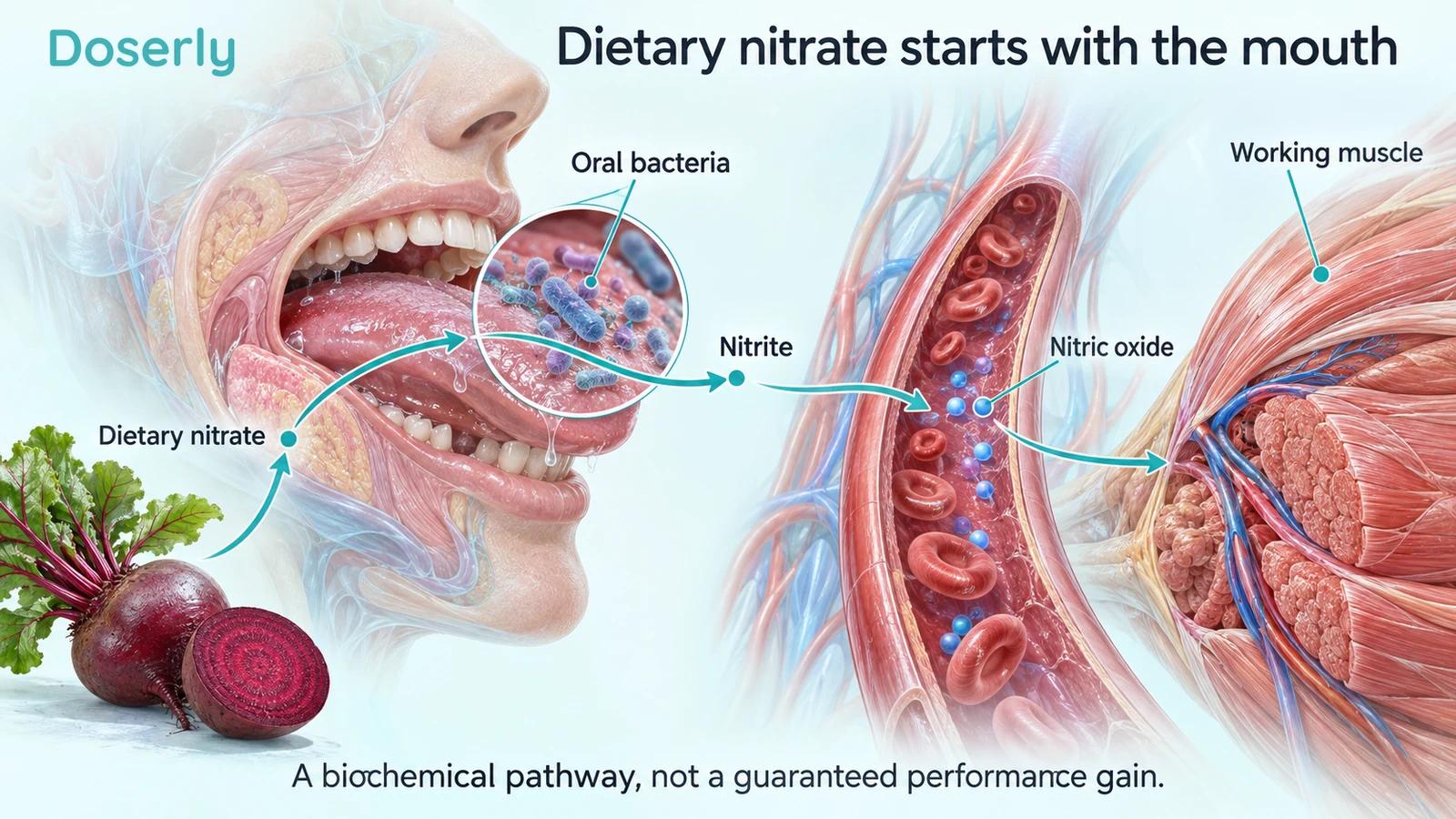
After nitrate is absorbed, some circulates back into saliva. Bacteria in the mouth help convert nitrate to nitrite. Swallowed nitrite can then contribute to nitric oxide formation through subsequent reactions. This is often called the nitrate–nitrite–nitric oxide pathway. Nitrate and nitrite are related compounds, not interchangeable names.
The oral step has been tested in humans. In a crossover experiment involving seven healthy volunteers, an antibacterial mouthwash greatly reduced the rise in blood nitrite after a nitrate load. The intervention used a chlorhexidine-containing rinse and sodium nitrate, not a beetroot race-performance protocol. Govoni and colleagues, 2008.
This helps explain why studies pay attention to oral hygiene products. It does not mean dental treatment should be stopped to improve supplement response. If a dentist has prescribed a rinse, that purpose remains important. The experiment establishes a biochemical contribution of oral bacteria; it does not establish that changing mouthwash improves a person's race result.
What a lower oxygen cost means
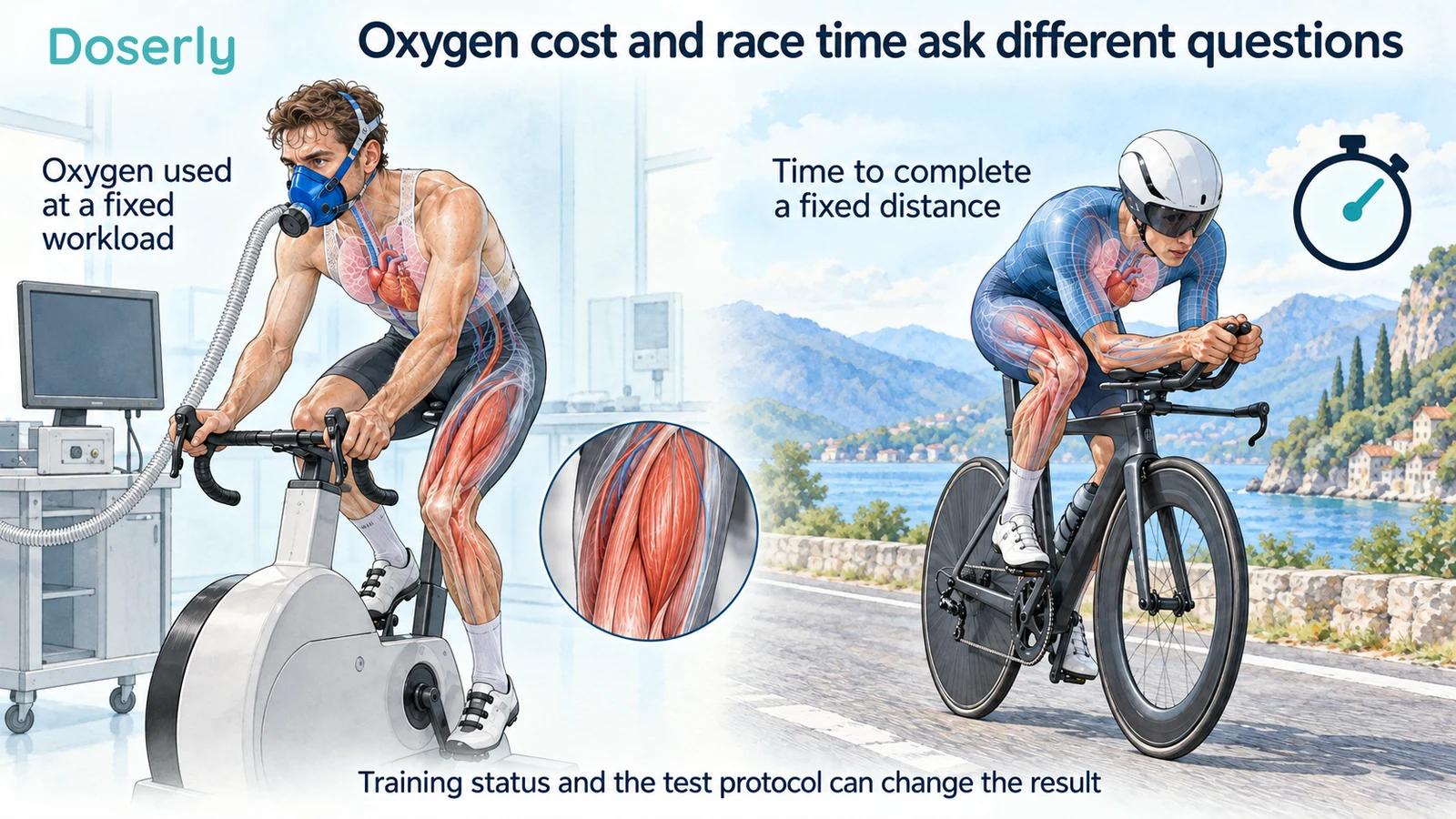
A laboratory can measure how much oxygen someone uses while cycling at a fixed power or running at a fixed speed. If oxygen use is lower at the same workload, researchers describe improved exercise economy. That is different from increasing maximal oxygen uptake, the highest rate at which the body can use oxygen during demanding exercise.
A lower oxygen cost also isn't automatically a faster race. A race involves pacing, motivation, terrain and the ability to sustain a higher workload. Researchers therefore need performance tests as well as physiological measurements. The most informative study depends on the question: a fixed-workload test helps explain efficiency, while a time trial measures completion of a specific task.
This distinction runs through the nitrate literature. It also makes seemingly conflicting statements compatible. A study can find a change in blood chemistry but no change in exercise economy, or improved economy without a clearly faster event. The pathway has several measurable stages.
The early cycling result was promising—and small
A 2011 randomized crossover trial studied nine club-level male cyclists. They consumed nitrate-rich beetroot juice or a nitrate-depleted beetroot placebo before 4-kilometre and 16.1-kilometre cycling time trials. The nitrate-depleted drink was useful because it retained the beetroot context while removing most of the proposed active nitrate exposure.
Performance improved by 2.8% over 4 kilometres and 2.7% over 16.1 kilometres. Mean times were 6.27 versus 6.45 minutes for the shorter test and 26.9 versus 27.7 minutes for the longer one. Riders produced more power without a significant difference in oxygen uptake during the trials. Lansley and colleagues.
These were real performance measurements, rather than simply a blood marker. They were also results from nine selected men in controlled tests. They don't mean every athlete should subtract roughly 3% from a personal best after drinking beetroot juice. The repeated-measures design improves efficiency by comparing each participant under both conditions, but it does not make a tiny sample representative of all endurance athletes.
Trained cyclists have shown both positive and negative results
A six-day study in twelve trained male cyclists compared concentrated beetroot juice with nitrate-depleted placebo. After an hour of submaximal cycling, riders completed a 10-kilometre time trial. Average completion time was 953 seconds with beetroot and 965 seconds with placebo, a difference of twelve seconds. Submaximal oxygen uptake was lower with beetroot. Cermak, Gibala and van Loon.
A separate trial in twenty well-trained male cyclists tested a single concentrated beetroot serving before a roughly one-hour time trial. Blood nitrite increased, but performance, power output and heart rate did not differ between conditions. Cermak and colleagues, acute trial.
The contrast is useful because both involved trained cyclists and concentrated beetroot. However, the studies also differed in exposure duration and the test itself. It would be a mistake to attribute the entire difference to fitness, or to conclude from two separate studies that six days always works while one serving never does. A direct comparison designed to isolate those factors would be needed.
Notice what the negative trial contributes. The higher blood nitrite makes it harder to explain the result simply by saying that nothing was absorbed. A measurable biochemical response can occur without improving the performance being tested.
Why might very fit athletes respond less?
A crossover study of twenty-one adults deliberately included a wide range of aerobic fitness. Participants received nitrate-containing or nitrate-free water for six days, then completed laboratory exercise and a 3-kilometre running time trial. Higher aerobic fitness was associated with smaller improvements in exercise oxygen cost and running performance, as well as smaller changes in blood nitrate and nitrite. Porcelli and colleagues, 2015.
This is unusually relevant to the starting-point question because fitness varied within one study. Still, the relationship does not define a universal fitness cutoff. It was a small experiment using nitrate in water, and an association between baseline fitness and response doesn't identify every biological cause of that response.
Highly trained athletes may have less room to improve some of the processes affected by nitrate, but that is an explanation to investigate, not a complete diagnosis of why a particular athlete didn't respond. Diet, baseline nitrate availability, oral conversion, exercise intensity and the outcome selected can also differ. “Elite” is a description of a population, not a guarantee of nonresponse.
A separate study in ten elite cyclists used six-day periods of beetroot juice or a blackcurrant-based placebo. It found no benefit for oxygen-uptake kinetics, endurance or repeated-sprint performance. The placebo was different from nitrate-depleted beetroot, which is another design detail to retain. Christensen and colleagues.
The evidence therefore supports a cautious pattern: highly trained groups have often shown less consistent benefits. It doesn't support telling every fit person that nitrate cannot help, or telling every beginner that it will.
The beetroot amount isn't the nitrate amount
A bottle may describe millilitres of juice or grams of beetroot powder without clearly stating nitrate content. Those numbers don't by themselves establish an exposure comparable to a study. Cultivation, processing and formulation can change what a serving supplies. Products also differ in sugar, fluid volume and other ingredients.
The studies above reported nitrate exposure rather than relying only on the word “beetroot.” For example, the early cycling study used approximately 6.2 millimoles of nitrate, while the six-day concentrated-juice study used approximately 8 millimoles daily. Those are research details, not a recommendation to reproduce either protocol. Lansley trial and six-day cycling trial.
A millimole is a unit describing an amount of a chemical substance. It is not the same as a milligram, and neither is interchangeable with grams of whole beetroot. A clear label and a verified preparation are more useful for interpreting a product than its color, earthy taste or marketing language.
Our beetroot guide offers broader background on preparations and nitrate biology. It can help you read the intervention details before comparing a supplement with one of these trials.
What a race-relevant evaluation would look like
If an athlete and sports dietitian decide to evaluate a product, the test should resemble the event that matters. A short fixed-distance trial may be more informative for that race than a laboratory time-to-exhaustion test at a completely different intensity. Repeated familiarization also helps reduce the chance that simply learning the test looks like a supplement effect.
Keep the practical conditions comparable: equipment, course, weather where possible, warm-up, food, caffeine and fatigue from previous training. Record gastrointestinal symptoms as well as performance. A small time improvement that comes with discomfort may have a different value on race day than it does in a short laboratory session.
One successful workout doesn't establish a reproducible response. Conversely, one disappointing attempt doesn't show that the whole nitrate literature is wrong. Personal testing is most useful when it describes repeatable outcomes under recognizable conditions, with uncertainty kept visible.
This is particularly important for elite athletes, where a small meaningful change may be difficult to separate from day-to-day variation. The evidence doesn't justify promising a large effect simply because the stakes of competition are high.
Safety belongs to the whole preparation and the person
Beetroot is a food, but a concentrated supplement is still an exposure worth considering in context. The NIH Office of Dietary Supplements describes the exercise evidence and notes that research on long-term use is more limited than short-term studies. Gastrointestinal tolerance and changes in urine or stool color can affect the experience of use. NIH exercise-supplement fact sheet.
Nitrate biology also relates to blood pressure. Someone taking medicines for circulation or experiencing dizziness should discuss the preparation with a clinician rather than assume a sport-oriented product has no relevance to medical care. These small exercise trials weren't designed to settle medication interactions or safety in every chronic illness.
A familiar beetroot-related color change should not be used to dismiss unexplained bleeding or persistent symptoms. Similarly, don't change prescribed oral care to imitate a research protocol. The performance question fits within nutrition, medical care and dental health rather than replacing them.
For endurance, the strongest practical message is to match the evidence to the athlete and event. Beetroot can alter nitrate-related biology, and some controlled trials have found faster performance. Starting fitness helps explain why results may differ, but formulation, timing and the actual test remain part of the answer.
Explore the research
- Oral bacteria and nitrate conversion, 2008: seven-volunteer mouthwash experiment.
- Club-cyclist time trials, 2011: nine men, two cycling distances.
- Six-day nitrate study, 2012: twelve cyclists, oxygen cost and 10-kilometre performance.
- Single-serving study, 2012: twenty well-trained cyclists, no time-trial benefit.
- Fitness and response, 2015: twenty-one adults across fitness levels.
- Elite-cyclist trial, 2013: ten cyclists, no benefit in tested outcomes.
- NIH exercise-supplement assessment: preparation and safety context.