
Supplements
October 16, 2026
Beef-liver capsules: what the nutrient story leaves off the label
On this page
Beef liver contains vitamin A, vitamin B12, iron and copper. That makes it a nutrient-rich food, and it explains the appeal of capsules for people who dislike eating liver. The practical question, though, is not simply whether liver contains nutrients. It's how much of each nutrient a particular serving provides, whether you need it, and what else you're already taking.
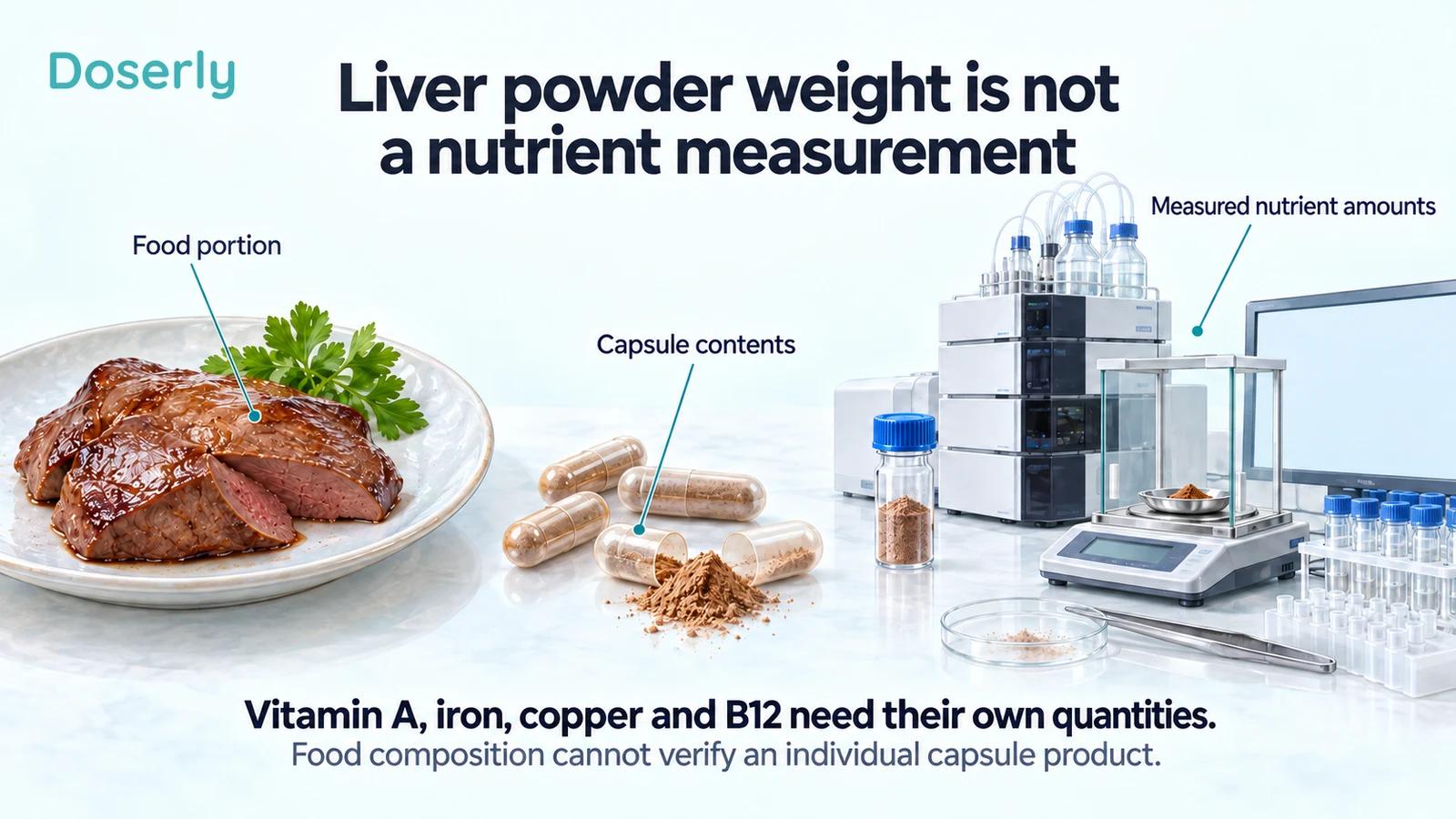
A label that lists grams of desiccated liver answers only part of that question. Desiccated means dried. The weight of dried tissue does not, by itself, tell you the vitamin A or iron amount, and a food-composition table cannot verify a particular bottle.
This article separates the nutritional facts from the product and health claims. Our beef-liver guide covers the wider category; here we'll focus on the information needed to evaluate a capsule as part of an actual routine.
Why liver's nutrient content is both the attraction and the concern
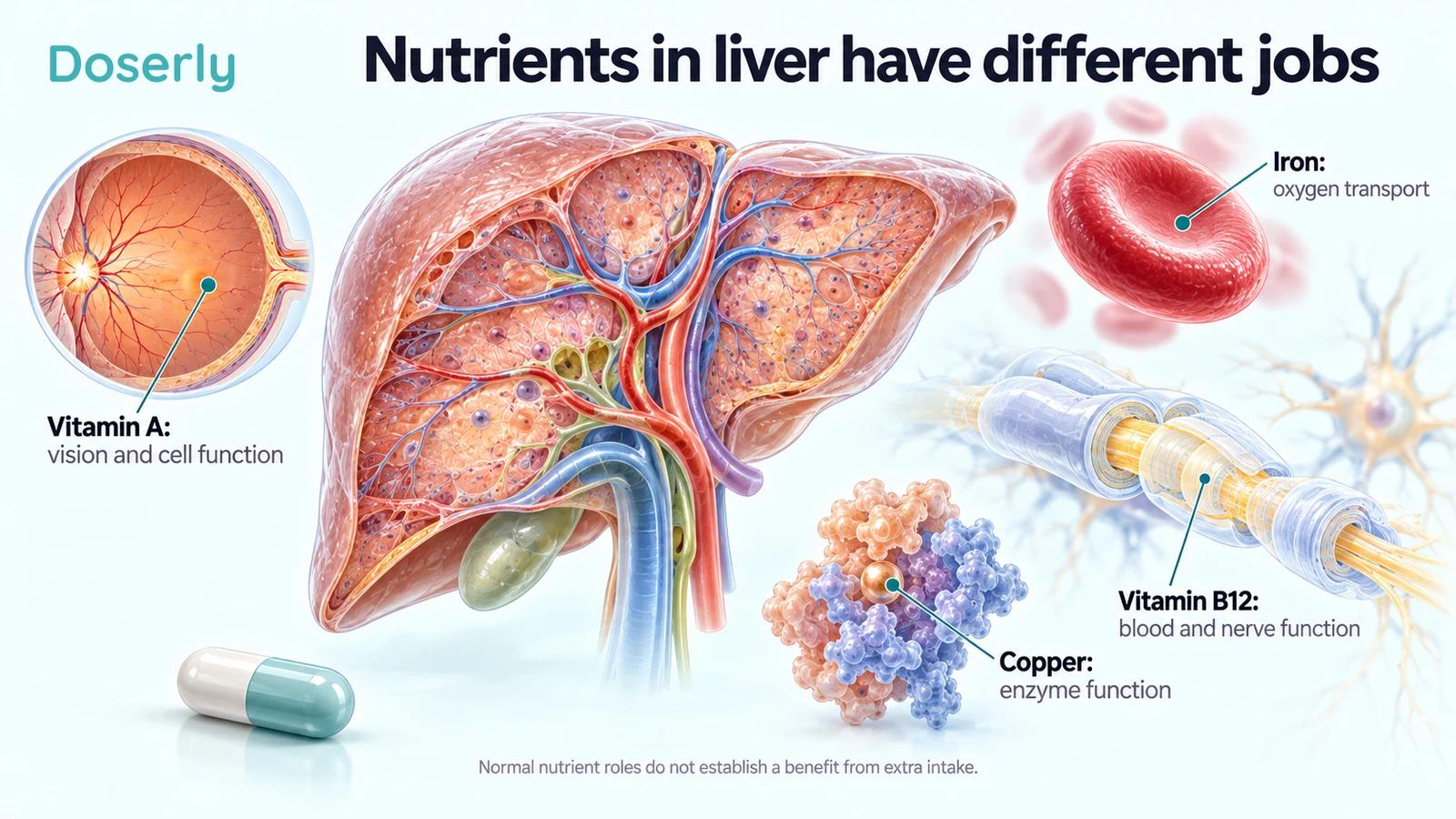
Several nutrients in liver have important jobs. Vitamin A supports vision and normal cell function. Iron is part of hemoglobin, the protein red blood cells use to transport oxygen. Vitamin B12 is involved in blood formation and nerve function, while copper supports a range of enzymes. NIH vitamin A, iron, vitamin B12 and copper
Those are established nutrient functions. They do not establish that extra intake will improve those functions in someone who already has enough. Nor do they show that an unspecified liver capsule treats fatigue, anemia, infertility or a skin condition.
Think of the difference between a food's composition and a treatment claim. The first asks what is present. The second asks whether a defined amount changes a particular outcome in people. Both are worth understanding, but one cannot stand in for the other.
A gram of powder is not a gram of iron
Consider a hypothetical label stating that a serving contains 3,000 mg of beef-liver powder. That means three grams of the ingredient. It does not mean three grams of vitamins, minerals or protein, and it does not establish the iron content.
For comparison, a nutrient line might list iron in milligrams, vitamin B12 in micrograms, or vitamin A in micrograms of retinol activity equivalents. Each amount describes a different substance. Mixing these categories makes a product appear more informative than it is.
A fresh-food-equivalent claim adds another layer. It may describe how much fresh tissue was used before drying, but it still isn't a measurement of every nutrient in the final serving. The relevant question is whether the manufacturer has a defensible nutrient specification for the finished product and serving you would actually use.
This is not a claim that every liver supplement contains too little or too much. It's a limit on what can be concluded from ingredient mass alone. Without the nutrient amounts, neither a benefit calculation nor a combined-intake check can be completed confidently.
What food data can—and cannot—tell us
NIH lists 6,582 micrograms RAE of vitamin A in a three-ounce serving of pan-fried beef liver. This illustrates why liver is regarded as a concentrated source. It is a food-table value for that food and portion, not a certificate for freeze-dried capsules. NIH vitamin A food table
Applying that number to a supplement would require assumptions about the starting material, water removal, processing, serving size and the manufacturer's definition of equivalence. A mathematically neat conversion can still be based on unverified inputs.
Food data are useful for understanding the category and planning meals. Product-specific information is needed to assess the bottle. A manufacturer may provide measured amounts or a justified specification, but the consumer should be able to tell which kind of information is being offered.
The same distinction applies to the word “natural.” It describes a source or marketing position; it doesn't supply the missing quantities. The nutrients remain biologically active regardless of whether the packaging emphasizes traditional eating or modern supplementation.
Vitamin A needs a whole-routine check
Liver supplies preformed vitamin A, including retinol and retinyl esters. This differs from the provitamin A carotenoids found in many plant foods. The adult upper intake level for preformed vitamin A is 3,000 micrograms RAE daily, applying to the combined amount from food and supplements. It is a safety boundary, not a target. NIH vitamin A safety assessment
If a liver supplement is added to a multivitamin, a separate vitamin A product or frequent liver meals, the amounts need to be considered together. An unknown amount in one product makes that accounting uncertain.
Keep the unit and form visible. “Vitamin A” can include different sources, and an old label using international units should not be compared casually with a newer one using RAE. Ask a pharmacist to reconcile labels when the forms or units are unclear.
The important practical question is not whether one capsule sounds small. It's how much preformed vitamin A the complete routine provides over time. More capsule volume is not automatically more useful nutrition.
Pregnancy changes the decision
NHS pregnancy guidance advises avoiding liver and liver products and supplements containing vitamin A as retinol because too much can harm fetal development. It also recommends specific pregnancy supplements, including folic acid, rather than treating nutrient-dense foods as substitutes for an established plan. NHS pregnancy vitamins and supplements
That makes liver capsules a poor product to add casually during pregnancy or pregnancy planning. “Food-based” is not an exemption from the concern. Bring the exact label to the maternity clinician before using it, particularly if you already take a prenatal product.
If you have already taken a product, avoid guessing at harm from the ingredient name alone. Tell the clinician the brand, amount, frequency and dates so the actual exposure can be assessed. A general internet discussion cannot determine the risk from an unidentified bottle or a single dose.
A liver capsule also should not displace prescribed deficiency treatment or the recommended prenatal routine simply because it contains several naturally occurring nutrients. Those are different decisions with different evidence.
Iron: fatigue is a reason to assess, not a diagnosis
Iron deficiency can contribute to anemia and impaired function, but fatigue alone does not identify it. Clinical assessment may include blood counts, ferritin and other measurements. Ferritin reflects iron stores but can rise with inflammation, so interpreting it may require more than one result. NIH iron assessment
If deficiency is confirmed, treatment needs an appropriate iron amount and follow-up. An unspecified quantity of liver powder cannot be assumed to deliver the same treatment as a product with a known elemental iron dose.
The reason for deficiency also matters. A person may need investigation of blood loss, intake or absorption, rather than simply a new supplement. Raising intake without understanding the clinical picture can leave the original problem unresolved.
The opposite problem is important too. Hemochromatosis involves excess iron accumulation. NIDDK advises people with this condition to avoid iron supplements and supplements containing iron unless their clinician directs otherwise. NIDDK: nutrition and hemochromatosis
A product promoted for “healthy blood” therefore does not have the same relevance for everyone. Someone with depleted iron stores and someone with iron overload need very different advice, even if both report tiredness.
B12 content doesn't settle a B12-treatment question
Vitamin B12 is necessary, but extra B12 does not appear to improve athletic performance or endurance in people whose status is sufficient. This is a useful example of why a nutrient's role in metabolism is not a universal energy claim. NIH vitamin B12
When B12 deficiency is present, its cause affects treatment. NICE guidance distinguishes dietary deficiency from malabsorption, including problems related to autoimmune gastritis or certain gastrointestinal surgeries. Some situations call for long-term injected replacement; others may be managed with an appropriate oral preparation and follow-up. NICE B12 guidance
A capsule containing an uncertain amount of food-bound B12 should not be substituted for that plan. The issue isn't whether liver contains B12—it does—but whether the product and route adequately address the person's condition.
This distinction becomes especially important if neurological symptoms are part of the concern. A product's reassuring food story is not evidence that it will correct an absorption problem or provide adequate replacement.
Copper is another amount worth knowing
Copper supports enzyme activity, and liver is a rich dietary source. It is also possible to get too much. NIH describes gastrointestinal effects and liver damage with excessive exposure, and identifies Wilson disease as a condition that makes copper accumulation particularly important. NIH copper fact sheet
A product that combines liver with other organs or added minerals deserves the same serving-level assessment. You cannot infer the copper amount from the total capsule count, and a high percentage of a daily reference value is not inherently a benefit.
If a clinician is investigating abnormal liver tests or a disorder of copper handling, include organ supplements in the medication history. They may not look like conventional mineral tablets, but their contents still belong in the assessment.
What human research has actually tested
A 2017 study explored whether desiccated beef-liver and meat powders could be used in complementary foods for 96 Indonesian children aged 12–23 months. It included a test-food assessment and a two-week home trial, examining acceptance of liver, meat, combined powders and placebo.
Mothers generally reported acceptable liking scores, but powder use during the home phase was low, with odor cited as a concern. The study asked whether families would use fortified meals; it did not establish that adult liver capsules improve hormones, fatigue or athletic performance. Acceptability trial
This is real human research, but it answers a narrower question than many capsule advertisements imply. It also shows why delivery matters: a nutritious ingredient can be difficult to incorporate consistently.
The targeted search for this article did not identify a convincing randomized adult capsule trial establishing broad vitality benefits. That is a description of the evidence located, not a claim that no relevant research could exist anywhere. The strong evidence for treating a diagnosed nutrient deficiency should not be repackaged as proof for an unmeasured multi-nutrient product.
What would make a product easier to evaluate?
Look for clear serving quantities, identified ingredients and nutrient information sufficient to address the reason you are considering it. If the goal is iron replacement, the iron amount matters. If the concern is vitamin A exposure, that amount and form matter.
Ask whether testing applies to the finished product and the batch being sold. A certificate describing contaminant testing alone does not establish the amounts of every nutrient. Likewise, a nutrient assay is not a clinical trial. Each answers a useful but different question.
In the United States, FDA does not approve dietary supplements before marketing in the way it approves medicines. Manufacturers have responsibilities for safety, labeling and manufacturing, but availability is not proof of clinical effectiveness. FDA supplement questions and answers
For a useful discussion, bring the label alongside the rest of your supplements and any relevant test results. Ask what nutritional gap is being addressed, how it will be assessed and whether a more precisely characterized option would meet that purpose.
Beef liver can be nutritious. A capsule still needs to earn its place through identifiable contents and a clear reason for use. Knowing what is in the serving is the first step toward deciding whether it adds something useful—or simply adds uncertainty to an already complicated routine.
Sources
- NIH: Vitamin A and carotenoids.
- NIH: Iron.
- NIH: Vitamin B12.
- NIH: Copper.
- NHS: Pregnancy vitamins and supplements.
- NIDDK: Eating, diet and nutrition for hemochromatosis.
- NICE: Vitamin B12 deficiency in over 16s, 2024.
- Desiccated liver and meat-powder acceptability trial, 2017.
- FDA: Questions and answers on dietary supplements.