
Supplements
October 16, 2026
B12 and fatigue: when testing matters more than an energy claim
On this page
Vitamin B12 is essential for healthy blood-cell formation and nervous-system function. A deficiency can cause serious problems, and fatigue can be one of the clues. That makes B12 a reasonable consideration when unexplained tiredness persists. It does not make fatigue a diagnosis of B12 deficiency.
The same distinction applies to treatment. Replacing a vitamin that someone lacks is different from giving extra vitamin to someone whose supply is adequate. A supplement can be necessary in the first situation without providing an energy boost in the second. The practical task is to understand the person's symptoms, risk factors and test results, then choose a plan that addresses the cause. NIH vitamin B12 overview
This is especially important when fatigue arrives with numbness, tingling, balance problems or changes in walking. Those symptoms deserve clinical assessment rather than a prolonged trial of an “energy” product. A normal-looking blood count does not, by itself, exclude B12 deficiency. NICE diagnostic guidance
Why eating B12 and absorbing it are different questions
B12 reaches the diet through animal-source foods and fortified foods, with supplements providing another source. Someone eating little or no animal-source food needs a reliable alternative source; the presence of a varied plant-based diet alone does not establish adequate B12 intake.
Food-bound B12 must be released during digestion. It eventually binds to intrinsic factor, a protein made in the stomach, and the complex is absorbed in the terminal ileum, the final part of the small intestine. Supplemental B12 is already in a free form, so it does not require the initial release from food protein. These steps explain why a person's intake can look reasonable while absorption remains a problem. NIH absorption and dietary sources
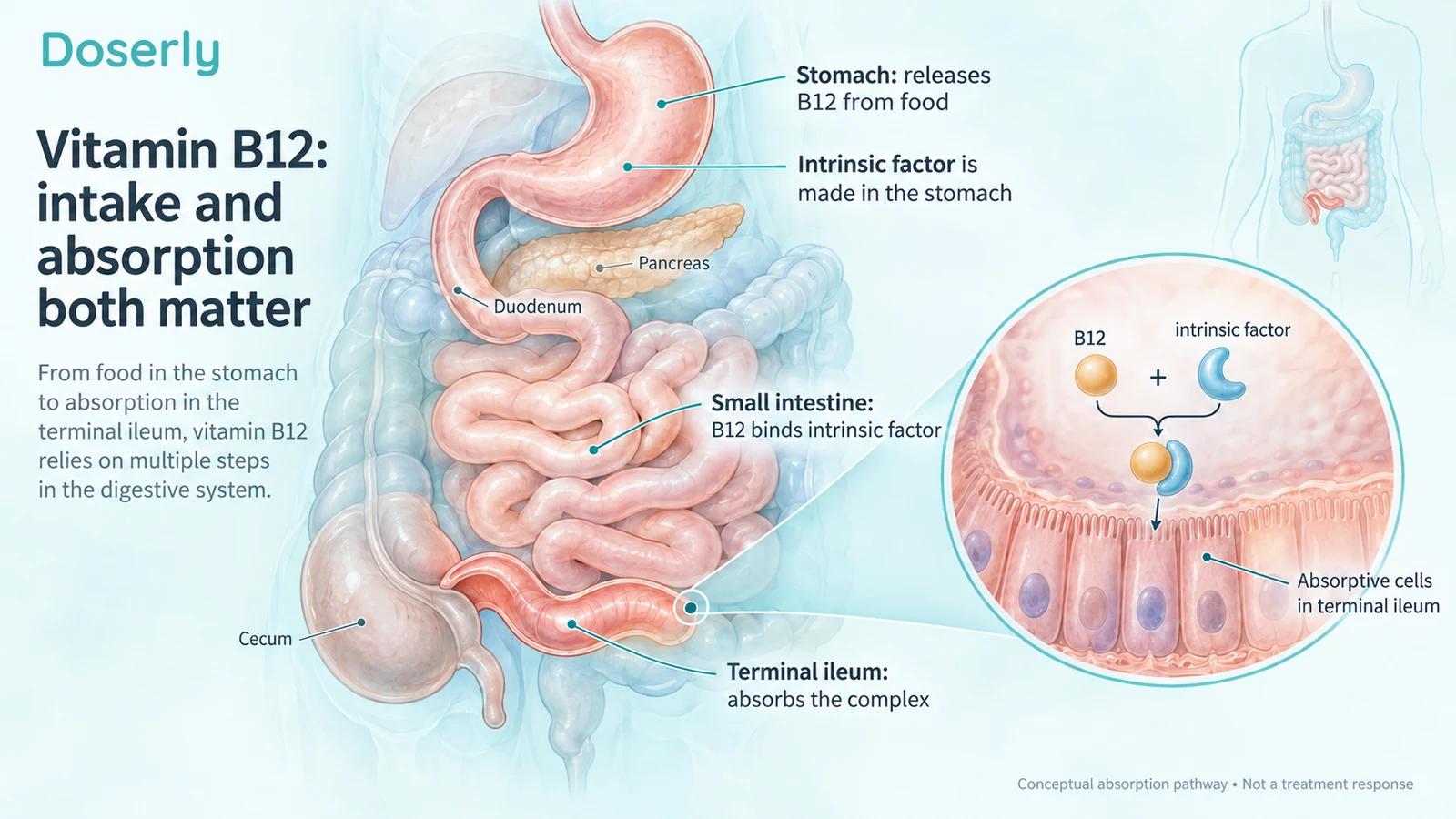
A history of autoimmune gastritis, relevant gastrointestinal surgery or another condition affecting absorption changes the evaluation. So can some medicines. This is why a clinician asks about more than the last few days of food: a dietary explanation, a medication effect and an irreversible absorption problem may require different long-term plans. NICE risk factors and management
Fatigue is useful information, but it is not specific
Tiredness becomes more useful clinically when it is described precisely. Does it mean sleepiness, reduced exercise tolerance, weakness, difficulty concentrating or a feeling of exhaustion despite rest? When did it begin, what changed around that time, and how does it affect ordinary activities?
Those details cannot diagnose B12 deficiency, but they help keep the assessment connected to the problem the person wants solved. A blood result and a symptom may coexist without one fully explaining the other. Even when deficiency is confirmed, there may be additional contributors to fatigue that need attention.
NICE includes unexplained fatigue among the possible symptoms of B12 deficiency. It recommends testing when a relevant symptom or sign occurs alongside a risk factor, while allowing clinical judgment when symptoms occur without a recognized risk factor. The guidance also warns against ruling out deficiency solely because anemia or enlarged red blood cells are absent. NICE recognition and testing recommendations
That last point prevents a common misunderstanding. B12 is involved in both blood-cell production and neurologic function. The clinical picture does not have to follow a neat sequence in which anemia appears first and nerve symptoms only later. New neurologic symptoms should be described clearly at the appointment, not reduced to a general fatigue score.
What the supplementation review did—and did not—find
A 2021 systematic review examined B12 supplementation for cognitive function, depressive symptoms and unexplained fatigue in people without overt B12 deficiency or advanced neurologic disease. It included 16 randomized trials with 6,276 participants. Those totals can sound like a large direct test of B12 for fatigue, but most of the evidence concerned other outcomes.
Only one included study reported unexplained-fatigue outcomes. It tested a B-vitamin combination and reported a vitality result at eight weeks; the groups also differed at baseline. The reviewers therefore could not produce a pooled fatigue estimate. Their conclusions about cognitive and depressive outcomes should not be repackaged as if 16 independent fatigue trials all gave the same answer.
The appropriate fatigue conclusion is that convincing evidence for routine supplementation in people without an established deficiency is lacking. It is not that the review proved B12 cannot help fatigue caused by deficiency—the review was not designed to test treatment of overt deficiency. Markun and colleagues, 2021
This difference is useful when comparing an advertisement with a study. “Supports normal energy metabolism” describes a nutrient's biological role. “Improves your persistent fatigue” is a clinical claim about a particular person or population. The first does not automatically establish the second, and a large dose does not bridge the gap.
Blood tests need context, especially after supplements
The initial assessment commonly includes a total or active B12 measurement, depending on the clinical situation and local practice. A borderline result may require additional investigation. Methylmalonic acid, or MMA, is one useful marker because it can rise when B12-dependent metabolism is impaired. But MMA can also rise with reduced kidney function, so it is not a stand-alone diagnosis. Homocysteine is even less specific because other factors, including folate status, affect it. NIH assessment of B12 status
Laboratory methods and reference ranges differ. Copying a threshold from a social-media post into a report with different units or a different assay can create unnecessary confusion. Bring the actual report, including units and the laboratory range, rather than only a number remembered from a phone call.
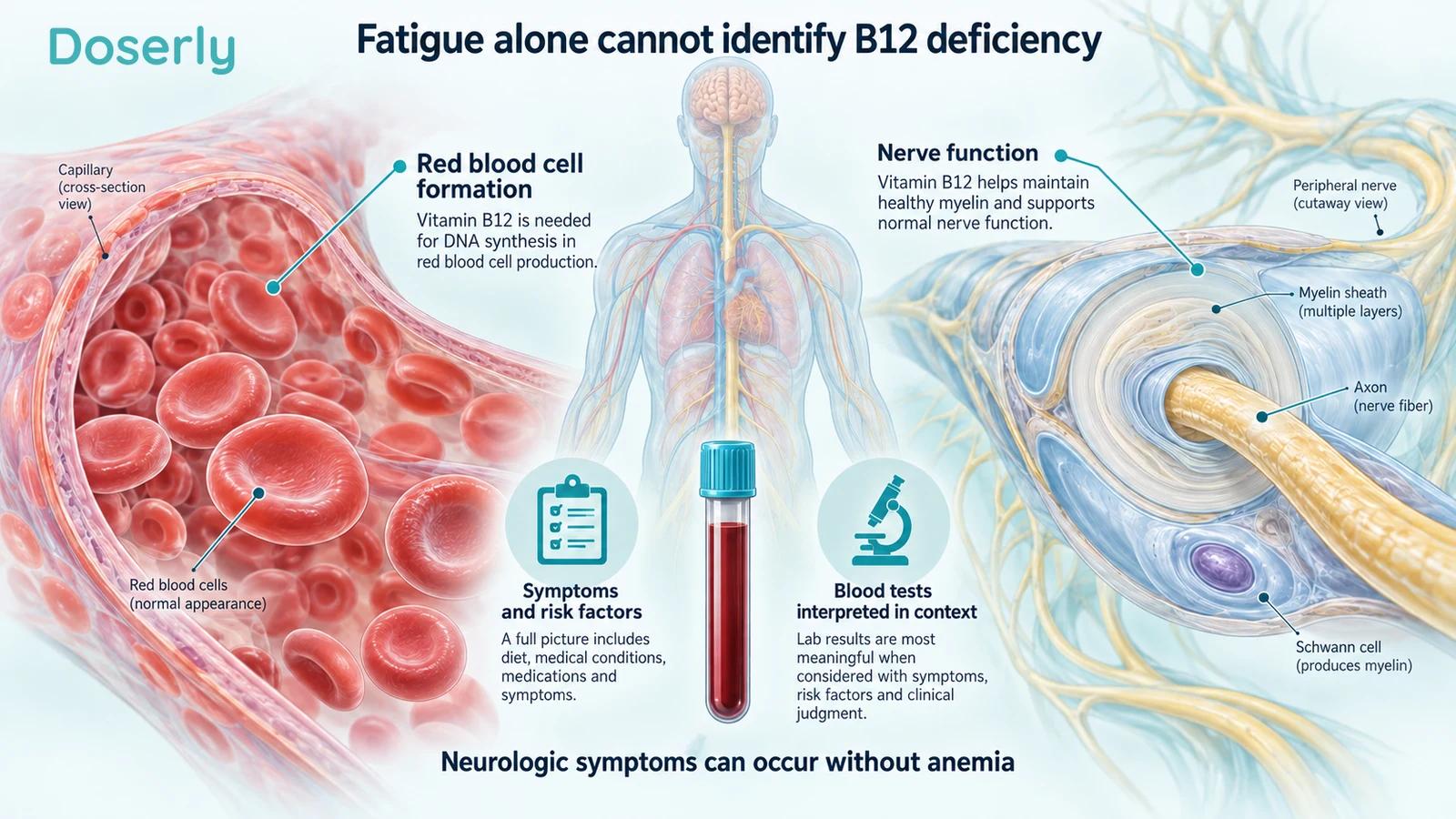
NICE recommends obtaining diagnostic blood samples before starting replacement where possible and asking about existing over-the-counter B12 use. Supplements can raise total or active B12 measurements without necessarily fully treating an underlying deficiency. The product, amount, route and timing therefore belong in the history. NICE test interpretation
This is not advice to stop prescribed treatment or delay urgent care to obtain a “clean” result. NICE specifically advises against waiting for results before replacement in people with suspected megaloblastic anemia and neurologic symptoms, especially signs concerning for spinal-cord involvement. The clinician has to balance diagnostic information with the consequences of delay. If you already started B12, say so; do not invent a washout period yourself.
Medication history can provide a useful clue
Metformin is a well-studied example. A randomized placebo-controlled trial followed 390 insulin-treated people with type 2 diabetes for 4.3 years. Adding metformin increased the absolute risk of biochemical B12 deficiency by 7.2 percentage points compared with placebo, with a confidence interval of 2.3 to 12.1 percentage points.
That finding supports attention to B12 status during long-term metformin treatment. It does not mean that every metformin user with fatigue has B12 deficiency, or that the medicine should be stopped without discussing its benefits and risks. The trial measured a defined biochemical outcome in a particular diabetes population; it was not a demonstration that B12 supplementation cures all fatigue associated with diabetes. De Jager and colleagues, 2010
Acid-suppressing medicines can also affect the release of B12 from food. A medication review can therefore be more informative than choosing between two supplement brands. Include prescription medicines, over-the-counter acid reducers and previous gastrointestinal procedures when discussing risk. NIH medication interactions
Injections versus tablets is a treatment question, not an energy ranking
People sometimes interpret an injection as inherently stronger or more effective for fatigue. The relevant question is whether the route and schedule reliably treat the diagnosed deficiency in that person's circumstances. Cause, symptom severity, absorption, adherence and follow-up all matter.
A 2018 Cochrane review included three randomized trials totaling 153 participants with B12 deficiency. It found low-quality evidence concerning correction of blood B12 levels with oral versus intramuscular treatment. The trials did not report the clinical symptom outcomes needed to decide which route best relieved fatigue or neurologic symptoms. A biochemical comparison is useful, but it does not establish an injection's superiority as an energy treatment. Cochrane route comparison
The later OB12 trial enrolled 283 adults aged 65 or older with deficiency. Oral treatment was not inferior to intramuscular treatment for normalization of B12 at eight weeks, but the study did not establish the same noninferiority conclusion at 52 weeks under its tested maintenance schedules. The oral schedule changed from daily treatment during the first eight weeks to weekly maintenance afterward, so the long-term result should not be generalized to every possible oral regimen. OB12 trial
These studies support an individualized replacement plan with follow-up, not self-selection of a route based on a wellness advertisement. Some causes require ongoing replacement; others may be addressed through diet or a reversible contributing factor. If injections have been prescribed for an established reason, a favorable oral-treatment headline is not a reason to change the plan independently.
What meaningful follow-up looks like
The follow-up question is more than whether the B12 number went up. It includes whether the original symptoms are improving, whether new symptoms have appeared, whether treatment is being taken as intended and whether the underlying cause has been addressed. Persistent fatigue deserves reassessment rather than automatic dose escalation.
A brief symptom record can help. Describe one or two concrete limitations, such as needing to stop during a usual walk or struggling to complete a normal workday. Record neurologic changes separately. Note the date treatment began and any other major changes in sleep, illness, medicines or routine that could affect how you feel. This creates a more interpretable account than a single daily “energy” score.
It also helps to keep the reason for supplementation visible. Preventing inadequate intake on a diet with few reliable B12 sources is a different purpose from treating a diagnosed absorption problem, and both differ from an unconfirmed attempt to improve fatigue. The same bottle can be used for different reasons; the follow-up plan should reflect the reason that actually applies.
A useful appointment starts with the question you need answered
Bring your supplement labels, medication list, relevant surgery or digestive history, and any previous B12 and blood-count results. Explain whether fatigue is the only symptom or whether there are sensory, balance, walking or cognitive changes. If a supplement was started before testing, record when and how much rather than leaving it out because it seems unrelated.
Ask what would confirm or weaken the suspected explanation, what cause is being considered if deficiency is found, and how response will be assessed. If the evidence does not point to B12 deficiency, that does not make the fatigue unimportant. It means the evaluation should keep looking rather than treating a normal nutrient level as the end of the conversation.
The Doserly vitamin B12 guide provides ingredient and formulation background. For persistent fatigue, the more useful aim is a clear diagnosis and a treatment plan matched to it. B12 replacement can be essential when needed; its importance is not a reason to assume that extra B12 is the missing answer for everyone who feels tired.
Sources
- NIH Office of Dietary Supplements: physiology, intake, biomarkers and medication considerations.
- NICE NG239: recognition, diagnosis and management of B12 deficiency.
- Markun and colleagues, 2021: supplementation review and limited fatigue evidence.
- De Jager and colleagues, 2010: metformin and B12 deficiency randomized trial.
- Wang and colleagues, 2018: oral versus intramuscular replacement review.
- Sanz-Cuesta and colleagues, 2020: OB12 route-comparison trial.