
Supplements
October 16, 2026
Alpha-lipoic acid for nerve symptoms: route and diagnosis matter
On this page
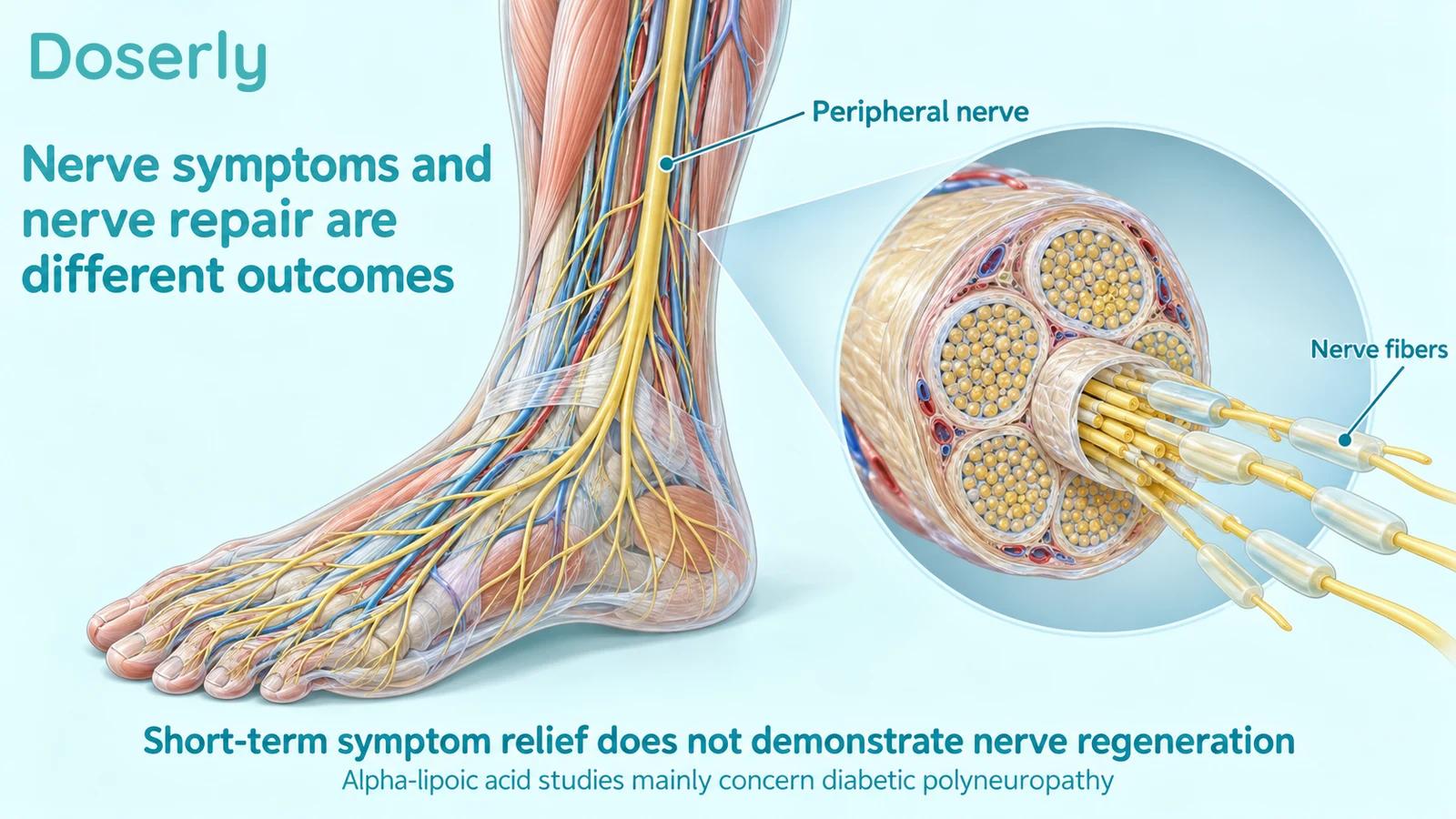
Alpha-lipoic acid, often abbreviated ALA, has been studied for nerve symptoms in people with diabetes. Some short trials found improvements in burning, stabbing pain, tingling or numbness. That evidence is worth understanding, but it does not establish that ALA repairs nerves, treats every cause of neuropathy or provides sustained benefit over years.
Three distinctions shape the evidence: oral versus intravenous treatment, symptom relief versus nerve-function outcomes, and diabetic neuropathy versus other diagnoses. A study can be positive for one question while leaving the others unresolved.
Our alpha-lipoic acid guide provides broader context. Here, the focus is what the clinical trials measured and how to interpret their results when nerve symptoms are the reason for considering a supplement.
Start with the diagnosis, not the supplement
Peripheral neuropathy describes damage or dysfunction involving nerves outside the brain and spinal cord. Diabetes is one cause, but similar symptoms can occur with other conditions. The National Institute of Diabetes and Digestive and Kidney Diseases describes evaluation based on symptoms, medical history, examination and, when appropriate, tests for other causes such as low vitamin B12, thyroid problems or kidney disease. NIDDK overview
This matters because the main ALA trials studied diabetic distal symmetric polyneuropathy. A result in that diagnosis cannot automatically be applied to a compressed nerve, an unexplained burning sensation or treatment-related nerve injury.
A supplement response also cannot establish the diagnosis. Symptoms can fluctuate for many reasons, and improvement does not prove which process caused them. Persistent, progressive or function-limiting symptoms deserve assessment rather than repeated changes of supplements.
Why symptom scores and nerve tests differ
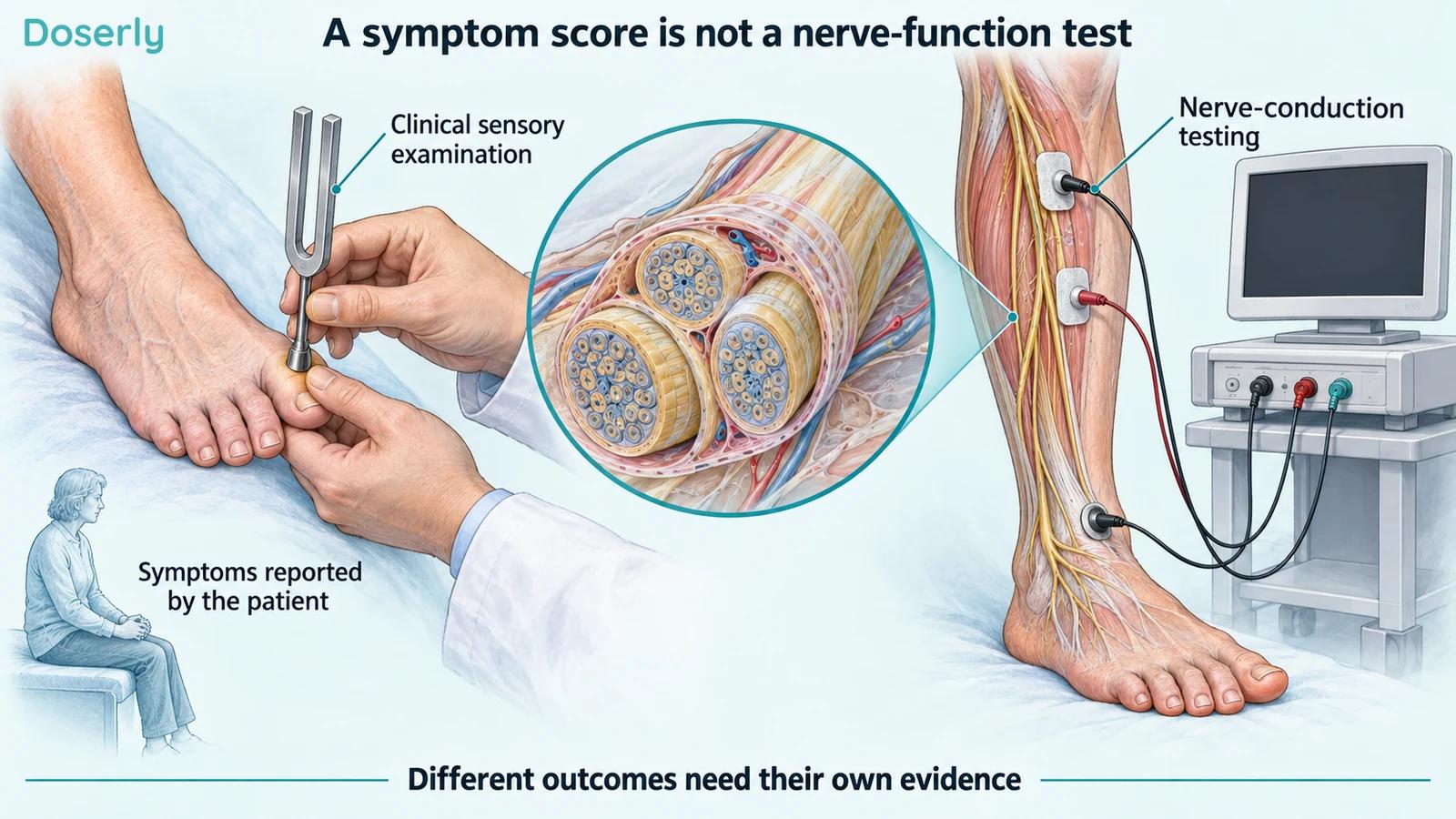
A symptom questionnaire can capture something very important: whether pain or discomfort is improving. But it does not directly measure nerve regeneration. Clinical examinations, nerve-conduction tests and sensory thresholds investigate different aspects of nerve function.
The Total Symptom Score, used in several ALA trials, combines features such as stabbing pain, burning, tingling and numbness. An improvement can be meaningful without proving that damaged fibers have regrown. Conversely, a change in a laboratory or electrophysiological measure may not produce an obvious improvement in daily life.
Long-term disease modification asks a larger question: does treatment alter the course of neuropathy or reduce consequences such as functional loss? That requires suitable outcomes and follow-up. A five-week symptom trial cannot answer it by itself.
This isn't a reason to discount pain relief. It is a reason to describe the benefit accurately and avoid turning a symptom result into a structural repair claim.
What the five-week oral SYDNEY 2 trial found
The 2006 SYDNEY 2 trial randomized 181 people with diabetic distal symmetric polyneuropathy to oral ALA at 600, 1,200 or 1,800 mg daily, or placebo, for five weeks after a placebo run-in. The primary outcome was change in Total Symptom Score. SYDNEY 2
Average scores fell by approximately 48–52% in the ALA groups, compared with 32% with placebo. At the 600 mg amount, 62% achieved at least a 50% score reduction, compared with 26% receiving placebo. Higher amounts did not produce a clear additional symptom advantage and were associated with more nausea, vomiting and vertigo.
That is positive short-term oral evidence. It is also a study in a defined symptomatic diabetic population, with follow-up measured in weeks. The amounts describe the research and should not be read as instructions to start or escalate treatment independently.
The placebo improvement is worth retaining when reading the headline percentages. A fall from baseline in the active group is not the entire treatment effect; the comparison with placebo helps separate treatment from natural variation, expectations and other changes during participation.
Intravenous evidence is a separate body of research
The earlier 2003 SYDNEY trial randomized 120 people with symptomatic diabetic sensorimotor polyneuropathy to intravenous ALA or placebo. After 14 supervised treatments, symptom scores improved more with ALA. Some additional neuropathy measures also favored treatment. Intravenous SYDNEY trial
This supports a short-term finding for the intravenous intervention that was actually tested. It does not establish equivalent results from a capsule with the same number of milligrams. Route changes exposure, administration requirements and safety considerations.
Nor does a favorable infusion trial justify self-directed injection or imply that an infusion is necessary for a person with nerve pain. Whether a treatment is available or appropriate depends on local medical practice and the individual's diagnosis and care plan.
When a supplement advertisement cites an ALA study, identifying the route is therefore an essential first step. An oral product should not borrow the full conclusion of an intravenous trial without evidence that supports the transfer.
The four-year NATHAN 1 trial gives a more complicated answer
The 2011 NATHAN 1 report described 460 people with mild-to-moderate diabetic polyneuropathy randomized to 600 mg oral ALA daily or placebo for four years. The primary endpoint combined a lower-limb neuropathy-impairment score with seven neurophysiological tests. That primary comparison was not statistically significant. NATHAN 1
Some secondary clinical-impairment measures favored ALA, including analyses of improvement and progression. Those findings are relevant, but they do not replace the null primary endpoint. The investigators also noted that the primary measure did not deteriorate substantially in the placebo group, limiting the opportunity to demonstrate prevention of deterioration.
Serious adverse events were reported more often in the ALA group: 38.1% versus 28.0%. That difference does not establish that ALA caused every event, but it should not disappear behind an unqualified statement that four-year use was harmless.
The study supports a nuanced interpretation: some favorable clinical signals, no demonstrated benefit on the prespecified composite primary outcome, and safety findings that require context. It does not establish universal nerve regeneration or a guaranteed slowing of neuropathy.
Why the longer-term evidence can look less favorable
A 2024 Cochrane review focused on trials lasting at least six months. It concluded that ALA probably has little or no effect on neuropathy symptoms at six months, with similarly limited evidence for meaningful effects on impairment. Cochrane review
This does not mean the reviewers overlooked five-week symptom improvements. Their question concerned a longer treatment horizon. Restricting follow-up changes which studies can answer the question and helps separate transient relief from sustained benefit.
A person deciding whether to continue a supplement indefinitely needs that distinction. A short-term response, even if attributable to treatment, does not establish that benefit will persist or that long-term disease progression is altered.
The review also cannot manufacture outcomes that trials did not measure adequately. Evidence about quality of life, foot complications and lasting functional benefit remains different from evidence about a symptom score. Absence of a demonstrated benefit is not proof of impossibility, but it limits what can be promised.
Does adding ALA to pregabalin improve pain control?
The PAIN-CARE trial, published online in 2023, compared ALA, pregabalin and their combination in a blinded crossover design. Fifty-five participants with peripheral neuropathic pain were randomized; 44 completed all three periods. Pregabalin performed better than ALA for the primary pain outcome, and the study did not show an added benefit from combining ALA with pregabalin. PAIN-CARE
A 2026 open-label trial, OPTIMUM, randomized 151 people with painful diabetic neuropathy to ALA, pregabalin or their combination for 12 weeks. Pregabalin alone met the study's criterion for noninferiority to the combination. A favorable exploratory cluster finding suggested a possible subgroup for further investigation, rather than proving that everyone benefits from adding ALA. OPTIMUM
Noninferiority is a specific statistical design: it asks whether one treatment is not worse than another by more than a predefined margin. It does not mean the treatments are identical or that every subgroup responds the same way.
These trials make routine stacking less straightforward than a mechanism-based argument suggests. Adding an antioxidant to a pain medicine may sound complementary, but the additional clinical benefit still needs to be demonstrated.
Product names do not guarantee trial equivalence
ALA products can differ in formulation, chemical form and delivery. A label emphasizing an R-form, a salt or enhanced absorption describes a product characteristic. It does not by itself establish superiority for neuropathy symptoms.
The key question is whether the actual preparation has suitable human outcome evidence. A comparison of blood exposure can support a pharmacokinetic claim; it cannot replace a clinical comparison showing better pain, function or tolerability.
Combination products add another complication. If several ingredients are administered together, a favorable result cannot automatically be assigned to ALA. Conversely, changing the ingredients or amounts means the marketed product may not reproduce the tested intervention.
Recording the full formulation is therefore more useful than recording only “ALA.” This is particularly important when someone changes brands while trying to judge whether symptoms are improving.
Safety includes more than stomach upset
Short-term trials reported gastrointestinal symptoms and dizziness-related effects, with more problems at higher amounts in SYDNEY 2. Longer-term safety deserves its own assessment, especially when the supplement is used alongside medicines. A small trial's tolerability finding cannot rule out uncommon adverse reactions.
The European Food Safety Authority assessed insulin autoimmune syndrome, a condition in which antibodies to insulin can cause episodes of low blood glucose. Its 2021 opinion concluded that added ALA, including in supplements, is likely to increase this risk in people with certain genetic susceptibilities. The panel could not establish a dose below which the syndrome would not occur. EFSA assessment
This is an uncommon safety issue with substantial uncertainty about individual risk, not a prediction that every user will develop hypoglycemia. It is also distinct from simply saying that a supplement may lower glucose a little.
Sweating, tremor, confusion or fainting can require prompt assessment for low blood glucose or other causes. Severe confusion, loss of consciousness or seizures need emergency care. People managing diabetes should discuss the product and monitoring plan with their clinician and should not adjust prescribed medicines based on supplement claims.
Symptom relief does not replace foot care
Reduced pain does not necessarily mean protective sensation has returned. Someone may feel less discomfort while still being vulnerable to unnoticed pressure, blisters or wounds. NIDDK emphasizes foot examination and preventive care for people with diabetic peripheral neuropathy. Foot-care context
That is a practical reason to keep treatment goals separate. Pain relief, balance, walking ability, sensation and skin integrity all matter. Improvement in one should not be used to assume improvement in the others.
A new foot wound, infection concern or change in function should be assessed within the person's clinical plan. A supplement record cannot replace examination, and a reassuring symptom score cannot establish that the foot is safe.
Making a monitored trial interpretable
If a clinician considers ALA reasonable for a specific situation, agree on what improvement would justify continuing it and when to reassess. The target might involve a symptom score, sleep disruption or a daily activity, rather than a vague expectation of “nerve healing.”
Record baseline symptoms, the exact product, treatment changes and adverse effects. Keep changes in glucose control, footwear, exercise and prescribed pain medicines visible, because they can influence the same outcomes. A record makes the discussion clearer without proving that every change was caused by ALA.
Also agree on what would prompt stopping or seeking care. Persistent side effects, new neurological findings or symptoms suggestive of hypoglycemia should not be interpreted as a necessary adjustment period.
ALA has credible short-term symptom findings in selected diabetic-neuropathy trials. Its longer-term and combination evidence is more mixed. The most useful conclusion preserves the route, diagnosis, outcome and duration of each study—and keeps relief of symptoms distinct from repair of nerves.
Sources
- NIDDK peripheral-neuropathy overview
- Oral SYDNEY 2 trial
- Intravenous SYDNEY trial
- Four-year NATHAN 1 trial
- 2024 Cochrane review
- PAIN-CARE trial
- 2026 OPTIMUM trial
- EFSA insulin-autoimmune-syndrome assessment