
Supplements
October 16, 2026
Algal omega-3s: compare EPA and DHA, not just the source
On this page
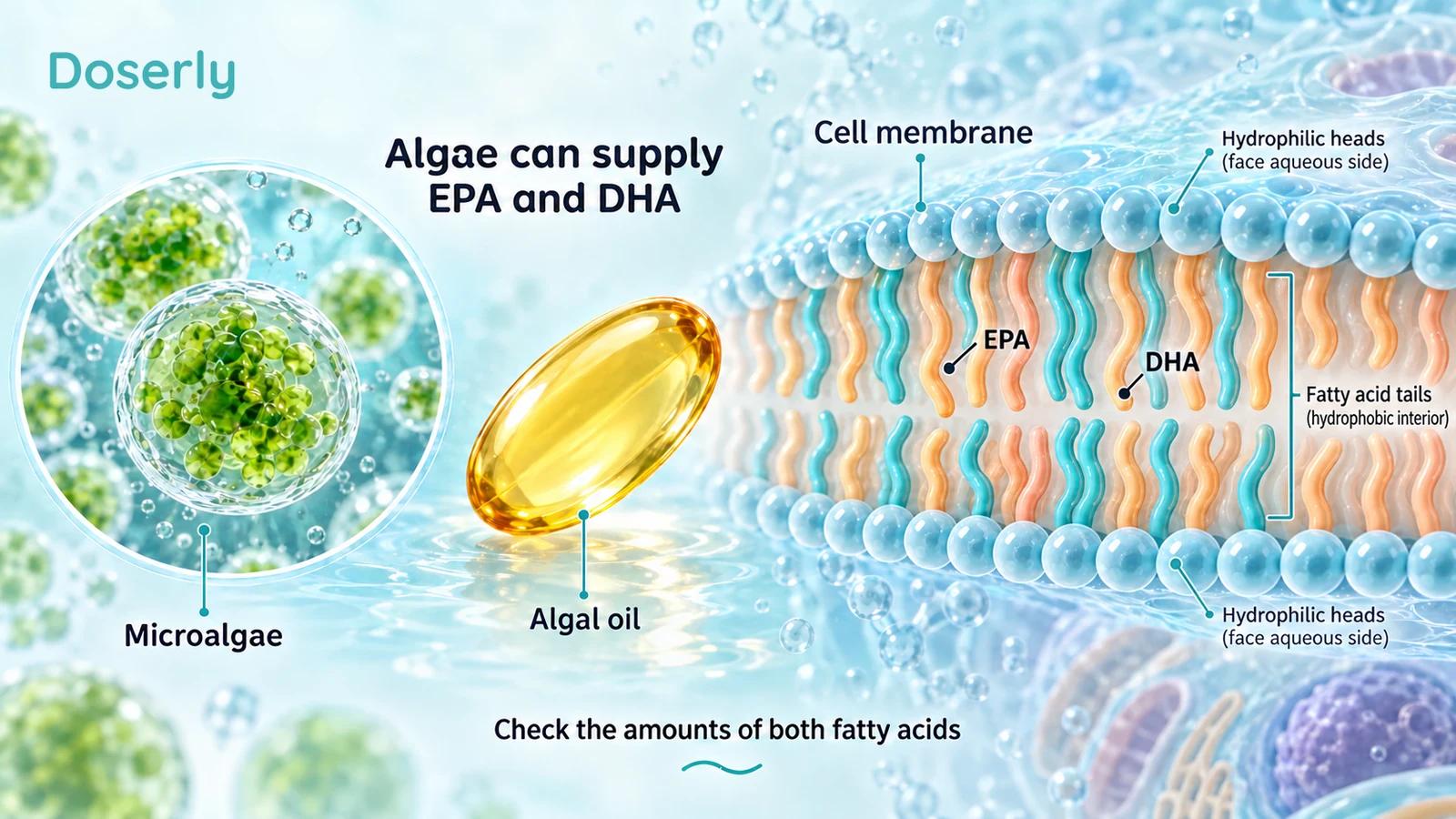
Algal oil can supply the long-chain omega-3 fatty acids DHA and EPA without requiring fish oil. That makes it relevant to people who avoid fish, including many vegetarians and vegans. The biological question is whether those fatty acids reach the blood and tissues in useful amounts. The practical question is whether a particular product supplies the EPA and DHA you're looking for.
Human studies show that algal omega-3s are absorbed and can raise blood fatty-acid levels. A newer comparison with fish oil is reassuring on that point, but it needs careful interpretation: the oils supplied different amounts and proportions of EPA and DHA, and the analysis measured blood composition rather than clinical outcomes. Comparative bioavailability report.
EPA, DHA and ALA are not the same nutrient
EPA is eicosapentaenoic acid and DHA is docosahexaenoic acid. Both are long-chain omega-3 fatty acids. They participate in cell-membrane structure and other biological processes. DHA is particularly prominent in the retina and brain. Their names describe the molecules, not whether they came from a fish or a cultivated microorganism. NIH omega-3 fact sheet.
ALA, alpha-linolenic acid, is another omega-3 found in plant foods such as flaxseed and walnuts. The body can convert ALA into longer-chain omega-3s, but conversion is limited. An ALA-rich oil therefore isn't automatically equivalent to a product supplying preformed DHA and EPA. “Plant-based omega-3” is too broad a label to tell you which fatty acids are present.
Some algal products mainly supply DHA. Others supply both DHA and EPA. A DHA-only product can be a meaningful source of DHA without meeting a goal that specifically requires EPA. Checking both amounts is more useful than assuming all algal oil has one standard profile.
What did the 2025 fish-oil comparison actually test?
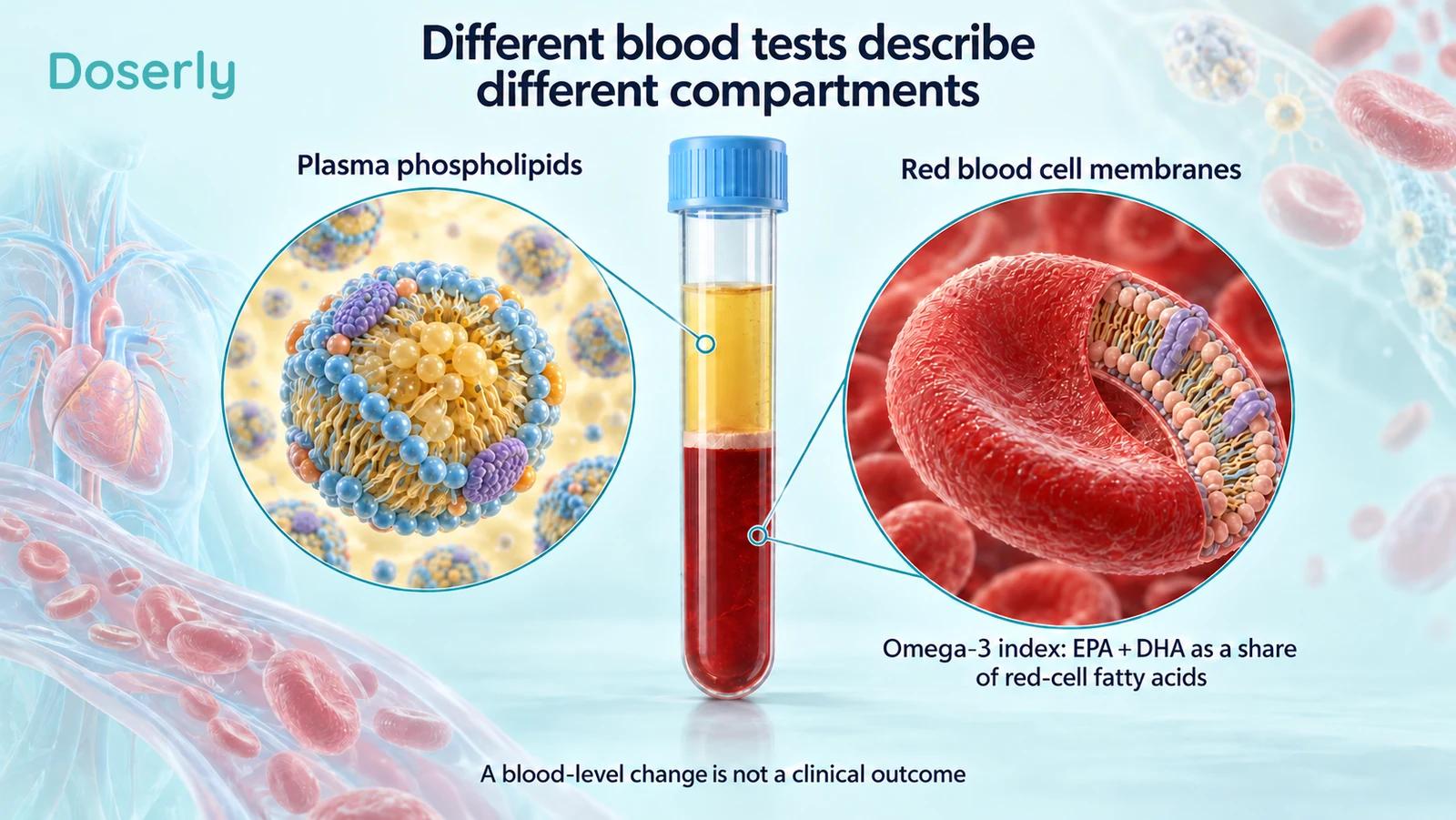
The 2025 report analyzed plasma phospholipid measurements from 74 adults after six and 14 weeks of supplementation. Plasma is the liquid portion of blood; phospholipids are a class of fats that occur in circulating lipid particles and cell membranes. Researchers compared microalgal oil, fish oil and a corn/soy oil control in a randomized, blinded study. Full primary report.
An important detail is easy to miss: this was an exploratory analysis of a trial whose lipid findings had already been published in 2014. The original trial enrolled 93 people. Seven discontinued, and another 12 were excluded from the newer analysis for reasons including adherence, weight loss or recent fish-oil use. These are two publications from the same underlying trial, not independent replications.
The daily microalgal preparation supplied 656 mg EPA and 1,772 mg DHA. The fish oil supplied 1,156 mg EPA and 820 mg DHA. Both oils were in triglyceride form, and participants took four capsules daily with food. The algal preparation therefore supplied more DHA and more total EPA plus DHA, while the fish preparation supplied more EPA.
Those details rule out a simple comparison of unadjusted blood rises as proof that one source is inherently better absorbed. If one group consumes more of a fatty acid, a higher blood level can reflect the amount consumed. The investigators adjusted the plasma measurements for intake before comparing the products.
What does “non-inferior” mean here?
The investigators concluded that intake-adjusted plasma availability of DHA and EPA from the algal product was non-inferior to that from fish oil. Their statistical rule required the lower bound of the 90% confidence interval for the ratio to remain at or above 80%. In plain language, they asked whether the algal product could be ruled out as meaningfully worse under a predefined margin. Analysis methods.
That supports algal oil as a credible source of these fatty acids. It does not prove that all algal and fish products are identical, that algal oil is superior, or that matching the blood response guarantees matching every health outcome. The result concerns particular oils, a selected population, the study duration and the blood compartment measured.
The study also had commercial involvement: several authors were employees of dsm-firmenich, and the statistical analyst worked under contract to the company. That doesn't invalidate the measurements. It is useful context when deciding how much weight to give one exploratory analysis and how valuable independent replication would be.
Earlier research compared algal DHA with salmon
A 2008 randomized study assigned 32 healthy adults to algal-oil capsules or measured portions of cooked salmon, each providing 600 mg DHA daily for two weeks. DHA increased by about 80% in plasma phospholipids and 25% in red blood cells in both groups. A post-hoc analysis supported comparable delivery of DHA from the two sources. Algal oil and salmon trial.
This comparison was closer to matching the nutrient amount than the later algae-versus-fish-oil trial. Still, it was small, short and open-label, meaning participants knew which food or supplement they were receiving. Its outcome was DHA availability, not cognitive performance, cardiovascular events or a comprehensive nutritional comparison.
Salmon provides more than DHA, while a capsule provides a concentrated ingredient. Saying they delivered similar DHA under study conditions does not mean that taking the capsule reproduces every nutritional consequence of eating fish. That distinction leaves room for both choices without making a supplement a complete substitute for a food.
Can algal DHA improve omega-3 status in vegetarians?
A randomized trial in 104 healthy vegetarians compared microalgal oil supplying 0.94 g DHA daily with olive-oil placebo for eight weeks. The omega-3 index increased from 4.8% to 8.4% in the supplemented group. The index is EPA plus DHA expressed as a percentage of red-blood-cell fatty acids. Vegetarian randomized trial.
This demonstrates a change in fatty-acid status. It doesn't establish that crossing a particular index threshold prevents a specific number of heart attacks or improves symptoms in someone who feels well. The trial wasn't designed to measure those outcomes. A proposed risk marker and a proven treatment target are not automatically the same thing.
A newer crossover trial in 116 volunteers studied a lower amount, 250 mg algal DHA daily, in omnivores, lacto-ovo vegetarians and vegans. Each treatment period lasted five weeks, separated by a five-week washout. Serum DHA rose with the supplement in all three dietary groups, with larger rises in the vegan group. Crossover trial.
The larger change in a group starting with different dietary exposure doesn't prove that everyone in that group needs the same supplement. It shows that the tested preparation can change the measured fatty-acid profile. Decisions about nutritional adequacy should consider the whole diet and the person's circumstances, rather than interpreting a dietary label as a diagnosis.
What about triglycerides and cholesterol?
The original 2014 report from the 93-person algae-versus-fish trial studied adults with triglycerides of 150–499 mg/dL. It compared an algal oil supplying about 2.4 g EPA plus DHA daily, a fish oil supplying about 2.0 g, and control oil over 14 weeks. Triglycerides changed by −18.9%, −22.9% and +3.5%, respectively. Both active groups differed significantly from control. Primary lipid trial.
LDL cholesterol moved in the other direction: +4.6% with algal oil, +6.8% with fish oil and −0.6% with control. That is a reminder that “improved lipids” can conceal different changes in different measurements. A lower triglyceride value doesn't necessarily mean a lower LDL value.
The trial supports a triglyceride-lowering effect for those preparations under those conditions. Because the EPA/DHA amounts and ratios differed, it doesn't isolate the source as the sole cause of any difference. And because it measured lipids over a few months, it doesn't establish that either product prevented cardiovascular events.
For someone with high triglycerides, the choice of treatment belongs in a broader clinical plan. The gram-level exposures in this study shouldn't be copied casually from a paper or treated as equivalent to every prescription omega-3 formulation. Formulation, indication and follow-up matter.
Reading an algal-oil label without losing the useful information
Start with the serving size. Then find the separate EPA and DHA amounts per serving, not merely the total oil weight. A bottle may emphasize a large number for “algal oil” while supplying a smaller amount of the fatty acids of interest. The remainder of the oil is not necessarily useless; it simply isn't all EPA and DHA.
For a purely hypothetical comparison, one product could list 1,000 mg algal oil but 250 mg DHA and no EPA, while another could provide 250 mg DHA plus 125 mg EPA in a different amount of oil. The first and second share a DHA amount, but not an EPA amount or total long-chain omega-3 content. These example labels are arithmetic illustrations, not actual products or recommended targets.
If dietary preferences are central to the choice, check the capsule shell and other ingredients as well as the oil source. An algal ingredient doesn't by itself tell you what every other component of a finished supplement contains. If allergy is the reason for avoiding fish, review the full label and manufacturing information with an appropriate healthcare professional.
Quality evidence should also match the product and batch. A reassuring claim about algae in general is not an analysis of a particular bottle's identity, oxidation or contaminants. The clinical studies discussed here cannot certify products they did not test.
What safety issues remain relevant?
NIH lists gastrointestinal effects such as unpleasant taste, heartburn, nausea and diarrhea among possible omega-3 supplement effects. High-dose omega-3 research has also identified an increased risk of atrial fibrillation in some cardiovascular-risk populations. Those findings don't establish that every nutritional algal-oil serving carries the same risk, but they do argue against assuming that more is always better. NIH safety discussion.
Medication use, a history of rhythm problems, pregnancy and treatment of marked triglyceride elevation deserve an individualized discussion. The relevant question isn't only whether an oil is vegan. It is what amount and formulation will be used, for what purpose, and with what follow-up.
For someone mainly seeking a non-fish source of DHA or EPA, the human absorption evidence is reassuring. Choose the product by its actual fatty-acid content and your nutritional goal. Our algal oil guide provides more background on formulations. The most useful conclusion from the research is that algae can deliver these nutrients; the source alone doesn't determine the full health effect.
Sources
- 2025 comparative bioavailability analysis.
- 2014 lipid trial from the same underlying study.
- 2008 algal DHA versus salmon trial.
- Vegetarian randomized omega-3-index trial.
- Crossover trial across dietary groups.
- NIH omega-3 professional fact sheet.