
Supplements
October 16, 2026
Activated charcoal’s detox marketing borrows from a very different medical use
On this page
Activated charcoal has a real medical use. It also appears in products promising to clean up the consequences of a heavy meal, a night out or a vaguely defined accumulation of “toxins.” The second claim borrows credibility from the first without preserving the conditions that make the medical use meaningful.
In poisoning care, clinicians need to know what was swallowed, when it happened, how much harm is expected and whether charcoal can help without creating additional risk. Routine detox marketing often specifies none of those things.
The difference is especially important for people taking medicines. Charcoal's capacity to bind certain substances is not limited to things someone wants removed. A product promoted as a harmless reset can change exposure to a drug that is supposed to remain effective.
For a suspected poisoning, seek expert help immediately rather than trying charcoal at home. In the United States, Poison Control is available at 1-800-222-1222. Call emergency services for collapse, seizures, trouble breathing or inability to wake the person; elsewhere, use your local poison center or emergency number. Poison Control first-aid guidance.
What charcoal actually does
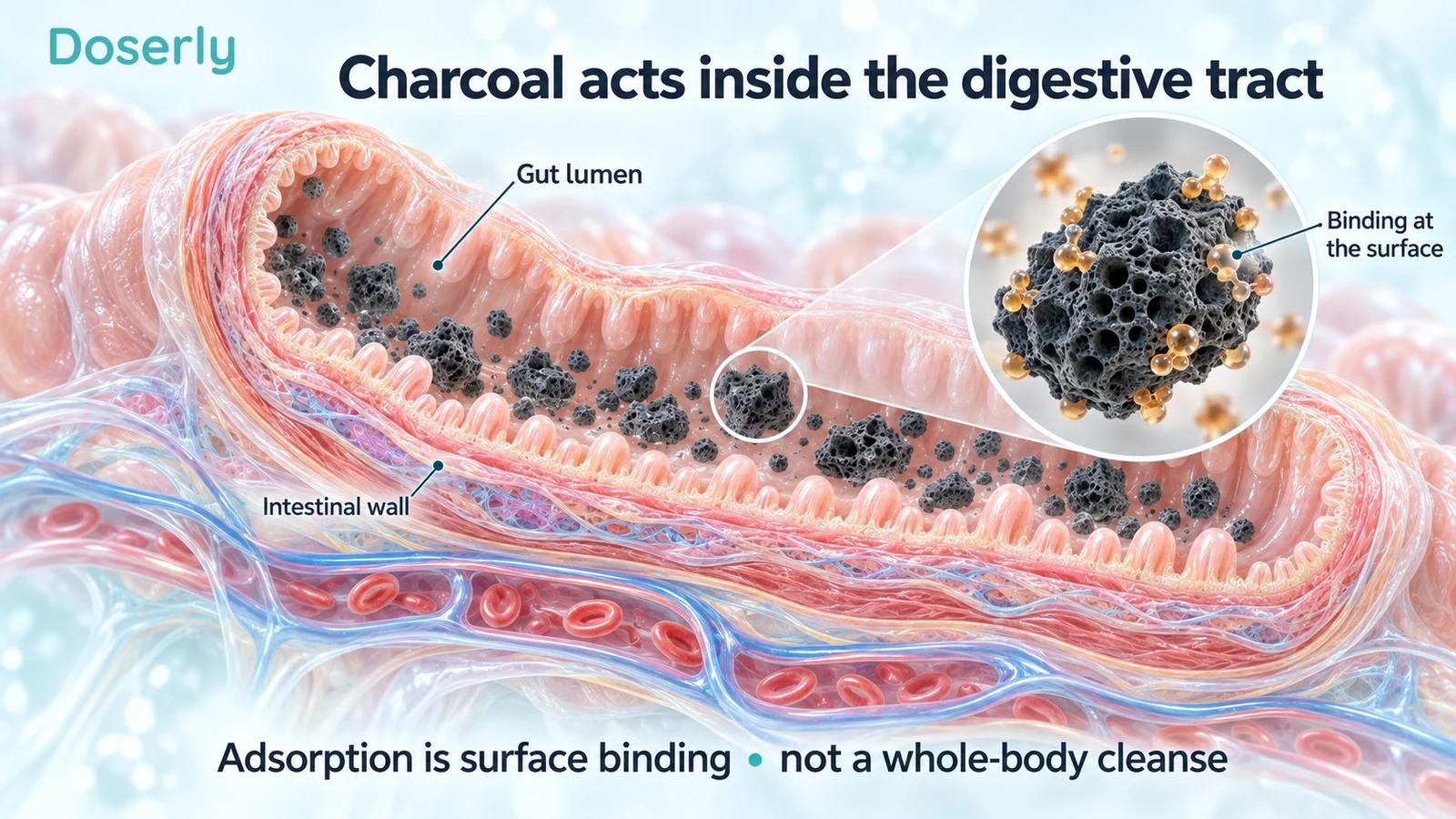
Activated charcoal has a highly porous surface that can bind some substances in the digestive tract. The term is adsorption: molecules attach to a surface. That differs from absorption, in which a substance moves into another material or into the body.
The location matters. Swallowed charcoal does not travel through the bloodstream scrubbing organs. Its useful binding activity occurs in the gut, where it may reduce the amount of a susceptible swallowed substance reaching the circulation. National Capital Poison Center explanation.
That mechanism is specific enough to test. Investigators can identify a drug, administer it under controlled conditions and measure whether charcoal changes drug exposure. “Removing toxins,” without identifying the substance or measuring a relevant outcome, is a much less informative claim.
There is a further nuance: clinical use can sometimes enhance elimination of certain already absorbed poisons through processes involving the gut. That still does not turn charcoal into a general blood cleanser. The medical question remains substance-specific, and the goal can differ between preventing further absorption and enhancing elimination.
The old one-hour rule is not the whole current story
The widely cited 2005 toxicology position paper discouraged routine single-dose charcoal use for every poisoned patient. It emphasized timing, whether the poison binds to charcoal and airway safety. It also distinguished volunteer absorption findings from demonstrated improvement in clinical outcomes. Read the historical position paper.
New recommendations published in 2026 by the Clinical Toxicology Recommendations Collaborative update that framing. They consider 43 poisons or poison categories and support use beyond the traditional one-hour point in selected circumstances, with timing depending on the substance and formulation. They also distinguish additional doses for ongoing gut decontamination from repeated doses intended to enhance elimination. The authors describe much of the underlying evidence as low or very low quality. Read the 2026 recommendations.
For readers, the implication is not a new home-treatment window. It is that a simple universal clock cannot replace toxicology assessment. A delayed presentation, a modified-release medicine and a different poison can raise different clinical questions.
Nor does being outside an old cutoff mean there is no reason to seek help. Poisoning assessment involves much more than deciding whether charcoal is appropriate.
A large hospital trial shows why outcomes matter
A 2008 randomized trial in three Sri Lankan hospitals assigned 4,632 patients with acute self-poisoning to no charcoal, one dose or multiple doses; outcomes were available for 4,629. Pesticides and yellow oleander seeds accounted for most exposures. Overall mortality did not differ between the groups. Read the Lancet trial.
That finding limits broad claims about routine charcoal treatment in that setting. It does not establish that charcoal has no role in every selected poisoning. The mix of substances, timing of presentation and clinical circumstances matter.
The study also illustrates an evidence hierarchy that detox advertising often blurs. Binding a substance in a laboratory, reducing its blood exposure in a volunteer and preventing serious harm in a poisoned patient are related but different achievements. A favorable result at one level cannot simply be renamed as a favorable result at another.
The leap to routine wellness is larger still. A hospital trial treating an identified dangerous exposure does not test whether daily charcoal improves health in people without that exposure.
The same binding property can disrupt a wanted medicine
In a randomized crossover study, 18 healthy participants completed experiments with apixaban, an anticoagulant. Charcoal given two hours after the drug reduced overall exposure by approximately 50%; at six hours, the reduction was approximately 28%. Peak concentrations were similar across conditions. These were pharmacokinetic measurements, not evidence that participants had fewer bleeding events or that routine co-use was safe. Read the apixaban study.
The study used controlled experimental exposures, and its charcoal conditions were not equivalent to taking a small retail capsule. Some measurements also excluded participants who vomited. Those details limit direct prediction of what will happen with a particular consumer product.
But the central lesson is clear: charcoal can alter exposure to a medicine even when the two are not swallowed together. That makes a generic instruction to “separate everything by a couple of hours” an unreliable guarantee.
Do not change, repeat or skip a prescribed dose to compensate for possible binding on your own. A pharmacist or clinician needs the exact medicine, charcoal product, amounts and times to assess the situation.
Different drugs do not share one charcoal timetable
A 2024 randomized study offers a useful contrast. Forty-five healthy adults were assigned to mavacamten alone or to mavacamten followed by charcoal; 37 completed the study. Drug exposure was lower when charcoal was given two hours later, but the six-hour condition had a similar pharmacokinetic profile to mavacamten alone. Read the mavacamten study.
That is not a contradiction of the apixaban result. They are different drugs studied under different designs and conditions. It is evidence against assuming that one spacing rule can cover every medicine.
The two studies also should not be compared as though their percentages reveal which drug is easier to “detox.” They measured specific exposures in healthy volunteers, not individualized treatment plans for overdose or everyday combination use.
For a medication routine, the relevant question is whether charcoal could interfere with a particular treatment. A long list of ingredients that charcoal might bind is less useful than checking the exact drug whose effect matters to you.
“Detox” needs a substance and an outcome
A useful detox claim should be able to answer four questions: which substance is being removed, from which part of the body, how removal was measured and whether the change improved health.
Consider a fictional product promising to “clear modern toxins.” If its supporting reference describes a hospital poisoning intervention, the reference has not identified what is supposedly accumulating in the purchaser or shown that the product removes it. The medical story supplies atmosphere, not the missing experiment.
The NIH's National Center for Complementary and Integrative Health reports that studies of detox programs are few and often methodologically weak. Its overview does not provide evidence that a routine charcoal cleanse improves long-term health. It also cautions that some detox products and practices can be unsafe. NCCIH detox and cleanse evidence review.
That overview concerns detox programs broadly; it is not itself a charcoal trial. The important reading habit is to keep that scope visible, just as one should keep the limits of a drug-binding study visible.
A compelling mechanism can justify a research question. It cannot substitute for a defined exposure and a meaningful human result.
Alcohol and “heavy metals” are particularly misleading shortcuts
The 2026 toxicology recommendations identify substances for which charcoal has no role in poisoning care, including ethanol, iron and lithium. A broad promise to remove alcohol or all metals therefore does not follow from charcoal's medical reputation. Clinical Toxicology Recommendations Collaborative.
This is another reason not to assume that everything unwanted in the body behaves the same way. The word “toxin” groups together substances with very different properties and treatments.
A product associated with “the morning after” can also encourage the wrong inference: that taking it offsets the exposure that came before. Without evidence for that exact outcome, the impression is not a reliable health claim.
If concern involves a real chemical or metal exposure, identifying it is the priority. A vague cleanse can delay the assessment needed to determine whether there was an exposure at all, how significant it was and what care is appropriate.
Why medical supervision is part of the intervention
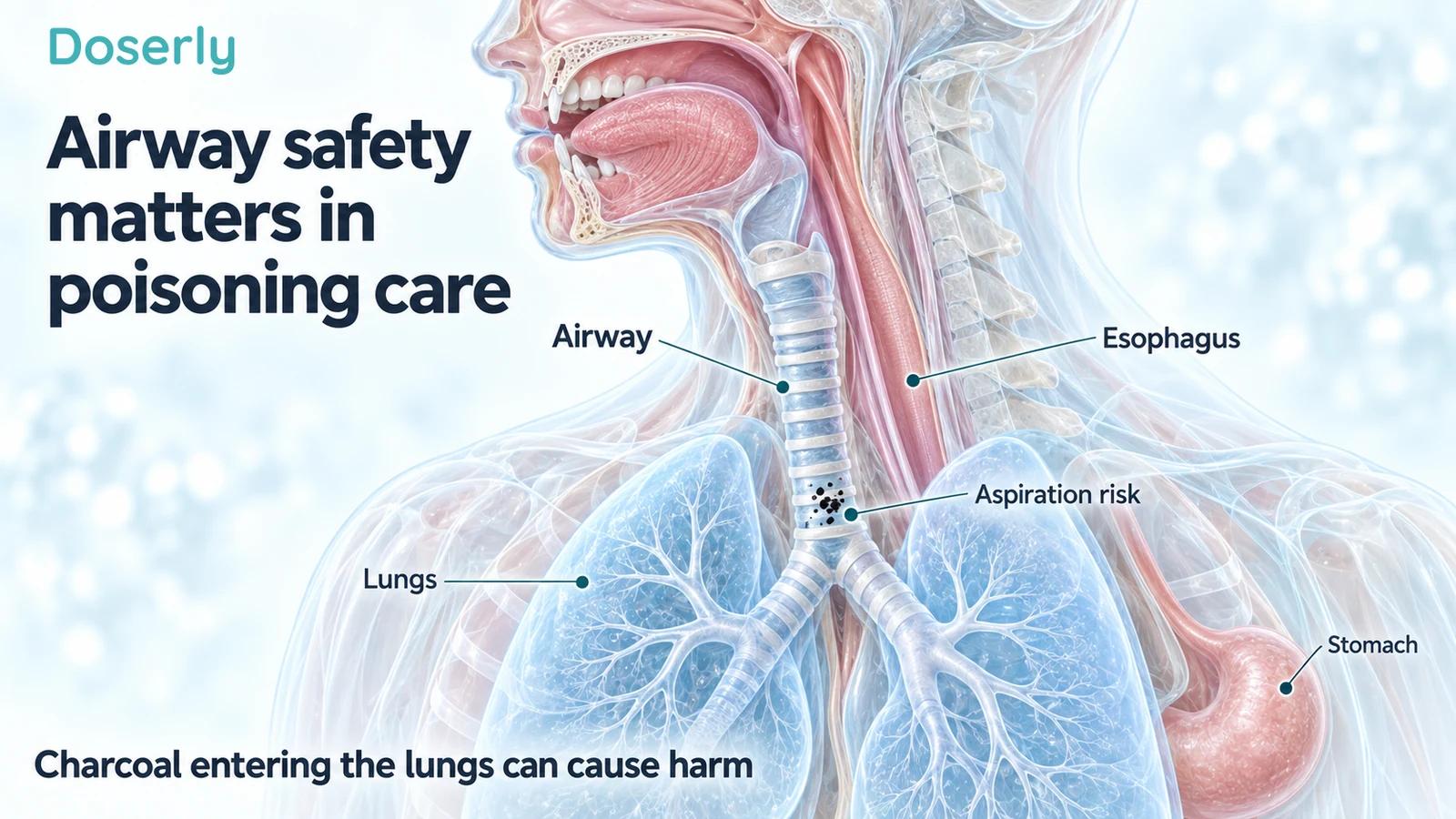
Charcoal can cause nausea and vomiting. Aspiration—material entering the airway—is a particular concern when someone is drowsy or cannot protect the airway. Bowel obstruction, perforation and gastrointestinal bleeding are also important reasons charcoal may be inappropriate. Poison Control specifically advises against using it at home to treat poisoning. National Capital Poison Center safety guidance.
These are not incidental details surrounding an otherwise universal remedy. They are part of deciding whether the intervention is suitable.
A hospital can assess the person, monitor the course of illness and use other treatments when indicated. A retail label cannot reproduce that setting. Nor is a capsule interchangeable with the formulations and exposures used in the clinical research.
The public-facing lesson is therefore not to memorize an administration method. It is to recognize a poisoning concern early and contact the appropriate service. Waiting to locate charcoal, trying a household substitute or treating a black-colored product as equivalent can distract from that step.
A history should distinguish a swallowed medicine from a topical or injected treatment, because a digestive-tract binding mechanism does not make every route of administration equivalent. Let the poison specialist or pharmacist interpret that information; a general detox claim cannot supply a route-specific interaction assessment.
A more useful record than a cleanse schedule
For a nonurgent discussion about a charcoal product, preserve the full label, the reason for considering it and a complete medicine list. Include over-the-counter products as well as prescriptions. If charcoal has already been taken, record the actual amount and time rather than an estimate such as “around breakfast.”
The Doserly activated-charcoal guide provides broader background for reviewing the ingredient. A routine record can support a pharmacist's assessment, but it should never become a reason to delay poison-center or emergency advice when an exposure is suspected.
For an everyday detox claim, ask for evidence that answers the actual promise. A trial showing reduced exposure to a specific medicine is a warning about interactions and a contribution to toxicology. It does not show that removing unspecified substances improves how a healthy person feels.
Activated charcoal's medical use deserves to be described accurately, including the updated evidence and its limits. Its real activity makes context essential. The more seriously we take that activity, the less sense it makes to treat charcoal as a neutral daily reset.
Sources
- Position paper: Single-dose activated charcoal (2005)
- Recommendations from the Clinical Toxicology Recommendations Collaborative on the administration of activated charcoal in acute oral overdose (2026)
- Multiple-dose activated charcoal in acute self-poisoning: a randomised controlled trial (2008)
- Effect of Activated Charcoal on Apixaban Pharmacokinetics in Healthy Subjects (2014)
- Effect of Activated Charcoal on Mavacamten Pharmacokinetics in Healthy Participants (2024)
- Detoxes and Cleanses: What You Need To Know (2025)
- Activated charcoal: An effective treatment for poisonings
- First aid: Act fast!