
Supplements
October 16, 2026
Lactobacillus probiotics: why the strain and the condition matter
On this page
A bottle that lists Lactobacillus tells you something about the organisms inside. It does not tell you whether the product prevents diarrhea during antibiotics, treats a stomach infection, improves IBS, or provides a benefit you would notice. Those questions require evidence for a defined preparation used in a defined setting.
The distinction becomes clearer when the same named strain has different results in different trials. Lactobacillus rhamnosus GG has shown a benefit in an older pediatric antibiotic-associated diarrhea trial, yet a large trial found no meaningful benefit when it was used to treat acute gastroenteritis in young children. A probiotic does not acquire a universal digestive-health effect because one study was positive.
This is not a reason to ignore strain names. It is a reason to read them together with the condition, participants, amount, duration, and outcome. Our Lactobacillus guide offers broader context. The practical task here is learning how to connect a label to the research without letting a familiar bacterial name do more work than it can.

Read the full name, including the letters at the end
A probiotic name can include a genus, species, and strain designation. In Lacticaseibacillus rhamnosus GG, the final letters identify the strain. A product listing only the species leaves an important part of that identity unspecified. A mixture may contain several individually named organisms, each with its own designation. NIH Office of Dietary Supplements
Some familiar names have also changed. A major taxonomic revision in 2020 reorganized the old Lactobacillus genus into multiple genera. Lacticaseibacillus is one of the resulting names. Older papers and current packaging may therefore use different genus terminology for the same named strain. The change in classification is not itself a reformulation or evidence of a new benefit. Taxonomic paper
For searching, keep both the old and new names in mind and preserve the strain code. A retailer's shortened description may omit details that appear on the actual package. If a study is cited but the label does not identify the strain or complete mixture, the match remains uncertain. The sensible response is to ask for the missing information, not to assume that every organism with the same species name is interchangeable.
The same strain, two different diarrhea questions
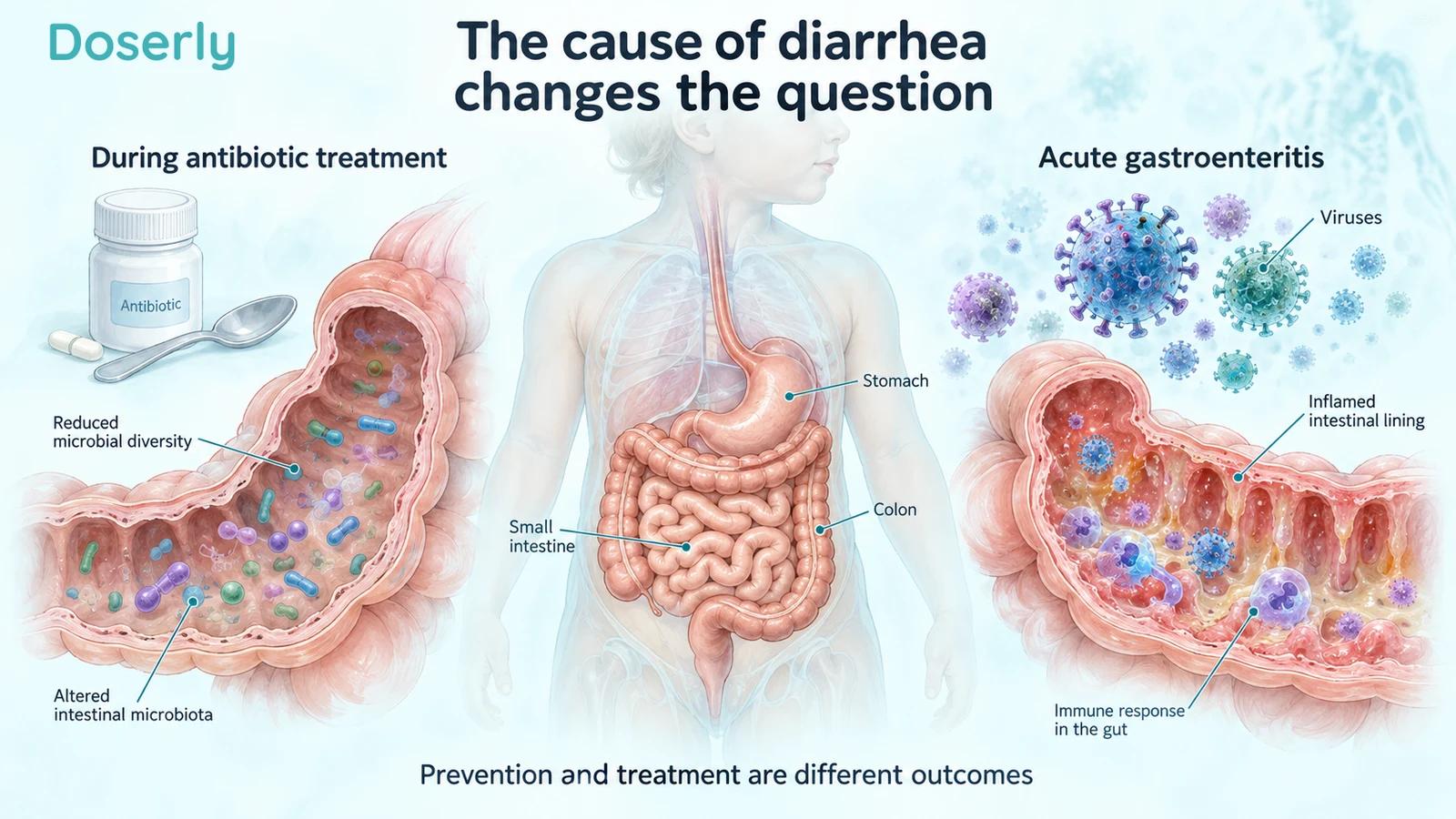
In a 1999 randomized trial, 202 children receiving oral antibiotics were enrolled and 188 completed the protocol. Researchers compared LGG with placebo in an outpatient setting. Diarrhea occurred in seven LGG-treated children and 25 placebo-treated children under the study's definition. The trial supports a preventive effect in that setting, while its age, size, and specific population limit broader conclusions. Antibiotic-associated diarrhea trial
A much larger 2018 trial asked a different question. It enrolled 971 children aged three months to four years presenting to US emergency departments with acute gastroenteritis. A five-day course of LGG did not improve the primary measure of subsequent illness severity. Moderate-to-severe illness occurred in 11.8% of analyzed children receiving LGG and 12.6% receiving placebo; diarrhea duration also did not differ significantly. Gastroenteritis trial
The findings should not be flattened into a debate about whether LGG “works.” Prevention during antibiotic treatment and treatment of an existing episode of gastroenteritis are different jobs. They involve different causes, timing, and populations. A positive result for one does not establish the other, and a negative result for one does not erase all research in the other.
This distinction is especially important for parents. A product associated with prevention of one type of diarrhea can sound like an obvious choice whenever a child has loose stools. The evidence does not justify that shortcut. A clinician needs to consider the cause and severity of the illness, hydration, age, and the child's medical situation before discussing an optional supplement.
More organisms did not guarantee a better result
The PLACIDE trial tested a multi-strain preparation containing lactobacilli and bifidobacteria in hospital patients aged 65 or older who were receiving antibiotics. The primary analysis included 2,941 participants. Antibiotic-associated diarrhea occurred in 10.8% of the probiotic group and 10.4% of the placebo group, with no evidence of prevention. C. difficile diarrhea was uncommon, and the difference for that outcome was also not statistically significant. PLACIDE trial
This was not a trial of every probiotic, and it should not be described that way. It was a substantial test of one defined mixture in older inpatients. The result shows why a long ingredient list and a large organism count cannot establish clinical benefit on their own. It also shows why evidence from children in outpatient care cannot simply be transferred to older hospital patients. PLACIDE trial
A blend raises a separate attribution problem. If the complete mixture has a benefit, that does not identify which component produced it. If an individual component has favorable research, that does not establish that a different mixture will reproduce the result. The preparation tested in the trial is the unit of evidence.
That does not mean combinations are inherently inferior. It means that adding more names does not remove the need for a trial. A product's complexity should make the evidence match more careful, not make a broad digestive-health claim more convincing.
Guidelines also separate the condition and preparation
The American Gastroenterological Association's 2020 guideline suggests against probiotics for children with acute infectious gastroenteritis. For IBS, it recommends use only in the context of a clinical trial. It also identifies certain preparations as options for preventing C. difficile infection during antibiotic treatment, a narrower and different outcome from preventing every episode of antibiotic-associated diarrhea. These are condition-specific recommendations with varying certainty, not an endorsement of the whole category. AGA guideline
A guideline can help frame a clinical discussion, but its wording should remain attached to the exact indication. “Suggested for prevention of C. difficile” cannot become “treats C. difficile,” and neither phrase means “repairs the microbiome after antibiotics.” Those statements make different promises and would require different evidence.
The same care applies to geography and care setting. A trial in North American emergency departments does not answer every question about all pathogens in all countries. That limitation should produce a narrower interpretation, not an invitation to disregard a large negative study whenever it is inconvenient.
CFU counts tell you quantity, not clinical usefulness
Colony-forming units, or CFU, describe viable organisms measured by their ability to form colonies under the test conditions. The NIH Office of Dietary Supplements advises attention to the amount through the product's shelf life, rather than only at manufacture, as well as storage instructions. A larger CFU number does not automatically make a product more effective. NIH fact sheet
This creates a useful distinction between product quality and clinical evidence. Accurate identity and viable counts are important quality questions. They do not answer whether the product improves your intended outcome. Conversely, a positive trial is less helpful if the retail product cannot be matched to the studied strain, preparation, and amount.
When comparing two packages, avoid turning the exercise into a competition for the largest number. Ask whether the amount is stated per capsule or per daily serving, whether the mixture is fully identified, and whether the cited study concerns the same product. If information is missing, write down that uncertainty. Do not fill it with assumptions based on packaging design or price.
A microbiome change is not a complete clinical outcome
Probiotic marketing often uses “balance” as though it were a measurable destination shared by everyone. Before accepting that claim, ask what the underlying study actually measured. Was it a symptom, an infection, a stool bacterial abundance, or the detection of the administered organism?
A laboratory measurement can be useful without proving a health benefit. Detecting a microbe after someone takes it does not, by itself, demonstrate fewer sick days or less abdominal pain. Similarly, an observed symptom improvement does not establish every proposed mechanism behind it. The clinical and mechanistic questions can inform each other while remaining distinct.
A practical way to read a claim is to replace the broad phrase with the actual endpoint. Instead of “supports recovery,” ask whether the trial measured diarrhea duration, recurrence, hospitalization, or something else. If the manufacturer cannot identify that endpoint, the wording is not giving you enough information for a decision.
This is also why a commercial stool test should not be treated as a shopping list for probiotic species. The trials discussed here assigned defined preparations and measured outcomes in groups of participants. They did not validate a rule that a low reading for one bacterial group means a particular retail supplement will help that individual.
Safety depends on who is taking it
Many healthy people tolerate probiotics, but that experience does not establish safety in every medical setting. NCCIH notes greater concern in people with severe illness or compromised immune function, and it emphasizes that safety information is incomplete for some uses. A live microbial product should not be treated as automatically harmless because the organism has a familiar name. NCCIH guidance
People who are seriously ill, immunocompromised, or receiving complex hospital care should involve their treating team before using a probiotic. For infants and young children, the decision belongs with their clinician rather than being extrapolated from an adult product. A probiotic also should not delay assessment or established care for significant diarrhea.
A useful conversation starts with a concrete purpose: prevention during a particular antibiotic course, treatment of a diagnosed condition, or a symptom that has not yet been evaluated. Bring the full product name and ingredient list. “I take a probiotic” is less informative than identifying exactly which preparation is being considered.
What a defensible product choice looks like
The strongest match is a named preparation with evidence for the same condition in people reasonably similar to the intended user. The label should allow that match, and the expected benefit should be described in terms a person can recognize. The choice should also account for safety, cost, and whether better-supported options already address the problem.
If you try a product after discussing it with a clinician, record the strain or full mixture, amount, start date, and the outcome being followed. Agree on a review point instead of assuming it should continue forever. Changing brands, adding several products, and altering diet at the same time makes it difficult to interpret the experience.
A strain name makes the question more precise. It does not answer it alone. The useful evidence joins the organism, preparation, person, condition, and measured outcome in one sentence—and keeps them together when the product reaches the shelf.
Sources
- NIH Office of Dietary Supplements: probiotics
- Zheng and colleagues: Lactobacillus taxonomy, 2020
- Vanderhoof and colleagues: LGG during antibiotics in children, 1999
- Schnadower and colleagues: LGG for acute gastroenteritis, 2018
- Allen and colleagues: PLACIDE, 2013
- AGA: role of probiotics in gastrointestinal disorders, 2020
- NCCIH: probiotics usefulness and safety