
Supplements
October 16, 2026
Prebiotics and gut symptoms: why a microbiome change is only part of the answer
On this page
Prebiotics provide material that certain microorganisms can use. In the gut, commonly studied examples include inulin-type fructans and galactooligosaccharides, often shortened to GOS. They are different from probiotics, which are live microorganisms. The idea is to influence organisms already present, rather than simply add new ones.
That makes prebiotics interesting for people with constipation, bloating or irritable bowel syndrome. But a change in a stool microbiome test does not automatically mean that pain, bowel habits or daily life have improved. Some trials show both microbial and symptom changes. Others show no meaningful symptom advantage, or show improvement despite a bacterial measurement moving in an unexpected direction.
The useful question is whether the particular preparation helps the particular problem you want to treat. Our prebiotic fibers guide provides background on the ingredients; here we'll examine what human experiments reveal when microbial results and symptoms are measured together.
What qualifies as a prebiotic?
The International Scientific Association for Probiotics and Prebiotics defines a prebiotic around two requirements: selective use by microorganisms and a health benefit for the host. “Host” simply means the person or animal whose microorganisms are being studied. A substance does not qualify merely because bacteria can ferment it in a test tube. ISAPP consensus statement
This distinction is helpful when looking at product claims. “Increases bifidobacteria” describes a microbial response. “Improves constipation” describes a health outcome. The second claim requires its own evidence, ideally measured in the same people using the same intervention.
An updated expert recommendation emphasizes defined composition, evidence of microbial use, a plausible mechanism and a measured health benefit in the target host. It also explains that a causal connection between the microbial change and benefit requires more than observing both at the same time. Prebiotic classification recommendations
A product can therefore be scientifically interesting before it is clinically useful for your symptoms. Conversely, a fiber may be useful through a physical effect without needing to be described primarily as a prebiotic. These categories help explain what was tested; they are not a ranking of which ingredient is best for everyone.
What stool testing tells researchers
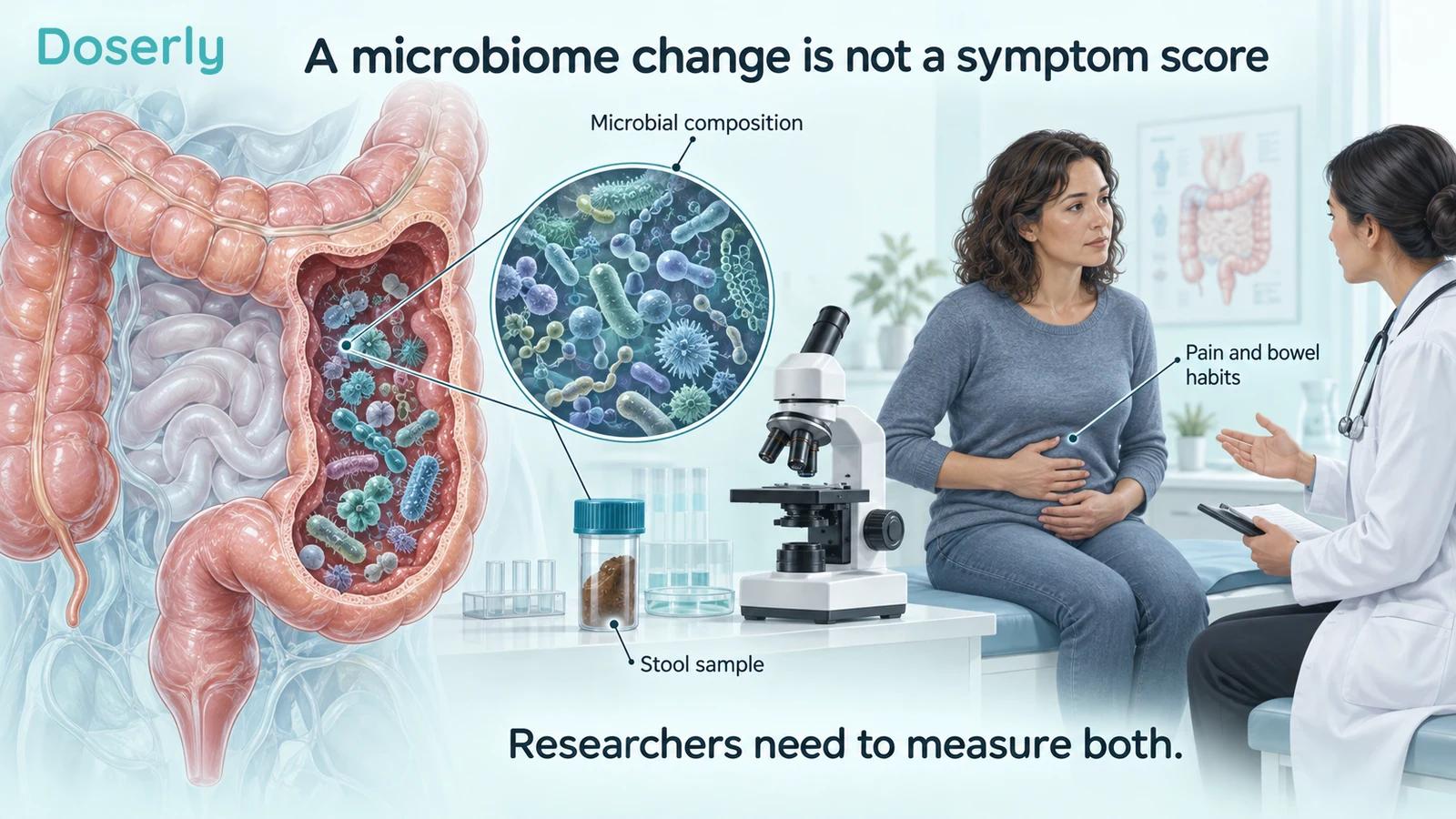
Microbiome studies often collect stool and use methods such as bacterial gene sequencing to estimate which groups are present. A result reported as relative abundance describes a group's share of the measured community. If one share increases, that does not necessarily mean its absolute cell count increased by the same proportion.
This is a mathematical limitation of proportions. Imagine a sample containing two measured groups. One can become a larger percentage because it increased, because the other decreased, or because both changed. Without the appropriate additional measurements, a percentage alone cannot distinguish those possibilities.
Stool sampling also does not directly measure every process occurring along the bowel. Researchers may add information about stool frequency, consistency, pain, quality of life or microbial metabolites. The point of combining measurements is to ask whether a biological change corresponds to something beneficial for the person. The recent inulin constipation study illustrates this approach by collecting both symptom information and stool sequencing data. Constipation trial
A GOS trial found both bacterial and symptom changes
A study reported in 2009 examined a specific trans-galactooligosaccharide preparation in people with IBS. Forty-four patients completed a 12-week single-center controlled study, with comparisons involving 3.5 g daily, 7 g daily and placebo. Researchers followed symptoms and stool characteristics as well as fecal bacteria.
Both prebiotic amounts increased bifidobacteria. The lower-amount group showed improvements in several measures, including bloating, flatulence, stool consistency and a composite symptom score. The higher-amount group improved some outcomes, but did not simply reproduce a larger version of every lower-amount benefit. Silk and colleagues
This is encouraging evidence for that preparation in that setting. It also illustrates why “more” is not a complete treatment rationale. The bacterial response and the symptom pattern need to be examined separately, rather than assuming that the amount producing a stronger microbial shift must produce the best experience.
The trial was small and used an older IBS definition. Its findings cannot establish that every GOS product or every person with bloating will respond similarly. The practical value is as a specific human study to discuss, rather than as proof of a category-wide effect.
A fructooligosaccharide trial found no final symptom advantage
An older multicenter trial tested a different preparation: 20 g daily of fructooligosaccharides, or FOS, against placebo for 12 weeks. Ninety-eight people were assigned to treatment and data from 96 were analyzed. At four to six weeks, symptom improvement was greater with placebo. By the end, there was no significant difference: reported improvement occurred in 58% of the FOS group and 65% of the placebo group. Olesen and Gudmand-Hoyer
The result does not prove that all prebiotics worsen IBS. It shows that this substantial daily exposure did not outperform placebo for the study's overall symptom outcome. It also gives a reason not to promise that an initially uncomfortable course inevitably becomes beneficial if someone persists long enough.
The study should not be described as showing a bacterial improvement without clinical benefit, because its reported clinical findings alone do not establish a particular microbiome shift. Keeping that boundary clear is part of answering the reader honestly: this was a symptom trial of a fermentable ingredient, not proof of every step in a microbiome mechanism.
Can symptoms improve while bifidobacteria fall?
Yes, and a randomized diet study makes that point particularly clearly. Sixty-nine adults with IBS were assigned to a sham diet with placebo, a low-FODMAP diet with placebo, or a low-FODMAP diet with a small GOS supplement for four weeks. FODMAPs are categories of fermentable carbohydrates that can contribute to symptoms in susceptible people.
Adequate relief was reported by 16 of 24 participants in the low-FODMAP-plus-GOS group versus 7 of 23 in the sham-diet control group. Yet adding GOS did not prevent the reduction in bifidobacteria associated with the diet. Wilson and colleagues
This is not a clean estimate of GOS alone: the highlighted comparison changed both diet and supplement. Nor does it establish that reducing bifidobacteria is desirable. It shows why one bacterial group's abundance is an incomplete substitute for a symptom outcome. Participants could report relief while that laboratory measure moved in a direction often described as unfavorable.
It also argues against treating a restrictive diet as a permanent goal simply because symptoms improve during a short study. The investigators cautioned against strict long-term restriction. A dietitian can help connect short-term symptom management with a nutritionally adequate and tolerable eating pattern.
What the newer inulin constipation study adds
A 2025 randomized, double-blind crossover trial studied 39 adults with functional constipation. Each intervention period involved four weeks of 12 g daily chicory inulin or placebo. Researchers measured bowel frequency, stool consistency, constipation symptoms, quality of life and microbial composition.
The study reported larger improvements with inulin in stool frequency, abdominal symptoms and aspects of wellbeing, along with shifts in several microbial groups. However, the researchers identified an apparent carryover effect: what happened in the first treatment period influenced the later comparison. They therefore also analyzed the first period as a parallel-group trial, which supported a positive effect. Registration was retrospective. Original study
This is positive evidence with a design complication, not a failed trial. In a crossover study, each person receives both interventions at different times. That can be efficient, but only if the effect of the first period does not distort the next one. Restricting analysis to the first period avoids part of that problem while reducing the information available for comparison.
Baseline microbial differences among stronger responders are also a research clue. They do not yet constitute a validated stool-test rule for choosing an individual's inulin product or amount.
Fermentation can be useful and uncomfortable
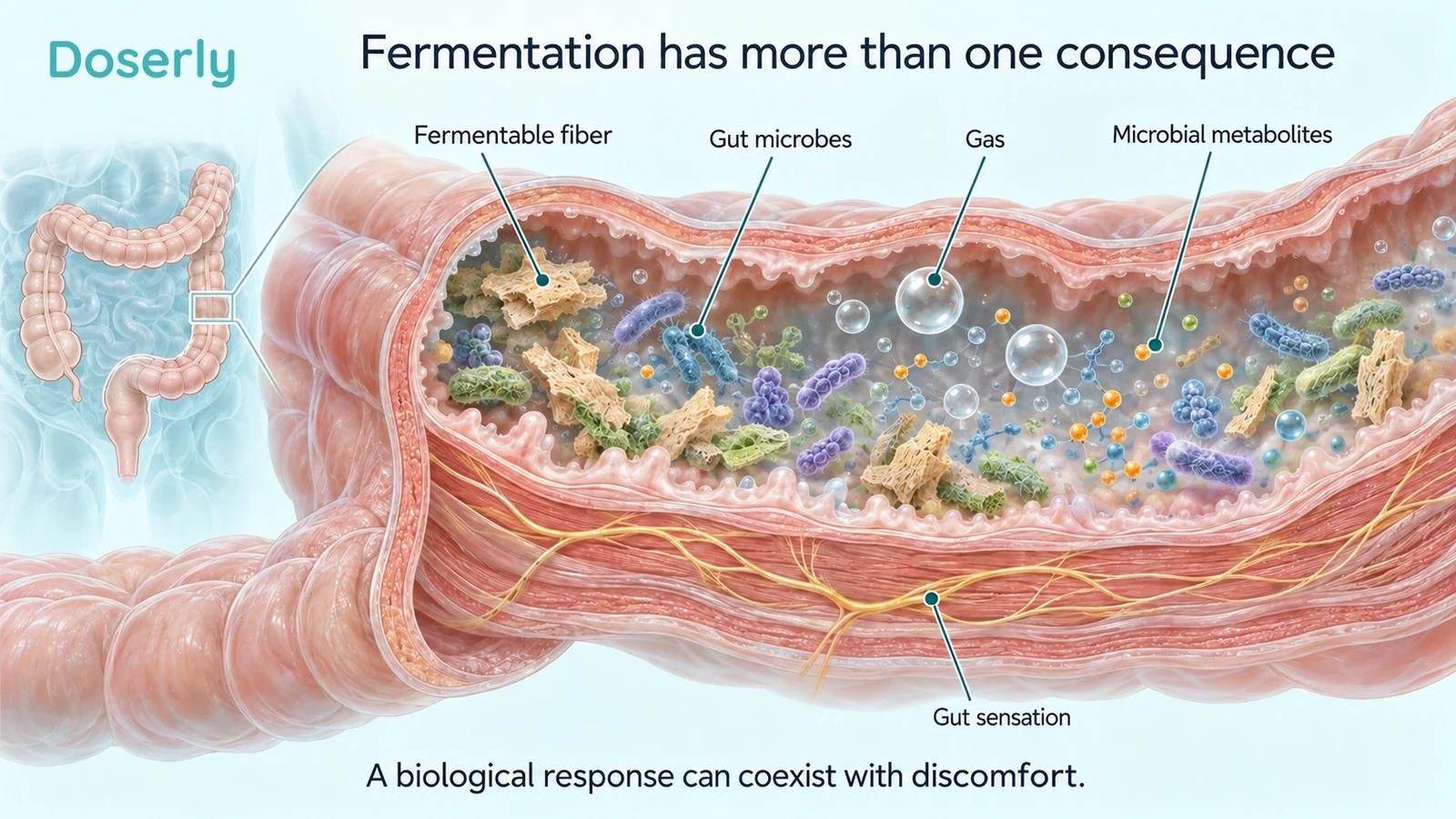
Gut microbes convert available substrates into metabolites, including short-chain fatty acids. Fermentation can also produce gas. Whether the overall experience is helpful depends on more than the presence of fermentation: movement of contents, sensitivity and the symptom being treated also matter.
In a mechanistic crossover experiment, 19 people with IBS consumed test drinks containing inulin, psyllium, both fibers or placebo on separate occasions. Researchers measured breath hydrogen and used MRI over six hours. Inulin increased colonic gas most; adding psyllium reduced the measured gas response. The investigators explicitly left open whether combining them would improve longer-term prebiotic tolerance. Gunn and colleagues
The research amounts were substantial and the observation period brief. This was not a general recommendation to combine two powders whenever bloating occurs. It was a controlled test of a mechanism, with a clinical question still to answer.
What should count as success for you?
For constipation, an increase in bowel movements may help, but frequency alone may miss persistent straining, hard stools or a feeling of incomplete emptying. For IBS, less bloating may be welcome even if stool frequency stays the same. For someone without digestive symptoms, the expected benefit needs to be named rather than assumed from a microbiome result.
A useful goal describes an experience that matters: less painful bloating after ordinary meals, more comfortable bowel movements or fewer disruptions to daily activities. That is more actionable than trying to maximize a bacterial percentage.
It also helps to decide what would make the intervention unacceptable. If discomfort prevents normal eating or social activities, that belongs in the assessment even if a test suggests the microbiome changed. A health benefit is a benefit to the person, not merely a movement in an interesting measurement.
How to discuss an unsatisfactory response
Bring the exact ingredient name, product label and timeline. Distinguish inulin, oligofructose and GOS rather than describing everything as a prebiotic. Note other dietary changes and products introduced at the same time. A new supplement alongside a new diet makes the response harder to attribute.
Record the symptoms you hoped to improve and any new ones. There is no need to label discomfort as detoxification or assume it proves beneficial bacteria are growing. The studies above measured symptoms precisely because an active biological effect can be uncomfortable or clinically unhelpful.
Do not respond to a disappointing supplement by excluding many foods indefinitely. The low-FODMAP study demonstrates a tradeoff that deserves guidance, not a simple instruction to remove fermentable foods forever. Likewise, a promising constipation result does not identify the cause of every person's constipation.
If a clinician recommends a prebiotic, ask what improvement they expect, over what period, and how the plan changes if it does not occur. Our prebiotic fibers guide and psyllium guide can help distinguish microbial approaches from another fiber's physical effects. The central measure remains whether the intervention produces a worthwhile, tolerable improvement in the problem you actually have.
Sources
- ISAPP consensus on prebiotic definition, 2017.
- Expert recommendations for classifying prebiotics, 2024 online/2025 issue.
- Silk et al., 2009: GOS, fecal microbiota and IBS symptoms.
- Olesen and Gudmand-Hoyer, 2000: FOS in IBS.
- Wilson et al., 2020: GOS with a low-FODMAP diet.
- Inulin and functional constipation trial, 2025.
- Gunn et al., 2022: MRI and fermentation study.