
Peptides
October 16, 2026
A diabetic cat can look well while glucose runs low: a glargine pilot's lesson
On this page
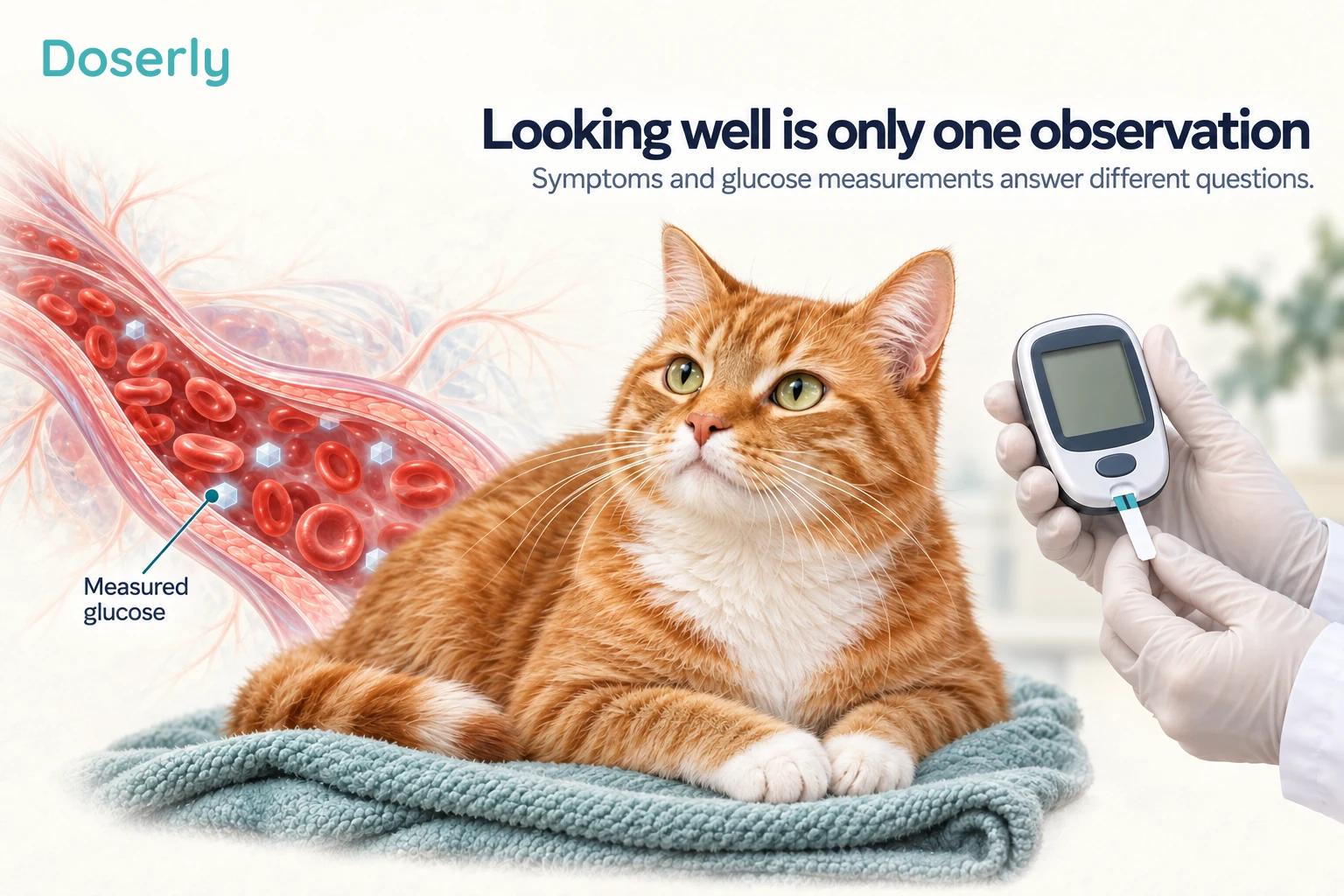
A diabetic cat may seem comfortable, eat reasonably well, and show none of the frightening signs an owner associates with low blood sugar. Those observations matter. They cannot, by themselves, establish that glucose stayed in a safe range between observations.
A small prospective study of concentrated insulin glargine makes that distinction unusually clear. Thirteen cats completed eight weeks of treatment and monitoring. Researchers detected biochemical hypoglycemia in 13 of 104 blood glucose curves, even though owners did not report clinical signs suggesting hypoglycemic episodes. The study used blood glucose below 60 mg/dL, or 3.3 mmol/L, as its biochemical definition. That is a research threshold, not a personalized treatment instruction. Glargine U-300 study
The result does not mean every cat taking glargine has silent hypoglycemia. Nor does it make appearance irrelevant. It explains why veterinary monitoring combines what a caregiver sees with what a meter or sensor measures.
What the glargine pilot actually tested
The investigators followed client-owned cats with different durations of diabetes. All received insulin glargine at a concentration of 300 units per milliliter, commonly written U-300, together with a low-carbohydrate diet. Owners performed a 16-hour glucose curve each week and completed a questionnaire about diabetes-related signs. Clinic assessments included serum fructosamine, a longer-term indicator of glycemic exposure.
This was a prospective study: measurements were planned and collected as treatment progressed. It was not a randomized comparison against another insulin. There was no simultaneous untreated or alternative-insulin group that could separate the effects of the formulation from diet, monitoring, dose adjustment, or other aspects of care.
Four cats were strongly suspected of having hypersomatotropism, a growth-hormone disorder that can complicate diabetes. The researchers excluded those cats from the efficacy evaluation. That left nine cats for the main assessment of treatment response, while all 13 remained relevant to the reported hypoglycemia findings.
That distinction is easy to lose in a short summary. “Thirteen cats improved” would not accurately describe the efficacy analysis. Equally, a safety summary restricted to nine would ignore observations collected in the larger group.
For most of the nine efficacy cats, owners reported improvement or disappearance of excessive drinking, urination, hunger, weight loss, lethargy, or abnormal demeanor by the final curve. The exact number differed by symptom: seven or eight of nine, rather than every cat for every outcome.
Median fructosamine also declined, from 604 to 366 micromoles per liter over the study. The broad ranges around those medians show that responses differed between cats. A group median is not an individual target or a reason to adjust a particular cat's treatment. Study design and outcomes
Why a better average does not exclude a low point
Fructosamine and glucose curves describe different aspects of treatment. A longer-term marker helps summarize exposure over time. A curve shows several measurements within a dosing interval. Neither is simply a more convenient version of the other.
Imagine two hypothetical cats whose longer-term averages improve. One might spend most of the day in a relatively consistent range. The other might alternate between high and low periods. An improving average alone cannot establish which pattern occurred. This is an explanation of what averages leave out, not a reconstruction of individual cats in the pilot.
Similarly, reduced thirst and improved weight can be encouraging without revealing every low glucose episode. These changes help the veterinarian assess the overall response to treatment; they do not provide a continuous record of glucose.
The 2025 iCatCare consensus consequently treats clinical observations, body weight, glucose information, and longer-term markers as complementary. Treatment goals include quality of life and avoiding hypoglycemia, rather than achieving an impressive laboratory number in isolation. iCatCare consensus
An owner should therefore be able to say both “she is much more herself” and “this low reading needs review.” Those statements are compatible. The first reports a meaningful improvement in daily life. The second identifies something that appearance cannot reliably resolve.
Thirteen curves does not mean thirteen affected cats
The pilot's denominator deserves particular attention. The investigators reported low glucose in 13 of 104 curves. A curve is a series of readings collected during one monitoring session.
That result does not tell us that 12.5% of cats became hypoglycemic. It does not say that glucose was low for 12.5% of the study, either. A cat could contribute more than one curve containing a low reading, and the abstract does not provide the distribution needed to calculate how many individual cats were affected.
Nor can weekly curves capture every event during the intervening days. A result observed during sampled periods is not a complete record of all glucose exposure over eight weeks.
The wording about symptoms also matters. Clinical signs suggesting hypoglycemia were not reported. That is an observation from this study, not proof that all biochemical episodes are harmless or that subtle signs were impossible.
The useful lesson is narrower and more dependable: monitoring detected a biochemical finding that caregiver observations alone had not identified. That supports paying attention to measured lows even when the animal looks well. Primary report
Blood glucose and sensor glucose need context
Today's caregivers may receive far more information than a weekly curve provides. Continuous glucose monitors can reveal overnight patterns and changes around meals or insulin administration. They also introduce a second measurement space.
A conventional glucose meter analyzes a blood sample. A sensor measures glucose in interstitial fluid, the fluid surrounding tissue cells. These values are related, but the two methods are not interchangeable at every moment.
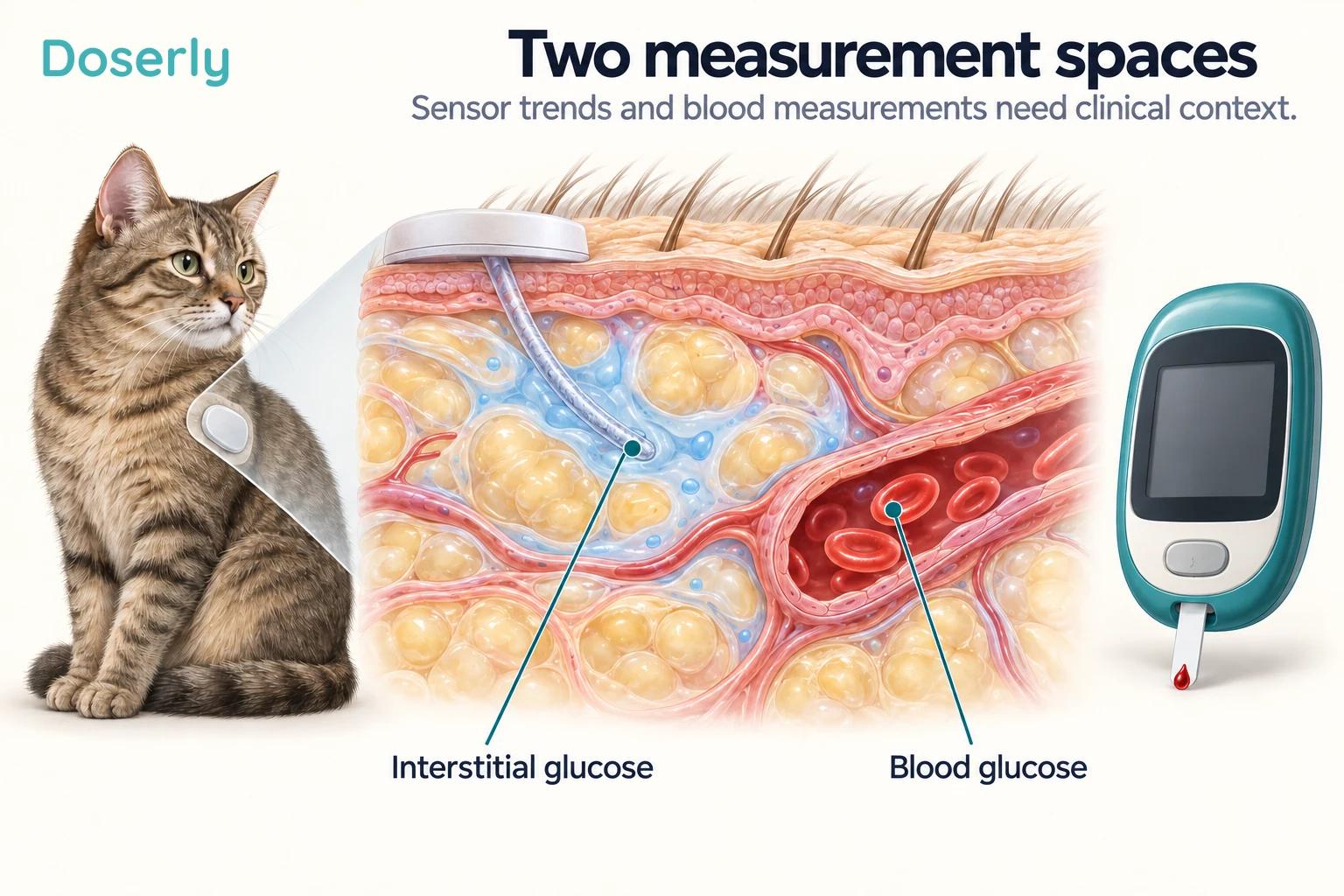
The 2026 AAHA guidance recommends that caregivers be trained to confirm low sensor readings with a veterinary-calibrated blood glucose meter, particularly when the cat has no obvious symptoms, before treatment adjustments. It also emphasizes interpreting glucose information alongside clinical signs and weight. AAHA glucose monitoring guidance
That is not permission to dismiss a low alert. It is a reason to have a written response plan that distinguishes confirming a reading from responding to an unwell cat. Repeatedly refreshing an app without knowing the next step is not a monitoring plan.
Device research is relevant here. A 2025 feline FreeStyle Libre 3 validation study compared sensor results with reference measurements, rather than assuming that a device developed for people would behave identically in cats. Validation concerns measurement performance; it does not prove that a particular insulin is safer or determine a dose for an individual animal. Feline sensor validation study
When sharing a low result, include its source. “Sensor reading” and “blood-meter reading” communicate more than “her glucose was low.” The time, symptoms, meals, and medication history give the veterinarian the context needed to interpret it.
Remission was a separate outcome
Two cats entered remission during the eight-week study, on days 29 and 53. Two additional cats entered remission after the study period, on days 82 and 96. All four had been newly diagnosed.
Combining these into “four cats achieved remission during the trial” changes the observation window. The distinction matters because an eight-week result and a later follow-up result answer different questions.
It also matters that this was not a comparison trial. The study cannot show that U-300 caused more remissions than U-100 glargine, another insulin, or a different management program. Diet, early treatment, residual insulin secretion, and other patient factors can influence the course of feline diabetes.
Remission is not a signal for a caregiver to discontinue insulin independently. A veterinarian determines whether treatment should change and what follow-up will establish that glucose remains controlled without insulin. The possibility of falling insulin requirements is one reason monitoring remains important as a cat improves. iCatCare consensus
A study can therefore contain encouraging clinical improvement and remission observations while still revealing a need for caution about low glucose. There is no contradiction to explain away.
U-300 is a concentration, not a home conversion task
Insulin glargine U-300 contains 300 units per milliliter. U-100 contains 100 units per milliliter. The shared name does not make their devices, volumes, or treatment plans interchangeable.
For example, the human Toujeo U-300 prescribing information explicitly warns against withdrawing insulin from its prefilled pen into a syringe. Its warnings also explain that changes in insulin strength, formulation, or administration can alter glucose control. This labeling is relevant to product and device safety; it is not a feline dosing protocol. Toujeo prescribing information
If a prescription changes, the practical question is whether the caregiver has the exact product, device, and veterinary instructions intended. Photographing the label and bringing the device to a demonstration can prevent a conversation from relying on “the glargine pen” as though that were a complete description.
The pilot's published treatment regimen should not be used to convert a current prescription. Its participants were monitored within a clinical study, and its starting regimen does not account for another cat's disease, current insulin response, food intake, or concurrent treatment.
What to record and when to seek help
A useful record connects measurements to events. Note the date and time, meter or sensor used, insulin product and prescribed administration, meal timing and appetite, vomiting or other illness, and any unusual behavior. Preserve the original readings or sensor export rather than rewriting only the values that look concerning.
Ask the veterinary team to specify the action thresholds for that cat, how to confirm a sensor low, who to contact after hours, and what to do when appetite changes before a scheduled injection. These decisions should be settled before a confusing reading occurs.
Weakness, unsteadiness, tremors, seizures, or collapse in an insulin-treated cat warrant urgent veterinary attention. Cornell's owner guidance identifies hypoglycemia as a potentially serious insulin complication. A cat with concerning symptoms should not be left waiting for a routine monitoring appointment. Cornell feline diabetes guidance
The pilot supports a practical form of reassurance: an attentive caregiver and a well-designed monitoring plan can contribute different, valuable information. Looking better is worth reporting. A measured low is also worth reporting. Keeping both observations visible gives the veterinarian a clearer picture than either one alone.
Sources
- Glargine U-300 prospective feline study
- 2026 AAHA glucose monitoring guidance
- Feline FreeStyle Libre 3 validation study
- 2025 iCatCare feline diabetes consensus
- Cornell feline diabetes guidance
- Toujeo U-300 prescribing information